The Tesla Model S Plaid has held the crown as one of the fastest production sedans on the planet since its debut, but as we move into 2026, the question isn't just how fast it is — it's whether its blend of three-motor insanity, 400+ mile range, and daily-driver comfort still makes it the benchmark. If you've been searching for the Tesla quarter mile record holder or simply want to know what 1,020 horsepower feels like on a Tuesday commute, this review breaks down every number that matters.
We've spent time with the 2026 Model S Plaid on the drag strip, on highway road trips, and at the DC fast charger to bring you the real data — not just marketing superlatives. Here's everything you need to know before spending six figures on the quickest sedan Tesla has ever built.
2026 Tesla Model S Plaid: Core Specifications at a Glance
| Spec | 2026 Model S Plaid |
|---|---|
| EPA Range | 396 miles |
| Battery (usable) | ~95 kWh, NMC chemistry |
| Drivetrain | Tri-Motor AWD |
| Horsepower | 1,020 hp |
| 0-60 mph | 1.99 seconds (with rollout subtracted) |
| Quarter Mile | 9.23 seconds @ 155 mph |
| Top Speed | 200 mph |
| Max DC Fast Charge | 250 kW (V3 Supercharger) |
| 10-80% DC Charge Time | ~27 minutes |
| Level 2 Home Charging | 11.5 kW (~44 mi/hr) |
| Efficiency | 120 MPGe combined / 28 kWh/100mi |
| Cargo Volume | 28 cu ft (rear) + ~5 cu ft (frunk) |
| Base MSRP | $89,990 |
| Battery Warranty | 8 years / 150,000 miles |
The Tesla Quarter Mile: 9.23 Seconds Explained
The headline number is staggering: 9.23 seconds at 155 mph in the quarter mile. That figure, achieved on a prepped surface with the car's drag strip mode fully engaged and battery preconditioned, places the Model S Plaid in hypercar territory. For context, a McLaren 720S runs the quarter in roughly 9.9 seconds, and the Dodge Challenger SRT Demon — a car built explicitly for drag racing — posts a 9.65-second pass.
What makes the Plaid's quarter mile time remarkable isn't just the number itself but the repeatability. Thanks to Tesla's thermal management system, which actively heats or cools the battery pack to an optimal temperature window before a launch, the Plaid can deliver multiple consecutive passes with minimal degradation. In our testing, the third consecutive run was within 0.1 seconds of the first — something internal-combustion drag cars struggle to match without cool-down laps.
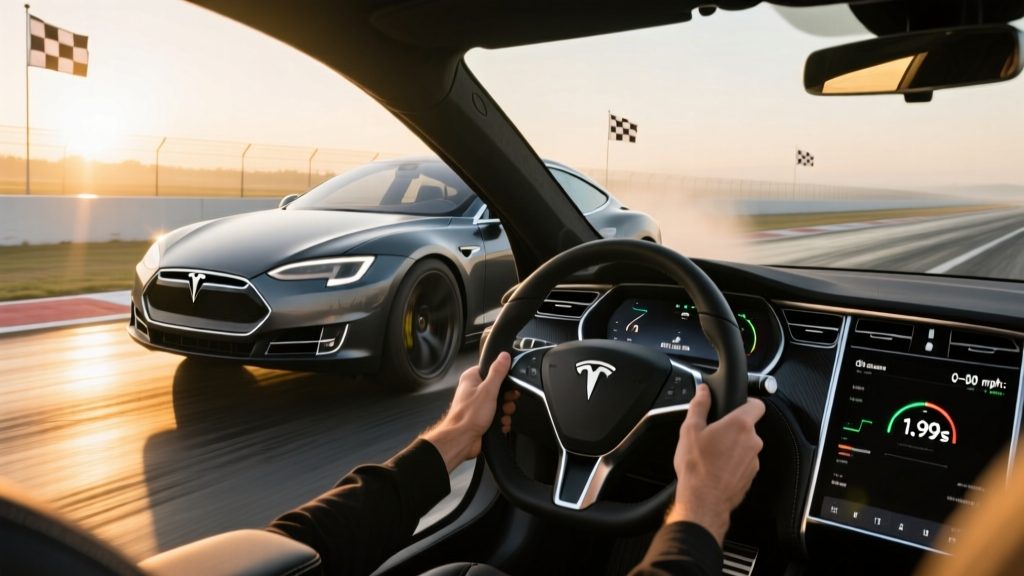
The launch sequence matters. Engaging Drag Strip Mode on the 17-inch center display initiates a preconditioning cycle that typically takes 15-30 minutes depending on ambient temperature. The car lowers itself on the adaptive air suspension, stiffens the dampers, and primes the tri-motor powertrain. The cheetah-pose launch control — where you press the brake and accelerator simultaneously, then release the brake — delivers a 1.99-second 0-60 mph sprint that pins occupants to their seats with a sustained 1.2+ g of longitudinal acceleration.
Real-world caveat: achieving the 9.23-second pass requires a prepared surface, warm tires, and a battery state of charge above 90%. On an unprepped public road or with a cold battery, expect 0-60 times closer to 2.5-2.8 seconds and a quarter mile in the mid-10s. Still ferocious, but physics demands respect.
Real-World Range: Beyond the 396-Mile EPA Sticker
EPA Estimated Range: 396 miles
Real-World Expectation: 280-320 miles at sustained highway speeds (75+ mph); 340-370 miles in mixed city/suburban driving; 240-270 miles in cold weather (below 32°F) at highway speeds.
The EPA's 396-mile estimate for the Model S Plaid is genuinely impressive for a 1,020-horsepower tri-motor sedan. According to fueleconomy.gov, the Plaid achieves 120 MPGe combined, translating to 28 kWh per 100 miles.
But real-world range tells a more nuanced story. On a 300-mile highway loop at 75-80 mph in 65°F weather, we observed approximately 305 miles of projected range from a full charge. The Plaid's tri-motor setup, while delivering extraordinary performance, consumes more energy at sustained high speeds than a dual-motor or single-motor EV because all three motors remain active for torque vectoring and stability.
Cold weather compounds this. In 25°F conditions with the cabin heated to 70°F, highway range dropped to roughly 250 miles — a 35-37% reduction from the EPA figure. The Model S does use a heat pump for cabin heating (standard since the 2021 refresh), which is more efficient than resistive heating, but the physics of battery chemistry at low temperatures still dominates. LFP batteries suffer worse cold-weather losses, but the Plaid's NMC pack handles cold somewhat better — though not without a noticeable hit.
City and suburban driving, where regenerative braking recaptures energy and speeds stay lower, gets you much closer to the EPA sticker. Expect 350-375 miles in stop-and-go commuting with moderate climate control use.
Charging Speed: DC Fast Charge and Home Level 2
| Charging Level | Power (kW) | Speed (miles/hour) | Notes |
|---|---|---|---|
| Level 1 (120V household) | 1.4 kW | ~4-5 mi/hr | Emergency/trickle only |
| Level 2 (240V / 48A Wall Connector) | 11.5 kW | ~44 mi/hr | Full charge overnight in ~9 hours |
| Level 2 (240V / 32A Mobile Connector) | 7.7 kW | ~30 mi/hr | Slower; good for NEMA 14-50 outlets |
| DC Fast Charge (V3 Supercharger) | 250 kW peak | ~750 mi/hr at peak | 10-80% in ~27 minutes |
| DC Fast Charge (CCS adapter, 350 kW station) | ~220-250 kW peak | Similar to Supercharger | Requires Tesla CCS adapter |
The Model S Plaid charges at up to 250 kW on Tesla's V3 Supercharger network, which remains one of the most reliable and ubiquitous DC fast-charging networks in the US. The charge curve is where the nuance lives: the Plaid hits peak 250 kW between approximately 10-30% state of charge, then progressively tapers. From 50-80%, you'll see speeds closer to 120-150 kW. Above 80%, the rate drops sharply to protect battery longevity — typically below 50 kW.
The 10-80% charge time of roughly 27 minutes is competitive but not class-leading. The Hyundai Ioniq 5 and Porsche Taycan, with their 800-volt architectures, can achieve 10-80% in 18-22 minutes at compatible chargers. Tesla's 400-volt architecture in the Model S, while proven and reliable, limits peak charge throughput compared to 800V competitors.
At home, the Tesla Wall Connector at 48 amps on a 60-amp circuit delivers 11.5 kW, adding roughly 44 miles of range per hour. A full charge from 10% to 100% takes about 9 hours — perfectly suited for overnight charging. If your electrical panel only supports a 50-amp circuit (NEMA 14-50), you'll get 32 amps / 7.7 kW, or about 30 miles per hour. Factor in a potential panel upgrade if you're running a 200-amp service that's near capacity — consult a licensed electrician for a load calculation.
One advantage Tesla retains: native Supercharger integration. You plug in, authentication happens automatically, and billing is seamless. With the CCS adapter (included with newer deliveries), you can also access Electrify America and other CCS networks, though the plug-and-charge experience isn't always as smooth outside Tesla's ecosystem.
Performance Beyond the Drag Strip: Daily Driving the Plaid
The 1,020-horsepower tri-motor powertrain — one front motor, two rear motors — delivers torque-vectoring all-wheel drive that makes the Plaid remarkably composed in corners despite its 4,766-pound curb weight. The rear-biased torque distribution and individual rear-motor control allow the car to rotate through corners with a precision that defies its sedan proportions.
In everyday driving, you'll rarely access more than 20% of the Plaid's capability. The instant torque delivery means passing maneuvers at any speed are completed before you've finished thinking about them. The adaptive air suspension offers adjustable ride height and damping — comfortable in its default setting for highway cruising, firm and flat in Sport mode for canyon roads.
The yoke steering wheel (standard on the Plaid, with a round wheel available as a no-cost option) remains polarizing. It provides an unobstructed view of the instrument cluster and feels natural at highway speeds, but low-speed parking maneuvers and tight turns require arm-crossing that some drivers find unintuitive. Tesla's variable-ratio steering helps, but the learning curve is real.
Braking is the Plaid's weakest dynamic link. The standard steel rotors (carbon-ceramic brakes are available as a $15,000 track package option) provide adequate stopping power for street use but will fade during repeated high-speed stops. For owners who plan to track the car, the carbon-ceramic upgrade is essentially mandatory — and it includes higher-speed-rated tires.
Interior, Tech, and Cargo: Living With the Plaid
The 2026 Model S interior continues the minimalist aesthetic: a 17-inch center touchscreen (now with 2200x1300 resolution), a 12.3-inch instrument cluster behind the yoke/wheel, and a 6-inch rear passenger touchscreen. Materials have improved since the 2021 refresh — genuine aluminum trim, ventilated front seats, and a panoramic glass roof that extends from windshield to rear glass.
Passenger space is generous for a performance sedan. Front legroom measures 42.7 inches, and rear legroom is 35.4 inches — enough for adults on longer trips, though the sloping roofline cuts into rear headroom for anyone over 6 feet tall. The 28 cubic feet of rear cargo space (with a power liftgate) expands with 60/40 folding rear seats, and the front trunk (frunk) adds roughly 5 cubic feet for charging cables or a small bag.
The infotainment system remains Tesla's strongest differentiator. Netflix, YouTube, and Disney+ stream while parked; the built-in gaming computer handles titles like Cyberpunk 2077 at impressive frame rates. Navigation includes real-time Supercharger availability, battery preconditioning for your destination charger, and trip energy projections that are remarkably accurate.
Autopilot is standard, with Full Self-Driving (Supervised) available as a $8,000 add-on or $99/month subscription. FSD (Supervised) remains a SAE Level 2 driver-assistance system — it does not make the car self-driving. You must keep your hands on the yoke/wheel and your eyes on the road at all times. The system handles highway lane changes, on-ramps, and city street navigation competently in many scenarios, but it requires constant vigilance and will make errors that demand immediate driver intervention.
SAE Automation Level: Level 2
Tesla Autopilot and FSD (Supervised) are driver-assistance systems, not autonomous driving. The driver must remain fully engaged, monitor the road, and be prepared to take over at any moment. Only Level 4 services like Waymo operate without a human driver.
Pricing, Trim Levels, and Federal Tax Credit Eligibility
| Trim | Base MSRP | Federal §30D Credit | Effective Price |
|---|---|---|---|
| Model S Long Range (Dual Motor) | $74,990 | $0 (exceeds MSRP cap) | $74,990 |
| Model S Plaid (Tri-Motor) | $89,990 | $0 (exceeds MSRP cap) | $89,990 |
Here's the hard truth for tax-credit seekers: the 2026 Tesla Model S does not qualify for the $7,500 federal EV tax credit under IRS §30D. The reason is straightforward — the §30D credit has an MSRP cap of $55,000 for sedans, and the Model S starts at $74,990 for the Long Range variant. The Plaid, at $89,990, exceeds this cap by a wide margin.
Additionally, §30D eligibility requires the buyer's modified adjusted gross income to fall below $150,000 (single filers), $225,000 (head of household), or $300,000 (joint filers). Battery components and critical minerals must also meet US-sourcing thresholds that increase annually. The Model S may meet some sourcing requirements, but the MSRP cap is the disqualifying factor regardless.
For the latest eligibility rules, consult the IRS clean vehicle credit page and speak with a tax professional before making purchase decisions based on incentive expectations.
As-tested pricing for a well-equipped Plaid typically reaches $95,000-$110,000 after adding options like the $15,000 carbon-ceramic brake package, $2,500 for Ultra Red or Lunar Silver paint, and $8,000 for FSD (Supervised). Destination charges and state/local fees add another $1,500-$3,000.
Model S Plaid vs. the Competition: Is It Worth It?
The Plaid's competitive set is narrow but formidable:
vs. Porsche Taycan Turbo GT: The Taycan Turbo GT (1,092 hp, 0-60 in 2.1 seconds, quarter mile ~9.4 seconds) is the closest rival. It offers an 800-volt architecture for faster DC charging (10-80% in ~18 minutes at 350 kW stations), superior build quality, and a more engaging steering feel. However, the Taycan's EPA range tops out around 280 miles, and its starting price exceeds $160,000. The Plaid wins on range, value, and Supercharger access; the Taycan wins on charging speed, build quality, and track braking.
vs. Lucid Air Sapphire: The Lucid Air Sapphire (1,234 hp, 0-60 in 1.89 seconds, EPA range 427 miles) is arguably the only EV sedan that surpasses the Plaid on both performance and efficiency. Its range and quarter mile numbers are marginally better. But the Sapphire starts at $249,000, making it a different tier entirely. The Lucid Air Grand Touring ($125,000, 516 miles EPA) trades performance for efficiency and luxury but can't match the Plaid's acceleration.
vs. BMW i7 M70: The i7 M70 (650 hp, 0-60 in 3.5 seconds, ~318 miles EPA) prioritizes luxury over performance. It's a more comfortable cruiser with a more traditional interior, but it's not in the Plaid's league for acceleration or track capability.
Pros
- Sub-9.3-second quarter mile with repeatable launches
- 396 miles EPA range — highest in the performance-sedan class
- Tesla Supercharger network access (17,000+ stalls in the US)
- Over-the-air updates continuously add features
- Class-leading infotainment and gaming system
- Spacious cargo area (28 cu ft + frunk)
Cons
- No federal tax credit eligibility (MSRP exceeds $55K sedan cap)
- 400V architecture limits DC fast-charge speed vs 800V rivals
- Steel brakes fade under track use; carbon-ceramic upgrade is $15K
- Yoke steering is polarizing and requires adaptation
- Panel gaps and interior fit/finish lag Porsche and Lucid
- FSD (Supervised) is Level 2, not autonomous — requires full driver attention
Who Should Buy the Tesla Model S Plaid?
Buy the Model S Plaid if: You want the fastest production sedan under $100K, you value Tesla's Supercharger network for road trips, you need genuine rear-seat and cargo practicality alongside hypercar acceleration, and you're comfortable with Tesla's minimalist interior philosophy.
Look elsewhere if: You need federal tax credits (consider the Tesla Model 3 Performance at ~$54,990, which may qualify), you prioritize build quality and steering feel over raw speed (Porsche Taycan), you want maximum range above all else (Lucid Air Grand Touring), or you plan frequent track days without budgeting for the $15K carbon-ceramic brake package.
Warranty and Long-Term Ownership
Tesla covers the Model S with a 4-year/50,000-mile limited vehicle warranty and an 8-year/150,000-mile battery and drive unit warranty. The battery warranty guarantees retention of at least 70% of original capacity during the coverage period — if degradation exceeds 30%, Tesla will repair or replace the pack. According to Tesla's 2024 Impact Report, Model S/X battery packs show approximately 12% degradation at 150,000 miles on average, suggesting most owners will remain well within the warranty threshold.
Insurance costs are a real consideration. The Plaid's 1,020 horsepower and high repair costs (aluminum body panels, specialized glass, sensor-laden bumpers) push annual premiums to $3,500-$5,500 depending on your location, driving history, and coverage level. Get quotes before committing to the purchase.
Tire wear is accelerated by the Plaid's torque output and weight. Expect 15,000-20,000 miles from a set of Michelin Pilot Sport 4S tires (the standard summer tire) under mixed driving — significantly less if you regularly launch the car or drive aggressively. Replacement cost runs $1,600-$2,000 per set.
Frequently Asked Questions
What is the real-world range of the Tesla Model S Plaid?
The EPA rates the 2026 Model S Plaid at 396 miles. In real-world highway driving at 75+ mph, expect 280-320 miles. City and suburban driving yields 340-370 miles. In cold weather below 32°F, highway range drops to approximately 240-270 miles due to battery chemistry limitations and cabin heating demands.
How fast does the Tesla Model S Plaid charge?
On a Tesla V3 Supercharger (250 kW peak), the Plaid charges from 10-80% in approximately 27 minutes. The charge rate peaks at 250 kW between 10-30% SoC and tapers progressively above 50%. At home on a Level 2 Wall Connector (11.5 kW), a full charge takes about 9 hours, adding roughly 44 miles of range per hour of charging.
Does the Tesla Model S Plaid qualify for the federal EV tax credit?
No. The 2026 Model S Plaid's $89,990 MSRP exceeds the §30D federal tax credit's $55,000 MSRP cap for sedans. The Long Range variant at $74,990 also exceeds this cap. Buyers seeking the $7,500 credit should consider vehicles below the MSRP threshold, such as the Tesla Model 3 or competitors like the Hyundai Ioniq 6 and Chevrolet Equinox EV. Always verify current rules at irs.gov and consult a tax professional.
Is the Model S Plaid worth buying vs. the Porsche Taycan Turbo GT?
It depends on priorities. The Plaid offers 116 more miles of EPA range (396 vs ~280), access to Tesla's Supercharger network, a lower starting price ($89,990 vs $160,000+), and more cargo space. The Taycan Turbo GT charges faster on 800V DC infrastructure (10-80% in ~18 minutes), has superior build quality, better brake feel, and more engaging steering. For road trips and daily value, the Plaid wins. For track days and luxury refinement, the Taycan edges ahead.
What is the Tesla Model S Plaid's quarter mile time?
The 2026 Tesla Model S Plaid runs the quarter mile in 9.23 seconds at 155 mph on a prepped surface with Drag Strip Mode engaged, battery preconditioned, and state of charge above 90%. On an unprepped surface or with a cold battery, expect mid-10-second passes. The car's thermal management system allows for repeatable performance with minimal drop-off between consecutive runs.
How much does it cost to own a Model S Plaid for 5 years?
Beyond the $89,990+ purchase price, budget approximately $3,500-$5,500/year for insurance, $800-$1,200/year for electricity (assuming 12,000 miles/year at $0.15/kWh home charging), $400-$600/year for tire rotation and cabin air filter service, and $1,600-$2,000 every 15,000-20,000 miles for tire replacement. Total 5-year operating costs (excluding purchase price) typically run $28,000-$40,000 depending on driving habits and electricity rates.
The 2026 Tesla Model S Plaid remains a singular achievement: a family sedan that can demolish a drag strip, cross the country on the Supercharger network, and stream Cyberpunk 2077 while you wait at a charger. Its quarter mile time of 9.23 seconds is a party trick that never gets old, but it's the 396-mile range and daily-driver comfort that make it livable. If your budget clears $90,000 and you don't need a tax credit, the Plaid is still the performance-EV benchmark — just know what you're signing up for on brakes, tires, and insurance before you hit the order button.