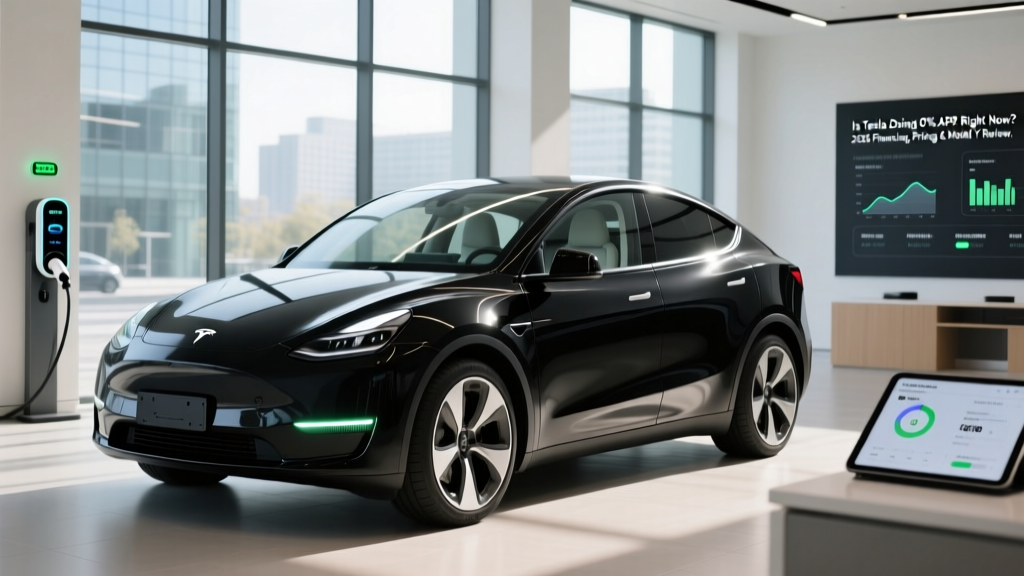
Is Tesla Doing 0% APR Right Now? The Short Answer
If you've been searching for low-cost financing on an electric vehicle, you've likely asked: is Tesla doing 0% APR right now? As of early 2026, Tesla is not broadly advertising a blanket 0% APR across its entire lineup. However, Tesla periodically rolls out promotional financing rates — often at 0.99%, 1.99%, or 2.99% APR — on select models and trims, typically timed around end-of-quarter delivery pushes or inventory-clearance events. These offers change frequently, sometimes appearing for as little as two weeks before reverting to standard rates.
The most reliable way to check current offers is directly through Tesla's website configurator or by contacting a local Tesla advisor. In the meantime, let's break down what Tesla's financing landscape looks like in 2026, using the 2026 Tesla Model Y — Tesla's best-selling vehicle and the one most buyers are financing — as our reference point.
2026 Tesla Model Y: Quick Spec Overview
| Spec | Long Range AWD | Performance |
|---|---|---|
| Base MSRP | $44,990 | $51,490 |
| EPA Range | 320 miles | 293 miles |
| Battery (usable) | ~75 kWh (NMC) | ~75 kWh (NMC) |
| Drivetrain | Dual-Motor AWD | Dual-Motor AWD |
| Horsepower | 384 hp | 456 hp |
| 0–60 mph | 4.8 sec | 3.5 sec |
| Max DC Fast Charge | 250 kW | 250 kW |
| 10–80% DCFC Time | ~27 min | ~27 min |
| Level 2 Home Charge | 11.5 kW (~44 mi/hr) | 11.5 kW (~44 mi/hr) |
| MPGe (combined) | 122 MPGe | 111 MPGe |
| Efficiency | 28 kWh/100 mi | 30 kWh/100 mi |
| Cargo (rear seats up) | 30.2 cu ft | 30.2 cu ft |
| Cargo (rear seats folded) | 72.1 cu ft | 72.1 cu ft |
| Battery Warranty | 8 yr / 120,000 mi | 8 yr / 120,000 mi |
Understanding Tesla's Financing: APR, Rates, and Deals
Tesla does not operate like a traditional dealership with negotiable APR offers. Instead, Tesla provides financing through its captive lending arm and partner banks, with rates displayed transparently during the online checkout process. Here's how Tesla financing typically works in 2026:
- Standard APR: Typically between 5.49% and 7.99% for well-qualified buyers (720+ FICO), depending on loan term (48–72 months) and market conditions.
- Promotional APR: Tesla periodically offers rates as low as 0.99%–2.99% on specific trims, usually the Long Range or base RWD variants, to stimulate demand during slower delivery windows.
- Lease rates: Money factors vary but generally translate to effective APRs between 4% and 7%.
- Loan terms: 36, 48, 60, and 72 months are standard. Longer terms reduce monthly payments but increase total interest paid.
The key insight: Tesla's promotional financing is model-specific and time-limited. If you see a 0.99% APR offer on the Model Y Long Range in Q1 2026, it may not exist by Q2. Buyers should configure their vehicle on Tesla.com and check the financing tab for real-time rates.
Sample Monthly Payment: Model Y Long Range at Various APRs
| Scenario | APR | Term | Down Payment | Est. Monthly |
|---|---|---|---|---|
| Promo financing | 0.99% | 60 mo | $5,000 | ~$668 |
| Standard rate | 6.49% | 60 mo | $5,000 | ~$761 |
| After $7,500 credit | 6.49% | 60 mo | $5,000 | ~$633 |
| Promo + credit | 0.99% | 60 mo | $5,000 | ~$541 |
Estimates based on $44,990 MSRP. Actual payments vary by taxes, fees, and trade-in. The $7,500 federal credit is applied as a point-of-sale reduction under current IRS §30D rules if eligibility criteria are met.
Real-World Range: What the EPA Number Doesn't Tell You
EPA Estimated Range: 320 miles (Long Range AWD)
Real-World Expectation: 265–290 miles on highway trips at 70–75 mph; 290–310 miles in mixed city/highway driving; 220–250 miles in sub-freezing winter conditions.
The Model Y Long Range's 320-mile EPA rating is solid for the segment, but real-world results depend heavily on driving style, terrain, and temperature. In our experience and consistent with EPA data on fueleconomy.gov, highway driving at sustained speeds of 70+ mph reduces range by roughly 15–18% compared to the EPA combined figure. Cold weather (below 32°F) compounds this, as the battery must expend energy on thermal management and cabin heating, even with Tesla's standard heat pump.
For daily commuting under 60 miles round-trip, range is essentially a non-issue. For road trips exceeding 250 miles, you'll want to plan Supercharger stops — which, as we'll see below, is where Tesla still holds a significant advantage.
Charging Speed: Supercharger Network and Home Setup
| Charging Level | Power | Miles Added/Hour | Notes |
|---|---|---|---|
| Level 1 (120V outlet) | ~1.4 kW | ~4–5 mi/hr | Emergency/trickle only |
| Level 2 (240V, 48A) | 11.5 kW | ~44 mi/hr | Full overnight charge in ~8 hrs |
| DC Fast Charge (Supercharger V3) | Up to 250 kW | ~1,000+ mi/hr (peak) | 10–80% in ~27 min; tapers above 80% |
| DC Fast Charge (Supercharger V4) | Up to 250 kW* | ~1,000+ mi/hr (peak) | Newer stalls; same vehicle-side limit |
*The Model Y's onboard charge architecture caps at ~250 kW. While Tesla's V4 Supercharger stalls are rated for higher output, the vehicle itself cannot accept more than its peak rate.
The Model Y uses NMC (nickel manganese cobalt) battery chemistry, which supports fast DC charging well but benefits significantly from battery preconditioning. When you navigate to a Supercharger using the car's built-in navigation, the thermal management system warms the battery to optimal temperature before you arrive — this can shave 5–10 minutes off your charge session, especially in cold weather.
The charge curve is the critical detail most spec sheets omit: the Model Y peaks near 250 kW only between roughly 10–30% State of Charge (SoC). From 30–60%, it sustains around 150–180 kW. Above 80%, the rate drops sharply to protect battery longevity, often falling below 50 kW. This is why the 10–80% metric (~27 minutes) is far more useful than peak kW alone.
At home, a Level 2 Wall Connector on a 60-amp circuit (48 amps continuous) delivers 11.5 kW, adding roughly 44 miles of range per hour. Most owners wake up to a full battery every morning. Installation costs for a home Level 2 setup typically range from $500 (simple outlet near panel) to $2,500+ (panel upgrade, long wire run). Always get a quote from a licensed electrician before committing.
Federal Tax Credit: Does the 2026 Model Y Qualify?
Under the IRS §30D Clean Vehicle Credit, eligible buyers can receive up to $7,500 in federal tax credits, which as of 2024 can be transferred to the dealer as a point-of-sale price reduction. However, eligibility depends on several factors that change periodically:
- MSRP cap: SUVs and trucks must be at or below $80,000. The Model Y qualifies (all trims are well under the cap).
- Buyer income cap: Modified adjusted gross income (MAGI) must not exceed $150,000 (single), $225,000 (head of household), or $300,000 (joint filers).
- Battery sourcing: A percentage of critical minerals and battery components must be sourced from the U.S. or FTA-partner countries. Tesla's U.S.-built vehicles have progressively improved compliance, but specific eligibility can shift as sourcing rules tighten annually. Check the latest IRS eligible vehicle list before purchasing.
- Point-of-sale transfer: Buyers can elect to transfer the credit to Tesla at purchase, reducing the purchase price by up to $7,500 upfront rather than waiting to claim it on their tax return.
Important caveat: Tax credit rules under §30D have undergone multiple revisions. Always verify current eligibility on irs.gov and consult a tax professional for your specific situation. Never assume a flat $7,500 savings without confirming your income, the vehicle's sourcing compliance, and the current rule set.
Who Should Buy the 2026 Tesla Model Y?
The Model Y remains one of the most versatile EVs on the market, but it isn't the right choice for every buyer. Here's a practical decision framework:
Choose the Model Y if:
- You want access to the Supercharger network — still the most reliable and widespread DC fast-charging network in the U.S. with 6,000+ stalls nationally.
- You need a compact/midsize SUV with strong cargo capacity (72.1 cu ft with seats folded) and optional third-row seating for small children.
- You value over-the-air software updates that add features post-purchase.
- You want strong performance (3.5 sec 0–60 in Performance trim) without a luxury-badge premium.
Look elsewhere if:
- You need a truck bed or serious towing capacity (the Model Y is rated for 3,500 lbs max — adequate for light trailers but not boats or campers).
- You prefer physical buttons and a traditional instrument cluster over Tesla's minimalist, screen-centric interior.
- You want a quieter, more luxurious ride — competitors like the Hyundai Ioniq 5 and BMW iX offer notably better NVH (noise, vibration, harshness) isolation.
- You prioritize IIHS Top Safety Pick+ status — check current IIHS ratings for the latest crash-test results.
Pros and Cons
Pros
- Access to the Supercharger network (fastest, most reliable public charging)
- Strong real-world efficiency (28 kWh/100 mi) keeps charging costs low
- Spacious cargo area (72.1 cu ft) rivals midsize gas SUVs
- Excellent software, OTA updates, and mobile app integration
- Competitive 320-mile EPA range in Long Range trim
- Low center of gravity provides confident handling
Cons
- Minimalist interior lacks physical controls; all climate/media via touchscreen
- Ride quality can be firm on rough roads compared to competitors
- No Apple CarPlay or Android Auto — Tesla's proprietary system only
- Insurance premiums run 15–30% higher than comparable gas SUVs
- FSD (Supervised) remains a Level 2 driver-assist — not autonomous driving
- Build quality inconsistency (panel gaps, paint) still reported by some owners
How It Stacks Up Against Key Competitors
| Spec | 2026 Tesla Model Y LR | 2026 Hyundai Ioniq 5 LR | 2026 Ford Mustang Mach-E ER |
|---|---|---|---|
| EPA Range | 320 mi | 318 mi | 312 mi |
| Battery (usable) | ~75 kWh (NMC) | 84 kWh (NMC) | 91 kWh (NMC) |
| Max DC Charge | 250 kW | 240 kW | 150 kW |
| 10–80% DCFC | ~27 min | ~18 min | ~45 min |
| 0–60 mph | 4.8 sec | 5.1 sec | 5.2 sec |
| Base MSRP | $44,990 | $47,500 | $46,995 |
| Charging Network | Supercharger (native) | NACS (SA adapter) | NACS (adapter) |
| Cargo (rear up) | 30.2 cu ft | 27.2 cu ft | 29.7 cu ft |
The Hyundai Ioniq 5 charges faster (18 minutes 10–80% thanks to its 800V architecture) and offers a more comfortable ride with Apple CarPlay. The Ford Mach-E provides a more traditional cockpit feel. But Tesla's Supercharger advantage — native, plug-and-charge reliability across thousands of stalls — remains a meaningful differentiator for road-trippers, even as competitors gain NACS access through adapters.
Warranty and Long-Term Ownership
Tesla covers the Model Y's battery and drive unit for 8 years or 120,000 miles (whichever comes first), with a minimum 70% capacity retention threshold during the warranty period. The basic vehicle limited warranty is 4 years or 50,000 miles.
NMC batteries in Teslas have shown average degradation of roughly 10–12% over the first 100,000 miles based on fleet data, with degradation slowing significantly after the initial break-in period. To maximize longevity, Tesla recommends keeping daily charge limits between 20–80% for NMC chemistry and only charging to 100% when needed for long trips.
Insurance remains a notable cost factor. Model Y premiums average 15–30% above comparable gas-powered compact SUVs, driven by high repair costs for collision damage (especially to the battery pack and integrated structural components). Get an insurance quote before ordering to avoid surprises.
Frequently Asked Questions
Is Tesla offering 0% APR financing in 2026?
Tesla does not currently advertise a permanent 0% APR program. However, promotional rates as low as 0.99%–2.99% appear periodically on select models and trims, typically during end-of-quarter delivery pushes. Check Tesla.com's financing section for current offers, as they change frequently.
How much does a 2026 Model Y cost after the federal tax credit?
The Model Y Long Range starts at $44,990. If you qualify for the full $7,500 §30D credit (based on income, battery sourcing, and MSRP cap compliance), the effective price drops to approximately $37,490 before state incentives, taxes, and fees. Eligibility varies — verify on irs.gov.
What is the real-world range of the Tesla Model Y?
Expect 265–290 miles on highway road trips at 70–75 mph, 290–310 miles in mixed city/highway driving, and 220–250 miles in cold weather (below freezing). The EPA combined rating is 320 miles for the Long Range AWD trim.
How fast does the Model Y charge at home and on the road?
At home on a Level 2 (240V, 48A) charger, the Model Y charges at 11.5 kW, adding roughly 44 miles per hour — a full charge takes about 8 hours. On a V3 Supercharger, it peaks at 250 kW and charges from 10–80% in approximately 27 minutes, though the rate tapers significantly above 80% SoC.
Is the Tesla Model Y worth buying over the Hyundai Ioniq 5 or Ford Mach-E?
It depends on your priorities. The Model Y wins on Supercharger access, cargo space, and software integration. The Ioniq 5 charges faster (18 min 10–80%) and has a more comfortable ride. The Mach-E offers a more conventional interior. All three qualify for federal tax credits (verify current eligibility). Test-drive all three before deciding.
Does the Model Y come with self-driving?
No. Tesla's Autopilot (included) and Full Self-Driving Supervised ($8,000 option or $99/month) are SAE Level 2 driver-assistance systems. They require continuous driver attention and hands-on-wheel supervision. They are not autonomous. Only Level 4 services like Waymo operate without a driver — and those are limited to specific geofenced areas.
What battery chemistry does the Model Y use?
The 2026 Model Y Long Range and Performance trims use NMC (nickel manganese cobalt) chemistry with approximately 75 kWh of usable capacity. NMC offers higher energy density than LFP (lithium iron phosphate) but Tesla recommends limiting daily charge to 80% to preserve longevity — unlike LFP, which can be charged to 100% daily.