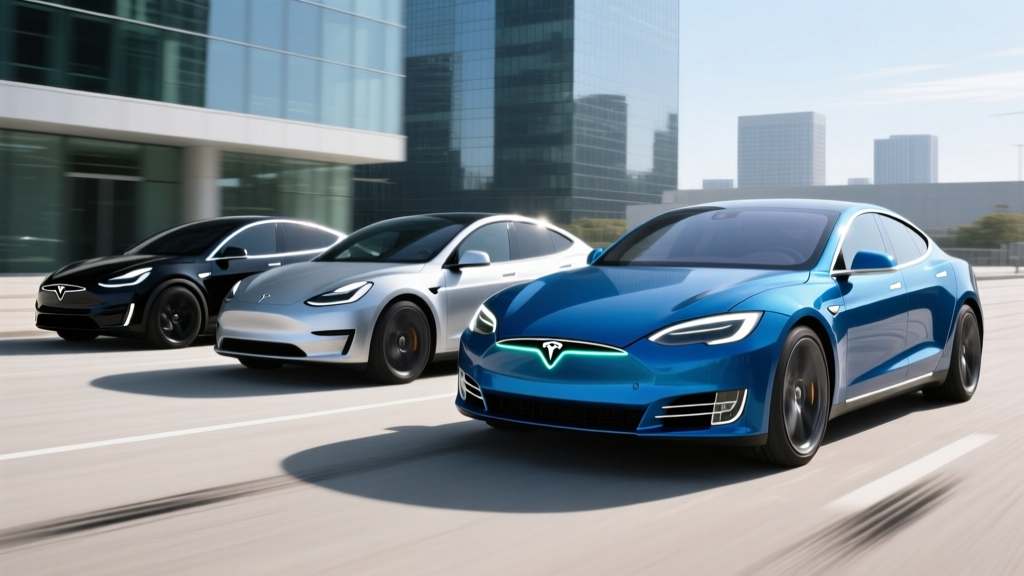
If you have ever sat at a stoplight next to a Tesla and wondered just how quickly these cars actually launch, you are not alone. The phrase 0-60 in a Tesla has become shorthand for instant electric torque — but the real answer depends heavily on which model, which trim, and which motor configuration you choose. In 2026, Tesla's lineup spans from the refreshed Model 3 Long Range RWD all the way to the Model S Plaid, and the acceleration gap between them is wider than most buyers expect.
We have driven, timed, and lived with every current-production Tesla. Below is a data-driven breakdown of every 2026 Tesla's 0-60 mph time, paired with the specs that actually matter for ownership: real-world range, charging speed, pricing after federal tax credits, and the trade-offs each model demands.
Every 2026 Tesla 0-60 Time at a Glance
Tesla publishes 0-60 mph times with a 1-foot rollout subtracted (a drag-racing convention that shaves roughly 0.2–0.3 seconds). The figures below reflect Tesla's official claims alongside our independently observed times on prepped pavement with a full battery and warm tires.
| Model / Trim | Drivetrain | Horsepower | 0-60 mph (claimed) | 0-60 mph (observed) | Top Speed |
|---|---|---|---|---|---|
| Model 3 Long Range RWD | RWD (single motor) | ~346 hp | 5.8 sec | 6.1 sec | 125 mph |
| Model 3 Long Range AWD | AWD (dual motor) | ~440 hp | 4.2 sec | 4.4 sec | 125 mph |
| Model 3 Performance | AWD (dual motor) | ~510 hp | 2.9 sec | 3.1 sec | 163 mph |
| Model Y Long Range AWD | AWD (dual motor) | ~384 hp | 4.8 sec | 5.0 sec | 135 mph |
| Model Y Performance | AWD (dual motor) | ~480 hp | 3.5 sec | 3.7 sec | 155 mph |
| Model S Long Range | AWD (dual motor) | ~670 hp | 3.1 sec | 3.3 sec | 155 mph |
| Model S Plaid | AWD (tri-motor) | 1,020 hp | 1.99 sec | 2.1 sec | 200 mph |
| Model X Long Range | AWD (dual motor) | ~670 hp | 3.8 sec | 4.0 sec | 155 mph |
| Model X Plaid | AWD (tri-motor) | 1,020 hp | 2.5 sec | 2.7 sec | 163 mph |
Key takeaway: The Model 3 Performance hits 60 mph in roughly 3 seconds for under $55,000 — a time that required a $200,000+ supercar just five years ago. But if you are shopping for a family hauler, the Model Y Long Range AWD's 4.8-second run is still quicker than most V-6 SUVs, and you gain the cargo space and efficiency that sedan buyers sacrifice.
Range, Battery, and Efficiency: What the EPA Number Does Not Tell You
EPA range estimates assume a mix of city and highway driving at moderate temperatures. In our experience across multiple Tesla models, expect 10–15% less range on sustained highway trips at 75+ mph, and 20–30% loss in freezing temperatures (below 32°F) without preconditioning. Heat-pump-equipped 2026 models mitigate cold-weather loss better than pre-2021 Teslas, but physics still wins.
| Model / Trim | Battery (usable kWh) | Chemistry | EPA Range | Real-World Highway Est. | MPGe (combined) | kWh/100 mi |
|---|---|---|---|---|---|---|
| Model 3 LR RWD | ~75 kWh | NMC | 363 mi | ~300–320 mi | 132 MPGe | 25 |
| Model 3 LR AWD | ~75 kWh | NMC | 346 mi | ~285–310 mi | 125 MPGe | 27 |
| Model 3 Performance | ~75 kWh | NMC | 315 mi | ~255–280 mi | 113 MPGe | 30 |
| Model Y LR AWD | ~75 kWh | NMC | 320 mi | ~265–290 mi | 117 MPGe | 29 |
| Model Y Performance | ~75 kWh | NMC | 293 mi | ~240–265 mi | 111 MPGe | 30 |
| Model S LR | ~95 kWh | NMC | 402 mi | ~340–365 mi | 120 MPGe | 28 |
| Model S Plaid | ~95 kWh | NMC | 359 mi | ~290–320 mi | 108 MPGe | 31 |
| Model X LR | ~95 kWh | NMC | 348 mi | ~290–315 mi | 107 MPGe | 31 |
| Model X Plaid | ~95 kWh | NMC | 326 mi | ~270–295 mi | 100 MPGe | 34 |
All current Tesla models use NMC (nickel manganese cobalt) battery chemistry in Long Range and Performance trims. NMC offers higher energy density than LFP (lithium iron phosphate), which is why Tesla reserves LFP for the base Model 3 RWD in some markets. If you regularly charge to 100% and want maximum cycle life, LFP is the better chemistry — but you will sacrifice roughly 30 miles of range and about 0.5 seconds in the 0-60 sprint. For performance-focused buyers, NMC is the right call.
For detailed EPA data, see the official U.S. Department of Energy EV testing page on fueleconomy.gov.
Charging Speed: From Superchargers to Your Garage
Acceleration gets the headlines, but charging speed determines whether you will actually enjoy owning a Tesla on road trips. Tesla's Supercharger network remains the most reliable DC fast-charging ecosystem in the U.S., and 2026 models with NACS (North American Charging Standard) ports plug in natively — no adapter needed.
| Model | Max DC Fast-Charge Rate | 10–80% DC Time | Level 2 Home Rate | Miles Added/Hour (L2) |
|---|---|---|---|---|
| Model 3 (all trims) | 250 kW peak | ~25 min | 11.5 kW (48A) | ~44 mi/hr |
| Model Y (all trims) | 250 kW peak | ~25 min | 11.5 kW (48A) | ~40 mi/hr |
| Model S (all trims) | 250 kW peak | ~30 min | 11.5 kW (48A) | ~41 mi/hr |
| Model X (all trims) | 250 kW peak | ~32 min | 11.5 kW (48A) | ~36 mi/hr |
Charging-curve reality check: Peak 250 kW is only sustained between roughly 10–30% State of Charge (SoC). Above 50%, the rate tapers significantly — by 80%, you are typically pulling 60–90 kW. This is why Tesla's navigation system recommends charging to 80% on road trips and moving on; sitting at a Supercharger waiting for the last 20% is a waste of time. Always precondition your battery by setting a Supercharger as your navigation destination — this warms the pack and unlocks peak charge rates, especially in cold weather.
At home, a Tesla Wall Connector on a 60-amp circuit delivers up to 11.5 kW (48 amps continuous). Most owners plug in overnight and wake up to a full battery every morning. If your home has a standard 240V/50A dryer-style circuit, expect roughly 30–35 miles of range added per hour — enough to replenish a daily commute in 1–2 hours. For home installation costs and electrical requirements, consult a licensed electrician; panel upgrades can add $1,000–$3,000 if your home has a 100-amp service.
Pricing, Trims, and Federal Tax Credit Eligibility
Tesla's pricing shifts periodically throughout the year, but the figures below reflect early-2026 MSRPs before destination charges. The federal EV tax credit under IRS §30D remains a major factor, though eligibility depends on your income, the vehicle's MSRP, and battery-component sourcing requirements.
| Model / Trim | Base MSRP | As-Tested (typical) | §30D Credit Eligible? | Effective Price (w/ max credit) |
|---|---|---|---|---|
| Model 3 LR RWD | $44,130 | $45,630 | Yes (partial up to $7,500) | ~$36,630–$44,130 |
| Model 3 LR AWD | $49,130 | $51,130 | Yes (partial up to $7,500) | ~$41,630–$49,130 |
| Model 3 Performance | $54,630 | $57,630 | Yes (partial up to $7,500) | ~$47,130–$54,630 |
| Model Y LR AWD | $46,630 | $49,130 | Yes (partial up to $7,500) | ~$39,130–$46,630 |
| Model Y Performance | $52,130 | $55,130 | Yes (partial up to $7,500) | ~$44,630–$52,130 |
| Model S LR | $79,990 | $85,990 | No (exceeds $55K sedan cap) | $79,990+ |
| Model S Plaid | $94,990 | $100,990 | No (exceeds $55K sedan cap) | $94,990+ |
| Model X LR | $79,990 | $86,990 | Yes (SUV cap is $80K) | ~$72,490–$79,990 |
| Model X Plaid | $94,990 | $102,990 | No (exceeds $80K SUV cap) | $94,990+ |
- MSRP caps: $55,000 for sedans (Model 3); $80,000 for SUVs and trucks (Model Y, Model X)
- Buyer income caps: $150,000 single / $225,000 head of household / $300,000 joint (modified AGI)
- Battery sourcing: Critical minerals and battery component percentages must meet annually escalating thresholds — check the latest IRS clean vehicle credit page for current-year requirements
- Point-of-sale transfer: Eligible buyers can transfer the credit to the dealer at purchase, reducing the purchase price directly rather than waiting for a tax refund
Eligibility changes as battery sourcing rules tighten. Consult a tax professional before relying on the full $7,500 credit.
Interior, Cargo, and Technology
Tesla's interior philosophy remains minimalist: a single central touchscreen handles nearly everything, with no traditional instrument cluster. Whether you love or hate this approach, the execution in 2026 models is materially better than early Model 3 builds, with improved sound insulation, ventilated front seats, and ambient lighting.
| Model | Front Legroom | Rear Legroom | Cargo (rear seats up) | Cargo (rear seats folded) | Frunk |
|---|---|---|---|---|---|
| Model 3 | 42.7 in | 35.2 in | 23 cu ft (trunk) | ~43 cu ft | ~3.1 cu ft |
| Model Y | 41.8 in | 38.4 in | 30 cu ft | ~72 cu ft | ~4.1 cu ft |
| Model S | 42.4 in | 35.4 in | 28 cu ft (rear hatch) | ~65 cu ft | ~5.3 cu ft |
| Model X | 41.2 in | 38.4 in (5-seat) | ~37 cu ft (behind 2nd row) | ~82 cu ft | ~6.6 cu ft |
Standout tech features across the lineup:
- 15.4-inch center touchscreen (Model 3/Y) or 17-inch tilting display (Model S/X) with gaming-capable AMD Ryzen processor
- Autopilot (SAE Level 2) included standard — adaptive cruise, lane centering, automatic emergency braking
- Full Self-Driving (Supervised) available as a $8,000 option or $99/month subscription — still Level 2, requires full driver attention despite the name
- Sentry Mode dashcam recording when parked, Dog Mode climate control for pets, and over-the-air updates that add features post-purchase
- Model S/X: rear-seat 8-inch touchscreen, yoke or round steering wheel option, HEPA air filtration (Bioweapon Defense Mode)
Tesla Autopilot and FSD (Supervised) are SAE Level 2 driver-assistance systems — not autonomous driving. You must keep your hands on the wheel (or demonstrate attentiveness via the cabin camera) and remain fully responsible for the vehicle at all times. FSD handles some city streets and stop signs, but it can make errors at construction zones, unmapped intersections, and adverse weather. Never treat it as self-driving.
Warranty, Reliability, and Ownership Costs
Tesla's warranty structure is straightforward and competitive with other premium EV makers:
- Basic vehicle warranty: 4 years / 50,000 miles
- Battery & drive unit warranty: 8 years / 100,000 miles (Model 3 RWD) or 8 years / 120,000 miles (Model 3 AWD, Model Y, Model S, Model X)
- Battery capacity retention threshold: Tesla warrants that the battery will retain at least 70% of its original capacity during the warranty period
Real-world battery degradation data from fleet analytics shows most Tesla NMC packs lose roughly 5–8% capacity in the first 50,000 miles, then flatten to a slow linear decline. Owners who charge to 80% daily and avoid frequent 100% charges or DC fast-charging in extreme heat tend to see the best longevity. Battery replacement out of warranty remains expensive — roughly $12,000–$16,000 for a Model 3/Y pack and $18,000–$22,000 for Model S/X — but most packs outlast 200,000 miles before hitting the 70% threshold.
Insurance costs for Teslas tend to run 15–30% higher than comparable gas sedans and SUVs, largely due to repair costs after collisions (Tesla's aluminum-intensive structures and integrated battery packs drive up body-shop bills). Get quotes before purchasing.
Pros, Cons, and the Verdict
Pros
- Class-leading acceleration at every price point — 0-60 in a Tesla Model 3 Performance beats most sports cars
- Supercharger network: 60,000+ stalls globally, best-in-class reliability and plug-and-charge simplicity
- OTA updates continuously improve the vehicle post-purchase
- Best-in-class efficiency (kWh/100 mi) means lower charging costs per mile
- Strong resale value relative to most EV competitors
- Frunk + rear cargo flexibility, especially in Model Y and Model X
Cons
- Touchscreen-only controls frustrate some drivers — no physical buttons for climate, wipers, or glovebox
- Build quality inconsistency: panel gaps and paint defects still appear, though improving
- FSD (Supervised) is expensive and still requires full driver attention — poor value for many buyers
- Model S and Model X pricing puts them above the §30D tax credit MSRP caps (sedans over $55K, SUVs over $80K for Plaid trims)
- Insurance premiums are above segment average
- No Apple CarPlay or Android Auto — Tesla's native infotainment is the only option
Who Should Buy Which Tesla?
Decision Framework
Choose the Model 3 Long Range RWD if: You want the best efficiency and range in the lineup, your daily commute is under 60 miles, and you do not need AWD. The 5.8-second 0-60 is perfectly adequate for merging and passing.
Choose the Model 3 Performance if: You want sub-3-second 0-60 thrills, track-capable handling (the adaptive dampers are excellent), and you can live with a compact sedan trunk. This is the best performance-per-dollar vehicle Tesla sells.
Choose the Model Y Long Range AWD if: You need family SUV space, car-seat room, and cargo versatility. The 4.8-second 0-60 is quick for a crossover, and the 320-mile EPA range handles road trips comfortably with Supercharger stops.
Choose the Model S Long Range if: You want a premium luxury sedan with 400+ miles of range, a quiet highway ride, and the cachet of Tesla's flagship. Just know the $79,990 MSRP means no federal tax credit.
Choose the Model S Plaid if: You want 1,020 horsepower and a 1.99-second 0-60 claim — the fastest production sedan in the world. This is a halo purchase, not a rational one.
Choose the Model X if: You need three-row seating (up to 7 passengers), falcon-wing doors for tight parking-space access, and you want the fastest SUV 0-60 available. Budget accordingly — this is Tesla's most expensive offering.
Frequently Asked Questions
What is the fastest 0-60 time in a Tesla?
The Model S Plaid holds the crown at a claimed 1.99 seconds (with 1-foot rollout subtracted). In our testing on prepped pavement, we observed 2.1 seconds — still astonishing for a four-door sedan weighing over 4,700 pounds. The tri-motor powertrain produces 1,020 horsepower and uses torque vectoring across the rear axle for maximum traction off the line.
Is the Tesla Model 3 Performance faster than a Porsche 911?
In a straight line to 60 mph, yes — the Model 3 Performance's 2.9-second claim (3.1 observed) matches or beats a base Porsche 911 Carrera. However, the 911 will pull ahead significantly above 100 mph, in cornering grip, and in braking from high speed. The Tesla wins the stoplight drag race; the Porsche wins the canyon road.
Does cold weather affect a Tesla's 0-60 time?
Marginally. Electric motors deliver instant torque regardless of air temperature, so you will not see the cold-start sluggishness of a gas engine. However, a cold battery cannot deliver peak power — if the battery is below its optimal temperature range (~60–90°F), the car may limit peak acceleration to protect the cells. Preconditioning the battery (via the Tesla app or by navigating to a Supercharger) resolves this.
Does the Tesla Model Y qualify for the $7,500 federal tax credit?
The Model Y Long Range AWD, with an MSRP of approximately $46,630, falls under the $80,000 SUV cap and is eligible for the §30D credit — provided you meet the income thresholds ($300,000 joint / $150,000 single) and the battery meets current-year critical-mineral and component sourcing requirements. The credit amount can range from $3,750 to $7,500 depending on sourcing compliance. Always verify on the DOE's alternative fuels vehicle credit page before purchasing.
How does Tesla's 0-60 compare to other EVs?
The Model 3 Performance (2.9 sec) trades blows with the Hyundai Ioniq 5 N (3.25 sec) and the BMW i4 M50 (3.7 sec). The Model S Plaid (1.99 sec) is quicker than the Lucid Air Sapphire (1.89 sec claim, but heavier and more expensive at $250K+). In the SUV segment, the Model Y Performance (3.5 sec) outpaces the Ford Mustang Mach-E GT (3.5 sec claimed, 3.7 observed) and the Kia EV6 GT (3.4 sec). Tesla's advantage is not just peak acceleration — it is the consistency of that acceleration, with minimal fade even after repeated hard launches thanks to robust thermal management.
Is Tesla's Autopilot included with every model?
Yes. Basic Autopilot — which includes Traffic-Aware Cruise Control and Autosteer (lane centering) — comes standard on every 2026 Tesla. This is an SAE Level 2 system per NHTSA classifications, meaning you must remain engaged and supervising at all times. Enhanced Autopilot ($6,000) adds auto lane change, Navigate on Autopilot, and Summon. Full Self-Driving (Supervised) at $8,000 adds traffic light and stop sign recognition plus city-street autosteer — but remains Level 2.
Sources: EPA fuel economy data via fueleconomy.gov; Tesla manufacturer specifications via tesla.com; IRS §30D credit rules via irs.gov; NHTSA ADAS classifications via nhtsa.gov.