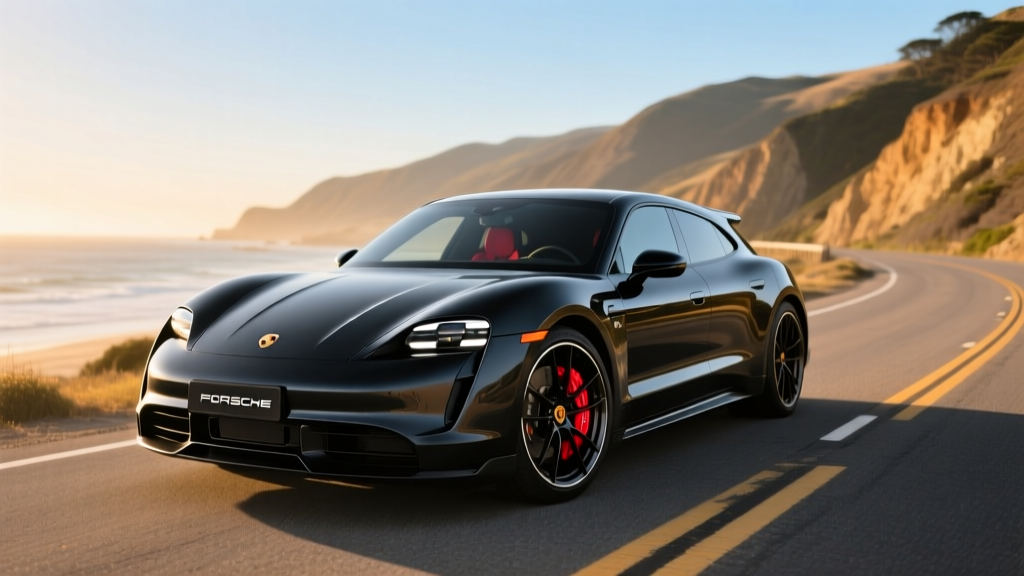
The Quick Verdict on the Taycan GTS Sport Turismo
The 2026 Porsche Taycan GTS Sport Turismo occupies a narrow but compelling slice of the EV market: it's the wagon-ified, performance-tuned middle child of the Taycan lineup, aimed at drivers who want sports-sedan dynamics with genuine cargo utility and all-weather capability. After the substantial refresh Porsche applied to the Taycan platform, the GTS variant now pairs a 104.5 kWh (gross) Performance Battery Plus with an 800-volt architecture capable of pulling a peak 320 kW at a DC fast charger — numbers that translate to genuine road-trip viability rather than just spec-sheet theater.
With 590 horsepower on overboost, a 3.1-second 0-60 time, and standard all-wheel drive, the GTS Sport Turismo delivers the acceleration and grip Porsche buyers expect. The wagon body adds roughly 5 cu ft of cargo volume over the sedan, plus rear headroom that finally accommodates adults comfortably. The trade-off? A base MSRP north of $143,000 and no federal §30D tax credit eligibility due to both price and Porsche's battery-sourcing profile. This is a premium performance EV for buyers who prioritize driving engagement over incentives.
Range, Efficiency, and Real-World Expectations
Real-World Expectation: Plan for ~240–260 miles on sustained highway driving at 70–80 mph. In cold weather (below 30°F), expect a 15–25% reduction, dropping effective range to roughly 210–240 miles without preconditioning. City and mixed driving with regenerative braking can approach or slightly exceed the EPA figure.
The 2026 Taycan GTS Sport Turismo carries Porsche's larger battery pack — the Performance Battery Plus — with a gross capacity of 104.5 kWh and approximately 97 kWh usable. The chemistry is an NMC (nickel-manganese-cobalt) lithium-ion configuration, chosen for its energy density and high discharge rates that support both the car's performance envelope and fast-charging capability.
On the EPA's fuel economy site, the GTS Sport Turismo posts a combined efficiency rating of approximately 83 MPGe, or roughly 40 kWh per 100 miles. That's competitive within the luxury performance EV segment but trails efficiency-focused models like the Lucid Air or Tesla Model S. The 800-volt electrical architecture helps minimize energy losses during both discharge and charging, but the GTS's wide tires, all-wheel-drive hardware, and 5,000-plus-pound curb weight work against efficiency.
In practical terms, this means a 300-mile highway road trip will require at least one DC fast-charging stop — a non-issue given the car's charging speed, but worth budgeting for. Commuters with home Level 2 charging will find the range more than adequate for daily driving, with a comfortable buffer for detours and climate use.
| Specification | Value |
|---|---|
| EPA Range (combined) | 283 miles |
| Battery Gross / Usable | 104.5 kWh / ~97 kWh |
| Battery Chemistry | NMC (Nickel-Manganese-Cobalt) |
| Drivetrain | Dual-motor AWD |
| Horsepower (overboost) | 590 hp |
| Torque | 590 lb-ft |
| 0-60 mph | 3.1 seconds |
| Top Track Speed | 155 mph |
| Max DC Fast Charge | 320 kW (peak) |
| 10-80% DC Fast Charge | ~18 minutes |
| Level 2 Home Charge Rate | 11 kW (AC) |
| EPA Efficiency | ~83 MPGe / ~40 kWh/100 mi |
| Cargo Volume (rear seats up) | 15.7 cu ft |
| Cargo Volume (rear seats folded) | 42.8 cu ft |
| Rear Legroom | 32.7 inches |
| Curb Weight | ~5,126 lbs |
| Battery Warranty | 8 years / 100,000 miles |
| Base MSRP | $143,295 (incl. $1,995 destination) |
Charging Speed: 800-Volt Architecture in Practice
Porsche was an early adopter of 800-volt EV architecture, and the 2026 Taycan GTS Sport Turismo reaps the benefits. The headline number is a peak DC fast-charging rate of 320 kW — among the highest available in any production EV. At a compatible 350 kW charger (Electrify America, Ionity in Europe, or similar), the GTS Sport Turismo can replenish from 10% to 80% state of charge in approximately 18 minutes.
But peak kW is not sustained kW. The Taycan's charging curve is aggressive in the 10–50% range, where it can hold close to 300+ kW, then tapers progressively through the 50–80% window. This is physics, not a flaw — battery management systems throttle current to protect cell longevity as the battery fills. The practical result is that the 10–80% sprint is genuinely quick, but topping from 80–100% will add another 20+ minutes. For road-trip planning, plan your stops around the 10–80% sweet spot.
| Charge Level | Power (kW) | Miles Added per Hour | Typical Use Case |
|---|---|---|---|
| Level 1 (120V household) | ~1.3 kW | ~3 mi/hr | Emergency / trickle top-off |
| Level 2 (240V, 48A home) | 11 kW (max AC) | ~27 mi/hr | Overnight home charging (~9 hrs 10–100%) |
| DC Fast Charge (350 kW station) | Up to 320 kW peak | ~600+ mi/hr (peak) | Road trips: 10–80% in ~18 min |
| DC Fast Charge (150 kW station) | ~150 kW sustained | ~350 mi/hr | Common public chargers: 10–80% in ~30 min |
For home charging, the Taycan's onboard AC charger accepts up to 11 kW on a 240-volt Level 2 circuit. With a 48-amp hardwired home charger (like a ChargePoint Home Flex or Porsche's own Mobile Charger Connect), you'll add roughly 27 miles of range per hour, meaning a full overnight session easily replenishes a day's worth of driving. A full 10–100% Level 2 charge takes approximately 9 hours.
Preconditioning matters. The Taycan's navigation system will automatically precondition the battery when a DC fast charger is set as your destination, warming or cooling the cells to optimize charge acceptance. Skipping preconditioning — especially in cold weather — can significantly reduce your peak charge rate and add minutes to your stop.
Performance: The GTS Sweet Spot
The "GTS" badge in Porsche's hierarchy sits between the 4S and the Turbo — a performance sweet spot that prioritizes driver engagement over outright power bragging rights. The 2026 Taycan GTS Sport Turismo delivers 590 horsepower (with launch control overboost) and 590 lb-ft of torque from its dual-motor all-wheel-drive powertrain. The result is a 3.1-second 0-60 mph time that feels effortlessly violent, accompanied by Porsche's synthetic "Electric Sport Sound" that adds an aural dimension to the acceleration.
What separates the GTS from lesser Taycans isn't just straight-line speed. Porsche tunes the GTS with specific damper calibrations for its standard PASM adaptive air suspension, a sharper rear-axle steering calibration, and standard Porsche Torque Vectoring Plus. The Sport Chrono package is included, adding the drive-mode selector with Sport Plus and the launch-control function. In Sport Plus, the car lowers its ride height, firms the dampers, and sharpens throttle response — transforming from a comfortable grand-touring wagon into a genuinely capable canyon carver.
The two-speed transmission on the rear motor — a Taycan hallmark — gives the car strong initial acceleration from the short first gear and efficient high-speed cruising in second. It's one reason the Taycan maintains its composure at triple-digit speeds where single-speed EVs begin to feel breathless.
Interior, Cargo, and Daily Usability
The Sport Turismo body style is the Taycan's practicality play. Compared to the sedan, the wagon roofline yields measurably improved rear headroom and a cargo area that's genuinely useful. Behind the rear seats, you get 15.7 cubic feet — enough for a week's worth of luggage for two or a Costco run without playing Tetris. Fold the 40/20/40-split rear seats and the space opens to 42.8 cubic feet, accommodating bicycles, ski gear, or flat-pack furniture with relative ease.
The front trunk (frunk) adds an additional 2.9 cubic feet, suitable for charging cables, a laptop bag, or groceries you want separated from the main cargo area.
Inside, Porsche has streamlined the dashboard with its latest PCM (Porsche Communication Management) infotainment system, centered on a 12.6-inch curved instrument cluster and a 10.9-inch central touchscreen. An optional 10.9-inch front-passenger display keeps your copilot entertained without distracting the driver. The system supports wireless Apple CarPlay and Android Auto, over-the-air updates, and integrated navigation with real-time charging-station routing.
Standard driver-assistance features include adaptive cruise control with stop-and-go, lane-keeping assist, traffic-sign recognition, and Porsche InnoDrive (predictive cruise that adjusts speed for upcoming curves and speed limits based on navigation data). These constitute SAE Level 2 driver assistance — the driver must remain attentive and keep hands on or near the wheel at all times. This is not autonomous driving.
Pricing, Tax Credits, and Ownership Costs
The 2026 Porsche Taycan GTS Sport Turismo starts at a base MSRP of $143,295, including Porsche's $1,995 destination charge. Popular options — the Premium Package, 21-inch RS Spyder Design wheels, SportDesign exterior elements, rear-axle steering, and premium leather interiors — can push a well-equipped example to $160,000–$170,000 before any incentives.
| Item | Detail |
|---|---|
| Base MSRP (incl. destination) | $143,295 |
| Typical As-Tested Price | $155,000 – $170,000 |
| Federal §30D Tax Credit | $0 — Not eligible |
| Reason for Ineligibility | MSRP exceeds $55,000 cap for wagons/sedans; battery critical-mineral and component sourcing do not meet current IRS thresholds |
| Estimated Annual Insurance | $3,800 – $5,200 (varies by state/driver profile) |
| Estimated Annual Electricity Cost (12,000 mi) | ~$600 – $900 (at $0.13–$0.18/kWh) |
Federal tax credit reality: The Taycan GTS Sport Turismo does not qualify for the IRS §30D New Clean Vehicle Credit. The reasons are twofold. First, while the IRS MSRP cap for SUVs, vans, and pickup trucks is $80,000, sedans and wagons are capped at $55,000 — and the GTS Sport Turismo's $143,295 sticker clears that threshold by a wide margin. Second, Porsche's battery cell sourcing and critical-mineral supply chains do not currently satisfy the progressively tightening domestic-content and FEOC (foreign entity of concern) requirements that the IRS enforces. Even if the price were eligible, the battery-sourcing rules would likely disqualify it. Buyers should not factor any federal credit into their purchase math.
Some states offer their own EV rebates or tax credits that are independent of federal rules — check your state's energy or DMV website for current programs, as these vary widely and change frequently.
On the ownership-cost side, electricity is dramatically cheaper than the premium gasoline a comparable Panamera GTS Sport Turismo would consume. At a national average of ~$0.15/kWh and the Taycan's ~40 kWh/100 mi consumption, you're looking at roughly $6 per 100 miles of driving — versus $15–$18 per 100 miles for a 17-mpg gasoline performance wagon on $3.50/gal premium. Over five years and 60,000 miles, that's approximately $5,400–$7,200 in fuel savings. Maintenance costs are also lower: no oil changes, no spark plugs, reduced brake wear from regenerative braking. However, insurance premiums for the Taycan GTS run significantly higher than average — expect quotes in the $3,800–$5,200 annual range depending on your profile.
Battery Warranty, Degradation, and Longevity
Porsche warrants the Taycan's high-voltage battery for 8 years or 100,000 miles, whichever comes first, against defects and excessive capacity loss. The warranty guarantees that the battery will retain at least 70% of its original usable capacity during the coverage period. If capacity falls below that threshold under normal use conditions, Porsche will repair or replace the battery pack.
The NMC chemistry in the Performance Battery Plus offers excellent energy density and power delivery, but it is more sensitive to long-term degradation from sustained high states of charge and extreme heat than LFP (lithium iron phosphate) chemistries. Porsche's battery management system includes a robust thermal-management system with liquid cooling and heating, which significantly mitigates degradation. Real-world data from earlier Taycan model years suggests degradation of approximately 5–8% over the first 60,000 miles — well within the warranty threshold.
For longevity, Porsche recommends daily charging to 80% (a configurable limit in the car's settings) and reserving 100% charges for road trips. The car's preconditioning and active thermal management handle most of the heavy lifting, but avoiding prolonged exposure to extreme heat while parked at full charge is prudent.
Pros, Cons, and Who Should Buy
Pros
- Class-leading 320 kW peak DC charging — 10-80% in ~18 min
- 590 hp and 3.1s 0-60 with genuine sports-car handling dynamics
- Wagon practicality: 42.8 cu ft max cargo, usable frunk
- 800V architecture maximizes charging and efficiency
- Excellent build quality and Porsche dealer service network
- Standard PASM air suspension and rear-axle steering on GTS
- Real-world range adequate for daily driving and road trips
Cons
- $143K+ base price with no federal tax credit eligibility
- Efficiency (~83 MPGe) trails efficiency-focused luxury EVs
- Real-world highway range drops to ~240 mi in cold conditions
- Insurance premiums significantly above segment average
- Rear-seat legroom (32.7 in) is tight for tall adults on long trips
- Infotainment learning curve; some functions buried in menus
- No access to Tesla Supercharger network without adapter (NACS transition ongoing)
Who this EV suits best: The Taycan GTS Sport Turismo is built for the driving-enthusiast household that needs wagon cargo space but refuses to compromise on dynamics. If your ideal weekend involves a 200-mile canyon drive with two suitcases and a dog crate, this car makes a compelling case. It's also well-suited to executive commuters who want a premium, understated alternative to the ubiquitous Tesla or a German luxury sedan. It is not the right choice for budget-conscious buyers chasing tax credits, for families needing third-row seating, or for those whose primary concern is maximum range per dollar.
Competitive Landscape: Is It Worth It?
The Taycan GTS Sport Turismo's direct competitors are few because the performance-EV-wagon segment is thin. The Audi RS e-tron GT shares the Taycan's J1 platform and 800V architecture but wears a sedan body with less cargo space and a higher starting price. The Tesla Model S Plaid offers more power and Supercharger access but lacks the Porsche's chassis refinement and interior craftsmanship. The BMW i5 M60 xDrive Touring (where available) provides wagon practicality at a lower price point but with less power and slower charging. The Mercedes-AMG EQE SUV competes on price and luxury but sacrifices the driving engagement Porsche delivers.
Against all of these, the Taycan GTS Sport Turismo's advantage is the holistic package: the 320 kW charging speed is best-in-class, the chassis balance and steering feel are unmatched in the EV space, and the wagon form factor is unique. The disadvantage is price — you pay a substantial premium for the Porsche crest and the engineering behind it, with no federal incentive to soften the blow.
Frequently Asked Questions
What is the real-world range of the Taycan GTS Sport Turismo?
The EPA rates it at 283 miles combined. In real-world highway driving at 70–80 mph, expect 240–260 miles. In cold weather below 30°F, plan for 210–240 miles unless you precondition the battery. City driving with regenerative braking can match or slightly exceed the EPA figure.
How fast does the Taycan GTS Sport Turismo charge?
On a 350 kW DC fast charger, it peaks at 320 kW and charges from 10–80% in approximately 18 minutes. At a 150 kW public charger, expect 10–80% in roughly 30 minutes. At home on a Level 2 (240V, 48A) charger, it accepts 11 kW, adding about 27 miles per hour — a full overnight charge in ~9 hours.
Does the Taycan GTS Sport Turismo qualify for the federal EV tax credit?
No. The 2026 Taycan GTS Sport Turismo does not qualify for the IRS §30D New Clean Vehicle Credit. Its $143,295 MSRP far exceeds the $55,000 cap for sedans/wagons, and its battery sourcing does not meet current critical-mineral and domestic-content requirements. Consult IRS.gov or a tax professional for the latest rules.
How much does it cost to own a Taycan GTS Sport Turismo?
Beyond the $143K+ purchase price, expect $3,800–$5,200 annually for insurance and roughly $600–$900 per year in home electricity costs (at 12,000 miles/year). Maintenance is lower than a gasoline equivalent — no oil changes, reduced brake wear. Over five years, fuel savings versus a comparable gasoline performance wagon can total $5,400–$7,200.
Is the Taycan GTS Sport Turismo worth buying over competitors?
If you prioritize driving dynamics, charging speed, and wagon practicality in a premium package, the GTS Sport Turismo is arguably the best-executed performance EV wagon available. If maximum range, lowest price, or tax-credit eligibility are your top priorities, look at the Tesla Model S, Lucid Air, or BMW i5. The Porsche commands a premium for its engineering depth — you're paying for how it drives, not just what it does.
What is the battery warranty?
Porsche covers the high-voltage battery for 8 years or 100,000 miles, guaranteeing at least 70% capacity retention. The limited vehicle warranty covers 4 years or 50,000 miles.