The Tesla Model 3 remains one of the most leased electric vehicles in the United States, and for good reason. Between aggressive manufacturer incentives, the federal tax credit's unique lease pass-through mechanism, and the refreshed Highland platform's tangible improvements in ride quality and cabin noise, the Model 3 presents a compelling case for drivers who want premium EV tech without the long-term depreciation risk of ownership.
But lease math is notoriously opaque. Monthly payments depend on money factor, residual value, mileage caps, and whether Tesla is offering conquest cash or loyalty bonuses in your region. This guide breaks down the 2026 Tesla Model 3 lease landscape with the same precision we apply to range and charging data — exact numbers, real-world caveats, and a clear verdict on whether leasing or buying makes more financial sense.
2026 Tesla Model 3 Lease Pricing Breakdown
Tesla's lease offers fluctuate monthly and vary by state, but the current 2026 Model 3 lease structure follows a predictable pattern. Below is a representative breakdown based on recent national offers for the most popular configuration.
| Parameter | Model 3 RWD | Model 3 Long Range AWD |
|---|---|---|
| Base MSRP | $38,990 | $45,990 |
| Lease Term | 36 months | 36 months |
| Annual Mileage Allowance | 10,000 mi/yr | 10,000 mi/yr |
| Monthly Payment (est.) | $399–$449 | $499–$559 |
| Due at Signing | $2,500–$3,999 | $3,500–$4,999 |
| Federal Credit Pass-Through | Up to $7,500 cap reduction | Up to $7,500 cap reduction |
| Effective Monthly (with credit) | ~$190–$240 | ~$290–$350 |
The lease pass-through advantage: Under IRS §30D rules, the federal EV tax credit technically belongs to the lessor (the financing entity), not the lessee. However, most manufacturers — Tesla included — pass the full $7,500 credit to the consumer as a capitalized cost reduction, effectively lowering your monthly payment. This is significant because buyers who exceed the §30D income caps ($150,000 single / $300,000 joint) cannot claim the credit on a purchase but can benefit from it through a lease, since the income cap does not apply to the leasing entity.
⚡ Lease Math Reality Check: A $7,500 cap reduction on a 36-month lease saves roughly $208/month. If your quoted payment doesn't reflect this discount, ask the advisor to itemize the capitalized cost reduction. Some third-party lessors retain a portion of the credit — always verify before signing.
EPA Range vs. Real-World Driving
EPA Estimated Range: 363 miles (Long Range AWD) / 346 miles (RWD Long Range) / 272 miles (RWD Standard)
Real-World Expectation: Plan for 280–310 miles on highway road trips at 70+ mph. In freezing temperatures (below 32°F), expect a 20–30% reduction, bringing the Long Range down to approximately 250–270 miles of usable range. City driving with regenerative braking recovers closer to the EPA sticker.
The 2026 Model 3 Long Range AWD achieves its 363-mile EPA rating through a combination of the Highland platform's improved aerodynamics (0.219 Cd), a heat pump for cabin efficiency, and Tesla's continued battery management refinements. The RWD variant uses a smaller battery but benefits from lower weight, partially offsetting the capacity difference.
For lessees, range matters differently than for buyers. A 36-month lease with 10,000 miles/year means 30,000 total miles — well within the battery's proven longevity envelope. You're unlikely to experience meaningful degradation during the lease term, and you won't face the 8-year battery warranty expiration question that long-term owners eventually confront.
Charging Speed: DC Fast and Home Level 2
| Charging Method | Peak Rate | 10–80% Time | Miles Added per Hour |
|---|---|---|---|
| DC Fast Charge (V4 Supercharger) | 250 kW | ~25 minutes (Long Range) | ~175 mi in 15 min |
| DC Fast Charge (CCS via adapter) | 250 kW | ~25 minutes | ~175 mi in 15 min |
| Level 2 Home (48A / 11.5 kW) | 11.5 kW | ~8.5 hours (0–100%) | ~44 mi/hr |
| Level 2 Home (32A / 7.7 kW) | 7.7 kW | ~12 hours (0–100%) | ~30 mi/hr |
| Level 1 (120V / 12A) | 1.4 kW | N/A | ~3–4 mi/hr |
The Model 3's 250 kW peak DC fast-charge rate is competitive but not class-leading. The Hyundai Ioniq 6 peaks at 350 kW on an 800V architecture, and the Porsche Taycan reaches 320 kW. However, Tesla's Supercharger network reliability — consistently above 95% uptime per third-party audits — means you're more likely to actually achieve the rated speed in practice compared to some CCS networks where broken stalls and software handshakes remain issues.
Charging curve reality: The Model 3 sustains peak rate only between roughly 10–35% state of charge. From 35–80%, the rate tapers progressively, averaging closer to 100–120 kW over the full 10–80% session. This is why the 25-minute 10–80% time doesn't translate to a linear 250 kW average. For road trips, plan stops around 20–25 minutes to reach 80%, then continue — pushing past 80% on DC fast charging is rarely time-efficient due to the steep taper.
Performance and Drivetrain
The 2026 Model 3 lineup offers three distinct powertrain configurations:
- Model 3 RWD: 271 hp, 317 lb-ft torque, 0–60 mph in 5.8 seconds. Single rear motor, LFP battery chemistry.
- Model 3 Long Range AWD: 346 hp, 389 lb-ft torque, 0–60 mph in 4.2 seconds. Dual motor, NMC battery chemistry.
- Model 3 Performance: 510 hp, 546 lb-ft torque, 0–60 mph in 2.9 seconds. Dual motor with track-tuned suspension, NMC battery.
For lease purposes, the Long Range AWD hits the sweet spot: the 4.2-second 0–60 time is genuinely quick, the dual-motor AWD provides confident traction in rain and light snow, and the 363-mile range eliminates range anxiety for nearly all driving patterns. The Performance variant is thrilling but commands a $5,000+ premium that inflates monthly lease payments substantially.
Battery Chemistry and Longevity
Tesla uses two distinct battery chemistries across the Model 3 lineup, and this matters for lessees considering end-of-lease options:
| Attribute | LFP (RWD Standard) | NMC (Long Range / Performance) |
|---|---|---|
| Usable Capacity | ~60 kWh | ~75 kWh (Long Range) / ~82 kWh (Performance) |
| Energy Density | Lower (heavier per kWh) | Higher |
| Recommended Daily Charge | 100% (no penalty) | 80% for daily, 100% for trips |
| Cycle Life | 3,000+ cycles | 1,500–2,000 cycles |
| Cold-Weather Performance | More range loss (~30%) | Moderate range loss (~20%) |
| Cobalt Content | Zero | Contains cobalt/nickel |
The LFP battery in the RWD model is notable for its exceptional cycle life and the ability to charge to 100% daily without accelerating degradation. Tesla explicitly recommends this in the vehicle settings. For a 36-month lease, degradation will be minimal regardless of chemistry — Tesla's battery data shows average degradation of 5–8% over 100,000 miles, and most lessees won't approach that mileage.
The battery and drive unit warranty covers 8 years or 100,000 miles (RWD) / 8 years or 120,000 miles (Long Range/Performance), whichever comes first, with a guaranteed minimum 70% capacity retention. This warranty transfers to subsequent owners, but for lessees, it's primarily relevant if you exercise the purchase option at lease-end.
Federal Tax Credit Eligibility via Lease
§30D Tax Credit Lease Pass-Through: The Model 3 Long Range AWD and Performance currently qualify for the full $7,500 federal tax credit when purchased. Through a Tesla Financial Services lease, this credit is applied as a capitalized cost reduction. The RWD variant's eligibility depends on current battery sourcing compliance — verify with Tesla at the time of signing, as critical mineral sourcing rules tighten annually under the Inflation Reduction Act.
Key caveats:
- The $7,500 credit applies to vehicles with MSRP ≤ $55,000 (sedans). All Model 3 trims qualify.
- Income caps ($150K single / $300K joint) apply to purchases only — lease pass-through has no income restriction for the lessee.
- Battery component and critical mineral sourcing requirements must be met. Tesla has maintained compliance for most configurations, but verify at order time.
- The credit is non-refundable on purchases but fully realized through lease cap reduction regardless of your tax liability.
This last point is crucial: if you owe less than $7,500 in federal income tax, you cannot claim the full credit on a purchase. Through a lease, the lessor (a corporation with substantial tax liability) claims the credit and passes the savings to you. This makes leasing the Model 3 financially superior to buying for many middle-income buyers who wouldn't fully utilize the credit.
Interior, Cargo, and Technology
The Highland refresh (introduced for 2024 and carried forward to 2026) transformed the Model 3's cabin from spartan to genuinely premium. Ventilated front seats, ambient lighting, a rear touchscreen for passengers, and significantly improved NVH (noise, vibration, harshness) levels make the 2026 Model 3 a different experience than pre-2024 models.
- Front headroom: 40.3 inches
- Front legroom: 42.7 inches
- Rear headroom: 37.8 inches
- Rear legroom: 35.2 inches
- Cargo volume (trunk): 23 cu ft
- Frunk: 3.1 cu ft
- Total cargo: 26.1 cu ft (seats up) / 64.9 cu ft (rear seats folded)
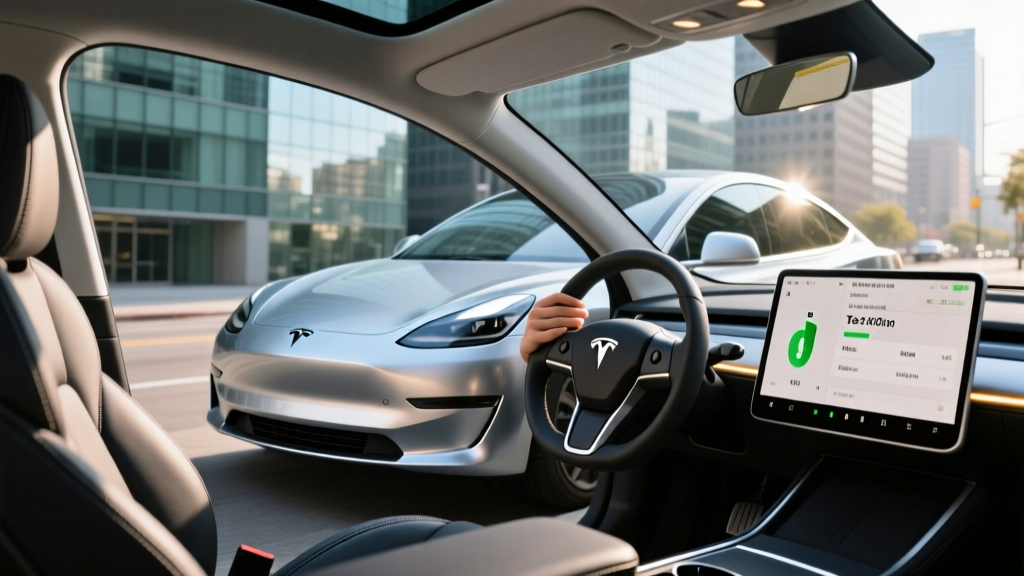
The 15.4-inch center touchscreen runs Tesla's proprietary infotainment system — no Apple CarPlay or Android Auto, but Tesla's native navigation, media, and climate controls are responsive and well-integrated. The minimalist interior (no physical buttons, no instrument cluster) remains polarizing. Steering-wheel-mounted controls and the touchscreen handle all functions, including gear selection via swipe on the screen (with backup buttons on the overhead console).
Driver assistance: Basic Autopilot (adaptive cruise + lane centering) is standard and competent for highway use. Enhanced Autopilot ($6,000) adds auto lane change and navigate-on-autopilot. Full Self-Driving (Supervised) at $8,000 or $99/month adds traffic light/stop sign recognition and city street autosteer. Critically, all Tesla driver-assist features are SAE Level 2 — the driver must remain engaged and supervising at all times. This is not autonomous driving.
Efficiency: MPGe and Cost Per Mile
| Trim | Combined MPGe | kWh/100 mi | Est. Cost per Mile* |
|---|---|---|---|
| RWD | 132 MPGe | 25 kWh/100 mi | $0.04–$0.06 |
| Long Range AWD | 125 MPGe | 27 kWh/100 mi | $0.04–$0.07 |
| Performance | 113 MPGe | 30 kWh/100 mi | $0.05–$0.08 |
*Cost per mile based on $0.13–$0.18/kWh residential electricity. Supercharger rates vary by location ($0.25–$0.40/kWh typical).
The Model 3 Long Range's 27 kWh/100 mi efficiency is excellent for a dual-motor AWD sedan. For context, the BMW i4 xDrive40 consumes roughly 30 kWh/100 mi, and the Hyundai Ioniq 6 (also very efficient) achieves 25 kWh/100 mi in its RWD configuration. Efficiency matters directly for lease economics: lower kWh consumption means lower fuel costs over the 30,000-mile lease term, partially offsetting the monthly payment.
Who Should Lease the Model 3?
The Model 3 lease makes the most sense for:
- Tech-forward commuters who want Supercharger network access and over-the-air updates without long-term ownership risk.
- High-income drivers (above §30D income caps) who can still access the $7,500 credit through lease pass-through.
- Drivers who upgrade every 3 years and prefer predictable monthly costs with no resale-value uncertainty.
- Urban/suburban drivers with home Level 2 charging who drive 25–40 miles daily with occasional longer trips.
Consider buying instead if you drive more than 15,000 miles/year (lease overage penalties of $0.20–$0.25/mile add up fast), plan to keep the vehicle 5+ years, or want to customize the vehicle (wraps, aftermarket wheels, etc. — leases require return to stock condition).
Pros and Cons
Pros
- Access to $7,500 federal credit regardless of income via lease pass-through
- Supercharger network reliability (95%+ uptime) is unmatched by CCS networks
- Highland platform ride quality and cabin noise are genuinely improved
- 363-mile EPA range (Long Range) covers nearly all road trips without stress
- Over-the-air updates continue to add features throughout the lease term
- Strong residual values protect against lease-end purchase option sticker shock
Cons
- No Apple CarPlay or Android Auto — Tesla's walled garden only
- Rear seat legroom (35.2 in) is tight for taller passengers on long trips
- Minimalist interior (no physical buttons, screen-only gear selection) polarizes
- Lease mileage caps (typically 10K/yr) are restrictive for high-mileage drivers
- FSD subscription ($99/mo) adds cost without delivering true autonomy
- Insurance premiums 15–25% higher than comparable gas sedans in most states
Frequently Asked Questions
What is the real-world range of the 2026 Tesla Model 3?
The EPA rates the Long Range AWD at 363 miles and the RWD at 272 miles. In real-world highway driving at 70–75 mph, expect 280–310 miles from the Long Range. In freezing weather, plan for 250–270 miles. The RWD delivers roughly 220–240 miles on highway in moderate temperatures.
How fast does the Model 3 charge at home and on DC fast chargers?
On a DC fast charger (Tesla Supercharger or CCS adapter), the Model 3 peaks at 250 kW and charges 10–80% in approximately 25 minutes. At home on a 48-amp Level 2 charger (11.5 kW), you'll add roughly 44 miles of range per hour, or a full charge in about 8.5 hours for the Long Range. Most owners charge overnight and wake up to a full battery daily.
How much does a Tesla Model 3 lease cost after the federal tax credit?
With the $7,500 federal credit applied as a cap reduction, expect monthly payments around $190–$240 for the RWD and $290–$350 for the Long Range AWD on a 36-month, 10,000-mile/year lease with $2,500–$4,999 due at signing. Exact figures vary by state, credit tier, and current Tesla incentives.
Is leasing a Tesla Model 3 worth it compared to buying?
Leasing is advantageous if you: (1) exceed §30D income caps and can only access the credit via lease, (2) prefer predictable 3-year costs with no resale risk, or (3) upgrade vehicles frequently. Buying is better if you drive 15,000+ miles/year, want to keep the car 5+ years, or plan to customize it. Run both scenarios with Tesla's online calculator before deciding.
Does the Model 3 qualify for the federal EV tax credit?
Yes, the Model 3 Long Range AWD and Performance currently qualify for the full $7,500 §30D credit when purchased, subject to battery sourcing compliance. The RWD's eligibility varies — confirm with Tesla at order time. Through a Tesla Financial Services lease, the credit is passed through as a cap reduction regardless of your personal income level.
What happens at the end of a Tesla Model 3 lease?
Tesla Financial Services leases typically offer a purchase option at the residual value stated in your contract (often 50–55% of MSRP for a 36-month lease). You can also return the vehicle with no further obligation (assuming mileage and wear are within limits) or lease a new Tesla. Unlike some manufacturers, Tesla does not currently offer lease-end loyalty incentives, so negotiate your next deal independently.
Can I charge a leased Tesla Model 3 at non-Tesla chargers?
Yes. The 2026 Model 3 comes with a NACS (Tesla) connector natively. Tesla sells a CCS adapter (~$150) that enables charging at Electrify America, EVgo, and other CCS networks. The Supercharger network remains the most reliable option, but the adapter provides flexibility for areas where third-party networks have better coverage.
Final Verdict
The 2026 Tesla Model 3 lease is one of the most financially efficient ways to access a premium long-range EV, particularly for drivers who benefit from the §30D credit pass-through. The Long Range AWD at approximately $290–$350/month (after credit) with 363 miles of EPA range, 250 kW DC fast charging, and Supercharger network access is difficult to beat on pure value. The main trade-offs are the restrictive mileage cap, the polarizing minimalist interior, and the lack of smartphone integration. If those aren't deal-breakers, the Model 3 lease is a strong choice — just verify the credit pass-through in writing before signing.