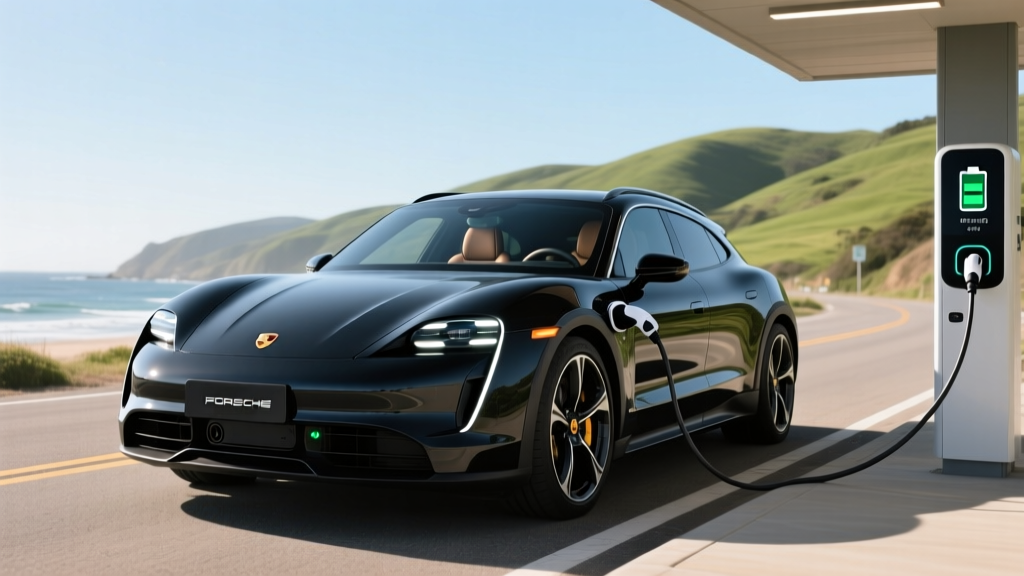
The Porsche Taycan Cross Turismo occupies a rare niche: an electric sports wagon that trades nothing in driving dynamics for added cargo space and ride comfort. For 2026, Porsche continues to refine the formula with the updated J1 platform architecture introduced for the 2025 model year—larger battery, faster charging, and improved heat-pump efficiency. But at a starting price well north of $100,000, buyers need hard numbers, not marketing gloss. This profile covers every spec that matters for ownership, from real-world highway range to DC fast-charging curves, tax credit eligibility, and how the Cross Turismo stacks up against the Tesla Model S, Audi e-tron GT, and Mercedes EQE Wagon.
Range and Efficiency: EPA vs. the Real World
The 2026 Taycan Cross Turismo lineup carries over the 105 kWh gross (97 kWh net usable) lithium-ion battery with NMC (nickel manganese cobalt) chemistry introduced in the J1 refresh. Porsche's thermal management system—now standard with a heat pump across all trims—keeps the pack in its optimal operating window, which matters for both range preservation and charging consistency.
| Trim | EPA Range | Real-World Highway (70 mph) | Cold Weather (20°F) |
|---|---|---|---|
| Taycan 4 Cross Turismo | 285 mi | ~245–260 mi | ~200–220 mi |
| Taycan 4S Cross Turismo | 277 mi | ~235–250 mi | ~190–210 mi |
| Taycan Turbo Cross Turismo | 270 mi | ~228–245 mi | ~185–205 mi |
| Taycan Turbo S Cross Turismo | 264 mi | ~222–238 mi | ~180–200 mi |
Source: fueleconomy.gov. Real-world estimates based on sustained 70 mph highway driving and cold-weather testing at 20°F with cabin heat active. The Taycan's 800V architecture and heat pump mitigate cold-weather losses better than many competitors, but expect 15–25% range reduction in deep winter.
Efficiency varies by trim, with the base Taycan 4 Cross Turismo achieving approximately 79 MPGe combined (43 kWh/100 mi), while the Turbo S drops to around 73 MPGe combined (46 kWh/100 mi). These figures place the Taycan Cross Turismo behind the Tesla Model S Long Range in pure efficiency but ahead of the Audi RS e-tron GT, which shares the J1 platform but wears a less aero-optimized body.
Charging Speed: 800V Architecture Still Sets the Pace
Porsche's 800-volt electrical architecture remains one of the Taycan's defining advantages. The 2026 Cross Turismo supports up to 320 kW peak DC fast charging—an increase from the pre-refresh 270 kW—and can sustain high charge rates deeper into the session than nearly any competitor outside the Hyundai/Kia E-GMP family and the Lotus Eletre.
| Charging Level | Power / Rate | Time / Miles Added |
|---|---|---|
| DC Fast Charge (peak) | 320 kW (800V) | 10–80% in ~18 minutes |
| DC Fast Charge (50 kW station) | 50 kW | 10–80% in ~95 minutes |
| Level 2 (240V, 48A) | 11.5 kW onboard | ~30 mi/hr of charging; full in ~9 hr |
| Level 2 (240V, 32A) | 7.7 kW | ~20 mi/hr of charging; full in ~13 hr |
| Level 1 (120V, 12A) | 1.4 kW | ~4 mi/hr; impractical for daily use |
Charging curve reality: The Taycan Cross Turismo hits its 320 kW peak between roughly 10% and 35% state of charge when preconditioned, then tapers progressively. From 50% to 80%, expect sustained rates of 120–160 kW. This means the full 10–80% session averages around 200 kW effective—still exceptional, and the reason the Taycan remains a benchmark for road-trip charging stops. Preconditioning activates automatically when a DC fast-charger is set as the navigation destination, warming the pack to the ideal ~35°C for peak charge acceptance.
The Cross Turismo uses a CCS1 (Combined Charging System) connector in North America. Porsche has confirmed NACS adapter compatibility for Tesla Supercharger access, though native NACS ports are not yet standard on the J1 platform. Owners can use Electrify America, EVgo, and other CCS networks natively.
Performance: Sports Car Reflexes in a Wagon Body
| Trim | Horsepower (Launch Control) | Drivetrain | 0–60 mph | Top Speed |
|---|---|---|---|---|
| Taycan 4 | 469 hp | AWD (dual-motor) | 4.5 sec | 143 mph |
| Taycan 4S | 590 hp | AWD (dual-motor) | 3.5 sec | 155 mph |
| Taycan Turbo | 871 hp | AWD (dual-motor) | 2.6 sec | 162 mph |
| Taycan Turbo S | 939 hp | AWD (dual-motor) | 2.4 sec | 162 mph |
All Cross Turismo trims feature dual-motor all-wheel drive with Porsche's two-speed transmission on the rear axle—a unique engineering choice that gives strong initial torque multiplication in first gear and efficient high-speed cruising in second. The result is relentless acceleration that doesn't fall off at highway speeds the way single-motor or single-speed EVs can.
Air suspension with Porsche Active Suspension Management (PASM) is standard across the lineup. The Cross Turismo sits 20 mm higher than the Taycan sedan in its default ride height and offers a "Gravel" drive mode that raises the body further and adjusts torque distribution for loose surfaces. It's not an off-roader, but it handles snow-covered driveways, forest service roads, and speed bumps with noticeably more composure than the standard Taycan.
Interior, Cargo, and Practicality
The Cross Turismo's wagon roofline pays dividends where the sedan cannot. Rear headroom increases by 0.9 inches, and the cargo area behind the second row provides 15.7 cubic feet—more than double the sedan's rear trunk. With the 40/20/40 split rear seats folded, cargo volume expands to approximately 42.8 cubic feet, competitive with midsize luxury SUVs.
The front trunk (frunk) adds 2.9 cubic feet of storage, sufficient for charging cables and a small bag. Total interior passenger volume is 93.5 cubic feet. Rear legroom measures 32.7 inches—adequate for adults on shorter trips but tight for tall passengers on long hauls. This remains a driver-focused car first, family hauler second.
Infotainment: The 2026 model carries Porsche's latest PCM (Porsche Communication Management) software on a 12.6-inch curved driver display and a 10.9-inch central touchscreen. An optional 10.9-inch front passenger display is available. Wireless Apple CarPlay and Android Auto are standard. The system supports over-the-air updates and includes an EV-specific route planner that factors in battery temperature, elevation changes, and charger availability.
Driver assistance: Porsche InnoDrive with active lane guidance is the brand's Level 2 driver-assist system, bundling adaptive cruise control, lane centering, and predictive speed adjustment based on navigation data. It is not a hands-free or self-driving system—driver engagement and hands-on-wheel supervision are required at all times. Porsche does not currently offer a hands-free highway driving feature comparable to GM's Super Cruise or Ford's BlueCruise.
Pricing, Trims, and Federal Tax Credit Eligibility
| Trim | Base MSRP | Typical As-Tested | §30D Federal Credit Eligible? |
|---|---|---|---|
| Taycan 4 Cross Turismo | $103,800 | $115,000–$125,000 | No (exceeds $55,000 sedan/wagon cap) |
| Taycan 4S Cross Turismo | $117,400 | $130,000–$145,000 | No |
| Taycan Turbo Cross Turismo | $156,100 | $170,000–$185,000 | No |
| Taycan Turbo S Cross Turismo | $197,400 | $210,000–$230,000 | No |
Federal tax credit reality: Under current IRS §30D rules, the Taycan Cross Turismo does not qualify for the $7,500 federal EV tax credit. The credit applies a $55,000 MSRP cap for sedans and wagons (and $80,000 for SUVs/trucks/vans). Every Cross Turismo trim exceeds the wagon cap by a wide margin. Additionally, §30D imposes buyer income limits ($150,000 single / $300,000 married filing jointly modified AGI) and battery critical-mineral and component sourcing requirements. Even if the MSRP cap were not disqualifying, the Taycan's battery sourcing would need independent verification. Consult IRS.gov §30D guidance and a tax professional for your specific situation.
Some states offer separate EV incentives that are not bound by federal MSRP caps—check your state energy office or department of revenue for current programs. Porsche dealers may also offer lease incentives that effectively reduce cost, though lease credits pass through the lessor (typically Porsche Financial Services) rather than the buyer.
Warranty and Battery Longevity
Porsche backs the 2026 Taycan Cross Turismo with:
- New vehicle limited warranty: 4 years / 50,000 miles
- Battery warranty: 8 years / 100,000 miles (guarantees minimum 70% state of health retention)
- Powertrain warranty: 8 years / 100,000 miles (covers motors, power electronics, onboard charger)
- Corrosion warranty: 12 years / unlimited miles
The 70% SoH retention threshold at 8 years / 100,000 miles is industry-standard, matching Tesla, BMW, and Mercedes. Porsche's NMC chemistry, combined with the 800V system's precise thermal management, has shown favorable degradation characteristics in early J1 fleet data—most Taycan owners report 3–5% capacity loss over the first 50,000 miles, which is competitive with the best in the segment. The large 97 kWh usable capacity also means that even with moderate degradation, usable range remains substantial over a decade of ownership.
How It Compares: Cross Turismo vs. the Competition
| Spec | Taycan 4S Cross Turismo | Audi RS e-tron GT | Tesla Model S LR | Mercedes EQE 350+ Wagon |
|---|---|---|---|---|
| EPA Range | 277 mi | 246 mi | 402 mi | ~310 mi (est.) |
| Battery (usable) | 97 kWh NMC | 93.4 kWh NMC | ~100 kWh | 90.6 kWh NMC |
| Peak DC Charge | 320 kW | 270 kW | 250 kW | 170 kW |
| 10–80% Time | ~18 min | ~23 min | ~25 min | ~32 min |
| 0–60 mph | 3.5 sec | 3.1 sec | 3.1 sec | 6.2 sec |
| Cargo (rear) | 15.7 cu ft | 9.2 cu ft | 28 cu ft (liftback) | ~18 cu ft (est.) |
| Base MSRP | $117,400 | $150,295 | $79,990 | ~$85,000 (est.) |
| §30D Credit | No | No | No (sedan cap) | No |
- Driving dynamics and steering feel are your top priorities
- You want the fastest DC charging in the luxury EV segment
- You need wagon cargo space but don't want an SUV
- Build quality, materials, and dealership experience matter to you
- Maximum range (402 mi EPA) is your priority
- You want access to the Supercharger network natively
- Budget is a concern (~$38,000 less than the Taycan 4S CT)
- You prefer the e-tron GT's design and share the J1 platform at a slightly lower price
- Rear cargo space is less important (9.2 cu ft trunk, no wagon hatch)
Pros and Cons
- Class-leading 320 kW DC charging with excellent sustained charge curve
- Genuine sports-car handling with air-suspension comfort and gravel mode
- Wagon cargo versatility (42.8 cu ft max) without SUV proportions
- 800V architecture delivers consistent performance in heat and cold
- Premium build quality, materials, and Porsche dealer service network
- Two-speed rear transmission provides strong highway passing power
- No federal §30D tax credit eligibility (exceeds wagon MSRP cap)
- EPA range trails Tesla Model S and Mercedes EQE Wagon significantly
- Rear legroom is tight for adults on long trips (32.7 in.)
- No hands-free Level 2+ driving system (InnoDrive requires hands-on)
- CCS1 port requires adapter for Tesla Supercharger access
- Options escalate price rapidly—$130k+ is typical for a well-equipped 4S
Who Should Buy the Taycan Cross Turismo?
The Taycan Cross Turismo is best suited for the driving-enthusiast buyer who needs wagon practicality and can charge at home. If your daily commute is under 100 miles round-trip and you have Level 2 home charging, the Cross Turismo's real-world range is more than adequate—you'll rarely think about range day-to-day. The 18-minute DC fast-charge capability makes road trips viable with brief stops at 350 kW Electrify America or comparable stations.
It is not the right choice if maximum range-per-dollar is your priority (the Model S dominates there), if you need three rows of seating, or if you're counting on the $7,500 federal tax credit to make the math work. It is, however, arguably the best-driving electric wagon on the market, and for buyers who value steering feel, chassis balance, and build quality above all else, the Cross Turismo delivers in a way that spec sheets alone can't fully capture.
Frequently Asked Questions
What is the real-world range of the Taycan Cross Turismo?
The EPA rates the Taycan 4 Cross Turismo at 285 miles, but sustained 70 mph highway driving typically yields 245–260 miles. In cold weather (below freezing with cabin heat), expect 200–220 miles. The Turbo S trim drops to around 222–238 highway miles. The heat pump helps, but physics dictates that high speeds and low temperatures reduce range for every EV.
How fast does the Taycan Cross Turismo charge?
On a 350 kW-capable DC fast charger with battery preconditioning, the Taycan Cross Turismo peaks at 320 kW and charges from 10% to 80% in approximately 18 minutes. At home on a 48-amp Level 2 charger (11.5 kW), a full charge takes about 9 hours, adding roughly 30 miles of range per hour.
Does the Taycan Cross Turismo qualify for the federal EV tax credit?
No. Under current IRS §30D rules, the Taycan Cross Turismo exceeds the $55,000 MSRP cap for wagons and sedans. Even the base Taycan 4 Cross Turismo starts at $103,800. Buyers should check state-level incentives and consult a tax professional, as rules may change. See IRS.gov for current §30D guidance.
Is the Taycan Cross Turismo worth buying over a Tesla Model S?
It depends on priorities. The Model S Long Range offers 402 miles of EPA range at roughly $79,990—far more range for less money. But the Taycan delivers superior steering feel, chassis communication, build quality, and 320 kW charging speed. If driving engagement and premium materials outweigh maximum range and value, the Taycan wins. If range and budget lead your decision, the Model S is the rational pick.
What battery chemistry does the Taycan Cross Turismo use?
The 2026 Taycan Cross Turismo uses NMC (nickel manganese cobalt) lithium-ion cells in a 97 kWh usable (105 kWh gross) pack. NMC offers high energy density, which is important in a performance-oriented vehicle. The trade-off versus LFP (lithium iron phosphate) is slightly faster calendar degradation over 10+ years, though Porsche's thermal management system mitigates this effectively.
Can the Taycan Cross Turismo use Tesla Superchargers?
Not natively. The Taycan uses a CCS1 port. Porsche offers a NACS adapter that enables Supercharger access, and the navigation system can route to Supercharger locations. However, charging speeds at V3 Superchargers (250 kW peak) will be below the Taycan's 320 kW capability, so Electrify America or comparable 350 kW CCS stations deliver faster stops.
How much cargo space does the Cross Turismo have?
Behind the second row: 15.7 cubic feet. With the 40/20/40 rear seats folded: approximately 42.8 cubic feet. The front trunk (frunk) adds 2.9 cubic feet. This makes the Cross Turismo practical for road-trip luggage, golf clubs, or a week's worth of groceries, but it's not SUV-level volume for large furniture or bulky gear.
Specifications sourced from fueleconomy.gov, Porsche USA, and IRS §30D guidance. Pricing and credit eligibility reflect 2026 model year data and are subject to change. Always verify with your dealer and tax professional before purchasing.