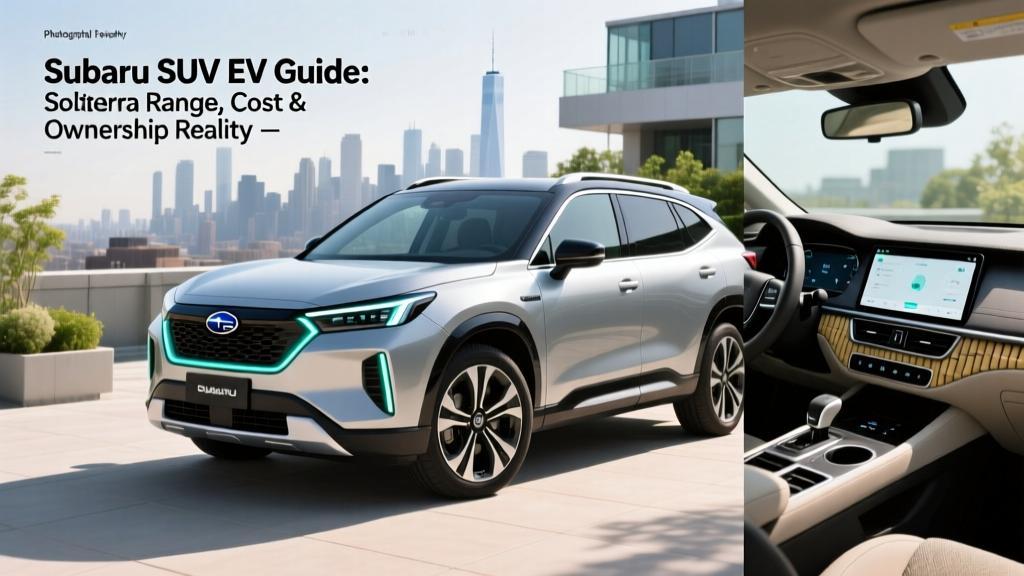
The Quick Answer: Is the Subaru Solterra the Right SUV EV for You?
If you're searching for a Subaru SUV EV, the 2026 Subaru Solterra is currently the brand's only all-electric offering. It delivers an EPA-estimated 227 miles of range (Limited/Touring trims with 20-inch wheels) or up to 228 miles (Premium trim with 18-inch wheels), standard all-wheel drive, and a starting MSRP around $38,495. It's best suited for Subaru loyalists who want symmetric AWD, 8.3 inches of ground clearance, and a familiar crossover form factor — primarily for daily commuting and moderate road trips under 200 miles. However, its DC fast-charging speed (peak ~150 kW) and relatively modest range place it behind competitors like the Hyundai Ioniq 5 and Tesla Model Y for long-distance travel. If you regularly drive in extreme cold or take frequent 300+ mile road trips, a Subaru PHEV or a longer-range EV may serve you better.
2026 Subaru Solterra: Core Specs at a Glance
The Solterra is built on the Toyota-co-developed e-TNGA platform (it shares underpinnings with the Toyota bZ4X). For 2026, Subaru has carried over the powertrain with minor software and feature updates. Here are the exact numbers buyers need:
| Specification | 2026 Subaru Solterra |
|---|---|
| EPA Range | 227–228 miles (trim dependent) |
| Battery Capacity | 72.8 kWh (usable ~64 kWh, NMC chemistry) |
| Drivetrain | Dual-motor AWD, 215 hp / 249 lb-ft torque |
| 0–60 mph | ~6.5 seconds |
| Max DC Fast Charge Rate | ~150 kW (peak) |
| 10–80% DC Fast Charge Time | ~35 minutes |
| Level 2 Charging Rate | 7.2 kW onboard charger |
| Level 2 Full Charge Time | ~9.5 hours (0–100%) |
| MPGe (Combined) | 104 MPGe (Premium); 102 MPGe (Limited/Touring) |
| Ground Clearance | 8.3 inches |
| Cargo Volume | 23.8 cu ft (rear seats up); 56.9 cu ft (folded) |
| Towing Capacity | Not rated for towing |
| Base MSRP | $38,495 (Premium) – $46,495 (Touring) |
| Battery Warranty | 8 years / 100,000 miles (70% capacity retention) |
Sources: EPA fueleconomy.gov, Subaru.com Solterra specs.
Real-World Range: What the EPA Sticker Doesn't Tell You
The EPA's 227–228 mile estimate assumes a mix of city and highway driving at moderate temperatures. In practice, your mileage will vary significantly based on three factors:
Real-World Range Expectations
- Mild weather, mixed driving: 210–225 miles achievable
- Highway-only at 75 mph: ~180–195 miles (aerodynamic drag reduces efficiency sharply)
- Cold weather (below 32°F): ~155–175 miles (battery chemistry slows, cabin heating draws energy)
- Cold + highway combined: As low as ~140–155 miles in worst-case scenarios
The Solterra's NMC battery chemistry experiences typical cold-weather capacity reduction of 25–35%. Subaru does include a battery preconditioning feature that warms the pack when navigating to a DC fast charger, which helps restore some charging speed in cold conditions — but it does not recover lost range.
For context, a gas-powered Subaru Outback (25 MPG combined) with a 16.9-gallon tank delivers roughly 422 miles of real-world range. The Solterra covers about half that distance per "fill-up," which is the central trade-off of going electric.
Charging Speed and Infrastructure: The Solterra's Biggest Limitation
The Solterra's DC fast-charging performance is where it falls behind key competitors. At a peak of ~150 kW, it's adequate but not class-leading. More importantly, the charging curve — the rate at which charging speed tapers as the battery fills — is relatively conservative:
| Charging Level | Power (kW) | Speed (Miles Added/Hour) | Typical Use Case |
|---|---|---|---|
| Level 1 (120V household) | ~1.4 kW | ~4–5 mi/hr | Emergency/overnight trickle |
| Level 2 (240V home) | 7.2 kW | ~24–26 mi/hr | Daily home charging |
| DC Fast (150 kW peak) | Up to 150 kW | ~120–150 mi/hr (peak) | Road trips, quick top-ups |
Real-world DC fast charging: On a 350 kW Electrify America or EVgo station, expect the Solterra to peak around 130–150 kW from 10–40% SoC, then taper to ~80 kW by 60%, and ~40 kW above 80%. A 10–80% session takes approximately 35 minutes. Compare this to the Hyundai Ioniq 5, which can achieve 10–80% in roughly 18 minutes at a 350 kW charger thanks to its 800V architecture.
Connector note: The 2026 Solterra uses the CCS1 connector for DC fast charging. It does not come with a NACS (Tesla-style) port. Subaru has not yet announced a NACS transition timeline. This means you cannot use Tesla Superchargers without an adapter, and adapter compatibility may be limited. Check Subaru's official site for the latest adapter announcements.
Solterra vs Gas Outback vs Toyota RAV4 Prime: Cost Comparison
The decision between a Subaru EV, a gas Subaru, or a plug-in hybrid often comes down to total cost of ownership. Here's a data-driven comparison over 5 years and 60,000 miles:
| Cost Factor | Solterra Touring ($46,495) | Outback Limited ($37,595) | RAV4 Prime XSE ($43,695) |
|---|---|---|---|
| Purchase Price | $46,495 | $37,595 | $43,695 |
| Est. Federal Tax Credit (§30D) | Up to $7,500* | $0 | Up to $7,500* |
| Effective Purchase Price | ~$38,995 | $37,595 | ~$36,195 |
| Fuel/Energy (60k mi) | ~$3,200 (home charging)** | ~$7,800 (gas @ $3.50/gal, 28 MPG) | ~$4,100 (mix of electric + gas) |
| Maintenance (60k mi) | ~$800 | ~$2,400 | ~$2,000 |
| Insurance (5-yr est.) | ~$9,500 | ~$7,800 | ~$8,500 |
| 5-Year Total Cost | ~$52,495 | ~$55,595 | ~$50,795 |
*Federal §30D tax credit eligibility depends on MSRP caps ($80,000 for SUVs), buyer income limits ($150K single / $300K joint AGI), and battery critical-mineral sourcing requirements. Verify current eligibility at IRS.gov. The credit can now be transferred to the dealer as a point-of-sale discount.
**Home charging cost assumes $0.14/kWh national average. Public DC fast charging costs significantly more — often $0.35–$0.55/kWh, which would raise the Solterra's 5-year energy cost to ~$5,500–$7,000.
Key takeaway: The Solterra can edge out the gas Outback on 5-year cost if you qualify for the full tax credit and charge primarily at home. Without home charging access, the cost advantage disappears. The RAV4 Prime PHEV often delivers the best of both worlds — 42 miles of electric-only range for daily commuting plus a gas engine for long trips — and may be the smarter choice for households without reliable home charging or those who frequently drive 200+ miles.
Home Charging: What First-Time EV Buyers Must Know
Charging at home is the single biggest factor in EV satisfaction. Here's what Solterra ownership requires:
| Item | Estimated Cost | Notes |
|---|---|---|
| Level 2 Charger (hardware) | $300–$700 | ChargePoint Home Flex, Emporia Vue, Wallbox Pulsar Plus |
| Electrician (240V/50A circuit) | $500–$2,000 | Depends on panel proximity and conduit runs |
| Electrical Panel Upgrade (if needed) | $1,500–$3,500 | Required if existing panel is 100A or maxed out |
| Permits & Inspection | $50–$300 | Varies by municipality |
| Total Estimated Install | $850–$6,500 | Most homes with 200A panels: $800–$1,800 |
Critical note: Always hire a licensed electrician for Level 2 installation. The Solterra's 7.2 kW onboard charger requires a dedicated 40A or 50A circuit. A professional will assess your panel capacity, wire gauge, and local code requirements. Some utilities offer rebates of $250–$1,000 for home charger installation — check with your local provider.
Without home charging: If you live in an apartment or lack garage/outdoor outlet access, relying on public charging adds cost, time, and frustration. Public DC fast charging is 2–4× more expensive per kWh than home electricity, and availability varies wildly by region. If home charging isn't an option, strongly consider a PHEV like the RAV4 Prime instead.
Common Misconceptions About the Solterra
| Myth | Fact |
|---|---|
| "It charges at Tesla Supercharger speeds" | The Solterra peaks at ~150 kW and uses CCS1. It cannot natively access Tesla Superchargers. Even at peak, 10–80% takes ~35 min vs ~18 min for 800V competitors. |
| "228 miles is plenty for road trips" | On a 75 mph highway in 40°F weather, expect ~155–175 miles. A 400-mile trip requires 2–3 charging stops of 30–40 minutes each. Plan accordingly. |
| "The battery will need replacing soon" | NMC batteries degrade ~10–15% over 100,000 miles. Subaru warranties 70% capacity retention for 8 years/100,000 miles. Full battery replacement (if ever needed) costs ~$10,000–$15,000 out of warranty. |
| "AWD means it's as capable off-road as a gas Subaru" | The Solterra has X-MODE and 8.3 inches of clearance, but it's not rated for towing and has less approach/departure angle than an Outback or Forester. It handles snow and light trails well, but isn't a serious off-roader. |
| "I'll definitely get the $7,500 tax credit" | §30D eligibility requires meeting income caps, MSRP limits, and battery-sourcing rules that change annually. The Solterra has historically qualified for the full credit, but always verify at IRS.gov before purchasing. |
Decision Framework: Should You Buy the Solterra?
Buy the Subaru Solterra If:
- You have home Level 2 charging (or can install it)
- Your daily commute is under 80 miles round-trip
- You want AWD for snow/rain and prefer Subaru's safety reputation and EyeSight driver assist
- You qualify for the federal §30D tax credit (check IRS.gov for current rules)
- Your longest regular trip is under 200 miles, or you don't mind planning charging stops
- You value lower maintenance costs (no oil changes, fewer brake replacements due to regenerative braking)
Consider a Gas Outback, RAV4 Prime, or Longer-Range EV If:
- You cannot charge at home (apartment, street parking, no garage)
- You regularly drive 250+ miles between stops
- You live in extreme cold climates (frequent sub-20°F winters) where range drops 30%+
- You need towing capacity (Solterra is not rated for towing; Outback tows 2,700–3,500 lbs)
- You want the fastest possible road-trip charging (consider Ioniq 5, Kia EV6, or Tesla Model Y)
- You want a PHEV bridge — electric daily commuting with gas flexibility (RAV4 Prime offers 42 mi electric range + 38 MPG gas)
Frequently Asked Questions
Does the 2026 Subaru Solterra qualify for the $7,500 federal tax credit?
The Solterra has historically qualified for the full §30D credit, but eligibility depends on battery critical-mineral sourcing, your income (AGI limits: $150K single / $300K joint), and the SUV MSRP cap of $80,000. The credit can now be applied as a point-of-sale discount through the dealer. Always verify current-year rules at IRS.gov before finalizing your purchase.
How does the Solterra compare to the Toyota bZ4X?
They share the same e-TNGA platform and 72.8 kWh battery, but Subaru tunes the Solterra with standard dual-motor AWD (the bZ4X offers a FWD base model), X-MODE for traction, and slightly different styling and interior materials. Range and charging speeds are nearly identical. The Solterra typically costs ~$1,500–$3,000 more at equivalent trim levels.
Can I use a Tesla Supercharger with the Solterra?
Not natively. The Solterra uses the CCS1 connector. Some automakers have begun offering NACS adapters for Supercharger access, but as of early 2026, Subaru has not confirmed an official adapter. Third-party adapters exist but may not be supported by Subaru or Tesla, potentially affecting warranty coverage. Monitor Subaru's announcements for updates.
What is the Solterra's real-world efficiency in kWh per mile?
The EPA rates the Solterra Premium at approximately 3.0–3.1 miles per kWh (or about 32–33 kWh per 100 miles). Highway driving at 75 mph drops this to ~2.5–2.7 mi/kWh. Cold weather further reduces efficiency to ~2.2–2.4 mi/kWh. For comparison, the Hyundai Ioniq 5 RWD achieves ~3.5 mi/kWh, making it notably more efficient.
Is Subaru planning a larger or longer-range EV SUV?
Subaru has announced plans for additional EV models by 2027–2028, including a larger three-row SUV. However, specific range, pricing, and charging specs have not been released. If you need more range or space today, the current Solterra is the only option in Subaru's EV lineup. Check Subaru's press site for updates on upcoming models.
What happens if the battery degrades significantly?
Subaru warranties the battery pack for 8 years or 100,000 miles with a 70% capacity retention threshold. If the battery falls below 70% of original capacity within the warranty period, Subaru will repair or replace it at no cost. Based on industry data from similar NMC packs, most EV batteries retain 85–90% capacity at 100,000 miles under normal use. Out-of-warranty replacement, while rare, would cost approximately $10,000–$15,000.