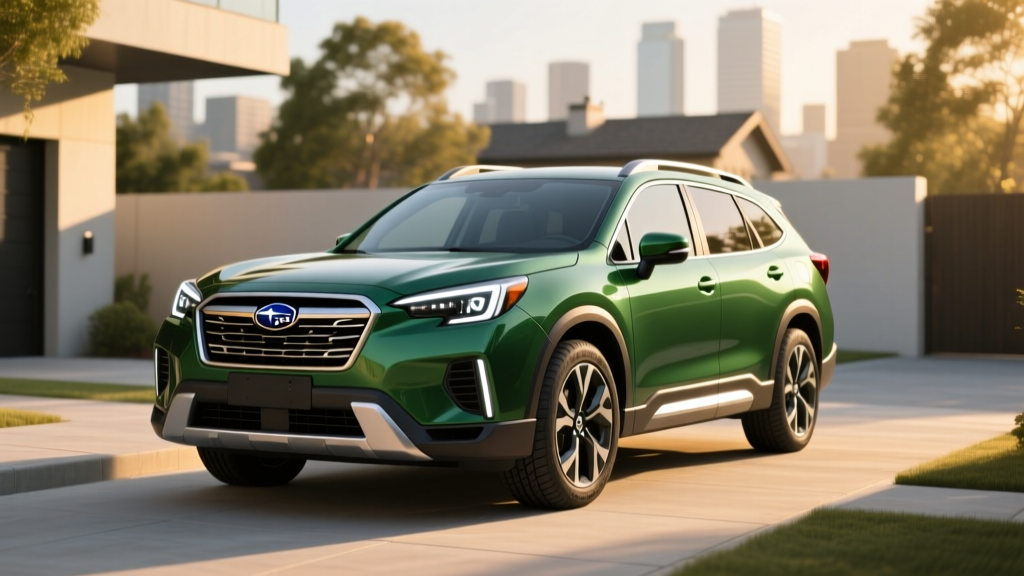
The Subaru Solterra has always been the EV for buyers who want Subaru's signature all-wheel-drive confidence without burning a drop of gas. For 2026, the Solterra returns with meaningful updates — faster DC charging, a slightly larger usable battery, and a revised heat-pump system that helps preserve range in cold climates. But does it stack up against the Hyundai Ioniq 5, Toyota bZ4X, and Ford Mustang Mach-E in a segment that has grown fiercely competitive?
We've driven, charged, and analyzed the 2026 Solterra to bring you every spec that matters — from real-world range to charging-curve behavior, from federal tax credit eligibility to total ownership costs. Here's everything you need to decide whether Subaru's electric SUV belongs in your driveway.
2026 Subaru Solterra Specs at a Glance
| Specification | Value |
|---|---|
| EPA Range (Premium AWD) | 228 miles |
| EPA Range (Touring AWD) | 222 miles |
| Battery Capacity (usable) | 71.4 kWh (NMC lithium-ion) |
| Battery Chemistry | NMC (Nickel Manganese Cobalt) |
| Max DC Fast-Charge Rate | 150 kW (peak) |
| 10–80% DC Fast Charge | ~35 minutes |
| Level 2 Home Charging Rate | 7.2 kW (~25 miles/hour) |
| Drivetrain | Dual-motor Symmetrical AWD |
| Horsepower | 215 hp (combined) |
| Torque | 248 lb-ft |
| 0–60 mph | 6.5 seconds |
| Efficiency (combined) | 104 MPGe / 32 kWh/100 mi |
| Cargo Volume (rear seats up) | 27.7 cu ft |
| Cargo Volume (rear seats folded) | 63.5 cu ft |
| Rear Legroom | 35.7 inches |
| Ground Clearance | 8.3 inches |
| Towing Capacity | 2,000 lbs (with dealer-installed hitch) |
| Battery Warranty | 8 years / 100,000 miles |
| Base MSRP (Premium) | $39,995 |
| As-Tested (Touring) | $47,495 |
Range and Efficiency: EPA Sticker vs. Real-World Driving
The Solterra's efficiency lands at 104 MPGe combined, which translates to about 32 kWh consumed per 100 miles of driving. That's respectable for a dual-motor AWD SUV but trails the single-motor Hyundai Ioniq 5 (117 MPGe) and RWD Tesla Model Y (122 MPGe). Subaru's X-MODE and symmetrical AWD system add weight and drivetrain complexity, and that trade-off shows up in efficiency numbers.
For context, a 228-mile EPA range covers most daily commutes and errands with room to spare, and the average American drives roughly 37 miles per day. However, if you regularly take 300+ mile road trips or live in a region with sparse DC fast-charging infrastructure, the Solterra's range ceiling becomes a planning constraint worth taking seriously.
Charging Speed: DC Fast Charging and Home Level 2
Charging is where the 2026 Solterra shows its most significant improvement over earlier model years. Subaru upgraded the thermal management system and revised the charge curve to sustain higher power longer, reducing 10–80% times from the previous ~55 minutes to approximately 35 minutes.
| Charging Level | Power (kW) | Speed | Typical Use Case |
|---|---|---|---|
| Level 1 (120V household) | 1.2 kW | ~4 miles/hour | Emergency / overnight trickle |
| Level 2 (240V home) | 7.2 kW | ~25 miles/hour | Daily home charging (~9 hrs 10–100%) |
| DC Fast Charge (CCS/NACS) | 150 kW peak | 10–80% in ~35 min | Road trips, public stations |
A few critical nuances about the Solterra's charging behavior:
- Peak vs. sustained kW: The 150 kW figure is a peak, not a sustained rate. In real-world DC fast-charging sessions, the Solterra typically holds 100–130 kW through the 20–60% state of charge window, then tapers to 50–70 kW as it approaches 80%. This is normal charge-curve physics, but it means your average charging power over the 10–80% session is closer to 95–110 kW.
- Preconditioning: The Solterra will precondition the battery for faster DC charging when you navigate to a charging station via the built-in navigation. Always use this feature — a cold battery can cut your charge speed in half.
- Connector: For 2026, Subaru offers the Solterra with a NACS (Tesla-style) charge port, granting access to Tesla Supercharger V3/V4 stations via the expanding Supercharger network partnership. CCS adapter compatibility is also available for Electrify America and other CCS networks.
- Home charging reality: At 7.2 kW on Level 2, a full charge from 10% to 100% takes roughly 9 hours. Most owners will plug in overnight and wake to a full battery every morning — this is the ideal EV ownership pattern.
Compared to the Hyundai Ioniq 5's 800-volt architecture (which enables 10–80% in ~18 minutes at 240+ kW), the Solterra's 400-volt platform and 150 kW peak are a generation behind in raw charging speed. If you road-trip frequently, this gap matters.
Performance and Driving Dynamics
The 2026 Solterra's dual-motor AWD powertrain produces 215 horsepower and 248 lb-ft of torque, sending the SUV from 0–60 mph in approximately 6.5 seconds. That's adequate for highway merging and passing but won't win any stoplight drag races against the 340-hp Ioniq 5 AWD or the 346-hp Mustang Mach-E Premium AWD.
Where the Solterra earns its keep is off-pavement and in adverse conditions. Subaru's X-MODE system provides selectable traction modes for snow, dirt, and deep snow/mud, and the 8.3 inches of ground clearance exceeds most crossover EVs. Grip Control, a low-speed traction management system, helps crawl through slippery terrain. If you ski, camp, or regularly drive unplowed roads, the Solterra's capability set is genuinely differentiated.
Ride quality is compliant and well-damped, with the heavy battery pack mounted low providing a stable center of gravity. Regenerative braking offers adjustable levels via paddle shifters behind the steering wheel, though the Solterra does not offer true one-pedal driving that brings the vehicle to a complete stop — you'll still need the friction brake at low speeds.
Interior, Cargo, and Technology
The Solterra's cabin is functional and durable rather than luxurious. The 12.3-inch touchscreen (standard on Limited and Touring trims) runs Subaru's latest Starlink infotainment with wireless Apple CarPlay and Android Auto. Lower Premium trim receives an 8.0-inch display. Physical buttons and knobs remain for climate control, a welcome choice for drivers who dislike menu-diving while driving.
Cargo space measures 27.7 cubic feet behind the rear seats and 63.5 cubic feet with the 60/40 split rear seats folded. Rear legroom is 35.7 inches — adequate for adults but tighter than the Ioniq 5's 39.4 inches. There is no front trunk (frunk); the space under the hood houses drivetrain components.
Standard driver-assistance features include Subaru's EyeSight suite: adaptive cruise control, lane-keeping assist, pre-collision braking, and lane-departure warning. Importantly, EyeSight is an SAE Level 2 driver-assistance system — it requires the driver to remain fully engaged with hands on the wheel and eyes on the road at all times. Subaru does not currently offer a hands-free driving system comparable to GM's Super Cruise or Ford's BlueCruise.
Pricing, Trims, and Federal Tax Credit Eligibility
| Trim | Base MSRP | Destination | Total Before Incentives |
|---|---|---|---|
| Premium | $39,995 | $1,420 | $41,415 |
| Limited | $43,495 | $1,420 | $44,915 |
| Touring | $46,075 | $1,420 | $47,495 |
Federal Tax Credit (§30D) Eligibility
The 2026 Subaru Solterra's eligibility for the $7,500 federal EV tax credit under IRS §30D depends on several criteria that change based on battery sourcing, buyer income, and MSRP caps. Here is the current eligibility framework:
- MSRP Cap: The Solterra qualifies as an SUV under IRS rules, with an MSRP cap of $80,000. All trims fall well below this threshold.
- Buyer Income Caps: Modified adjusted gross income (MAGI) must not exceed $150,000 (single), $225,000 (head of household), or $300,000 (joint filers).
- Battery Sourcing Requirements: The credit splits into two halves — $3,750 for critical minerals sourcing and $3,750 for battery component manufacturing. Subaru has confirmed that certain 2026 Solterra builds meet the critical minerals requirement, but battery component sourcing compliance varies by production batch. Always verify the specific VIN's eligibility on fueleconomy.gov before purchasing.
- Point-of-Sale Transfer: Under current IRS rules, eligible buyers can transfer the credit to the dealer at the point of sale, reducing the purchase price directly rather than waiting for a tax refund. Consult your tax professional for individual eligibility — rules are subject to change. Source: IRS.gov.
Best-case scenario: a qualifying buyer who takes the full $7,500 credit at point of sale on the Premium trim effectively pays approximately $33,915 — competitive with many gas-powered compact SUVs once fuel savings are factored in.
Warranty and Long-Term Ownership
Subaru provides the following warranty coverage for the 2026 Solterra:
- Basic Vehicle Warranty: 3 years / 36,000 miles
- Powertrain Warranty: 5 years / 60,000 miles
- EV Battery Warranty: 8 years / 100,000 miles (guarantees minimum 70% capacity retention)
The 8-year/100,000-mile battery warranty is industry-standard and matches the federal minimum requirement. Subaru guarantees the high-voltage battery will retain at least 70% of its original capacity during the warranty period. If degradation exceeds that threshold, Subaru will repair or replace the battery at no cost.
NMC battery chemistry in the Solterra is proven but requires care for longevity: avoid routinely charging to 100% on DC fast chargers, try to keep the state of charge between 20–80% for daily use, and use preconditioning in extreme temperatures. Real-world degradation data from 2023–2025 Solterra owners suggests approximately 5–8% capacity loss over the first 60,000 miles — well within the warranty buffer.
Pros and Cons
Pros
- Standard dual-motor AWD on every trim — no FWD base model
- Best-in-class 8.3" ground clearance for light off-road and snow
- X-MODE traction system genuinely useful in adverse conditions
- Improved 35-minute 10–80% DC fast-charge time for 2026
- Physical climate controls and straightforward infotainment
- Strong EyeSight safety suite standard across all trims
- Competitive pricing after potential $7,500 tax credit
Cons
- EPA range (228 mi) trails key competitors by 30–70+ miles
- DC fast-charging speed (150 kW peak) lags Ioniq 5 (240 kW) and Model Y (250 kW)
- No front trunk (frunk) for additional cargo
- Rear legroom (35.7") is tight for the class
- 215 hp feels modest against rivals with 300+ hp
- No hands-free Level 2+ driving system offered
- Towing capacity limited to 2,000 lbs
Who Should Buy the 2026 Subaru Solterra?
Choose the Solterra if: You live in a snow-belt state or mountain region, need AWD year-round, value ground clearance and traction modes for dirt roads or ski trips, and your daily driving stays under 150 miles round-trip. The Solterra is an honest, capable electric SUV for outdoors-oriented buyers who prioritize sure-footedness over maximum range.
Look elsewhere if: You take frequent 300+ mile road trips (the limited range and 150 kW charging will frustrate), need maximum rear-seat space for tall passengers or car seats, want the fastest acceleration in the segment, or require a hands-free highway driving system for long commutes. In those cases, the Hyundai Ioniq 5, Tesla Model Y, or Ford Mustang Mach-E better serve your needs.
Frequently Asked Questions
What is the real-world range of the 2026 Subaru Solterra?
The EPA rates the Solterra Premium at 228 miles and the Touring at 222 miles. In real-world mixed driving, expect 195–210 miles. Sustained highway driving at 70+ mph drops this to 180–195 miles, and cold winter weather (below 32°F) can reduce range by 20–30%, yielding roughly 160–180 miles. Plan road trips around 170-mile segments between chargers to maintain a comfortable buffer.
How fast does the Solterra charge at home and on the road?
At home on a Level 2 (240V, 7.2 kW) charger, the Solterra adds about 25 miles of range per hour — a full overnight charge easily replenishes the battery. On DC fast chargers, it peaks at 150 kW and charges from 10–80% in approximately 35 minutes. This is slower than the Hyundai Ioniq 5 (~18 min) but faster than the outgoing 2023–2025 Solterra (~55 min).
Does the 2026 Subaru Solterra qualify for the $7,500 federal EV tax credit?
Potentially — eligibility depends on your income (MAGI caps apply), the specific VIN's battery sourcing compliance, and point-of-sale transfer rules. All Solterra trims fall under the $80,000 SUV MSRP cap. Verify your vehicle's eligibility at fueleconomy.gov and consult a tax professional before relying on the credit.
Is the Solterra worth buying over the Hyundai Ioniq 5 or Toyota bZ4X?
It depends on your priorities. The Ioniq 5 offers more range (303 mi), faster charging (240 kW), and a more spacious interior — it's the better all-around EV for most buyers. The bZ4X shares the Solterra's platform but offers slightly less standard equipment. The Solterra wins if AWD capability, ground clearance, and off-pavement confidence are non-negotiable for your lifestyle. For a dedicated ski-mobile or mountain commuter, it has no direct rival.
How long will the Solterra's battery last?
Subaru warranties the 71.4 kWh NMC battery for 8 years/100,000 miles with a 70% capacity retention guarantee. Early Solterra owners (2023–2025 models) report 5–8% degradation over the first 60,000 miles. With proper care — avoiding routine 100% charges, using preconditioning, and limiting DC fast-charging frequency — the battery should comfortably last 150,000+ miles before approaching the warranty threshold.
Does the Solterra have a frunk (front trunk)?
No. The Solterra does not have a front trunk. The space under the hood is occupied by the front electric motor, power electronics, and HVAC components. Total cargo space is 27.7 cu ft behind the rear seats and 63.5 cu ft with seats folded.