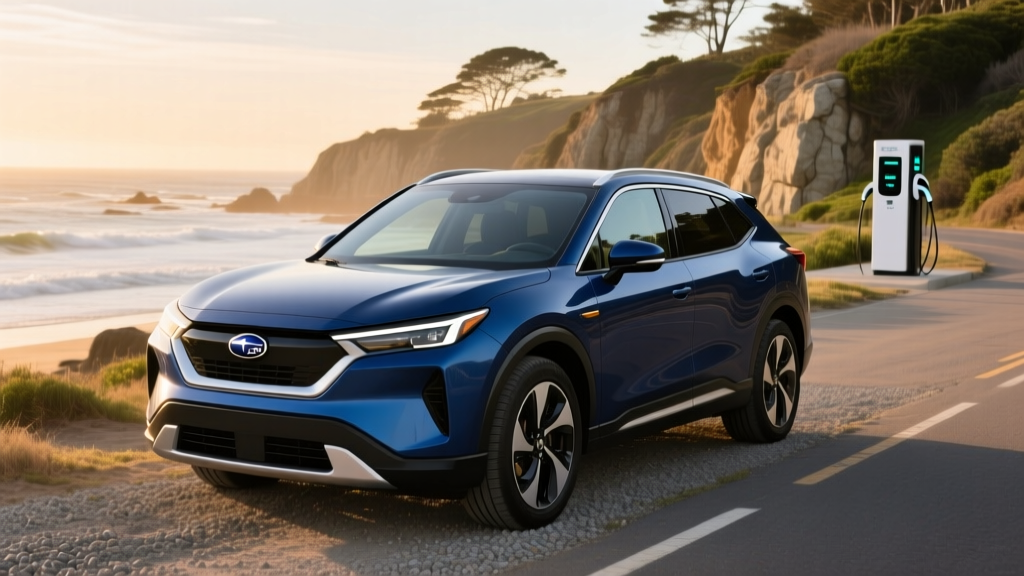
The Subaru Solterra has always been the EV for buyers who want electric propulsion without abandoning the brand's dirt-road, ski-rack DNA. For 2026, Subaru has addressed the two loudest complaints from early adopters—sluggish DC fast charging and mediocre highway range—with a larger battery pack and a meaningfully improved charge curve. The result is a compact electric SUV that finally feels competitive in a segment dominated by the Hyundai Ioniq 5, Kia EV6, and Volkswagen ID.4.
But does the 2026 Solterra car do enough to justify its price and win over shoppers who don't already have a Subaru sticker on their laptop? We spent time with the updated model, cross-referenced EPA data, and mapped real-world charging behavior to give you the numbers that actually matter.
2026 Solterra at a Glance: Core Specs
| Specification | 2026 Subaru Solterra (AWD) |
|---|---|
| EPA Range | 228 miles (Touring); up to 245 mi (Base/Premium w/ smaller wheels) |
| Battery Capacity | 81.6 kWh usable (NMC lithium-ion) |
| Drivetrain | Dual-motor AWD (standard on all trims) |
| Horsepower / Torque | 215 hp / 249 lb-ft |
| 0–60 mph | 6.5 seconds |
| Max DC Fast Charge | 150 kW (peak) |
| 10–80% DC Charge Time | ~35 minutes |
| Level 2 Home Charge Rate | 11.5 kW (~37 miles per hour) |
| EPA Efficiency | 104 MPGe combined (228-mi trim); 111 MPGe (245-mi trim) |
| Cargo Volume | 23.8 cu ft (rear seats up) / 63.5 cu ft (rear seats folded) |
| Base MSRP | $38,995 (Base) — $46,495 (Touring) |
| Battery Warranty | 8 years / 100,000 miles |
Range: What the EPA Sticker Doesn't Tell You
Subaru quotes an EPA-estimated 228 miles for the Touring trim on 20-inch wheels and up to 245 miles for the Base and Premium trims equipped with 18-inch wheels. The larger 81.6 kWh NMC battery (up from 71.4 kWh in the 2023–2024 models) is the main driver of this improvement.
EPA 228–245 miles is the mixed-cycle sticker number. Expect approximately 195–215 miles on sustained highway driving at 70–75 mph, where aerodynamic drag punishes the Solterra's boxy SUV profile. In freezing temperatures (below 32°F), plan for a 20–30% reduction, dropping effective range to roughly 160–185 miles on the highway. City driving with regenerative braking recaptures energy more effectively, often meeting or slightly exceeding the EPA figure in mild weather.
The Solterra's standard heat pump—a feature some competitors still charge extra for—helps mitigate cold-weather losses by efficiently warming the cabin without draining the traction battery as aggressively as resistive heating. That said, the boxy shape and 4,365-pound curb weight work against efficiency at highway speeds. For comparison, the Hyundai Ioniq 5 AWD with a similarly sized battery achieves up to 290 miles EPA thanks to its more aerodynamic profile and slightly higher energy density packaging.
Charging Speed: Improved but Not Class-Leading
The 2026 Solterra's DC fast-charging upgrade is the headline fix. Earlier models peaked around 100 kW and tapered aggressively, earning criticism on road trips. The 2026 model now accepts up to 150 kW at a DC fast charger, and the charge curve holds more steadily through the mid-state-of-charge window.
| Charging Level | Power / Rate | Speed (Approx.) |
|---|---|---|
| Level 1 (120V household) | 1.4 kW | ~5 miles per hour |
| Level 2 (240V home / public) | 11.5 kW | ~37 miles per hour; full charge in ~7.5 hours |
| DC Fast Charge (CCS) | 150 kW peak | 10–80% in ~35 minutes; 20–80% in ~28 minutes |
A few ownership realities worth noting: The 150 kW peak is just that—a peak. The Solterra's charge curve begins tapering noticeably past 60% state of charge (SoC), and by 80% you're pulling closer to 50–60 kW. This is standard lithium-ion behavior to protect cell longevity, but it means a 10–90% session will take closer to 50 minutes. If you regularly road-trip, plan your stops around the 20–80% sweet spot where charging is fastest.
The Solterra uses the CCS1 connector standard. Subaru has confirmed that NACS (Tesla Supercharger) compatibility arrives via a factory adapter for 2026 models, and the 2027 model year will transition to a native NACS port. For now, you can access Tesla's Supercharger network using the included adapter, which significantly expands route flexibility on long trips.
At home on a Level 2 charger (11.5 kW onboard charger), the Solterra replenishes from empty to full overnight in about 7.5 hours—solid for daily use. Most owners will plug in each evening and wake up with a full battery, making the DC fast-charge rate relevant primarily for road trips.
Performance and Driving Dynamics
Every 2026 Solterra comes with dual electric motors and Subaru's Symmetrical All-Wheel Drive. The combined output is 215 horsepower and 249 lb-ft of torque, sent to all four wheels. The 0–60 mph sprint takes 6.5 seconds—adequate for merging and passing but noticeably behind the Ioniq 5 AWD (5.2 seconds) and EV6 GT-Line AWD (5.1 seconds).
Where the Solterra earns its keep is off-pavement. With 8.3 inches of ground clearance—best in the compact electric SUV segment—and Subaru's X-MODE traction management system with Grip Control, this is genuinely the EV you want if your weekends involve forest service roads, snow-covered driveways, or trailhead parking lots. No competitor in this class matches its rough-surface capability.
Ride quality is composed and slightly firm, tuned more for confidence than plushness. Steering feel is direct if not particularly communicative, and the turning radius of 18.7 feet makes it manageable in tight urban environments. One-pedal driving is available via steering-wheel paddle selectors that adjust regen intensity, though it doesn't quite bring the car to a complete stop—the friction brakes engage below about 3 mph.
Interior, Cargo, and Technology
The cabin uses durable, hardwearing materials rather than luxury surfaces—consistent with Subaru's outdoorsy brand positioning. A 12.3-inch touchscreen (14-inch on Touring) anchors the dash, running Subaru's latest Starlink infotainment system with wireless Apple CarPlay and Android Auto. Physical climate control knobs remain, which is a practical win for gloved hands in winter.
Passenger and cargo dimensions:
- Front legroom: 42.1 inches
- Rear legroom: 35.7 inches (competitive but not class-leading)
- Cargo behind rear seats: 23.8 cu ft
- Cargo with rear seats folded: 63.5 cu ft
- No front trunk (frunk) — the space houses power electronics
Standard driver-assistance features are comprehensive under the EyeSight umbrella: adaptive cruise control with lane centering, lane-keep assist, automatic emergency braking, and blind-spot monitoring. This is an SAE Level 2 driver-assist system—meaning you must keep your hands on the wheel and eyes on the road at all times. It is not autonomous driving.
Notable tech drawbacks: The infotainment system, while improved, still lags behind Hyundai/Kia's interface in responsiveness and menu logic. There's no native route planner that integrates charging stops automatically (a feature Tesla and GM's Ultifi platform include), so road-trip route planning requires third-party apps like A Better Routeplanner.
Pricing, Trims, and Federal Tax Credit Eligibility
| Trim | MSRP | Est. Price After §30D Credit* |
|---|---|---|
| Base | $38,995 | $31,495 |
| Premium | $41,995 | $34,495 |
| Limited | $44,495 | $36,995 |
| Touring | $46,495 | $38,995 |
*Federal tax credit estimates assume full eligibility. Actual credit varies.
The 2026 Solterra's pricing puts it squarely in the mainstream compact EV SUV segment. All trims fall under the $80,000 MSRP cap for SUVs under IRS §30D rules, making them potentially eligible for the full $7,500 federal EV tax credit.
- MSRP cap: Vehicle base price must be ≤ $80,000 for SUVs (Solterra qualifies on all trims)
- Buyer income cap: Modified AGI ≤ $150,000 (single), $225,000 (head of household), $300,000 (joint)
- Battery sourcing: Must meet critical minerals and battery component requirements (phased thresholds increase annually — verify current-year compliance on IRS.gov)
- Point-of-sale transfer: Eligible buyers can transfer the credit to the dealer at purchase, reducing the out-of-pocket price immediately
- Final assembly: Must be assembled in North America (Solterra is assembled in Japan — this may affect eligibility)
Critical caveat: The Solterra is manufactured at Toyota's Motomachi plant in Japan. Under §30D, the vehicle must undergo final assembly in North America to qualify for the federal credit. Subaru has indicated that production adjustments or trade-agreement interpretations may allow eligibility, but buyers should verify the VIN on the IRS clean vehicle credit lookup tool before relying on the $7,500 credit. If the Solterra does not qualify for §30D, it may still be eligible for lease incentives, as the commercial clean vehicle credit (§45W) has different assembly rules that lessors can leverage.
Efficiency and Ownership Costs
The EPA rates the 2026 Solterra at 104 MPGe combined (228-mile Touring trim) and 111 MPGe combined (245-mile Base trim). In energy terms, that translates to roughly 32–34 kWh per 100 miles. This is below the efficiency of the Ioniq 5 AWD (113 MPGe, ~30 kWh/100 mi) and the Tesla Model Y Long Range (122 MPGe, ~28 kWh/100 mi), largely due to the Solterra's weight and less aerodynamic shape.
At a national average electricity rate of $0.17/kWh, charging the Solterra at home costs roughly $5.50–$5.80 per 100 miles. DC fast charging on Electrify America or EVgo at $0.40–$0.48/kWh pushes that to $12.80–$16.30 per 100 miles—still below the cost of gasoline at $3.50/gallon in a 25 MPG compact SUV (~$14.00/100 mi), but the gap narrows significantly when relying exclusively on public fast charging.
The battery and powertrain carry Subaru's 8-year/100,000-mile warranty, with coverage against capacity loss below 70% of original state of health (SoH). This is standard for the segment and matches Hyundai, Kia, and Volkswagen. Subaru's NMC cell supplier provides cells with demonstrated long-term cycle stability, and the liquid-cooled thermal management system helps preserve battery health across temperature extremes.
How the Solterra Stacks Up Against Key Rivals
| Spec | 2026 Subaru Solterra | 2026 Hyundai Ioniq 5 AWD | 2026 VW ID.4 AWD |
|---|---|---|---|
| EPA Range | 228–245 mi | 260–290 mi | 245–275 mi |
| Battery (usable) | 81.6 kWh | 77.4 kWh | 82.0 kWh |
| DC Fast Charge (peak) | 150 kW | 240 kW | 175 kW |
| 10–80% Time | ~35 min | ~18 min | ~29 min |
| 0–60 mph | 6.5 sec | 5.2 sec | 5.7 sec |
| Ground Clearance | 8.3 in | 6.1 in | 6.7 in |
| Base MSRP | $38,995 | $45,500 | $41,995 |
The Solterra trades range and charging speed for off-road capability, standard AWD across all trims, and a lower entry price. If your priorities are road-trip charging speed and maximum range, the Ioniq 5 wins decisively. If you need genuine rough-road capability, deep snow traction, and a lower starting price, the Solterra has no direct electric rival.
Pros, Cons, and Who Should Buy the Solterra
- Class-leading 8.3 inches of ground clearance and genuine AWD capability
- Standard heat pump (not an extra-cost option)
- Improved battery capacity (81.6 kWh) and range over prior model years
- Comprehensive EyeSight safety suite standard on all trims
- Lower base price than most AWD electric SUV competitors
- Physical climate controls — practical in cold weather
- NACS adapter included for Tesla Supercharger access
- DC fast charging (150 kW peak) lags behind Ioniq 5 (240 kW) and EV6 (240 kW)
- Real-world highway range falls short of EPA sticker by ~15%
- No front trunk (frunk)
- Infotainment interface less intuitive than Korean competitors
- Final assembly in Japan creates §30D tax credit uncertainty
- 215 hp feels modest for the vehicle's 4,365-lb weight
- No native route planner with integrated charging stops
- Choose the Solterra if: You live in a region with snow, dirt roads, or rough terrain; you value standard AWD and high ground clearance; your daily commute is under 80 miles round-trip with home charging; you want a lower entry price for an AWD electric SUV.
- Look elsewhere if: You take frequent 300+ mile road trips and need the fastest possible DC charging (Ioniq 5/EV6); you need maximum cargo space (ID.4 offers more); you require guaranteed §30D tax credit eligibility and cannot risk the Japan-assembly question; you prioritize acceleration and driving dynamics over off-road capability.
Frequently Asked Questions
What is the real-world range of the 2026 Subaru Solterra?
The EPA rates the Solterra at 228–245 miles depending on trim and wheel size. In real-world highway driving at 70–75 mph, expect approximately 195–215 miles. In freezing temperatures, range can drop to 160–185 miles on the highway. City driving with regenerative braking in mild weather may meet or slightly exceed the EPA figure.
How fast does the Solterra charge at home and on DC fast chargers?
On a Level 2 home charger (11.5 kW), the Solterra adds roughly 37 miles of range per hour and charges fully in about 7.5 hours. On a DC fast charger, it peaks at 150 kW and charges from 10–80% in approximately 35 minutes. The charge curve tapers significantly past 80% SoC.
Does the 2026 Solterra qualify for the $7,500 federal EV tax credit?
Eligibility is uncertain due to the Solterra's Japanese final assembly, which conflicts with §30D's North American assembly requirement. All trims fall under the $80,000 MSRP cap for SUVs. Buyers must verify VIN eligibility on the IRS clean vehicle lookup tool and meet income thresholds ($150K single / $300K joint). Leasing may provide an alternative path to incentives via the §45W commercial credit.
Is the Solterra worth buying over the Hyundai Ioniq 5 or VW ID.4?
If off-road capability, snow traction, and ground clearance are priorities, the Solterra has no electric rival. If range, charging speed, and interior tech matter more, the Ioniq 5 is the stronger all-around EV. The ID.4 offers more cargo space and a comfortable ride but less ground clearance and slower acceleration.
Does the Solterra have a frunk (front trunk)?
No. The space under the front hood houses power electronics and the onboard charger. All cargo must go in the rear cargo area (23.8 cu ft behind the rear seats, 63.5 cu ft with seats folded).
What battery chemistry does the Solterra use, and how long will it last?
The Solterra uses NMC (nickel manganese cobalt) lithium-ion cells with liquid-cooled thermal management. Subaru warrants the battery for 8 years or 100,000 miles against capacity loss below 70% state of health. Based on industry degradation data for liquid-cooled NMC packs, expect approximately 10–15% capacity loss over the first 100,000 miles under normal use.
Can the Solterra tow?
Subaru does not rate the 2026 Solterra for towing. Unlike the Rivian R1S or Ford Mustang Mach-E (which offer 3,000–3,500 lb ratings), the Solterra is not designed for trailer use. Roof rails support crossbars for cargo boxes and bike racks, consistent with Subaru's adventure-oriented positioning.