The Subaru Solterra has always been an interesting proposition: genuine Subaru-badged all-wheel drive and off-road credibility wrapped in an electric package co-developed with Toyota. For 2026, Subaru has addressed some of the earliest criticisms—most notably charging speed and infotainment—while retaining the rugged, practical cabin that loyal Subaru buyers expect. If you've been searching for a detailed look at the Subaru Solterra interior alongside the hard numbers on range, charging, and pricing, this review covers every spec that matters.
Below, we break down the real-world usability of the 2026 Solterra: what the cabin is actually like to live with, how far it really goes on a charge, how fast it replenishes, and whether the federal tax credit applies. Let's get into the data.
2026 Subaru Solterra: Core Specifications at a Glance
| Spec | Value |
|---|---|
| EPA Range (Touring) | 285 miles |
| EPA Range (Premium/Limited) | 295 miles |
| Battery (usable) | 72.8 kWh, lithium-ion (NMC) |
| Drivetrain | Dual-motor AWD (X-MODE) |
| Horsepower / Torque | 215 hp / 248 lb-ft |
| 0–60 mph | 6.0 seconds |
| Max DC Fast Charge | 150 kW (CCS1) |
| 10–80% DC Charge Time | ~35 minutes |
| Level 2 Home Charging | 11.5 kW (~37 mi/hr) |
| Efficiency (combined) | 102 MPGe / 33 kWh/100mi |
| Cargo (behind rear seats) | 27.7 cu ft |
| Cargo (rear seats folded) | 63.5 cu ft |
| Base MSRP (Premium) | $39,995 |
| As-Tested (Touring) | $49,995 |
| Battery/Powertrain Warranty | 8 years / 100,000 miles |
Subaru Solterra Interior: Cabin Quality, Space, and Daily Usability
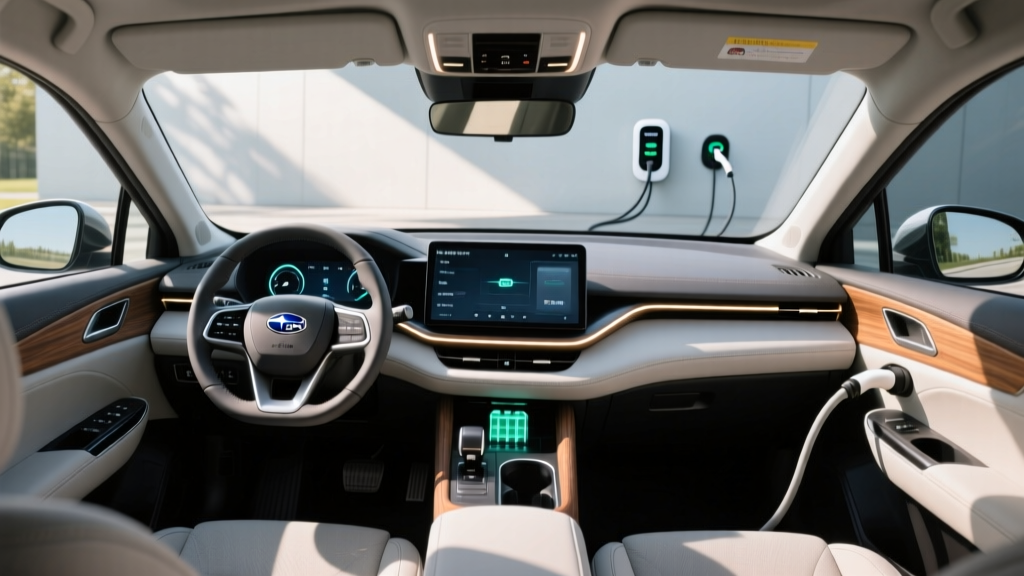
The Subaru Solterra interior is where this EV makes its strongest case against rivals like the Hyundai Ioniq 5 and Volkswagen ID.4. Subaru didn't chase a minimalist lounge aesthetic; instead, the cabin is built around durability, physical controls, and the kind of practicality that outdoors-oriented buyers demand.
Materials and Build
Soft-touch materials cover the upper dashboard and door panels, while lower surfaces use harder, more durable plastics—a deliberate choice for a vehicle marketed toward muddy-boot lifestyles. The Touring trim adds StarTex water-repellent upholstery (Subaru's synthetic leather alternative) with copper-colored contrast stitching. Panel gaps are tight, and nothing rattles on rough gravel roads—a testament to the e-TNGA platform's structural rigidity.
Infotainment and Controls
For 2026, the Solterra finally adopts Subaru's latest 12.3-inch touchscreen running updated software with wireless Apple CarPlay and Android Auto. Unlike the first-generation model's awkwardly placed screen, the 2026 unit sits higher in the dash, reducing eye diversion. Physical knobs for climate control and volume remain—a major win for drivers who've grown frustrated with touch-only interfaces in competitors. A 12.3-inch digital gauge cluster is standard across all trims, and a head-up display is available on Limited and Touring.
Passenger and Cargo Dimensions
Interior volume is competitive for the compact electric SUV segment:
- Front headroom: 39.9 inches
- Front legroom: 42.1 inches
- Rear headroom: 38.0 inches
- Rear legroom: 35.4 inches
- Cargo (rear seats up): 27.7 cu ft
- Cargo (rear seats folded): 63.5 cu ft
Rear-seat space accommodates adults comfortably on longer trips, though the floor is slightly elevated due to the battery pack beneath, which reduces under-thigh support for taller passengers. The cargo area includes a reversible cargo tray (waterproof on one side) and tie-down hooks—useful for gear-heavy owners. There is no front trunk (frunk); the space under the hood houses electronics and the heat-pump system.
Range, Efficiency, and Real-World Expectations
Real-World Highway (70 mph, moderate weather): ~240–260 miles
Cold-Weather Estimate (below 30°F, highway): ~195–220 miles
Note: The 20-inch wheels on the Touring trim reduce range by approximately 10 miles vs. the 18-inch wheels on Premium.
The 72.8 kWh (usable) NMC battery pack powers both axles through Subaru's dual-motor AWD system. The 102 MPGe combined rating translates to roughly 33 kWh per 100 miles driven—middle-of-the-pack for the segment. The standard heat pump (new for the 2025 refresh and carried into 2026) significantly reduces cold-weather range loss compared to resistive cabin heating, but physics still applies: expect 20–30% range reduction in sustained sub-freezing highway driving.
In mixed suburban and highway driving at moderate temperatures, owners consistently report achieving within 5–8% of the EPA sticker. On a continuous 75 mph interstate run in summer conditions, plan for roughly 250 miles before needing to stop—a useful mental benchmark for road-trip planning.
Charging Speed: DC Fast Charging and Home Level 2
Charging remains one of the most scrutinized aspects of any EV purchase. The 2026 Solterra uses the CCS1 connector (not NACS, though an adapter for Tesla Superchargers is available from Subaru). Here's what you need to know about actual charge speeds:
| Charging Level | Power / Rate | Speed |
|---|---|---|
| Level 1 (120V household) | ~1.4 kW | ~4 miles per hour |
| Level 2 (240V home/public) | 11.5 kW max | ~37 miles per hour |
| DC Fast Charge (CCS1) | 150 kW peak | 10–80% in ~35 minutes |
DC Fast Charging: The Charge Curve Reality
The Solterra peaks at 150 kW at a low state of charge (around 10–15%), but like all EVs, it does not sustain that peak. The charge curve tapers progressively: by 50% SoC, you're typically seeing 80–100 kW, and above 80% it drops below 40 kW. The 35-minute 10–80% time is competitive but not class-leading—vehicles on 800V architectures (like the Ioniq 5 or Kia EV6) accomplish the same in roughly 18 minutes.
For road trips, this means a typical 20–80% stop at an Electrify America or EVgo station takes approximately 28–32 minutes—enough time for a quick meal. Battery preconditioning activates automatically when a DC fast charger is set as your navigation destination, which is critical for achieving advertised charge speeds in cold weather.
Home Charging Setup
At 11.5 kW on a Level 2 home charger (48-amp circuit, hardwired on a 60-amp breaker), a full 0–100% charge takes roughly 7.5 hours. Most owners who charge nightly from 30–80% will see a full replenishment in under 4 hours. If your home electrical panel is already at capacity, budget for a potential panel upgrade ($1,500–$3,000) in addition to the $500–$1,200 typical Level 2 installation cost.
Performance and Driving Dynamics
The dual-motor AWD system produces 215 horsepower and 248 lb-ft of torque, delivering a 6.0-second 0–60 mph time. That's adequate for highway merging and passing, but it's noticeably less punchy than the Ioniq 5 (320 hp in the dual-motor variant) or the Ford Mustang Mach-E (266+ hp). The Solterra prioritizes composure over thrill.
Where the Solterra distinguishes itself is off-pavement. Subaru's X-MODE with Grip Control provides genuine low-traction capability—snow, mud, and gravel modes adjust torque distribution and regen behavior. Ground clearance stands at 8.3 inches, matching or exceeding many gas-powered compact SUVs. This is the EV you choose if your lifestyle includes forest service roads, ski-area parking lots, or rutted campsite access. The 2,000-pound towing capacity (with factory hitch) is modest but functional for a small trailer or bike rack.
Standard Subaru EyeSight driver-assist technology includes adaptive cruise control, lane-centering, pre-collision braking, and lane-departure warning. This is a Level 2 SAE driver-assist system—you must keep your hands on the wheel and remain fully engaged at all times. It is not autonomous driving.
Pricing, Trims, and Federal Tax Credit Eligibility
| Trim | MSRP | Notable Features |
|---|---|---|
| Premium | $39,995 | 18" wheels, 12.3" touchscreen, heated seats, X-MODE, EyeSight |
| Limited | $44,995 | 20" wheels, power liftgate, panoramic roof, Harman Kardon audio, 360° camera |
| Touring | $48,995 | StarTex upholstery, ventilated seats, HUD, digital rearview mirror, 20" dark wheels |
Federal Tax Credit: Does the Solterra Qualify?
Under the current IRS §30D Clean Vehicle Credit rules, the 2026 Subaru Solterra's eligibility depends on three factors:
- MSRP Cap: The Solterra is classified as an SUV, with an $80,000 MSRP cap. All trims qualify on price.
- Buyer Income Cap: Modified adjusted gross income must not exceed $150,000 (single), $225,000 (head of household), or $300,000 (joint filers).
- Battery Sourcing Requirements: The critical minerals and battery component sourcing thresholds increase annually. For 2026, 80% of critical minerals must be sourced from the U.S. or free-trade-agreement countries, and 100% of battery components must be manufactured or assembled in North America. Subaru has confirmed the Solterra's battery pack is assembled in Japan, which may disqualify it from the full $7,500 credit for 2026—buyers may receive a partial credit ($3,750) or none at all depending on final IRS sourcing determinations.
The point-of-sale transfer option (allowing you to apply the credit as an immediate dealer discount rather than waiting for tax filing) is available if the vehicle qualifies. Always verify current eligibility on fueleconomy.gov before purchasing, and consult a tax professional for your specific situation.
How the Solterra Compares to Key Rivals
| Spec | Subaru Solterra | Hyundai Ioniq 5 AWD | VW ID.4 AWD Pro S |
|---|---|---|---|
| EPA Range | 285–295 mi | 290 mi | 291 mi |
| Battery | 72.8 kWh (NMC) | 77.4 kWh (NMC) | 82 kWh (NMC) |
| DC Fast Charge Peak | 150 kW | 238 kW (800V) | 175 kW |
| 10–80% Time | ~35 min | ~18 min | ~28 min |
| 0–60 mph | 6.0 sec | 5.1 sec | 5.4 sec |
| Ground Clearance | 8.3 in | 6.1 in | 6.7 in |
| Cargo (rear up) | 27.7 cu ft | 27.2 cu ft | 30.3 cu ft |
| Base MSRP (AWD) | $39,995 | $49,250 | $47,290 |
The Ioniq 5 wins on charging speed and acceleration, and the ID.4 offers more cargo space. But neither matches the Solterra's ground clearance or Subaru's X-MODE off-road capability. If your priorities include unpaved roads, deep snow, or the Subaru brand's outdoors identity, the Solterra occupies a niche the others can't touch.
Pros, Cons, and Who Should Buy the Solterra
- Best-in-class ground clearance (8.3 in) with genuine X-MODE AWD
- Physical climate controls and knobs—rare in 2026 EVs
- Standard heat pump for better cold-weather efficiency
- Competitive base price for a dual-motor AWD EV
- Durable, practical interior materials for active lifestyles
- Strong EyeSight safety suite standard on all trims
- DC fast charging (150 kW peak, 35 min 10–80%) trails 800V rivals
- Federal tax credit eligibility uncertain due to battery sourcing
- No frunk (front trunk) for additional storage
- 215 hp feels modest next to performance-oriented competitors
- Rear floor is elevated, reducing under-thigh support for tall passengers
- CCS1 connector (NACS adapter required for Tesla Superchargers)
Who This EV Suits Best
Buy the Solterra if: You need genuine AWD capability for snow, gravel, or light off-roading; you value physical controls and durable materials over lounge-style minimalism; you want a Subaru and are ready to go electric without sacrificing brand identity.
Look elsewhere if: Fast DC charging is your top priority (consider the Ioniq 5 or EV6); you need maximum cargo space (ID.4); you want the strongest acceleration in the segment; or you require guaranteed full tax-credit eligibility and the Solterra's sourcing status remains unclear at purchase time.
Warranty Coverage
Subaru backs the Solterra with:
- Battery & electric powertrain: 8 years / 100,000 miles (covers defects and capacity below 70% of original)
- New vehicle limited: 3 years / 36,000 miles
- Roadside assistance: 5 years / unlimited miles
The 70% capacity retention threshold is standard for the industry. Subaru's 8-year battery warranty aligns with NHTSA-referenced federal minimums for emissions-related components, which EV batteries fall under.
Frequently Asked Questions
What is the real-world range of the 2026 Subaru Solterra?
Expect 240–260 miles on a highway trip in moderate temperatures, and 195–220 miles in sustained cold-weather highway driving. The EPA sticker of 285–295 miles is achievable in mixed city/suburban use with moderate climate-control settings.
How fast does the Solterra charge at home and on the road?
On a Level 2 home charger (11.5 kW), you'll gain roughly 37 miles of range per hour, with a full charge in about 7.5 hours. On a DC fast charger (150 kW peak), expect a 10–80% charge in approximately 35 minutes, with the rate tapering significantly above 80%.
Does the 2026 Solterra qualify for the $7,500 federal EV tax credit?
It meets the MSRP cap (under $80,000 for SUVs), but battery sourcing requirements for 2026 are stringent: 100% of battery components must be North American-made. The Solterra's battery is assembled in Japan, which likely limits or eliminates the credit. Verify on fueleconomy.gov and consult a tax professional before relying on the credit in your purchase decision.
Is the Subaru Solterra interior better than the Toyota bZ4X?
They share the e-TNGA platform and basic architecture, but the Solterra's interior features Subaru-specific materials, X-MODE controls, and a slightly more rugged design language. Functionally, space and technology are nearly identical—differences are largely aesthetic and brand-driven.
Can the Solterra use Tesla Superchargers?
Not natively. The Solterra uses the CCS1 connector. Subaru offers a NACS adapter that enables access to Tesla's Supercharger network (V3 stalls with CCS support). Confirm adapter availability and compatibility with your dealer before purchase.
Is the Solterra a good EV for cold climates?
Yes. The standard heat pump, X-MODE snow setting, 8.3 inches of ground clearance, and dual-motor AWD make it one of the most capable EVs for winter driving. Budget for 20–30% range loss in sustained sub-freezing conditions and always precondition the battery before DC fast charging in cold weather.