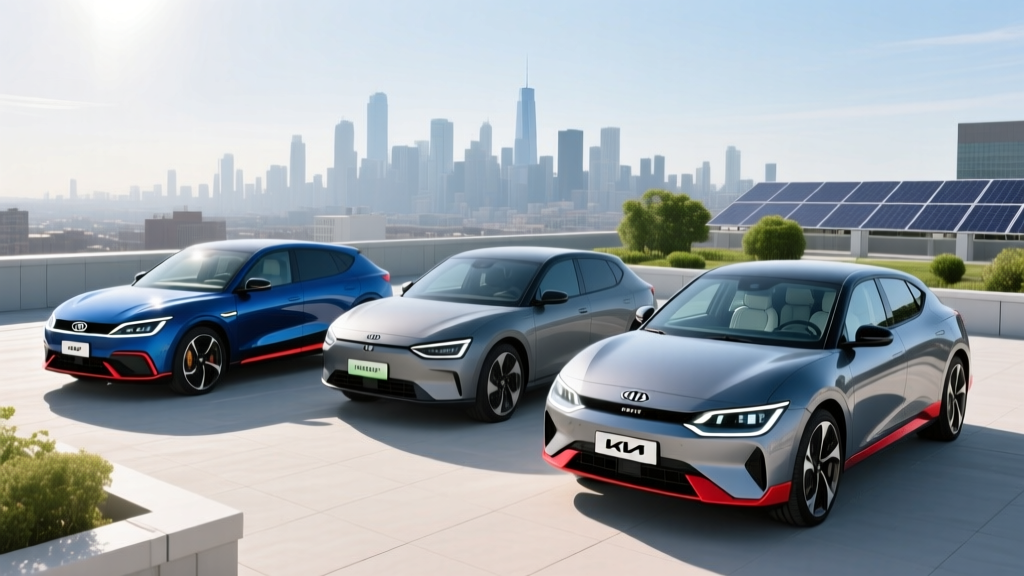
Kia's Electric Lineup at a Glance
Kia currently sells three fully electric vehicles in the U.S.: the EV6 (crossover, EPA 232–310 mi, from ~$42,900), the EV9 (three-row SUV, EPA 230–304 mi, from ~$54,900), and the Niro EV (compact crossover, EPA 239 mi, from ~$39,600). All three use Kia's 800V-capable architecture (EV6/EV9) or a 400V system (Niro EV), and all carry Kia's 10-year/100,000-mile battery warranty. Federal §30D tax credit eligibility varies by model, battery sourcing, and buyer income — check the IRS qualified list before assuming a flat $7,500 discount.
2026 Kia EV Specs: Side-by-Side Comparison
Numbers matter when you're spending $40K–$70K. Here's how Kia's three battery-electric models stack up on the metrics that affect daily ownership.
| Spec | 2026 Niro EV | 2026 EV6 | 2026 EV9 |
|---|---|---|---|
| Body Style | Compact CUV | Midsize Crossover | 3-Row SUV |
| EPA Range | 239 mi | 232–310 mi | 230–304 mi |
| Battery (usable) | 64.8 kWh (NMC) | 58–77.4 kWh (NMC) | 76.1–100 kWh (NMC) |
| Max DC Fast Charge | ~85 kW (400V) | 239 kW (800V) | 210 kW (800V) |
| 10–80% DCFC Time | ~43 min | ~18 min | ~24 min |
| Level 2 Rate | 7.2 kW | 10.9 kW | 10.9 kW |
| 0–60 mph | 7.2 sec | 3.4–7.2 sec | 5.0–8.2 sec |
| Horsepower | 201 hp | 167–576 hp | 215–379 hp |
| Starting MSRP | ~$39,600 | ~$42,900 | ~$54,900 |
| Battery Warranty | 10 yr / 100,000 mi | 10 yr / 100,000 mi | 10 yr / 100,000 mi |
Real-World Range Reality: EPA numbers assume mixed driving at moderate temperatures. On sustained highway trips at 70–75 mph, expect the EV6 Wind AWD (EPA 282 mi) to deliver roughly 235–255 miles before you'll want to plug in. In freezing weather (below 25°F), all three models will lose 20–30% of rated range unless preconditioned and garage-kept. The EV9's boxy shape hits highway efficiency especially hard — plan for ~200–220 real miles on a road trip in the Land AWD trim.
Charging Speed: Where Kia's 800V Architecture Pays Off
The single biggest technical difference between Kia's lineup is the charging architecture. The EV6 and EV9 use an 800-volt electrical system, which lets them accept dramatically higher DC fast-charge rates than most competitors still on 400V platforms. The Niro EV uses a conventional 400V setup.
| Charging Level | Power | Niro EV (mi/hr) | EV6 (mi/hr) | EV9 (mi/hr) |
|---|---|---|---|---|
| Level 1 (120V) | ~1.4 kW | ~4 | ~4 | ~3 |
| Level 2 (240V) | 7.2–10.9 kW | ~23 | ~35 | ~30 |
| DC Fast | 85–239 kW | ~140 (peak) | ~650 (peak) | ~500 (peak) |
Understanding kW vs kWh: kW (kilowatts) measures charging power — how fast energy flows into the battery. kWh (kilowatt-hours) measures battery capacity — how much energy the battery stores. A 239 kW peak charge rate doesn't mean you get 239 kWh in an hour; it means the EV6 can accept energy at that rate briefly, tapering as the battery fills. The 10–80% time is the practical metric: the EV6 hits it in roughly 18 minutes on a 350 kW charger, while the Niro EV takes about 43 minutes on a 100+ kW station.
Charging curve reality: The EV6 peaks at 239 kW only between roughly 10–55% State of Charge (SoC). Above 80%, the rate drops to under 50 kW to protect the battery. If you're road-tripping, plan stops around 15–20% SoC and unplug at 80% — the last 20% takes nearly as long as the first 60%.
EV vs Gas vs Hybrid: What Does Ownership Actually Cost?
Kia sells the Niro in EV, hybrid (HEV), and plug-in hybrid (PHEV) forms. The EV6 and EV9 are electric-only. Here's a five-year cost snapshot comparing the Niro EV against the Niro HEV and a typical compact gas CUV to ground the economics.
| 5-Year Cost Factor | Niro EV | Niro HEV | Gas Compact CUV (avg) |
|---|---|---|---|
| Purchase Price (MSRP) | $39,600 | $26,940 | $28,500 |
| Est. Federal Tax Credit | $0–$7,500* | $0 | $0 |
| Fuel/Energy (5 yr / 75K mi) | $3,200–$4,800 | $5,400 | $8,100 |
| Maintenance (5 yr) | $1,800 | $3,600 | $4,200 |
| Insurance (5 yr est.) | $9,500 | $7,800 | $7,500 |
| Est. 5-Year Total | $46,100–$54,100 | $43,740 | $48,300 |
*§30D credit eligibility depends on battery critical-mineral sourcing, buyer AGI, and MSRP caps. Verify at irs.gov and the DOE qualified vehicle list before purchasing.
Key takeaways: EVs save substantially on fuel and maintenance (no oil changes, fewer brake replacements thanks to regen braking), but insurance premiums run 15–25% higher on average. The Niro EV's upfront premium over the HEV is roughly $12,600, partially offset if the full §30D credit applies. If you charge at home on a cheap utility rate ($0.12/kWh), fueling costs drop to ~$3,200 over five years. Relying solely on public DC fast charging ($0.35–$0.48/kWh) pushes that closer to $4,800 — still below gas, but the gap narrows.
Federal Tax Credit: What Actually Qualifies in 2026?
The §30D Clean Vehicle Credit offers up to $7,500, split into two halves: $3,750 for meeting critical-minerals sourcing requirements and $3,750 for battery-component manufacturing requirements. As of 2026, vehicles with any battery components from a "foreign entity of concern" (FEOC) are disqualified from the component half, and critical-mineral rules tighten annually.
- MSRP cap: SUVs (EV6, EV9, Niro EV) must be under $80,000 — all Kia EVs qualify on price.
- Buyer income cap: AGI must not exceed $150K (single), $225K (head of household), or $300K (joint).
- Battery sourcing: Check the DOE's qualified vehicle list — Kia's supply chain has shifted, and eligibility can change mid-year.
- Point-of-sale transfer: You can transfer the credit to the dealer at purchase for an immediate price reduction, or claim it on your tax return.
- Final assembly: Must occur in North America — all U.S.-spec Kia EVs currently meet this.
Kia's EV6 and EV9 battery cells are manufactured by SK On, with increasing U.S. production via the BlueOval SK joint venture in Kentucky. However, critical-mineral sourcing compliance is the moving target. Always confirm on fueleconomy.gov the week you plan to buy — don't rely on month-old forum posts.
Real-World Ownership: What First-Time Buyers Should Know
Specs tell half the story. Here's what daily life with a Kia EV actually looks like once the showroom excitement fades.
Home Charging Is Non-Negotiable for Most Owners
If you can install a Level 2 (240V) home charger, a Kia EV integrates seamlessly into daily life — plug in at night, wake up with a full battery. A Level 2 install typically runs $800–$2,500 depending on panel capacity and conduit distance. The EV6 and EV9 accept up to 10.9 kW on Level 2, meaning a full charge from 10% takes about 7–9 hours overnight. If you're limited to a standard 120V outlet (Level 1), expect ~4 miles of range per hour of charging — workable for the Niro EV if you drive under 30 miles daily, painful for the EV9.
Apartment and Street-Parking Realities
Roughly 30% of U.S. drivers lack dedicated home parking. If you rely on public charging, the EV6's 800V architecture becomes essential — a 15-minute DC fast-charge stop adds ~150 miles. The Niro EV's slower 85 kW peak makes public-only ownership a bigger time commitment. Map your local Electrify America, EVgo, or ChargePoint stations before committing.
Cold-Weather Range Loss
Kia's EV6 and EV9 use a heat pump (standard on most trims) to warm the cabin efficiently, which reduces but doesn't eliminate cold-weather range loss. In sustained sub-30°F driving, expect 20–30% range reduction. The EV9 Land AWD, rated at 280 miles EPA, may deliver 195–220 miles in January highway conditions. Preconditioning the battery while still plugged in at home preserves range significantly.
Common Misconceptions About Kia EVs
| Myth | Fact |
|---|---|
| "The battery will need replacing in 5 years." | Kia warranties the battery for 10 years/100,000 miles with a 70% capacity retention threshold. Industry data shows NMC batteries losing ~10–15% capacity over 150,000 miles with normal use. |
| "All Kia EVs qualify for the $7,500 tax credit." | Eligibility depends on battery sourcing, buyer income, and MSRP. Check the IRS qualified list — partial credit ($3,750) or zero credit is possible depending on the model year and production batch. |
| "EVs cost more to maintain because of the battery." | EVs eliminate oil changes, spark plugs, timing belts, and most brake wear. Average 5-year maintenance is $1,800–$2,200 vs $4,000+ for gas equivalents. |
| "Fast charging destroys the battery." | Kia's thermal management system actively cools the pack during DC fast charging. Occasional fast charging (road trips) causes negligible extra degradation. Daily DCFC is not recommended, but daily Level 2 is ideal. |
| "The EV9 can tow like a gas SUV." | The EV9 GT-Line AWD is rated for 4,500 lbs — adequate for a small boat or utility trailer, but towing cuts range by 40–50%. A 304-mile EV9 drops to ~160–180 real miles while towing at highway speed. |
Which Kia EV Should You Buy? A Decision Framework
Choose the Niro EV if: You want the most affordable entry point (~$39,600), drive under 200 miles daily, mostly commute in-city, and have reliable home Level 2 charging. It's the practical choice for budget-conscious buyers who don't need fast road-trip charging.
Choose the EV6 if: You want the best charging speed in the lineup (10–80% in ~18 min), need 280+ miles of real highway range, enjoy performance (the GT trim hits 0–60 in 3.4 seconds), or plan regular road trips. The 800V architecture is the strongest argument here.
Choose the EV9 if: You need three rows of seating for family hauling, want up to 304 miles EPA range in a large SUV, and can absorb a $55K+ starting price. Best for households outgrowing two-row crossovers who want electric without stepping to a luxury badge.
Choose a Kia hybrid (Niro HEV/Sorento HEV) instead if: You lack home charging access, regularly drive 400+ miles between stops, live in a region with sparse DC fast-charging infrastructure, or want to minimize upfront cost. Hybrids sacrifice nothing on road-trip convenience but can't match EVs on per-mile fueling cost or maintenance.
Frequently Asked Questions
Does the Kia EV6 use NACS or CCS for charging?
Starting with the 2025 model year refresh, Kia began transitioning to the NACS (Tesla-style) charge port on new EV6 models. Earlier EV6 vehicles use CCS1. Adapters are available from Kia and third parties for accessing Tesla Superchargers on CCS-equipped vehicles. The EV9 launched with CCS1, with NACS adoption following in subsequent model years. Confirm the connector on the specific vehicle you're purchasing.
How long does the Kia EV battery warranty last?
All Kia EVs carry a 10-year/100,000-mile high-voltage battery warranty. The warranty guarantees the battery will retain at least 70% of its original capacity. If degradation falls below that threshold within the warranty period, Kia will repair or replace the battery at no cost. This is among the longest battery warranties in the industry.
Can I charge a Kia EV at a Tesla Supercharger?
Yes — Kia has joined the NACS charging standard. Newer Kia EVs with native NACS ports can access Tesla Superchargers directly. CCS-equipped Kia EVs can use a Kia-provided or approved NACS adapter. Check Kia's official site for adapter availability and compatibility with your specific model year.
What's the real-world range of the EV9 on a road trip?
The EV9 Land AWD (EPA 280 mi) delivers approximately 220–245 miles at highway speeds in mild weather, and 195–220 miles in cold conditions. The RWD Long Range trim (EPA 304 mi) adds roughly 20–30 real-world miles. Plan charging stops at 15–20% SoC for optimal charge-curve speed.
Is the Kia EV6 GT worth the premium?
The EV6 GT ($61,400+) delivers 576 hp and a 3.4-second 0–60 time, but range drops to 206 miles EPA and the ride is noticeably stiffer. Unless you're buying for performance specifically, the GT-Line AWD ($52,000-ish) offers 282 miles of range, 320 hp, and a more compliant suspension for daily driving.