The Short Answer on Subaru Electric Vehicles
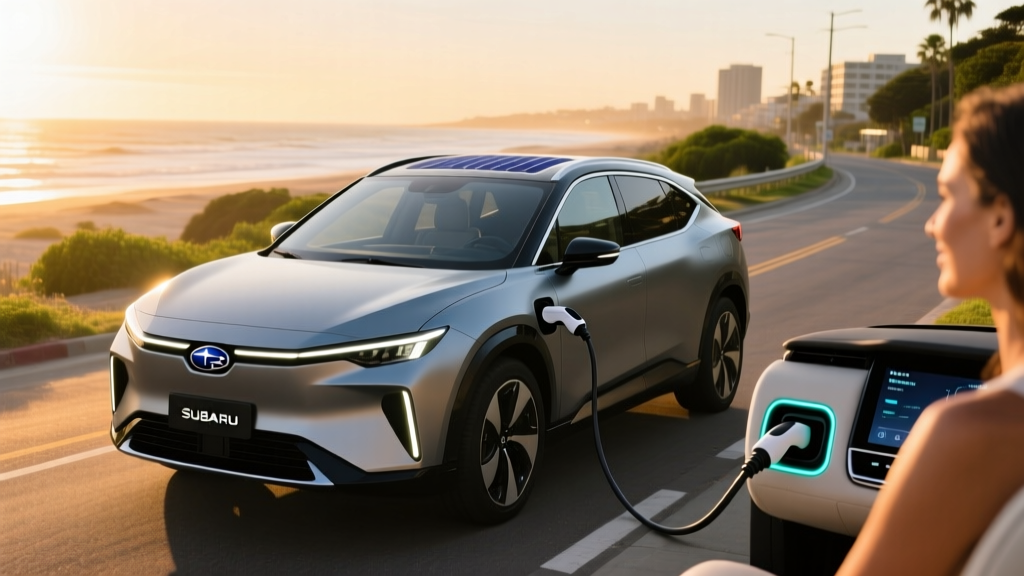
As of 2026, Subaru's electric vehicle lineup centers on the Solterra, a fully electric compact SUV developed jointly with Toyota (its twin is the bZ4X). The 2026 Solterra delivers an EPA-estimated 222–227 miles of range (depending on trim), charges at up to 150 kW DC fast charging (10–80% in approximately 30 minutes), and starts at roughly $39,995 before incentives. It comes standard with Subaru's signature symmetrical all-wheel drive and strong off-road capability. However, its range lags behind key rivals like the Hyundai Ioniq 5 (305+ mi) and Tesla Model Y (310+ mi), making it best suited for buyers who prioritize AWD traction, rugged utility, and daily commutes under 150 miles with reliable home charging access.
What Subaru Electric Vehicles Are Available Now?
Subaru's EV strategy has been deliberate rather than expansive. The brand currently offers one fully electric vehicle for the U.S. market:
2026 Subaru Solterra — A compact electric SUV built on the Toyota/Subaru co-developed e-TNGA platform. It seats five, offers 8.3 inches of ground clearance, and comes exclusively with dual-motor all-wheel drive. For 2026, Subaru has refined the thermal management system and slightly improved charging speeds over earlier model years.
Subaru has also announced plans for additional electric models later this decade, including a larger three-row SUV, but those remain in the announced/preliminary stage with no confirmed specs or pricing. If you're shopping for a Subaru EV today, the Solterra is your only option.
| Specification | Value |
|---|---|
| EPA Range | 222 mi (Touring) / 227 mi (Premium) |
| Battery Capacity | 72.8 kWh (usable), NMC chemistry |
| Drivetrain | Dual-motor AWD, 215 hp / 249 lb-ft torque |
| 0–60 mph | ~6.5 seconds |
| DC Fast Charge (Peak) | 150 kW (10–80% in ~30 min) |
| Level 2 Charge Rate | ~6.6 kW (full charge in ~11 hours) |
| Efficiency | 104 MPGe combined (Premium) |
| Ground Clearance | 8.3 inches |
| Cargo Volume | 23.8 cu ft (rear seats up) |
| Battery Warranty | 8 years / 100,000 miles |
| Starting MSRP | $39,995 (Premium) / $44,995 (Touring) |
Real-World Range vs. the EPA Sticker
Range Reality Check
EPA Estimate: 227 miles (Premium trim, 18" wheels)
Real-World Expectation: ~185–210 miles in mixed driving; ~165–180 miles sustained highway at 70+ mph; ~150–170 miles in freezing temperatures with cabin heat.
The Solterra's EPA range figure is modest by 2026 standards, and real-world conditions compress it further. The e-TNGA platform's thermal management has improved for 2026, but the 72.8 kWh usable battery (NMC chemistry) simply holds less energy than competitors. Hyundai's Ioniq 5 carries a 77.4 kWh pack and achieves over 300 EPA miles with RWD; the Tesla Model Y Long Range uses an ~81 kWh pack for 310+ miles.
Where the Solterra holds up is in its X-MODE AWD system, which provides genuine off-road capability that most electric crossovers lack. If your routine includes forest service roads, ski-resort parking lots, or unplowed mountain passes, the Solterra's traction advantage is measurable. But for pure range-per-kWh efficiency, it trails the segment leaders.
For 2026, Subaru added a more aggressive battery preconditioning feature: when you navigate to a DC fast charger in the Solterra's infotainment, the system warms or cools the battery to optimize charge acceptance. This is critical — without preconditioning, a cold battery at a 150 kW charger might only accept 50–70 kW initially, extending your stop significantly.
Charging: What to Expect at Home and on the Road
| Charging Level | Power | Miles Added per Hour | Typical Use |
|---|---|---|---|
| Level 1 (120V) | ~1.4 kW | ~4–5 mi/hr | Overnight trickle (emergency only) |
| Level 2 (240V, 32A) | ~6.6 kW | ~22–25 mi/hr | Home daily charging (full in ~11 hrs) |
| DC Fast Charge | Up to 150 kW | ~150 mi in 30 min (10–80%) | Road trips, public stations |
Home charging is essential for Solterra ownership. With 227 miles of EPA range and real-world figures often lower, relying solely on public DC fast charging is both expensive and inconvenient. A Level 2 home charger (240V, 32-amp circuit) replenishes the battery from empty to full overnight. Installation typically costs $800–$2,000 depending on your electrical panel's capacity and the run length to your garage or driveway — always get a quote from a licensed electrician before committing.
On the road, the Solterra's 150 kW peak DC fast-charge rate is adequate but not class-leading. The Ioniq 5 peaks at 240 kW (10–80% in ~18 min on a 350 kW charger), and the Tesla Model Y peaks around 250 kW. The Solterra's charge curve also tapers noticeably above 80% State of Charge (SoC) — a common pattern with NMC batteries to protect longevity. Plan to charge to 80% and go; waiting for 100% at a fast charger is rarely worth the time.
The Solterra uses the CCS1 connector for DC fast charging and the J1772 connector for Level 2 AC charging. Subaru has not announced a transition to NACS (Tesla's connector) for the Solterra, though future models may adopt it. For now, access to Tesla Superchargers requires an adapter (if compatible) or sticking with networks like Electrify America, EVgo, and ChargePoint.
Solterra vs. Gas Subaru: Cost and Ownership Breakdown
The most common Subaru cross-shop is the Solterra versus the gasoline Outback or Forester. Here's how the numbers compare over five years of ownership, assuming 12,000 miles per year (60,000 miles total):
| Cost Category | Solterra Premium | Outback Premium (AWD, 2.5L) |
|---|---|---|
| Purchase Price (MSRP) | $39,995 | $35,495 |
| Estimated Federal Tax Credit (§30D) | $0–$7,500* | $0 |
| Fuel / Electricity (60k mi) | $2,400–$4,200** | $7,800*** |
| Maintenance (60k mi) | ~$900 | ~$2,800 |
| Insurance (5-yr avg) | ~$9,500 | ~$7,500 |
| Est. Depreciation (5 yr) | ~$18,000 | ~$14,000 |
| Estimated 5-Year Total | $48,795–$61,295 | $53,595–$67,795 |
*Tax credit eligibility depends on 2026 IRS §30D rules: buyer income caps, battery critical-mineral sourcing, and MSRP limits. Check current eligibility on IRS.gov. As of early 2026, the Solterra's battery sourcing has been in flux — some buyers may qualify for $3,750 (partial) rather than the full $7,500, and some may not qualify at all depending on the manufacturing period.
**Electricity cost varies widely: ~$0.13/kWh national average for home charging ($2,400 for 60k mi), but public DC fast charging can run $0.35–$0.50/kWh, pushing costs to $4,200+.
***Based on 26 MPG combined and $3.40/gallon national average (source: fueleconomy.gov).
The Solterra's higher upfront cost is offset by dramatically lower fuel and maintenance expenses. EVs eliminate oil changes, transmission fluid, spark plugs, and exhaust-system repairs. Regenerative braking extends brake-pad life significantly. However, EV insurance premiums remain 15–30% higher on average due to repair-cost data for battery packs and specialized body work.
Tax Credit Eligibility: What You Actually Need to Know
2026 §30D Federal Tax Credit Requirements
- Buyer Income Caps: Modified AGI ≤ $150,000 (single) / ≤ $300,000 (married filing jointly)
- MSRP Caps: SUVs ≤ $80,000; sedans ≤ $55,000 (Solterra qualifies on price)
- Battery Sourcing: Critical minerals and battery components must meet phased-in percentage thresholds from U.S. or FTA-partner countries — this is where Solterra eligibility gets complicated
- Point-of-Sale Transfer: Eligible buyers can transfer the credit to the dealer at purchase for an upfront price reduction (rather than waiting for a tax refund)
- Final Assembly: Vehicle must undergo final assembly in North America
The Solterra is assembled at Toyota's Motomachi plant in Japan, which creates a significant final-assembly disqualification for the §30D new-vehicle credit as of current rules. This is a critical detail many buyers miss. Subaru and Toyota have been lobbying for sourcing and assembly adjustments, and rules evolve — always verify your specific vehicle's VIN eligibility on fueleconomy.gov before purchasing. If the Solterra does not qualify for the new-vehicle credit, you may find used Solterra models eligible for the up-to-$4,000 used EV credit (30% of sale price, capped at $4,000, with lower income thresholds).
Common Misconceptions About the Solterra
| Myth | Fact |
|---|---|
| "The Solterra qualifies for the full $7,500 tax credit." | Likely not — Japan final assembly disqualifies it under current §30D rules. Always verify by VIN. |
| "It's just a rebadged Toyota bZ4X." | They share the e-TNGA platform and battery, but Subaru tunes the suspension, AWD system, and X-MODE differently. Interior materials and feature packaging also differ. |
| "227 miles of range isn't enough for anyone." | The average American drives 37 miles/day (FHWA data). 227 EPA miles covers most daily needs with home charging. Range limitation is primarily a road-trip concern. |
| "EV batteries need replacing after 100,000 miles." | NMC batteries typically retain 80–90% capacity at 100k miles with proper charging habits. Subaru warrants the Solterra battery for 8 years/100,000 miles against falling below ~70% capacity. |
| "You can't take an EV off-road." | The Solterra's 8.3" ground clearance, X-MODE AWD, and instant electric torque make it genuinely capable on dirt roads and light trails — arguably better than gas Subarus at low-speed crawling. |
Decision Framework: Is the Solterra the Right EV for You?
Choose the Subaru Solterra If:
- You need AWD for snow, mountains, or unpaved roads and want genuine off-road capability in an EV
- Your daily commute is under 100 miles round-trip and you have reliable home Level 2 charging
- You're a current Subaru owner loyal to the brand and its safety reputation (EyeSight driver-assist is standard)
- You rarely take road trips exceeding 200 miles one-way, or you're willing to plan DC fast-charge stops
- You value Subaru's resale-value track record and dealer network in rural/mountain states
Look at a Competitor Instead If:
- Maximum range is your top priority — the Hyundai Ioniq 5 (305+ mi), Tesla Model Y (310+ mi), or Chevrolet Blazer EV (320+ mi) all go significantly farther per charge
- You rely exclusively on public charging with no home access — the Solterra's 227-mile range makes this challenging and expensive
- You want the fastest DC charging for road trips — the Ioniq 5's 800V architecture (240 kW peak) cuts charge stops by ~40%
- You need a third row — the Solterra seats five only; consider waiting for Subaru's announced three-row EV or look at the Kia EV9
- Federal tax credit eligibility is deal-critical — the Solterra's Japan assembly likely disqualifies it from the §30D new-vehicle credit
First-Time EV Buyer Checklist for the Solterra
If you're transitioning from a gas Subaru to the Solterra, prepare for these ownership realities:
- Install a Level 2 home charger before delivery. Budget $800–$2,000 for a quality 32-amp unit plus electrician installation. If your electrical panel is at capacity (common in older homes), a panel upgrade can add $1,500–$3,000.
- Download charging-network apps now. Electrify America, EVgo, ChargePoint, and PlugShare are essential for trip planning. The Solterra's native navigation covers routing, but third-party apps provide real-time charger status.
- Set your charge limit to 80% for daily use. NMC batteries last longest when kept between 20–80% SoC. Reserve 100% charges for road-trip mornings only.
- Understand cold-weather range loss. At 20°F, expect 20–30% range reduction. Use seat heaters and steering-wheel heat instead of blasting cabin air — resistive heating is a major range drain.
- Factor in insurance costs. Get a quote before purchasing. EV insurance is typically higher; some insurers offer EV-specific policies with battery coverage.
Frequently Asked Questions
Does Subaru have any other electric vehicles besides the Solterra?
Not yet for the U.S. market. Subaru has announced plans for additional EVs, including a three-row electric SUV expected later this decade, but no models beyond the Solterra are currently available for purchase. The Solterra remains Subaru's sole fully electric offering as of 2026.
How does the Solterra's AWD compare to a gas Subaru's AWD?
The Solterra uses a dual-motor setup (one motor per axle) rather than a mechanical driveshaft. This provides instant torque to all four wheels with no lag. Subaru's X-MODE software simulates the limited-slip and torque-vectoring behavior of its traditional symmetrical AWD. In practice, the Solterra's AWD is excellent for snow and light off-road use, though it lacks the low-range gearing of a Wrangler-class vehicle.
Can I charge the Solterra at Tesla Superchargers?
Not natively. The Solterra uses the CCS1/J1772 connector standard. Tesla's Supercharger network uses NACS. Some automakers have adopted NACS adapters for Supercharger access, but Subaru has not confirmed adapter compatibility for the Solterra as of 2026. Check with your dealer for the latest adapter availability. For now, plan road trips around Electrify America, EVgo, and ChargePoint DC stations.
What is the Solterra's battery replacement cost?
Full battery pack replacement is estimated at $12,000–$18,000 out of warranty, based on current e-TNGA pack pricing. However, NMC battery degradation data suggests most packs retain 85–90% capacity at 150,000 miles with proper charging habits. Subaru's 8-year/100,000-mile battery warranty covers capacity loss below approximately 70%, making a full replacement rare within the warranty period.
Is the Solterra good for cold climates?
Yes, with caveats. The AWD system and ground clearance handle snow and ice well, and the battery preconditioning helps mitigate cold-weather charging slowdowns. However, expect 20–30% range reduction in sub-freezing temperatures. A 227-mile EPA range becomes roughly 160–180 miles in deep winter. If your winter commute exceeds 80 miles one-way, plan accordingly or consider a longer-range EV.