The Quick Answer: Is a Subaru EV Right for You?
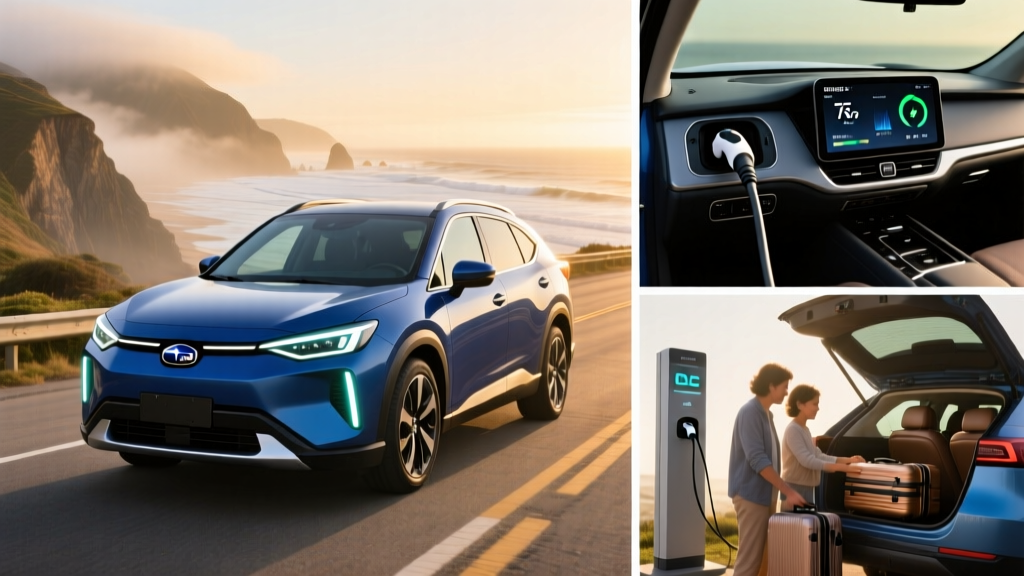
Subaru's electric offering for 2026 centers on the Solterra, a compact electric SUV co-developed with Toyota (which sells the nearly identical bZ4X). The 2026 Solterra delivers an EPA-estimated 228 miles of range (Limited trim with 18-inch wheels), peaks at ~150 kW DC fast charging (10–80% in approximately 30 minutes), and starts at roughly $39,995. It qualifies for a partial or full federal tax credit under IRS §30D rules depending on battery-sourcing compliance and your income. It's a solid pick for Subaru loyalists who want standard AWD, decent ground clearance (8.3 inches), and EyeSight safety tech — but its range and charging speed lag behind rivals like the Hyundai Ioniq 5 and Tesla Model Y. If you need 300+ miles or tow frequently, look elsewhere. If you want an electric Subaru for commuting, light trail use, and snowy climates, it works.
2026 Subaru Solterra: The Only Subaru EV You Can Buy Today
As of 2026, Subaru offers one battery-electric vehicle: the Solterra. There is no Subaru EV sedan, truck, or three-row SUV. Subaru has announced future EV plans tied to its partnership with Toyota, but no additional models are on sale or available to order. If you search for a "Subaru EV," the Solterra is your answer.
The Solterra rides on the e-Subaru Global Platform, shared with the Toyota bZ4X. For 2026, Subaru offers three trims:
- Premium — Base trim, 18-inch wheels, EPA-est. 228 miles range, MSRP ~$39,995
- Limited — Added features, 18-inch or available 20-inch wheels (20-inch drops range to ~222 miles), MSRP ~$43,995
- Touring — Top trim, 20-inch wheels standard, EPA-est. 222 miles, MSRP ~$46,995
All trims include dual-motor all-wheel drive producing 215 horsepower and 249 lb-ft of torque, with a 0–60 mph time of approximately 6.5 seconds.
| Spec | Value |
|---|---|
| EPA Range (18" wheels) | 228 miles |
| EPA Range (20" wheels) | 222 miles |
| Battery Capacity (usable) | ~65.6 kWh (Lithium-ion, NMC chemistry) |
| Peak DC Fast Charge Rate | ~150 kW |
| 10–80% DC Fast Charge Time | ~30 minutes |
| Level 2 Charging (240V) | ~6.6 kW onboard charger |
| Horsepower | 215 hp |
| Torque | 249 lb-ft |
| 0–60 mph | ~6.5 seconds |
| Drivetrain | Dual-motor AWD (standard) |
| Ground Clearance | 8.3 inches |
| Cargo Volume | 23.8 cu ft (rear seats up) |
| MPGe (combined) | ~104 MPGe |
| Battery/Powertrain Warranty | 8 years / 100,000 miles |
| Base MSRP (Premium) | ~$39,995 |
Real-World Range: What to Actually Expect
The EPA sticker says 228 miles, but real-world results vary significantly:
- Mild-weather city/suburban driving: 220–240 miles achievable with moderate regen use
- Highway driving at 70+ mph: Expect ~180–200 miles — aerodynamic drag hits all EVs hard at speed
- Cold weather (below 30°F): Plan for 150–180 miles. The Solterra's battery thermal management is adequate but not class-leading, and cold saps NMC chemistry efficiency by 20–30%
- Mountainous terrain: Heavy regen on descents recovers some energy, but sustained climbs will cut range sharply
For a 228-mile EPA vehicle, budgeting 180 miles as your "safe" trip-planning range in mixed conditions is prudent. This means road trips require a charging stop roughly every 2.5–3 hours of driving.
Solterra vs Gas Subaru: A Real Cost Comparison
Most Solterra shoppers are cross-shopping against the Subaru Outback, Forester, or Crosstrek. Here's how the numbers stack up over 5 years and 75,000 miles of ownership, comparing the Solterra Premium against a similarly equipped 2026 Subaru Outback Premium (AWD, 2.5L, ~26 MPG combined):
| Category | Solterra EV | Outback (Gas) |
|---|---|---|
| Purchase Price (MSRP) | $39,995 | $34,595 |
| Est. Federal Tax Credit (§30D) | –$3,750 to –$7,500* | $0 |
| Effective Purchase Price | $32,495–$36,245 | $34,595 |
| Fuel / Electricity (75k mi) | $2,100–$3,400** | $7,800*** |
| Maintenance (5 yr) | $800–$1,200 | $3,000–$3,800 |
| Insurance (5 yr avg) | $7,500–$9,000 | $6,000–$7,500 |
| Estimated 5-Year Total | $42,895–$49,845 | $51,395–$55,895 |
* Federal tax credit eligibility depends on battery critical-mineral and component sourcing requirements under IRS §30D rules, plus buyer income caps ($150k single / $300k joint) and MSRP caps ($80k for SUVs). The Solterra's credit amount has fluctuated — verify current-year eligibility on the IRS website or with your tax professional before purchasing.
** Electricity cost assumes $0.14/kWh home charging average and ~30% public DC fast charging at $0.35–$0.50/kWh. Source: fueleconomy.gov.
*** Gas cost assumes $3.40/gallon and 26 MPG combined.
Charging the Solterra: Home, Public, and What You'll Actually Spend
Understanding charging is where most first-time EV buyers get confused. Here's the critical distinction: kW (kilowatts) measures charging power — how fast energy flows into the battery. kWh (kilowatt-hours) measures energy capacity — how much the battery holds. The Solterra's battery holds ~65.6 kWh of usable energy.
| Level | Power (kW) | Miles Added per Hour | Use Case |
|---|---|---|---|
| Level 1 (120V household) | ~1.2 kW | ~3–4 miles/hr | Emergency / overnight top-up only |
| Level 2 (240V home charger) | ~6.6 kW | ~20–24 miles/hr | Daily home charging — full charge in ~10 hours |
| DC Fast Charge (CCS) | Up to ~150 kW peak | N/A (time-based) | Road trips — 10–80% in ~30 min |
Home Charging Setup Costs
If you have a garage or driveway with electrical panel access, a Level 2 home charger is the single best investment for EV ownership. Expect the following:
- Level 2 charger unit: $350–$700 (ChargePoint Home Flex, Emporia Vue, Wallbox Pulsar Plus)
- Electrician install (240V/50A circuit): $500–$1,500 if panel is nearby; $1,500–$3,000+ if a panel upgrade or long conduit run is needed
- Permit fees: $50–$200 depending on municipality
- Total typical install: $900–$2,400 for most homes with a 200A panel
The Solterra uses a CCS1 connector for DC fast charging and a J1772 connector for Level 1/Level 2 AC charging. Note: Subaru has not announced a transition to the Tesla NACS connector for the current-generation Solterra, so you'll rely on CCS-compatible networks like Electrify America, EVgo, and ChargePoint for public fast charging.
The Charging Curve Reality
Subaru advertises a peak charge rate of ~150 kW, but that peak only holds between roughly 10–40% state of charge. Above 60%, the rate tapers significantly — often dropping below 50 kW past 80%. This is normal for NMC battery chemistry and is managed by the vehicle's thermal system to protect battery longevity. Plan road-trip stops around 10–80% charges rather than filling to 100%, which wastes time at the taper.
Federal Tax Credit: Does the Solterra Qualify?
The federal EV tax credit under IRS §30D can reduce your effective purchase price by up to $7,500, but eligibility is not automatic. Here's what determines whether you get the credit:
§30D Credit Requirements (2026)
- MSRP Cap: Vehicle must be under $80,000 (SUVs/vans/pickups) — Solterra qualifies ✓
- Buyer Income Cap: Modified AGI must not exceed $150,000 (single) or $300,000 (married filing jointly)
- Battery Component Sourcing: Percentage of battery components manufactured or assembled in North America must meet annual thresholds — this determines whether you get $3,750 or the full $7,500
- Critical Minerals Sourcing: Percentage of critical minerals sourced from the US or FTA partners must meet thresholds — this determines the other $3,750 half
- Point-of-Sale Transfer: You can transfer the credit to the dealer at purchase to reduce your out-of-pocket cost immediately (rather than waiting for tax filing)
- Final Assembly: Vehicle must undergo final assembly in North America — the Solterra is assembled in Japan, which has been a limiting factor in full credit eligibility for some model years
Key caveat: Because the Solterra is assembled in Japan (at Toyota's Motomachi plant), its eligibility for the full $7,500 credit has been inconsistent year-to-year as sourcing rules tighten. Some buyers have qualified for $3,750 (half credit) while others received the full amount depending on the model year's battery-sourcing documentation. Always verify current eligibility on the fueleconomy.gov tax credit page and consult a tax professional before relying on the credit in your purchase decision.
Solterra vs the Competition: How It Stacks Up
The Solterra doesn't exist in a vacuum. Here's how it compares to key rivals in the compact electric SUV segment:
| Spec | Subaru Solterra | Hyundai Ioniq 5 (AWD) | Tesla Model Y (LR AWD) | Ford Mustang Mach-E (AWD) |
|---|---|---|---|---|
| EPA Range | 228 mi | 290 mi | 320 mi | 290 mi |
| Battery (usable) | ~65.6 kWh | ~77.4 kWh | ~75 kWh | ~75.7 kWh |
| Peak DC Charge | ~150 kW | ~240 kW | ~250 kW | ~150 kW |
| 10–80% Time | ~30 min | ~18 min | ~20 min | ~33 min |
| AWD Standard? | Yes | Optional | Yes (LR AWD) | Optional |
| 0–60 mph | 6.5 sec | 5.0 sec | 4.8 sec | 5.1 sec |
| Ground Clearance | 8.3 in | 6.1 in | 6.6 in | 5.7 in |
| Base MSRP (AWD) | ~$39,995 | ~$47,500 | ~$46,630 | ~$43,995 |
| Connector | CCS1 | NACS (2026) | NACS | NACS (2026) |
Where the Solterra wins: Standard AWD across all trims, highest ground clearance in the segment (genuine light-trail and deep-snow capability), lowest starting price for AWD, and Subaru's EyeSight driver-assistance suite standard. It also retains Subaru's reputation for build quality and dealer service in rural and mountain regions.
Where the Solterra falls short: Range is the weakest in its class — 60–90 fewer EPA miles than competitors. DC fast charging is slower than the Ioniq 5 and Model Y. The CCS1 connector means you cannot use Tesla Superchargers without an adapter, and even then, compatibility is not guaranteed. The interior, while functional, feels a generation behind Tesla and Hyundai in infotainment responsiveness.
Common Subaru EV Misconceptions — Fact vs Fiction
| Myth | Fact |
|---|---|
| "Subaru makes multiple EVs" | The Solterra is Subaru's only EV as of 2026. Future models have been announced but are not on sale. |
| "It gets 228 miles no matter what" | EPA is a lab estimate. Highway driving at 75 mph in winter can drop real range to 150–170 miles. Always budget conservatively. |
| "The battery will need expensive replacement soon" | Subaru warranties the battery for 8 years/100,000 miles against capacity loss below 70%. NMC batteries in modern thermal-managed packs typically retain 85–90% capacity after 100k miles based on industry degradation data. |
| "I can charge at Tesla Superchargers" | The Solterra uses CCS1, not NACS. Some networks are adding CCS adapters, but native Supercharger access is not guaranteed. Check network compatibility before relying on it. |
| "EVs cost more to own than gas cars" | Over 5 years, the Solterra can save $4,000–$8,000 in fuel and maintenance vs a comparable gas Subaru, especially if you charge at home and qualify for the tax credit. |
| "I need to charge every day" | With 228 miles of range and a typical 30–40 mile daily commute, most owners charge 2–3 times per week on Level 2 at home. |
Decision Framework: Should You Buy the Subaru Solterra?
Choose the Solterra If:
- You live in a snowy or mountainous region and need standard AWD with 8.3 inches of ground clearance
- Your daily commute is under 60 miles round-trip and you have home Level 2 charging
- You're a Subaru loyalist who values dealer relationships, EyeSight safety tech, and build quality
- You rarely take road trips over 200 miles one-way, or you're willing to plan charging stops
- You want the lowest starting MSRP for a standard-AWD electric SUV in the segment
Look Elsewhere If:
- You need 300+ miles of range for frequent long road trips — consider the Model Y or Ioniq 5
- You want the fastest DC charging for minimal road-trip downtime — the Ioniq 5 at 240 kW is significantly quicker
- You rely on Tesla Superchargers in your area — the Solterra's CCS1 connector limits your network options
- You need a third row or substantial towing capacity — no current Subaru EV offers either
- You live in an apartment without charging access and your area has limited public CCS infrastructure
What First-Time EV Buyers Must Know Before Purchasing
If the Solterra is your first EV, here are the ownership realities no brochure mentions:
Home Charging Is Non-Negotiable for Convenience
Public-only EV ownership is possible but painful. Relying on DC fast chargers for daily charging costs 2–3x more per mile than home Level 2, adds 30+ minutes to your routine several times a week, and subjects you to broken-stall frustration. Before buying, confirm you can install a 240V outlet or hardwired charger. Renters and apartment dwellers should check whether their building has or plans EV charging infrastructure.
Insurance Costs More
EV insurance premiums run 10–25% higher than equivalent gas vehicles due to higher repair costs and battery replacement risk. Get a quote before purchasing — the $1,500–$2,500 annual premium difference partially offsets fuel savings.
Maintenance Is Minimal but Not Zero
Expect to pay for tire rotation (every 5,000–7,500 miles — EVs wear tires faster due to instant torque and heavier weight), cabin air filter replacement, brake fluid checks (regen braking means brake pads last 100k+ miles), and wiper fluid. No oil changes, no spark plugs, no transmission fluid.
Cold Weather Is Real
If you live where winters drop below freezing, accept that your 228-mile Solterra will deliver 150–180 miles on cold days. Preconditioning the battery while plugged in (using the Subaru app to warm the cabin and battery before departure) recovers some range and improves charge speeds.
Frequently Asked Questions
Is Subaru making more EVs after the Solterra?
Subaru has announced plans for additional EVs through its Toyota partnership, targeting multiple battery-electric models by the end of the decade. However, as of 2026, no additional Subaru EVs are on sale or available to order. Any future models should be treated as announced/preliminary until official specs and pricing are released.
Can the Solterra tow?
The 2026 Solterra is not rated for towing by Subaru. If you need towing capability, consider a plug-in hybrid alternative or a different EV like the Ford F-150 Lightning or Rivian R1S.
How does the Solterra handle off-road?
With 8.3 inches of ground clearance, X-MODE AWD management, and Subaru's Grip Control, the Solterra handles gravel roads, snow, and mild trails competently — similar to a Crosstrek. It is not a dedicated off-roader and lacks underbody skid plates for serious rock crawling.
What happens if the battery degrades?
Subaru's battery warranty guarantees the pack will retain at least 70% of original capacity for 8 years or 100,000 miles. If it falls below that threshold, Subaru will repair or replace it under warranty. Out-of-warranty battery replacement for a pack this size typically costs $8,000–$15,000 at current market rates, though prices are declining as battery manufacturing scales.
Does the Solterra qualify for the $7,500 federal tax credit?
Eligibility varies by model year and current IRS §30D sourcing requirements. The Solterra's Japan assembly and evolving battery supply chain mean it has qualified for partial ($3,750) or full ($7,500) credit depending on the production batch. Always verify on fueleconomy.gov and with your tax advisor before purchase. The credit can be transferred to the dealer at point of sale to reduce your purchase price immediately.
Is the Solterra the same as the Toyota bZ4X?
Mechanically, yes — they share the e-Subaru Global Platform, battery, and powertrain. Differences are primarily in styling, suspension tuning, trim content, and dealer experience. The Solterra includes standard AWD on all trims (the bZ4X offers FWD on base trims) and Subaru's X-MODE. Pricing is comparable, but Subaru dealers tend to serve more rural and outdoor-oriented buyers.