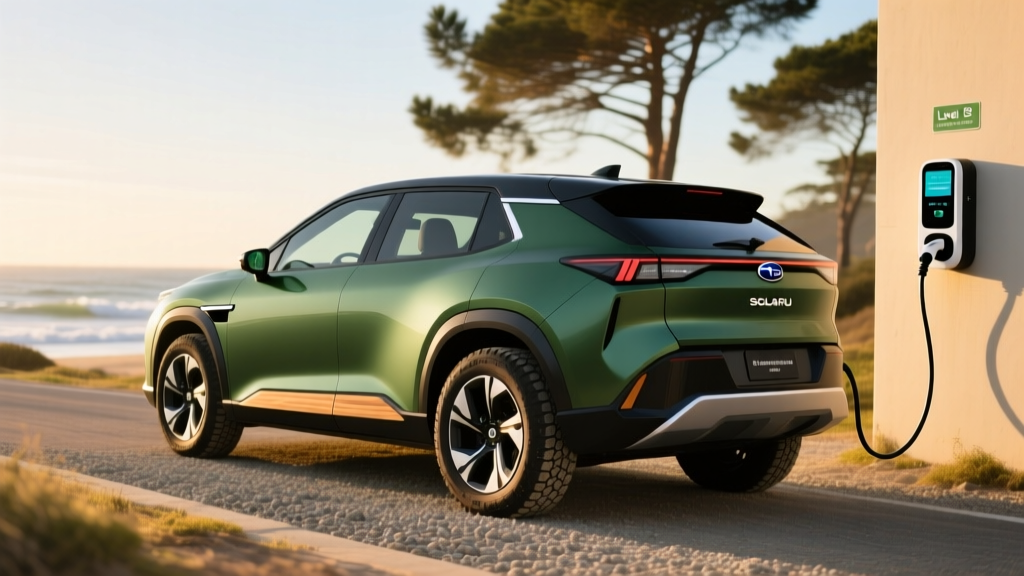
If you're researching a new Subaru electric vehicle, you're almost certainly looking at the Subaru Solterra — the brand's only all-electric model, co-developed with Toyota (which sells it as the bZ4X). For the 2026 model year, the Solterra offers an EPA-estimated range of up to 227 miles (XLE FWD trim), a 72.8 kWh usable battery, DC fast charging up to 150 kW with a 10–80% time of roughly 30 minutes, and a starting MSRP around $39,995. It qualifies for a partial or full federal tax credit under IRS §30D, depending on your income, battery sourcing, and point-of-sale election. It's a solid pick for Subaru loyalists who want standard AWD (on most trims), genuine 8.3 inches of ground clearance, and a practical compact SUV — but it trails competitors like the Hyundai Ioniq 5 and Tesla Model Y on both range and charging speed.
2026 Subaru Solterra: Core Specifications at a Glance
Before we get into ownership economics, here are the hard numbers. Subaru updated the Solterra for 2025 with improved charging hardware and a slightly larger usable battery, and the 2026 model carries those improvements forward. Data sourced from fueleconomy.gov and Subaru's official specifications.
| Specification | XLE (FWD) | XLE (AWD) | Touring (AWD) |
|---|---|---|---|
| EPA Range | 227 mi | 222 mi | 207 mi |
| Battery (usable) | 72.8 kWh, Lithium-ion (NMC chemistry) | ||
| Combined MPGe | 111 MPGe | 107 MPGe | 102 MPGe |
| DC Fast Charge (peak) | 150 kW (CCS1 connector) | ||
| 10–80% DCFC Time | ~30 minutes | ||
| Level 2 Charging (240V) | 7.2 kW onboard charger (~9.5 hrs, 0–100%) | ||
| Horsepower | 201 hp (FWD) | 215 hp (AWD dual-motor) | |
| 0–60 mph | ~7.1 sec | ~6.5 sec | |
| Ground Clearance | 8.3 inches | ||
| Cargo Volume | 23.8 cu ft (rear seats up) / 63.5 cu ft (folded) | ||
| Starting MSRP | $39,995 | $41,995 | $48,995 |
| Battery/Powertrain Warranty | 8 years / 100,000 miles | ||
Solterra vs. Gas Subaru: The Real Cost of Ownership
The most common cross-shop for Solterra buyers is a gas-powered Subaru Outback or Forester. Let's compare five-year costs using concrete numbers. We're using the 2026 Outback Premium AWD (MSRP ~$34,995, EPA 29 MPG combined) as the baseline, and the Solterra XLE AWD (MSRP $41,995) as the EV comparison. Electricity priced at the US average of $0.16/kWh; gas at $3.40/gallon.
| Cost Category (5 Years / 75,000 Miles) | Solterra XLE AWD | Outback Premium AWD |
|---|---|---|
| Purchase Price (MSRP) | $41,995 | $34,995 |
| Federal Tax Credit (§30D) | –$3,750 to –$7,500* | $0 |
| Effective Purchase Price | ~$34,495–$38,245 | $34,995 |
| Fuel / Electricity (75k mi) | ~$2,750 (home charging) | ~$8,790 |
| Maintenance (5 yr) | ~$1,200 (tire rotations, cabin filter, fluid top-offs) | ~$3,500 (oil changes, brakes, filters) |
| Insurance (estimated avg) | ~$9,500 | ~$7,800 |
| 5-Year Total (approx.) | ~$47,945–$51,695 | ~$55,085 |
*Federal tax credit eligibility depends on your modified adjusted gross income (AGI ≤ $150k single / $300k joint), the vehicle's battery component and critical-mineral sourcing, and MSRP caps ($80,000 for SUVs). As of 2026, the Solterra qualifies for at least $3,750 and potentially the full $7,500 depending on your tax situation and current sourcing compliance. You can elect to transfer the credit to the dealer at point of sale for an immediate price reduction. Verify current eligibility at IRS.gov §30D and confirm with your tax professional.
The takeaway: Over five years, the Solterra breaks even or saves you money compared to a gas Outback — even with higher insurance premiums — primarily because you're spending roughly $6,000 less on fuel and $2,300 less on maintenance. The savings grow if you have access to free or discounted workplace/public charging, or if gas prices rise. If you drive fewer than 10,000 miles per year, the math narrows considerably.
Charging the Solterra: What You Actually Need to Know
The Solterra's charging profile is its most debated characteristic. Here's the practical breakdown:
Level 1 (120V Household Outlet)
The included portable charging cord delivers roughly 1.2 kW, adding about 4–5 miles of range per hour. A full 0–100% charge takes over 60 hours. This works only as a trickle supplement — it will not sustain daily driving of more than 30–40 miles without falling behind.
Level 2 (240V Home Charger)
With the Solterra's 7.2 kW onboard charger, a Level 2 home station (like a ChargePoint Home Flex or Emporia Level 2) adds roughly 25–28 miles of range per hour. A full charge from empty takes about 9.5 hours — meaning you plug in at night and wake up full every morning. Most EV owners do 80%+ of their charging at home, and this is the setup that makes EV ownership effortless.
Home installation cost: Expect $500–$1,500 for the charger hardware and $800–$2,500 for electrician labor (running a 240V/50A circuit to your garage or driveway). If your electrical panel needs an upgrade from 100A to 200A service, add $1,500–$3,000. Always get a quote from a licensed electrician before committing.
DC Fast Charging (Public)
The Solterra peaks at 150 kW on a CCS1 DC fast charger. In practice, the charging curve looks like this:
- 10–40% SoC: Sustains near 150 kW (fastest segment)
- 40–60% SoC: Tapers to ~100–120 kW
- 60–80% SoC: Drops further to ~60–80 kW
- 80–100% SoC: Trickle charging, very slow (avoid unless necessary)
The stated 10–80% time of ~30 minutes is realistic at a functioning 150 kW+ station (like Electrify America or EVgo). However, this is notably slower than competitors: the Hyundai Ioniq 5 charges 10–80% in about 18 minutes thanks to its 800V architecture and 240 kW peak, and the Tesla Model Y (with NACS) can add range even faster on the Supercharger network. If you take frequent road trips exceeding 200 miles, those extra 12 minutes per stop add up.
Solterra vs. the Competition: Where It Fits
The Solterra doesn't exist in a vacuum. Here's how it stacks up against the compact electric SUVs it competes with most directly:
| Attribute | Subaru Solterra AWD | Hyundai Ioniq 5 AWD | Tesla Model Y LR AWD | Ford Mustang Mach-E AWD |
|---|---|---|---|---|
| EPA Range | 222 mi | 290 mi | 311 mi | 290 mi |
| DC Fast Charge (10–80%) | ~30 min | ~18 min | ~25 min | ~28 min |
| Starting MSRP (AWD) | $41,995 | $49,600 | $47,990 | $46,995 |
| Ground Clearance | 8.3 in | 6.1 in | 6.6 in | 5.7 in |
| Connector | CCS1 | CCS1 / NACS* | NACS | CCS1 / NACS* |
| Standard AWD? | Yes (most trims) | Optional | Yes (LR) | Optional |
*Hyundai and Ford have announced NACS adoption for newer model years; check your specific build for connector type.
The Solterra's advantages are clear: lowest starting price for AWD, best ground clearance for light off-pavement use, and Subaru's reputation for durability and dealer support in rural/mountain regions. Its disadvantages are equally clear: shortest range and slowest fast charging in this group. This isn't a flaw for the right buyer — it's a trade-off.
Common Misconceptions About the Solterra
| Misconception | Fact |
|---|---|
| "It's just a rebadged Toyota bZ4X — why not buy the cheaper one?" | They share the e-TNGA platform and battery, but the Solterra comes with standard AWD on most trims (the bZ4X is FWD-only), more ground clearance, and Subaru's X-MODE traction system. The bZ4X starts lower but isn't a direct equivalent. |
| "227 miles of range isn't enough for anyone." | The average American drives ~37 miles per day (FHWA data). Even with real-world highway reduction to ~200 miles, the Solterra covers a week of commuting on a single charge. The issue isn't daily driving — it's road trips over 200 miles, where you'll need one fast-charge stop. |
| "The battery will need expensive replacement in a few years." | Subaru warranties the battery for 8 years / 100,000 miles against dropping below 70% capacity. Industry data from Recurrent Auto shows most modern NMC batteries retain 85–92% capacity at 100,000 miles. A full replacement (rare) would cost roughly $12,000–$16,000 out of warranty, but catastrophic failure within the warranty period is covered. |
| "I can't take it off-road — it's an EV." | The Solterra's 8.3 inches of ground clearance, X-MODE with Snow/Dirt and Deep Snow/Mud settings, and dual-motor AWD make it genuinely capable on forest roads, snowy passes, and light trails. It won't replace a Wrangler, but it outperforms most crossover competitors on unpaved surfaces. |
| "It qualifies for the full $7,500 tax credit for everyone." | Eligibility depends on your income (AGI caps apply), battery sourcing requirements (which can change mid-year), and MSRP limits. The Solterra's MSRP is well under the $80,000 SUV cap, but the credit amount ($3,750 or $7,500) depends on whether it meets both critical-mineral and battery-component thresholds. Always verify on the IRS website before purchasing. |
Who Should Buy the Solterra — And Who Shouldn't
✅ Choose the Subaru Solterra if:
- You live in a snowy or mountainous region and value standard AWD with genuine ground clearance (8.3") over maximum range
- Your daily driving is under 120 miles round-trip and you have access to Level 2 home charging
- You're a current Subaru owner who trusts the dealer network and wants to stay in the brand
- You want the lowest-cost AWD electric SUV in the segment (under $42k before credits)
- You take road trips infrequently (2–3 times per year) and don't mind a 30-minute charge stop
❌ Look elsewhere if:
- You regularly drive more than 250 miles between stops — the Ioniq 5 (290 mi) or Model Y (311 mi) will save you time and stress
- You cannot install a Level 2 charger at home and would rely entirely on public DC fast charging — the Solterra's 30-minute charge time and lack of battery preconditioning make this frustrating
- You live in a very cold climate (sustained sub-20°F winters) and need maximum range retention — the lack of a heat pump on lower trims hurts efficiency
- You prioritize fastest possible road-trip charging — Hyundai's 800V architecture (Ioniq 5/6) is meaningfully quicker
- You need three rows of seating or more than 64 cu ft of cargo space — consider the Kia EV9 or Rivian R1S
First-Time EV Buyer Checklist for the Solterra
If this is your first electric vehicle, here's what to sort out before you sign the paperwork:
- Confirm home charging access. Do you have a garage, carport, or driveway where a 240V outlet can be installed? If you live in an apartment or park on the street, map out reliable public Level 2 chargers near your home or workplace before committing. Apps like PlugShare and ChargePoint show real-time availability.
- Get an electrician quote. Before buying, have a licensed electrician assess your panel capacity and quote a 240V/50A circuit installation. If they recommend a panel upgrade, factor in the $1,500–$3,000 cost.
- Verify your tax credit eligibility. Check the IRS clean vehicle credits page for current income caps, sourcing requirements, and the point-of-sale transfer process. Ask your dealer whether they support the transfer — it reduces your out-of-pocket cost at purchase rather than waiting for a tax refund.
- Adjust your insurance expectations. EVs typically cost 15–25% more to insure than comparable gas vehicles due to higher repair costs and parts pricing. Get a quote from your insurer before finalizing the purchase.
- Plan your first road trip. Before a long drive, practice using DC fast chargers locally. Learn how the Solterra's navigation routes you to chargers and understand that charging slows significantly above 80% SoC — plan to charge to 80% and go, not 100%.
Frequently Asked Questions
Does the 2026 Subaru Solterra qualify for the $7,500 federal tax credit?
It qualifies for up to $7,500, but the actual amount ($3,750 or $7,500) depends on current battery-sourcing and critical-mineral requirements set by the IRS. Your personal eligibility also requires meeting income caps ($150,000 single / $300,000 joint MAGI) and the vehicle MSRP must be under $80,000 (which all Solterra trims are). The credit can be transferred to the dealer at point of sale as an instant discount. Always verify at IRS.gov before purchasing, as sourcing rules can shift.
How long does the Solterra battery last?
Subaru warranties the high-voltage battery for 8 years or 100,000 miles against capacity loss below 70%. Real-world data from fleet analytics firm Recurrent Auto suggests most modern lithium-ion EV batteries retain 85–92% of original capacity at 100,000 miles with normal use. To maximize longevity, avoid routinely charging to 100% or draining to 0% — keeping the battery between 20% and 80% for daily use reduces stress on the NMC cells.
Can I tow with the Solterra?
No. Subaru does not rate the Solterra for towing, and there is no factory hitch option. If you need to tow even a small trailer, you'll need to look at the Ford Mustang Mach-E (up to 1,500 lbs with the GT), Rivian R1S, or a plug-in hybrid like the Subaru Outback PHEV (if available in your market).
Is the Solterra good in snow?
Yes — this is arguably the Solterra's strongest use case. The dual-motor AWD system, X-MODE traction management, 8.3 inches of ground clearance, and low center of gravity (battery pack under the floor) give it excellent traction in snow and ice. Pair it with dedicated winter tires and it outperforms most AWD gas crossovers in winter conditions. The main winter limitation is range: expect a 20–30% reduction in sub-freezing temperatures due to battery chemistry and cabin heating demands.
What connector does the Solterra use, and will it become obsolete?
The 2026 Solterra uses the CCS1 (Combined Charging System) connector. While the industry is shifting toward Tesla's NACS standard (with most automakers adopting it by 2025–2026), CCS1 remains fully supported at Electrify America, EVgo, ChargePoint, and other major networks. Subaru has not yet announced a NACS transition timeline for the Solterra, but CCS1-to-NACS adapters are available and will continue to provide access to Tesla Superchargers. CCS1 is not becoming obsolete in the near term — it remains a viable, widely supported standard.
How much does it cost to charge the Solterra at home?
Filling the 72.8 kWh battery from 10% to 100% at the US average electricity rate of $0.16/kWh costs roughly $10.50. That gives you approximately 200 real-world miles, working out to about $0.05 per mile — compared to roughly $0.12 per mile for a gas Outback at $3.40/gallon and 29 MPG. Over 15,000 miles per year, that's a savings of roughly $1,050 annually on fuel alone when charging at home.