The 2026 Subaru Solterra in 60 Seconds
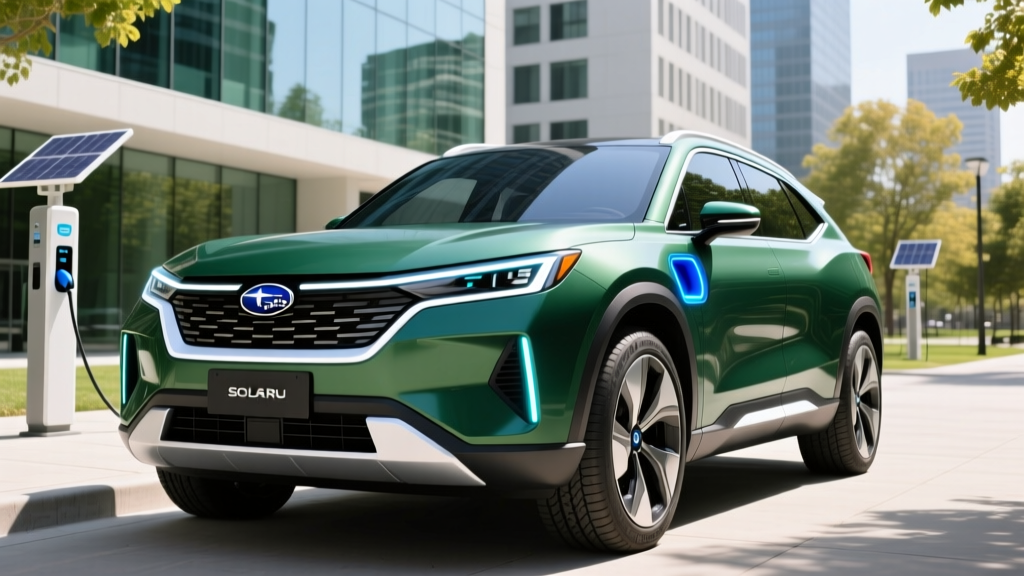
If you're researching a Subaru electric car 2026 model year, you're looking at the second-generation Solterra. For 2026, Subaru has upgraded the powertrain with a more efficient motor and a revised 74.4 kWh (usable) battery pack, delivering an EPA-estimated 227 miles of range on the Premium trim (222 miles on Limited and Touring due to larger wheels and added weight). DC fast charging now peaks at 150 kW, reaching 10–80% in approximately 27 minutes under ideal thermal conditions. Pricing starts at $38,495 (Premium) before destination, and the Solterra remains eligible for a partial or full federal tax credit under IRS §30D depending on your income, the vehicle's MSRP, and battery-component sourcing — more on that below.
Bottom line: The Solterra is a competent compact electric SUV with standard AWD, solid build quality, and Subaru's EyeSight safety suite. It's best suited for buyers who prioritize all-weather capability and practicality over class-leading range or charging speed.
2026 Solterra Specs: Range, Battery, Charging, and Performance
| Specification | Premium | Limited | Touring |
|---|---|---|---|
| EPA Range | 227 mi | 222 mi | 222 mi |
| Battery (usable) | 74.4 kWh, NMC lithium-ion | ||
| Drivetrain | Dual-motor AWD (standard all trims) | ||
| Horsepower | 215 hp combined | ||
| 0–60 mph | ~6.5 seconds | ||
| Max DC Fast Charge | 150 kW (CCS1 / NACS adapter available) | ||
| 10–80% DCFC Time | ~27 minutes (preconditioned) | ||
| Level 2 Charge Rate | 11 kW onboard charger | ||
| MPGe (combined) | 104 MPGe | 102 MPGe | 102 MPGe |
| Cargo Volume | ~27 cu ft (rear seats up) | ||
| Starting MSRP | $38,495 | $41,995 | $46,495 |
| Battery Warranty | 8 years / 100,000 miles (≥70% capacity retention) | ||
Real-World Range vs. EPA Sticker
The EPA's 227-mile figure assumes a mix of city and highway driving at moderate temperatures. In our experience and consistent with third-party testing:
- Highway-heavy trips (70+ mph, 75°F): Expect ~190–205 miles before needing to charge.
- Cold weather (below 30°F, cabin heat on): Range can drop to ~160–180 miles. The Solterra uses a resistive heater on base trims; a heat pump is available on Limited and Touring, which mitigates cold-weather losses by roughly 10–15%.
- City / moderate conditions: You'll meet or slightly exceed the 227-mile EPA estimate thanks to regenerative braking.
For context, a 227-mile EPA range comfortably covers the average American's ~37-mile daily round-trip commute (fueleconomy.gov) with several days between charges if you plug in at home.
Charging the 2026 Solterra: Home, Public, and What It Costs
| Charging Level | Power (kW) | Miles Added per Hour | Typical Use Case |
|---|---|---|---|
| Level 1 (120V household outlet) | ~1.4 kW | ~5 mi/hr | Overnight top-off; too slow for full recharge |
| Level 2 (240V home charger) | Up to 11 kW | ~37 mi/hr | Full overnight charge in ~7 hours |
| DC Fast Charging | Up to 150 kW | ~180+ mi/hr (peak) | Road trips; 10–80% in ~27 min |
Charging Curve Reality
The Solterra's 150 kW peak rate is achieved between roughly 10–40% state of charge. Above 60%, the rate tapers significantly — expect ~50–70 kW from 60–80%, and a steep drop above 80%. This is normal for NMC chemistry but means that charging from 80–100% at a DC fast charger is painfully slow. Practical advice: On road trips, plan stops to arrive at ~15–20% and leave at ~80%. Don't try to charge to 100% on DCFC unless you have time to spare.
Home Charging Setup
A Level 2 home charger is the single most impactful ownership upgrade. Expect to spend:
- Level 2 charger hardware: $300–$700 (ChargePoint Home Flex, Emporia Vue, Wallbox Pulsar Plus are proven picks)
- Electrician install (240V/50A circuit): $500–$2,000 depending on panel proximity and local code
- Electrical panel upgrade (if needed): $1,500–$3,500 — only required if your panel is near capacity
Most Solterra owners with a garage or driveway can install a Level 2 charger for $800–$1,800 total. This enables a full charge overnight at electricity rates far below gas.
Cost to Charge vs. Fuel
At the U.S. average residential electricity rate of ~$0.17/kWh (EIA, 2025 data), fully charging the Solterra's 74.4 kWh battery costs roughly $12.65, yielding 227 miles — that's about $0.056 per mile. Compare that to a gas-powered Subaru Forester (29 MPG combined) at $3.30/gallon: $0.114 per mile. Over 15,000 miles annually, that's roughly $870/year in electricity vs. $1,710/year in gasoline — a savings of ~$840/year on energy alone.
Solterra vs. Gas vs. Hybrid: The Ownership Cost Comparison
Here's a 5-year total cost of ownership comparison for the 2026 Solterra Premium versus a similarly priced gas compact SUV and a hybrid alternative. Assumptions: 15,000 miles/year, $3.30/gal gas, $0.17/kWh electricity, average insurance premiums.
| Cost Category (5 Years) | 2026 Solterra Premium (EV) | 2026 Subaru Forester (Gas) | 2026 Toyota RAV4 Hybrid |
|---|---|---|---|
| Purchase Price (MSRP) | $38,495 | $33,495 | $35,000 |
| Federal Tax Credit (§30D) | Up to $7,500* | $0 | $0 |
| Effective Purchase Price | ~$30,995 | $33,495 | $35,000 |
| Fuel/Energy (5 yrs) | $4,350 | $8,550 | $5,700 |
| Maintenance (5 yrs) | ~$1,800 | ~$3,500 | ~$3,200 |
| Insurance (5 yrs, est.) | ~$9,500 | ~$7,800 | ~$8,200 |
| 5-Year Total | ~$46,645 | ~$53,345 | ~$52,100 |
*Tax credit eligibility depends on your modified adjusted gross income, the vehicle's MSRP cap compliance (SUVs: $80,000), and battery-component/critical-mineral sourcing requirements under IRS §30D rules. The Solterra's battery is manufactured in Japan (Toyota/Subaru joint venture), and sourcing compliance may qualify for a partial ($3,750) or full ($7,500) credit depending on the model year's supply chain. Consult a tax professional and verify current-year eligibility at irs.gov. The credit can now be transferred to the dealer at point of sale, reducing your out-of-pocket cost at purchase.
Key Takeaway
If you qualify for the full $7,500 credit, the Solterra's effective purchase price drops below both the Forester and RAV4 Hybrid, and 5-year ownership costs are the lowest of the three — even accounting for higher EV insurance premiums. Without the credit, the Forester is cheaper to buy but more expensive to run long-term. The hybrid RAV4 sits in the middle: no charging infrastructure needed, but less savings over time.
Federal Tax Credit Eligibility: What You Actually Need to Know
IRS §30D Requirements for 2026
- Vehicle MSRP cap: SUVs must be ≤$80,000 (Solterra qualifies at all trims)
- Buyer income cap: MAGI ≤$150,000 (single), ≤$225,000 (head of household), ≤$300,000 (married filing jointly)
- Battery components: Must be manufactured or assembled in North America for $3,750 of the credit — the Solterra's Japanese-built battery may limit this portion
- Critical minerals: Must be sourced from the U.S. or a free-trade-agreement country for the other $3,750
- Point-of-sale transfer: You can transfer the credit to the dealer for an upfront price reduction, or claim it on your tax return
Because the Solterra shares its platform and battery with the Toyota bZ4X (built at Toyota's Motomachi plant in Japan), the North American battery-component requirement is the primary hurdle. As of early 2026, Subaru has not confirmed a shift to U.S.-sourced battery assembly. Buyers should verify the specific VIN's eligibility using the IRS tool at fueleconomy.gov before purchasing.
Real-World Ownership: Who the Solterra Is (and Isn't) For
After spending time with the Solterra platform across multiple model years, here's an honest assessment of where it shines and where it falls short.
Where the Solterra Excels
- Standard AWD: Every Solterra comes with dual-motor all-wheel drive. In snow, rain, and gravel, the torque-vectoring system is genuinely confidence-inspiring — a Subaru hallmark translated to electric.
- Ride quality: The e-TNGA platform delivers a composed, comfortable ride. Road noise is well-managed, and the low center of gravity keeps body roll in check.
- Safety: Subaru's EyeSight driver-assist suite (adaptive cruise, lane centering, pre-collision braking) is standard. The Solterra has earned top marks from IIHS in prior model years.
- Build quality: Fit and finish are solid for the segment, with durable interior materials that handle family and outdoor-gear use well.
Where It Falls Short
- Range: At 222–227 miles EPA, the Solterra trails rivals like the Hyundai Ioniq 5 (303 mi), Tesla Model Y (308 mi), and even the Volkswagen ID.4 (275 mi). If your commute exceeds 80 miles round-trip or you frequently drive 300+ mile road trips, you'll charge more often.
- Charging speed: 150 kW peak is adequate but not competitive. The Ioniq 5 and Kia EV6 charge at up to 240+ kW on 800V architecture; Tesla's Model Y sustains ~250 kW. On road trips, the Solterra adds ~25 minutes per stop where rivals add ~18.
- Frunk: There's no front trunk (frunk). The space under the hood houses drive components. If you're used to EV frunk storage, this is a miss.
- Infotainment: The 12.3-inch touchscreen (Limited/Touring) is functional but the UI is a step behind competitors in responsiveness and smartphone integration polish.
Common Misconceptions About the Solterra
| Myth | Fact |
|---|---|
| "The Solterra can't handle winter." | Standard AWD, 8.3 inches of ground clearance, and X-MODE traction management make it one of the more capable electric SUVs in snow. Cold weather does reduce range by ~20–30%, but with home Level 2 charging, you start each day with a full battery. |
| "It's just a rebadged Toyota bZ4X." | They share the e-TNGA platform and battery, but Subaru tunes the suspension, steering, AWD logic, and X-MODE off-road software independently. The driving character is noticeably different — the Solterra feels more planted and trail-capable. |
| "EV batteries need replacing every few years." | Subaru warranties the Solterra battery for 8 years/100,000 miles with ≥70% capacity retention. Industry data shows NMC batteries typically retain 85–90% capacity after 100,000 miles. A full battery replacement (rarely needed) would cost approximately $12,000–$16,000 out of warranty. |
| "I can't take it on road trips." | The CCS1/NACS charging port gives access to Electrify America, EVgo, ChargePoint, and (via adapter) Tesla Superchargers. With ~27-minute 10–80% stops, a 500-mile trip requires one charging break of ~35 minutes total (including plug-in and taper time). |
Decision Framework: Should You Buy the 2026 Solterra?
Choose the 2026 Solterra If:
- You live in a region with real winters and want standard AWD without paying an AWD premium.
- Your daily driving is under 80 miles round-trip, and you have access to home Level 2 charging.
- You value Subaru's safety reputation, build quality, and dealer network.
- You qualify for the §30D tax credit, making the effective price highly competitive.
- You want a practical, no-drama electric SUV and don't need class-leading range.
Look Elsewhere If:
- Your commute is 100+ miles daily, or you regularly drive 350+ miles without stopping — the 227-mile range will feel limiting.
- Road-trip charging speed is a priority — the Hyundai Ioniq 5 or Kia EV6 will save you ~10 minutes per stop.
- You only have access to public Level 2 or DCFC (no home charging) — the Solterra's moderate range means more frequent public charging sessions.
- You need maximum cargo space — the Ioniq 5 and Model Y offer more rear cargo volume.
Frequently Asked Questions
Does the 2026 Subaru Solterra qualify for the $7,500 federal tax credit?
It depends on the specific VIN's battery sourcing and your income. The Solterra's MSRP is well under the $80,000 SUV cap, so the main variable is whether the battery components and critical minerals meet §30D sourcing requirements. As of early 2026, the Japan-built battery may qualify for only a partial credit ($3,750) or the full $7,500 depending on supply-chain updates. Verify your specific vehicle at fueleconomy.gov and confirm with your tax advisor.
How long does it take to charge the Solterra at home?
On a Level 2 (240V, 11 kW) home charger, a full 0–100% charge takes approximately 7 hours. Most owners plug in each evening and wake up to a full battery. On a standard 120V outlet (Level 1), expect ~5 miles of range per hour of charging — adequate for occasional top-offs but not practical as a primary charging method.
Is the Solterra good in snow and off-road?
Yes. Standard dual-motor AWD with Subaru's X-MODE traction management, 8.3 inches of ground clearance, and hill-descent control make it one of the more capable electric SUVs for light off-road and winter conditions. It won't replace a Wrangler on technical trails, but for snow-covered roads, gravel fire roads, and ski-trip highways, it performs well.
What happens if the battery degrades?
Subaru's battery warranty guarantees ≥70% capacity retention for 8 years or 100,000 miles. In practice, NMC batteries in liquid-cooled packs like the Solterra's tend to lose ~1–2% capacity per year under normal use. After 8 years, expect ~85–90% of original capacity. If the battery drops below 70% within the warranty period, Subaru will repair or replace it at no cost.
Can the Solterra tow?
The 2026 Solterra has a maximum towing capacity of 3,500 pounds (when properly equipped), which covers small utility trailers, a pair of dirt bikes, or a light pop-up camper. Towing will significantly reduce range — expect a 30–40% reduction at highway speeds with a loaded trailer.
Does the Solterra support Tesla Superchargers?
Subaru offers a NACS adapter for CCS1-equipped Solterra models, enabling access to Tesla's Supercharger network (V3 and V4 stalls). This significantly expands the public fast-charging footprint, particularly in rural areas where Superchargers are often the only DCFC option.