The Subaru EV in 60 Seconds
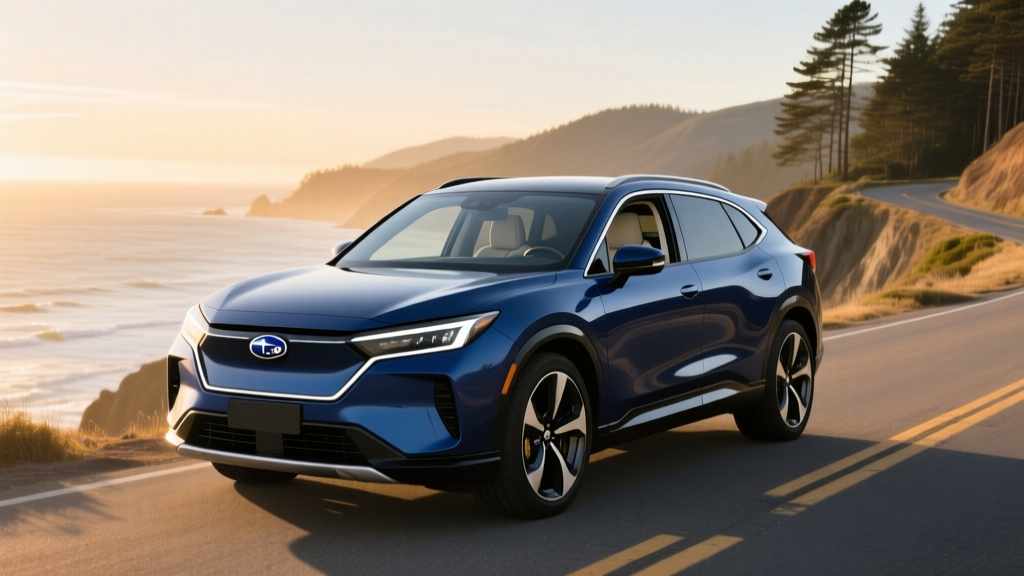
Subaru's only all-electric vehicle is the Solterra, a compact electric SUV co-developed with Toyota (its twin is the bZ4X). For the 2026 model year, the Solterra offers an EPA-estimated 227 to 285 miles of range depending on trim and wheel size, DC fast charging up to 100 kW (10–80% in roughly 35 minutes), and a starting MSRP around $44,995. It qualifies for a partial or full §30D federal tax credit depending on battery-sourcing compliance and your income. It's a solid pick for Subaru loyalists who want standard AWD, 8.3 inches of ground clearance, and real off-road capability in an EV — but its charging speed and highway efficiency lag behind rivals like the Hyundai Ioniq 5 and Tesla Model Y.
2026 Subaru Solterra: Range, Battery, and Efficiency by the Numbers
The Solterra is built on the e-Subaru Global Platform, sharing its core architecture with the Toyota bZ4X. The usable battery capacity is 71.4 kWh (lithium-ion, NMC chemistry), and Subaru offers two drivetrain configurations that materially affect range.
| Spec | Premium / Limited (18" wheels) | Touring (20" wheels) |
|---|---|---|
| EPA Range | 285 miles | 227 miles |
| Battery (usable) | 71.4 kWh NMC | 71.4 kWh NMC |
| Drivetrain | Dual-motor AWD, 215 hp | Dual-motor AWD, 215 hp |
| Combined MPGe | 104 MPGe | 93 MPGe |
| Efficiency | 32 kWh/100 mi | 36 kWh/100 mi |
| 0–60 mph | ~6.5 sec | ~6.5 sec |
| Max DC Fast Charge | 100 kW | 100 kW |
| 10–80% DC Time | ~35 min | ~35 min |
| Level 2 Charge Rate | 7.2 kW | 7.2 kW |
| Ground Clearance | 8.3 in | 8.3 in |
| Cargo Volume | 23.8 cu ft (rear seats up) | 23.8 cu ft |
| Base MSRP | $44,995 | $51,995 |
| Battery Warranty | 8 years / 100,000 miles | |
Real-World Range: What to Actually Expect
The EPA numbers above assume mixed driving at moderate temperatures. Here's what Subaru Solterra owners and independent testers consistently report:
- Highway cruising (70–75 mph, 65°F): Expect ~240 miles on the Premium trim, ~190 miles on Touring. The Solterra's boxy shape and AWD drivetrain create more drag and parasitic loss than sleeker rivals.
- Cold weather (below 32°F): Plan for a 20–30% range reduction. A Premium-trim Solterra rated at 285 miles EPA may deliver 200–225 miles in sustained winter driving. The Solterra does include a battery preconditioning function, but it's less aggressive than Tesla's or Hyundai's systems.
- City / suburban driving (moderate climate): You'll come closest to — or even slightly exceed — the EPA number, thanks to regenerative braking in stop-and-go traffic.
Charging the Subaru Solterra: Home, Public, and the 100 kW Limitation
The Solterra's 100 kW peak DC fast-charge rate is its most debated spec. In a market where the Hyundai Ioniq 5 peaks at 240 kW and the Tesla Model Y at 250 kW, the Solterra charges noticeably slower on road trips. Here's what each charging level looks like in practice:
| Level | Power | Miles Added per Hour | Use Case |
|---|---|---|---|
| Level 1 (120V) | ~1.2 kW | ~4 mi/hr | Emergency / trickle only |
| Level 2 (240V, home) | 7.2 kW | ~24 mi/hr | Daily charging; full charge in ~10 hours |
| DC Fast Charge | 100 kW peak | N/A (timed session) | 10–80% in ~35 min; tapers significantly above 80% |
Charging-curve reality check: The Solterra hits its 100 kW peak only between roughly 10–30% state of charge. By 50% SoC, the rate drops to around 70 kW, and above 80% it falls below 30 kW. A 10–80% session takes about 35 minutes at a capable 150+ kW charger, but if you're using a 50 kW CHAdeMO or older CCS station, plan for 60–90 minutes.
Connector note: The 2026 Solterra uses a CCS1 connector for DC fast charging and a J1772 inlet for Level 2. With Subaru's commitment to adopting NACS (Tesla's connector) in future model years, current CCS owners can access Tesla Superchargers via an approved adapter. Always verify adapter compatibility with Subaru before purchasing.
Solterra vs. Gas Outback: 5-Year Cost Breakdown
The most common cross-shopping question: does going electric save money versus a comparably equipped Subaru Outback? We modeled 5 years / 75,000 miles of ownership using national averages.
| Cost Category | Solterra Premium (EV) | Outback Premium (Gas) |
|---|---|---|
| MSRP (before incentives) | $44,995 | $34,495 |
| Federal tax credit (§30D) | −$3,750 to −$7,500* | $0 |
| Effective purchase price | $37,495–$41,245 | $34,495 |
| Fuel / energy (75k mi) | $2,625 (home L2, $0.14/kWh) | $8,500 (28 MPG avg, $3.17/gal) |
| Maintenance (5 yr) | ~$1,200 | ~$3,100 |
| Insurance (5 yr avg) | ~$9,500 | ~$7,800 |
| Estimated depreciation | ~$18,000 | ~$13,500 |
| 5-Year Total Cost | $68,820–$71,970 | $67,395 |
*§30D credit amount depends on battery critical-mineral and component sourcing requirements, which are phased in annually. Verify current-year eligibility at IRS.gov. The credit is also subject to buyer income caps ($150k single / $300k joint AGI) and MSRP caps ($80k for SUVs). Point-of-sale transfer is available through registered dealers.
The takeaway: Over five years, the Solterra and Outback land in a near-tie on total cost. The EV's fuel and maintenance savings (~$7,800 combined) are largely offset by higher insurance premiums (~$1,700 more) and steeper depreciation. The Solterra pulls ahead in years 6–10 if battery health holds, since maintenance stays minimal and the Outback faces major service intervals (timing components, transmission fluid, exhaust). Your local electricity rate and driving volume are the biggest swing factors.
Tax Credit Eligibility: What Subaru EV Buyers Must Know
§30D Federal EV Tax Credit Checklist (2026 Rules)
- Vehicle MSRP cap: ≤ $80,000 for SUVs (Solterra qualifies on all trims)
- Buyer AGI cap: ≤ $150,000 (single) / $225,000 (head of household) / $300,000 (joint)
- Battery sourcing: Split credit — $3,750 for critical minerals + $3,750 for battery components. Each half has escalating domestic/free-trade-partner sourcing thresholds per IRS guidance.
- Final assembly: Must occur in North America (Solterra is assembled in Japan — this is the key risk factor for eligibility)
- Point-of-sale transfer: Available through IRS-registered dealers, reducing your drive-off price instead of waiting for tax filing
- Verification: Check the VIN on fueleconomy.gov before signing a purchase agreement
Critical caveat for Subaru buyers: The Solterra is manufactured at Toyota's Motomachi plant in Japan. Under current §30D rules, the vehicle must undergo final assembly in North America to qualify for any federal credit. As of early 2026, the Solterra does not meet this requirement, meaning buyers should not expect the $3,750–$7,500 federal credit. Subaru and Toyota have signaled future production shifts, but until confirmed, budget without the federal incentive. Some state-level rebates (California, Colorado, New York, and others) may still apply — check your state's energy office for current programs.
Common Subaru EV Misconceptions — Corrected
| Myth | Fact |
|---|---|
| "Subaru doesn't make an EV." | The Solterra has been on sale since 2023 and is in its 2026 model year. It's a fully electric compact SUV with 215 hp dual-motor AWD. |
| "The range is too low for road trips." | The Premium trim's 285-mile EPA range covers most interstate drives with a single 35-minute DC stop. However, Touring trim at 227 miles requires more planning on 400+ mile routes. |
| "It charges as fast as other EVs." | At 100 kW peak, the Solterra charges roughly 2.5× slower than an Ioniq 5 (240 kW) on DC fast chargers. Road-trip stops take 35 minutes vs. 18 minutes for the fastest competitors. |
| "AWD EVs can't handle real winter conditions." | The Solterra's dual-motor AWD with X-MODE and 8.3 inches of ground clearance outperforms most AWD crossovers in snow. Range loss of 20–30% in sub-freezing temps is real but manageable with route planning. |
| "The battery will need expensive replacement soon." | Subaru warranties the battery at 8 years / 100,000 miles with a capacity-retention threshold of 70%. Industry data from similar NMC packs shows ~10–12% degradation at 100k miles under normal use. |
Who Should Buy the Subaru Solterra — and Who Shouldn't
Subaru EV Decision Framework
Choose the Solterra if:
- You're a current Subaru owner who values brand loyalty, dealer relationships, and the Subaru safety/visibility ethos
- You need genuine off-road capability (8.3" clearance, X-MODE, hill descent) in an EV
- You drive under 200 miles daily and can charge at home overnight on Level 2
- You live in a moderate or cold climate where the Solterra's AWD and heat pump matter
- You prioritize build quality, physical controls, and a traditional SUV layout over touchscreen-centric interiors
Look elsewhere if:
- You take frequent 400+ mile road trips and need the fastest possible DC charging (consider Hyundai Ioniq 5, Kia EV6, or Tesla Model Y)
- You need 300+ miles of real-world highway range (the Tesla Model Y Long Range delivers ~310 highway miles; the Ioniq 5 Long Range AWD delivers ~270)
- You rely entirely on public charging and don't have home/workplace Level 2 access — the Solterra's slower charge rate amplifies public-charging inconvenience
- You want the maximum possible federal tax credit — the Japan assembly currently disqualifies the Solterra from §30D
- Cargo space is paramount — the Solterra's 23.8 cu ft trails the Model Y (30.2 cu ft) and Ioniq 5 (27.2 cu ft) with rear seats up
What First-Time Subaru EV Buyers Should Know Before Signing
1. Home charging is non-negotiable for satisfaction. The Solterra's 7.2 kW Level 2 rate means a full overnight charge adds roughly 240 miles — enough for nearly any daily commute. Budget $800–$2,200 for a quality Level 2 home charger installation (equipment: $400–$700; electrician labor and permit: $400–$1,500). If your home has a 200-amp panel with spare capacity, installation is straightforward. Older 100-amp panels may require a $1,500–$3,000 upgrade — get a licensed electrician's assessment before purchasing.
2. Plan road trips around charging infrastructure. Use apps like PlugShare or A Better Routeplanner to identify DC fast chargers along your route. The Solterra's CCS connector works with Electrify America, EVgo, and ChargePoint networks. In rural areas and national parks — classic Subaru territory — DC fast chargers remain sparse. For remote camping trips, the Solterra's range is adequate for getting there and back to civilization, but don't plan on charging at trailheads.
3. Insurance costs more. EV insurance premiums run 15–25% higher than equivalent gas vehicles, driven by higher repair costs and battery replacement risk. Get quotes from your current insurer and at least two competitors before committing. Some insurers offer EV-specific discounts.
4. The bZ4X twin is worth cross-shopping. The Toyota bZ4X shares the Solterra's platform, battery, and powertrain but starts at a lower MSRP and may have different trim availability. The Solterra adds Subaru's X-MODE off-road software, more aggressive cladding, and standard AWD on all trims (the bZ4X offers FWD on lower trims). Drive both before deciding.
5. Watch for the next-generation Subaru EV. Subaru has announced plans for additional EV models by 2027–2028, including a larger three-row SUV. If you're not in a rush and want more range, faster charging, or a bigger vehicle, waiting may be worthwhile. Any future model assembled in North America would also likely restore §30D tax credit eligibility.
Frequently Asked Questions
Is the Subaru Solterra a good EV for daily commuting?
Yes, if your round-trip commute is under 150 miles and you can charge at home. The Solterra's 7.2 kW Level 2 charger replenishes the battery fully overnight, and its ride quality, visibility, and cabin noise are well-suited to daily driving. The regenerative braking system isn't as strong as one-pedal setups in Tesla or Hyundai, so expect to use the brake pedal normally.
How does the Solterra compare to the Toyota bZ4X?
They share the same 71.4 kWh battery, dual-motor AWD powertrain (215 hp), and charging hardware. The Solterra is standard AWD on all trims, includes X-MODE, and has more rugged exterior styling. The bZ4X starts lower in price and offers a FWD variant. EPA range figures differ slightly due to weight and aerodynamic differences. Both are assembled in Japan.
Can I tow with the Subaru Solterra?
The 2026 Solterra has a maximum towing capacity of 2,000 pounds when properly equipped — enough for a small utility trailer or a pair of dirt bikes, but not a camping trailer or boat. Towing will significantly reduce range, potentially by 30–40% at highway speeds.
What happens if the Solterra's battery degrades?
Subaru's battery warranty guarantees at least 70% capacity retention for 8 years or 100,000 miles, whichever comes first. Real-world data from similar NMC packs suggests 10–15% degradation over 100,000 miles under normal conditions. A full battery replacement, if needed out of warranty, is estimated at $12,000–$18,000 based on current parts pricing for the e-Subaru platform.
Does the Solterra qualify for any tax credits in 2026?
As of early 2026, the Solterra does not qualify for the §30D federal tax credit because final assembly occurs in Japan, not North America. State-level incentives may still apply. Check IRS.gov and your state's energy office for the latest rules. Subaru has not confirmed a timeline for North American assembly.
Is Subaru developing other electric vehicles?
Yes. Subaru has committed to launching several additional BEVs by 2028, including models built on a dedicated next-generation EV platform. Details on range, pricing, and production location remain preliminary. If North American assembly is part of the plan, those future models would likely qualify for the federal tax credit.