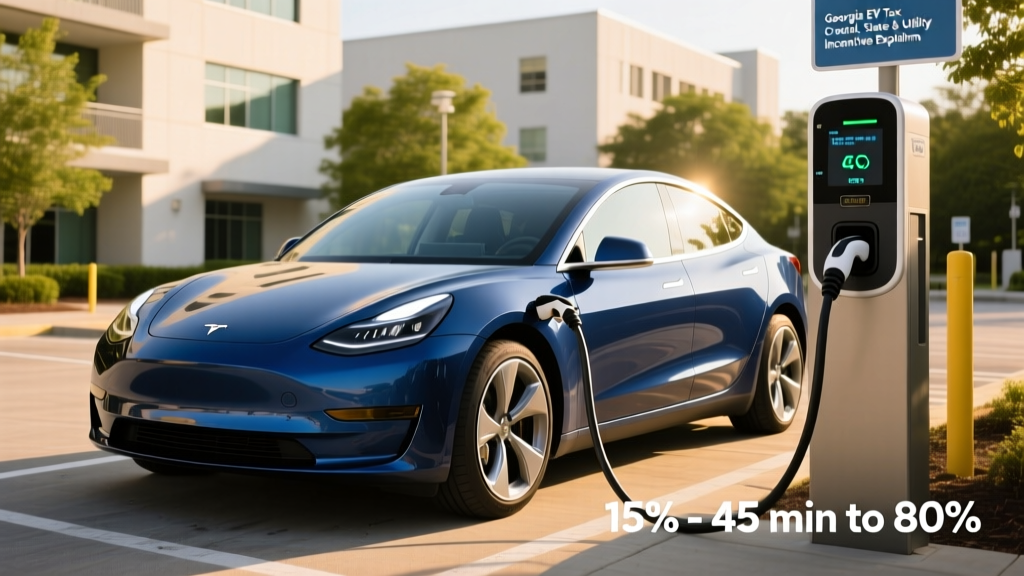
If you're shopping for an electric vehicle in Georgia, you've likely searched for a Georgia EV tax credit and found conflicting or outdated information. Here's the bottom line up front: Georgia no longer offers a state-level EV purchase tax credit. The state's $2,500 credit ended in 2015, and today Georgia actually imposes an annual EV registration fee instead. But Georgia buyers can still access the federal §30D Clean Vehicle Credit (up to $7,500), utility rebates, and significant fuel and maintenance savings that make EV ownership compelling in the Peach State.
This guide breaks down exactly what incentives are available to Georgia EV buyers in 2026, how the federal credit works with its income caps, MSRP limits, and battery-sourcing requirements, and what a realistic five-year total cost of ownership looks like for a Georgia driver compared to a gas vehicle.
Federal §30D Tax Credit: What Georgia Buyers Can Actually Claim
The federal Clean Vehicle Credit under IRS §30D remains the most significant incentive available to Georgia EV shoppers. As of 2026, eligible buyers can receive up to $7,500 applied at the point of sale — meaning you don't need to wait until tax season to benefit. The dealer applies the credit as a reduction in your purchase price or down payment, provided you meet all eligibility requirements.
But qualifying isn't automatic. The credit has multiple stacked requirements that eliminate some buyers and some vehicles:
IRS §30D Eligibility Checklist (2026 Tax Year)
- Buyer income caps: Adjusted gross income must not exceed $300,000 (married filing jointly), $225,000 (head of household), or $150,000 (single/other filers)
- Vehicle MSRP caps: Vans, SUVs, and pickup trucks capped at $80,000 MSRP; sedans and other body styles capped at $55,000 MSRP
- Battery sourcing requirements: The vehicle must meet critical-mineral and battery-component sourcing thresholds that increase annually — in 2026, 80% of critical minerals must be sourced from the U.S. or free-trade-agreement countries, and 100% of battery components must be manufactured or assembled in North America
- Final assembly: Vehicle must undergo final assembly in North America
- Vehicle type: New, previously unregistered plug-in electric vehicle with battery capacity ≥7 kWh
- Transfer election: You may transfer the credit to the dealer at point of sale (effective Jan 1, 2024) or claim it on your federal tax return
The battery-sourcing rules have narrowed the list of qualifying vehicles significantly since 2023. Models like the Tesla Model Y, Ford F-150 Lightning, and certain trims of the Chevrolet Equinox EV have qualified at various points, but the list shifts as automakers restructure supply chains. Always verify current eligibility on fueleconomy.gov before committing to a purchase.
Does Georgia Have Its Own EV Tax Credit or Rebate?
As of 2026, Georgia does not offer a state EV tax credit or purchase rebate. The state previously offered a $2,500 tax credit for zero-emission vehicle purchases, but that program was eliminated effective July 1, 2015, under HB 170.
In fact, Georgia EV owners face an additional annual registration fee. As of recent legislation, electric vehicles are subject to a $214.40 annual fee (in addition to standard registration) intended to offset lost gas-tax revenue. Plug-in hybrids face a reduced fee. This is an ownership cost that Georgia EV buyers should budget for — though it amounts to roughly $17.87/month, which is modest relative to fuel savings.
State and Local Incentives Vary Significantly
While Georgia lacks a state purchase incentive, your specific city, county, or electric utility may offer rebates. Georgia Power, for example, has historically offered off-peak charging rate programs and occasional EV rebates. Municipal utilities like those in Decatur or Clarksville may have separate programs. Always check with your local utility and municipality, as these programs change frequently and are not tracked at the federal level.
Charging vs. Gas: Real $/Mile Cost in Georgia
The strongest financial argument for going electric in Georgia is fuel savings. Georgia's average residential electricity rate in 2026 hovers around $0.135/kWh, while regular unleaded gasoline averages approximately $3.15/gallon. Let's run the math on a realistic comparison.
| Metric | EV (e.g., Hyundai Ioniq 5) | Gas Car (e.g., Toyota RAV4) |
|---|---|---|
| Energy Efficiency | 3.6 mi/kWh (120 MPGe) | 30 MPG combined |
| Fuel/Energy Cost | $0.135/kWh (GA home avg) | $3.15/gal (GA avg) |
| Cost Per Mile | $0.038/mile | $0.105/mile |
| Annual Cost (12,000 mi) | $456 | $1,260 |
| 5-Year Fuel Cost | $2,280 | $6,300 |
Assumes 100% home Level 2 charging at Georgia residential rates. Public DC fast charging at $0.35–$0.48/kWh will increase EV costs for road trips. Gas prices and electricity rates fluctuate.
Over five years, a Georgia EV driver charging primarily at home saves roughly $4,020 in fuel costs compared to a comparable gas vehicle. If you have access to off-peak charging rates through Georgia Power's Plug-in Electric Vehicle rate plan, your per-kWh cost could drop to around $0.06–$0.09/kWh overnight, pushing your cost per mile below $0.03.
However, if you rely heavily on public DC fast charging — say, at Electrify America or EVgo stations in metro Atlanta — your cost per mile rises to $0.09–$0.13/mile, which narrows or eliminates the advantage. Home charging access remains the single biggest factor in EV economics.
Maintenance Savings: Fewer Parts, Less Spending
EVs eliminate entire categories of routine maintenance. No oil changes, no spark plugs, no timing belts, no transmission fluid, no exhaust system repairs. Regenerative braking dramatically extends brake pad and rotor life — many EV owners report original brake pads lasting 80,000–100,000+ miles.
| Maintenance Item | Gas Vehicle (5 yr / 60k mi) | EV (5 yr / 60k mi) |
|---|---|---|
| Oil Changes | $600–$900 (6–10 changes) | $0 |
| Brake Pads & Rotors | $600–$1,200 (1–2 replacements) | $0–$200 (rarely needed) |
| Transmission Fluid/Service | $200–$500 | $0 |
| Spark Plugs / Ignition | $200–$400 | $0 |
| Coolant / Filters | $300–$500 | $100–$200 |
| Tire Rotation & Replacement | $800–$1,400 | $900–$1,600 (EVs wear tires faster due to weight & torque) |
| Cabin Air Filter / Wipers | $150–$250 | $150–$250 |
| Total Estimated | $2,850–$5,150 | $1,150–$2,250 |
The net maintenance savings for an EV over five years is typically $1,700–$2,900. The one area where EVs can cost more is tires — the additional vehicle weight and instant torque wear tires faster, and EV-specific tires (like Michelin e.Primacy or Hankook iON) carry a premium.
Insurance Cost Reality: Why EVs Cost More to Insure
This is the line item that catches many new EV owners off guard. EV insurance premiums are typically 15–25% higher than equivalent gas vehicles, according to industry data. There are concrete reasons for this:
- Higher repair costs: EV battery packs are expensive to replace if damaged. Even minor collision damage near the battery enclosure can trigger a total-loss declaration.
- Specialized labor: Fewer body shops have high-voltage certification, limiting repair options and increasing labor rates.
- Higher vehicle values: EVs generally have higher MSRPs than comparable gas vehicles, increasing comprehensive and collision coverage costs.
- Rapid depreciation uncertainty: Insurers factor in uncertain resale values when pricing total-loss payouts.
For a Georgia driver, expect annual EV insurance to run $1,800–$2,600 depending on the model, your driving record, and coverage level — compared to $1,400–$2,100 for a similar gas vehicle. That's roughly $300–$600/year more. Shop quotes from multiple carriers; some insurers like State Farm and Progressive have begun offering EV-specific policies, and Tesla Insurance is available in Georgia for Tesla owners.
EV Depreciation: The Biggest Cost Variable
Depreciation is the single largest ownership cost for any vehicle, and EVs have experienced more volatility than gas cars in recent years. In 2023–2024, Tesla's aggressive price cuts cascaded through the used EV market, causing some models to lose 40–50% of their value in the first two years. By 2025–2026, the market has stabilized somewhat, but EV depreciation remains a concern.
Current five-year depreciation expectations for mainstream EVs:
- Tesla Model Y / Model 3: 45–55% depreciation over 5 years (improved from 2023–2024 lows but still steep)
- Hyundai Ioniq 5 / Kia EV6: 40–50% depreciation over 5 years
- Ford F-150 Lightning: 35–45% depreciation over 5 years (truck segment holds value better)
- Chevrolet Equinox EV: 45–55% (newer model, limited data)
- Comparable gas vehicles: 35–45% average over 5 years
The broader EV market is still normalizing. Factors working against EV resale values include rapid technology improvements in newer models, battery degradation concerns among used buyers, and the fact that federal tax credits effectively reduce the "real" purchase price — which resets depreciation expectations. On the plus side, as EV adoption grows and charging infrastructure matures, mainstream acceptance should support stronger residual values over time.
Five-Year Total Cost of Ownership: Georgia EV vs. Gas
Let's synthesize all of this into a realistic five-year TCO for a Georgia driver comparing a mid-range EV crossover (like the Hyundai Ioniq 5 SEL at ~$47,500 MSRP) against a comparable gas crossover (like the Toyota RAV4 XLE at ~$34,000 MSRP). We'll assume 12,000 miles/year, home charging, and the buyer qualifies for the full $7,500 federal credit applied at point of sale.
| Cost Category | EV (Ioniq 5 SEL) | Gas (RAV4 XLE) |
|---|---|---|
| Purchase Price (MSRP) | $47,500 | $34,000 |
| Federal Tax Credit (§30D) | −$7,500 | $0 |
| Effective Purchase Price | $40,000 | $34,000 |
| Georgia EV Registration Fee (5 yr) | $1,072 | $0 |
| Fuel / Energy (5 yr) | $2,280 | $6,300 |
| Maintenance (5 yr) | $1,700 | $3,800 |
| Insurance (5 yr) | $11,000 | $8,750 |
| Estimated Resale Value (Year 5) | $22,000 | $20,400 |
| Depreciation | $18,000 | $13,600 |
| Total 5-Year Net Cost | $34,052 | $32,450 |
In this scenario, the EV's five-year total cost is within roughly $1,600 of the gas vehicle — despite a $13,500 higher sticker price before incentives. The federal tax credit, fuel savings, and maintenance savings nearly close the gap. The remaining difference is largely attributable to higher insurance premiums and the EV registration fee.
Several factors could tip this comparison in either direction:
- If gas prices rise to $4+/gal: The EV pulls ahead by $1,000–$2,000 over five years.
- If you charge on off-peak utility rates: Add another $500–$800 in fuel savings.
- If EV depreciation improves as the market matures: The gap narrows or reverses.
- If you don't qualify for the federal credit: The EV costs $7,500+ more over five years.
Frequently Asked Questions
Is there a Georgia state EV tax credit in 2026?
No. Georgia eliminated its $2,500 state EV tax credit in 2015. The state currently imposes an additional annual EV registration fee of approximately $214.40 instead. Georgia EV buyers should focus on the federal §30D credit (up to $7,500) and any local utility rebates.
How much does it really cost to own an EV over 5 years in Georgia?
Based on our analysis, a mid-range EV crossover costs roughly $34,000–$36,000 over five years including purchase (net of tax credit), fuel, maintenance, insurance, registration fees, and depreciation. A comparable gas vehicle costs roughly $32,000–$34,000 over the same period. The gap is narrow and highly dependent on your electricity rates, gas prices, insurance quotes, and whether you qualify for the federal credit.
Do I qualify for the federal $7,500 EV tax credit?
You may qualify if your AGI is below $150,000 (single) or $300,000 (married filing jointly), the vehicle MSRP is under $80,000 (SUV/truck) or $55,000 (sedan), the vehicle meets 2026 battery-sourcing and critical-mineral requirements, and it was assembled in North America. Check current eligibility on fueleconomy.gov and consult a tax professional for your specific situation.
How much do I save on fuel and maintenance with an EV?
A Georgia EV owner charging at home at $0.135/kWh saves approximately $4,000 on fuel over five years compared to a 30-MPG gas vehicle. Maintenance savings add another $1,700–$2,900 over the same period. Combined, that's roughly $5,700–$6,900 in operational savings over five years.
Are EVs more expensive to insure in Georgia?
Yes, typically 15–25% more expensive than comparable gas vehicles. Expect to pay $300–$600 more per year for EV insurance due to higher repair costs, specialized labor requirements, and elevated vehicle values. Get quotes from multiple insurers before purchasing.
How well do EVs hold their value?
EV depreciation has been steeper than gas vehicles, with mainstream models losing 40–55% of their value over five years compared to 35–45% for gas vehicles. The used EV market has stabilized since the 2023–2024 price correction, but rapid technology advances and battery health concerns continue to pressure residuals. Trucks like the F-150 Lightning tend to hold value better than sedans.
Does Georgia Power offer EV rebates or special rates?
Georgia Power has historically offered a Plug-in Electric Vehicle time-of-use rate plan that provides significantly lower per-kWh pricing during off-peak overnight hours (roughly $0.06–$0.09/kWh vs. $0.135 standard). Contact Georgia Power directly or visit their website for current program availability, as utility incentive programs change annually.