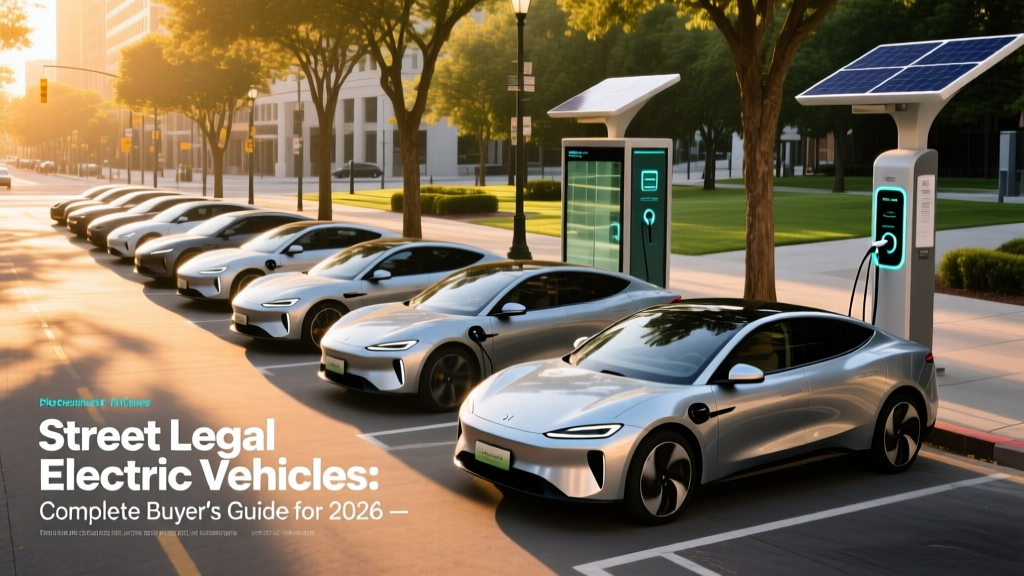
Quick Answer: What Are Street Legal Electric Vehicles?
Street legal electric vehicles are fully road-registered battery electric vehicles (BEVs), plug-in hybrids (PHEVs), and standard hybrids (HEVs) that meet all Federal Motor Vehicle Safety Standards (FMVSS), carry proper DOT/EPA certification, and can be legally driven on any public road in the United States. Unlike Neighborhood Electric Vehicles (NEVs) — which are limited to 25 mph and restricted roads — street legal EVs have no speed or access restrictions. In 2026, over 80 street legal EV models are available new from major automakers, with EPA ranges from 114 miles (MINI Cooper SE) to 402 miles (Lucid Air Grand Touring), and base MSRPs ranging from roughly $28,000 to over $100,000.
If you've been searching for street legal electric vehicles, you're likely trying to separate highway-capable, fully certified EVs from low-speed neighborhood carts, converted golf carts, or kit cars that can't legally be driven on most roads. This guide covers exactly what qualifies, what it costs to buy and own one, how EVs compare to gas and hybrid alternatives, and what first-time buyers need to know before signing a purchase agreement.
What Makes an EV Street Legal? The Real Requirements
Every street legal electric vehicle sold in the United States must satisfy a layered set of federal and state requirements. At the federal level, the National Highway Traffic Safety Administration (NHTSA) enforces FMVSS compliance — covering crashworthiness, lighting, braking, airbags, seatbelts, and electronic stability control. The EPA separately certifies emissions (or zero-emissions status for BEVs) and publishes official range and efficiency figures at fueleconomy.gov.
At the state level, street legal EVs must carry a valid title, registration, license plates, and meet state inspection requirements where applicable. Insurance is mandatory in every state except New Hampshire and Virginia (which have alternative financial-responsibility rules).
Street Legal EVs vs. NEVs and LSVs
Neighborhood Electric Vehicles (NEVs) and Low-Speed Vehicles (LSVs) are federally classified under FMVSS 500 and are limited to a top speed of 25 mph. They lack airbags, crash structures, and highway capability. They are legal only on roads with speed limits of 35 mph or less (varies by state). Brands like GEM, Club Car, and various imported micro-carts fall into this category.
By contrast, every mainstream EV from Tesla, Hyundai, Ford, Chevrolet, BMW, Rivian, Kia, and others is a full passenger vehicle with no road-access restrictions. If a vehicle has a standard 17-character VIN, passes FMVSS, and can be registered at your local DMV without special low-speed restrictions, it is a street legal electric vehicle.
The Cost Reality: Street Legal EVs vs. Gas Cars in 2026
The most common question from first-time EV buyers is whether the higher sticker price is offset by fuel and maintenance savings. The answer depends heavily on your electricity rate, annual mileage, and whether you qualify for the federal EV tax credit under IRS §30D.
| Category | 2026 Hyundai Ioniq 6 SE (BEV) | 2026 Toyota Camry LE (Gas) | 2026 Toyota Camry SE Hybrid |
|---|---|---|---|
| Base MSRP | $38,650 | $29,995 | $33,495 |
| Fed. Tax Credit (est.) | Up to $7,500* | $0 | Up to $7,500* |
| Effective Purchase Price | $31,150 | $29,995 | $25,995 |
| Fuel/Energy (60k mi) | $3,360 (home, $0.14/kWh) | $8,550 ($3.50/gal, 32 MPG) | $5,250 ($3.50/gal, 52 MPG) |
| Maintenance (5 yr) | $1,800 | $3,600 | $3,400 |
| Insurance (5 yr avg) | $9,500 | $7,200 | $7,400 |
| 5-Year Total Cost | $45,810 | $49,345 | $44,045 |
| Cost Per Mile | $0.76 | $0.82 | $0.73 |
*Federal §30D tax credit eligibility depends on MSRP caps ($55,000 sedans), buyer income limits ($150k single / $300k joint), battery critical-mineral and component sourcing, and point-of-sale transfer availability. Verify current rules at irs.gov and consult a tax professional.
Where EVs Save Money
Electricity costs roughly one-third to one-half of gasoline per mile when charging at home on a standard residential rate. Maintenance is dramatically lower — no oil changes, no spark plugs, no transmission fluid, no exhaust system. Brake wear is significantly reduced thanks to regenerative braking, which uses the motor to slow the vehicle and recapture energy into the battery.
Where EVs Cost More
Insurance premiums for EVs average 15–30% higher than comparable gas cars, driven by higher repair costs for battery and structural components, specialized labor, and elevated parts pricing. Upfront purchase price remains higher for most EV segments, though the gap continues to narrow. Public DC fast charging at networks like Electrify America or EVgo typically costs $0.35–$0.55 per kWh — reducing or eliminating the fuel-cost advantage if you can't charge at home.
Range, Charging, and Real-World Ownership Considerations
Marketing range figures and real-world driving range are rarely the same number. The EPA test cycle includes city and highway segments with moderate temperatures, but actual range depends on speed, elevation, temperature, HVAC use, and battery preconditioning.
EPA Range vs. Real-World Expectations
As a rule of thumb for 2026 BEVs:
- City / moderate weather: Expect 95–105% of EPA range
- Highway (70–80 mph): Expect 75–85% of EPA range
- Cold weather (below 30°F): Expect 60–75% of EPA range, worst-case with cabin heating and no heat pump
- Towing: Expect 40–55% of EPA range depending on trailer weight and aerodynamics
| Charging Level | Power (kW) | Typical Miles Added/Hour | Use Case |
|---|---|---|---|
| Level 1 (120V household) | 1.0–1.4 kW | 3–5 mi/hr | Overnight top-up, PHEVs, low-mileage drivers |
| Level 2 (240V home/public) | 7.2–19.2 kW | 25–65 mi/hr | Daily home charging, workplace, destination |
| DC Fast Charge (public) | 50–350 kW | 150–1,200 mi/hr (peak) | Road trips, highway corridors, quick top-ups |
A critical distinction for new buyers: kW (kilowatts) measures power — how fast energy flows into the battery. kWh (kilowatt-hours) measures energy capacity — the total amount stored. Think of kW as the width of the hose and kWh as the size of the tank. A 77 kWh battery charged at a peak rate of 235 kW (like the Hyundai Ioniq 5) can reach 10–80% in approximately 18 minutes under ideal conditions, but the charge curve tapers significantly above 80% to protect battery health. Sustained peak rates only apply in the 10–50% SoC window.
Home Charging Access: The Make-or-Break Factor
Home Level 2 charging is the backbone of practical EV ownership. A 240V Level 2 charger (typically 32–48 amps, 7.7–11.5 kW) fully replenishes most EVs overnight. Installation costs vary widely:
- Simple install (panel nearby, no upgrade): $500–$1,200
- Moderate install (long conduit run): $1,200–$2,500
- Panel upgrade required (100A → 200A): $2,500–$5,000+
Renters and condo owners without dedicated parking face a genuine barrier. If you cannot install or access reliable Level 2 charging at home or work, a PHEV or HEV may be more practical than a BEV until public infrastructure in your area improves.
Street Legal EV vs. Gas vs. Hybrid: Which Is Right for You?
| Myth | Fact |
|---|---|
| "EV batteries need replacing every 5 years" | Federal law mandates 8-year/100,000-mile battery warranty (10 years in CARB states). Data from Recurrent Auto shows average 2023-era packs retain ~90% capacity at 100,000 miles. Full replacement runs $8,000–$20,000 if needed out of warranty. |
| "EVs are worse in cold weather" | Range drops 15–40% in sub-freezing temps, but EVs start instantly, produce cabin heat via heat pump or resistance, and can precondition while plugged in. Gas cars also lose efficiency in cold weather, just less visibly. |
| "EVs are worse for the environment because of the grid" | Even on coal-heavy grids, a BEV produces fewer lifetime CO₂ emissions than a comparable gas car (Union of Concerned Scientists data). As the grid decarbonizes, the advantage grows. |
| "You can't take an EV on a road trip" | With DC fast-charging networks like Tesla Supercharger, Electrify America, and EVgo now offering 150–350 kW stations across major corridors, a 500-mile trip adds 30–50 minutes of charging. Planning apps like A Better Routeplanner make this straightforward. |
| "All EVs qualify for the $7,500 tax credit" | Fewer than half of new EVs sold qualify due to battery-sourcing, critical-mineral, MSRP, and buyer-income rules under §30D. Always verify on fueleconomy.gov before purchasing. |
First-Time EV Buyer Decision Framework
Which Electrified Vehicle Type Fits Your Situation?
Choose a BEV (full electric) if:
- You have reliable Level 2 home or workplace charging
- Your daily commute is under 80 miles round-trip
- You want the lowest per-mile operating cost and minimal maintenance
- You take road trips 3 or fewer times per year and can plan DCFC stops
- You qualify for federal or state EV incentives that close the price gap
Choose a PHEV (plug-in hybrid) if:
- You have home charging but also take frequent long road trips
- You want 25–45 miles of electric-only range for commuting with a gas backup
- You live in an area with limited DC fast-charging infrastructure
- You want EV-like daily driving without any range anxiety
Choose an HEV (standard hybrid) if:
- You cannot charge at home or work (apartment, street parking, no outlet access)
- You want better fuel economy without changing your fueling habits
- You drive high annual mileage and want to minimize fuel cost without plugging in
Stick with gas (for now) if:
- You regularly tow heavy loads over long distances in cold or remote areas
- Your budget is under $25,000 and you need a reliable used vehicle today
- You drive fewer than 5,000 miles per year and the fuel savings don't offset a higher purchase price
Top Street Legal Electric Vehicles to Consider in 2026
Here are six widely available, fully street legal electric vehicles spanning different segments, with exact EPA figures and pricing:
| Model | EPA Range | Battery (kWh) | Peak DC Charge | 10–80% | 0–60 mph | Base MSRP |
|---|---|---|---|---|---|---|
| Chevrolet Equinox EV 2LT | 319 mi | 85 kWh (NMC) | 150 kW | ~32 min | 7.8 sec | $33,600 |
| Hyundai Ioniq 5 SE | 318 mi | 77.4 kWh (NMC) | 235 kW | ~18 min | 7.4 sec | $42,600 |
| Tesla Model Y Long Range | 320 mi | 78.1 kWh (NMC) | 250 kW | ~22 min | 4.8 sec | $44,990 |
| Ford F-150 Lightning XLT | 240 mi (std) / 320 mi (ext) | 98 / 131 kWh (NMC) | 150 kW | ~38 / 44 min | 4.0 sec (ext) | $54,995 |
| Kia EV6 Wind AWD | 282 mi | 77.4 kWh (NMC) | 235 kW | ~18 min | 5.1 sec | $47,700 |
| Rivian R1S Dual-Motor | 352 mi (Max Pack) | 141 kWh (NMC) | 200 kW | ~42 min | 4.5 sec | $79,900 |
All models above are fully FMVSS-compliant, carry standard 17-character VINs, are eligible for registration in all 50 states, and are currently available for purchase. Battery and powertrain warranties are a minimum of 8 years / 100,000 miles as federally mandated, with some brands offering longer coverage.
Frequently Asked Questions
Are converted gas cars street legal as electric vehicles?
Yes, but only if the conversion meets state inspection and registration requirements. Most states require a rebuilt or reconstructed vehicle title, a state police or DMV inspection, proof that all original safety equipment (lights, wipers, mirrors, seatbelts) remains functional, and updated weight and classification data. Insurance can be difficult to obtain for conversions. Factory-built EVs from established manufacturers avoid all of these hurdles.
Can I buy a street legal electric vehicle from China and drive it in the US?
Only if the vehicle has been certified to FMVSS by the manufacturer and imported through a registered importer (RI). Most Chinese-market EVs (BYD, NIO, Xpeng) are not FMVSS-certified for US sale as of 2026 and cannot be legally imported for road use. Gray-market imports face seizure by CBP. The exception is vehicles over 25 years old, which are exempt from FMVSS under the NHTSA import rule.
Do street legal EVs require special insurance?
No special policy type is required — standard auto insurance covers EVs. However, premiums are typically 15–30% higher than equivalent gas cars due to battery replacement costs, specialized repair networks, and higher parts pricing. Some insurers offer EV-specific discounts or battery-coverage riders. Shop quotes from GEICO, Progressive, State Farm, and EV-focused carriers like Lemonade or Root before purchasing.
What happens if my EV battery degrades?
Federal law requires manufacturers to warrant the battery for at least 8 years or 100,000 miles (10 years/150,000 miles in CARB states like California, New York, and Massachusetts). The warranty typically guarantees the battery will retain at least 70% of original capacity. Real-world degradation data from Recurrent Auto shows most modern NMC and LFP packs lose only 5–12% capacity in the first 100,000 miles. Out-of-warranty replacement costs range from $8,000 for smaller packs to $20,000+ for large packs like the Ford F-150 Lightning extended-range.
What's the cheapest street legal electric vehicle I can buy new in 2026?
The Nissan LEAF S starts at approximately $28,140 with 149 miles of EPA range and uses the older CHAdeMO DC charging standard (limited to 50 kW peak). The Chevrolet Equinox EV 2LT at $33,600 offers 319 miles of range and CCS charging, making it the more practical value for most buyers despite the higher sticker. Used EVs under $20,000 include older LEAFs, first-gen Chevrolet Bolts, and early BMW i3 models — but check battery State of Health (SoH) before purchasing.
Do I need a special license to drive an electric vehicle?
No. A standard state driver's license is all that's required. Street legal EVs are classified identically to gas cars for licensing purposes. No EV-specific endorsement or training is mandated in any US state.