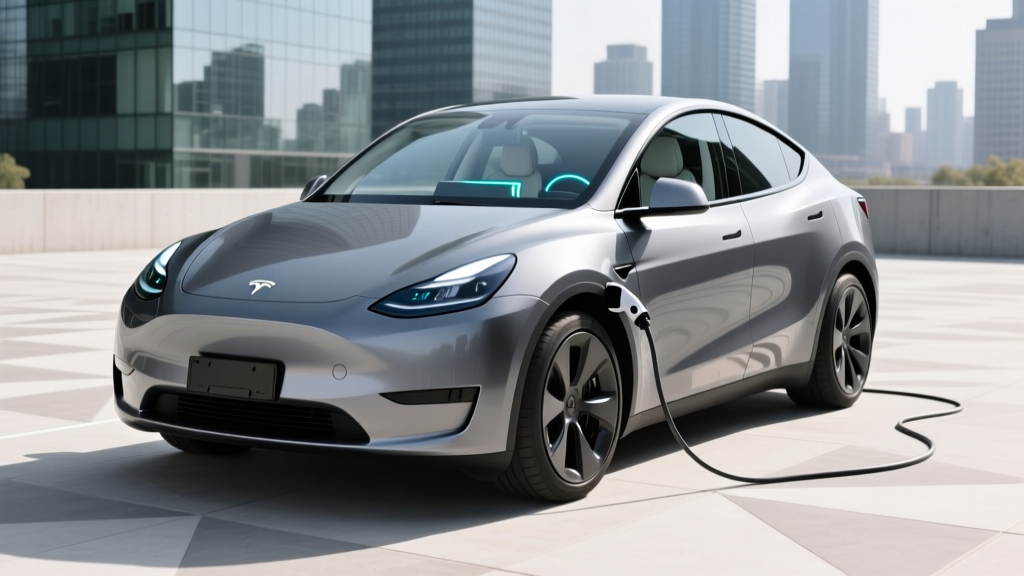
The Stealth Grey Tesla Model Y has become one of the most frequently configured variants of Tesla's best-selling crossover since the Juniper refresh landed in showrooms. The muted, graphite-leaning hue pairs well with the Model Y's cleaner surfacing and slimmed lighting signatures, giving the SUV a slightly more understated presence than the polarizing white or bold red options. But paint is only skin deep — what matters to an EV buyer is whether the 2026 Model Y Long Range AWD underneath that Stealth Grey coat delivers on range, charging speed, and daily usability.
This review covers the 2026 Tesla Model Y Long Range AWD in full: EPA range versus real-world expectations, DC fast-charging behavior, home charging practicalities, tax-credit eligibility under current IRS §30D rules, and how it stacks up against the Hyundai Ioniq 5, Ford Mustang Mach-E, and Kia EV6.
2026 Tesla Model Y Long Range AWD: Key Specifications
| Specification | 2026 Model Y Long Range AWD |
|---|---|
| EPA Range | 320 miles |
| Usable Battery Capacity | ~75 kWh (NMC chemistry) |
| Drivetrain | Dual-Motor AWD |
| Horsepower | 384 hp (combined) |
| 0–60 mph | 4.8 seconds |
| Max DC Fast-Charge Rate | 250 kW (peak) |
| 10–80% DC Fast Charge | ~24 minutes |
| Level 2 Home Charging | 11.5 kW (~44 mi/hr) |
| Efficiency | 122 MPGe combined / 28 kWh/100 mi |
| Cargo Volume (rear seats up / folded) | 30.2 / 72.1 cu ft |
| Rear Legroom | 41.6 in |
| Battery & Drive Unit Warranty | 8 years / 120,000 miles |
| Base MSRP (excl. destination) | $44,990 |
Range & Efficiency: EPA vs. the Real World
The EPA rates the 2026 Model Y Long Range AWD at 320 miles on a full charge. That figure is competitive within the segment — the Ioniq 5 Long Range AWD sits at 290 miles, while the Mach-E Extended Range AWD reaches 312 miles. Tesla's efficiency advantage comes from its heat-pump standard thermal management system, a low-drag Juniper body, and aggressive regenerative braking calibration.
- City / mixed commuting (55–70°F): 305–325 miles — you'll often match or slightly beat the EPA sticker in stop-and-go driving where regen recovers energy.
- Highway cruising (70–80 mph, 70°F): 265–285 miles — sustained high-speed driving cuts range roughly 12–17% below EPA.
- Cold weather (20–35°F, highway): 220–250 miles — expect 22–30% range loss in freezing temps even with the heat pump preconditioning the cabin and battery.
- Worst-case (sub-20°F, mountain highway, full HVAC): ~200 miles — plan charging stops conservatively in deep winter.
Source: EPA fueleconomy.gov
The Juniper Model Y's 75 kWh (usable) NMC battery pack prioritizes energy density over the cycle-life advantages of LFP chemistry found in the base RWD Model Y. If your priority is maximum daily range and cold-weather performance, the Long Range AWD's NMC pack is the right choice. If you want a lower-cost daily driver you can charge to 100% without long-term degradation concerns, the RWD's LFP pack may suit you better — though you sacrifice roughly 50 miles of range and the second motor.
Charging Speed: DC Fast, Level 2, and the Charge Curve Reality
Tesla's 250 kW peak DC fast-charging capability on the Model Y Long Range remains segment-competitive, though rivals like the Ioniq 5 (350 kW peak on 800V architecture) and the 2026 Kia EV6 (up to 350 kW) have leapfrogged in peak rate. The more meaningful metric is the 10–80% time and the sustained charging curve, not the headline peak number.
| Charging Level | Power | Speed / Notes |
|---|---|---|
| Level 1 (120V household) | ~1.4 kW | ~5 miles of range per hour — emergency/trickle only |
| Level 2 (240V, 48A Wall Connector) | 11.5 kW | ~44 miles per hour; full charge in ~7 hours |
| DC Fast (Tesla Supercharger V3) | Up to 250 kW peak | 10–80% in ~24 min; tapers to ~60 kW above 80% |
| DC Fast (Supercharger V4 / CCS adapter) | Up to 250 kW | Same curve; NACS native on 2026 models |
Charge curve reality check: The Model Y Long Range will sustain roughly 200–250 kW between 10% and 35% State of Charge (SoC), then taper progressively. By 60% SoC, expect ~120 kW; by 80%, ~60 kW. Charging from 80–100% at a DC fast charger is painfully slow — plan to unplug at 80% on road trips and move on. The 24-minute 10–80% time assumes battery preconditioning is active, which happens automatically when you navigate to a Supercharger in the Tesla infotainment system.
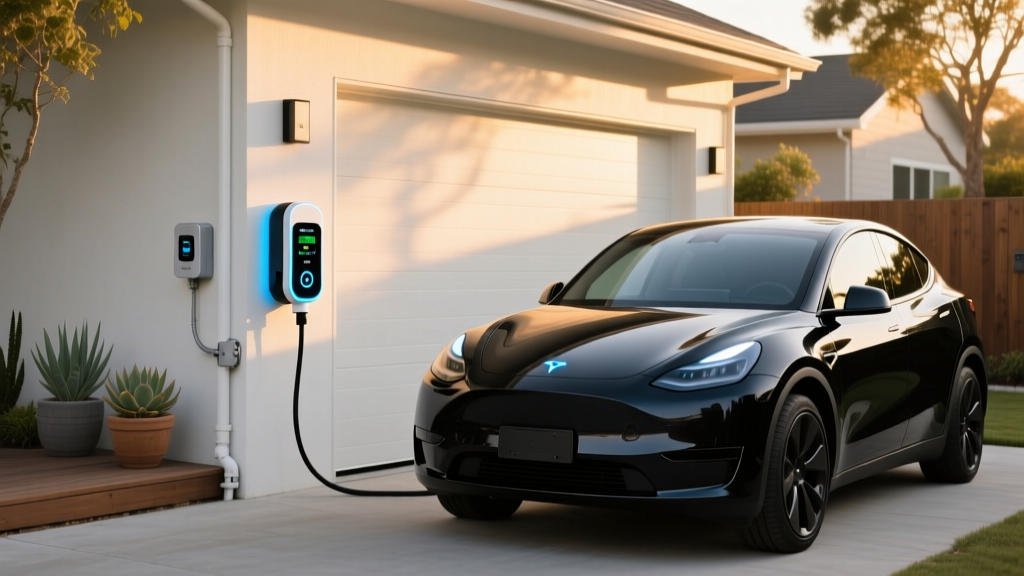
For home charging, the Tesla Wall Connector at 48 amps on a 60A circuit delivers the full 11.5 kW the Model Y's onboard charger can accept. A typical overnight session from 30% to 80% takes about 3.5 hours — more than sufficient for daily use. Installation costs for a 240V/60A circuit typically run $800–$2,000 depending on panel proximity and local permit requirements; a panel upgrade to 200A service can add $2,000–$4,000 if your home has older 100A service.
Performance & Driving Dynamics
The dual-motor AWD powertrain produces 384 hp and delivers a 4.8-second 0–60 mph time — quick enough to merge confidently onto any freeway and entertaining on back roads, though it's no Model Y Performance (3.5 seconds). The Juniper refresh brought revised suspension tuning with frequency-selective dampers, and the result is a noticeably more compliant ride than the pre-2025 Model Y, which drew frequent criticism for harshness over broken pavement.
Steering remains precise if artificially light, and the low center of gravity from the floor-mounted battery keeps body roll well-controlled. One-pedal driving via Tesla's strong regenerative braking mode is intuitive after a day of acclimation. The Model Y's 3,500-pound towing capacity (with the optional tow hitch) is adequate for a small utility trailer or a pair of dirt bikes but falls short of the Ford F-150 Lightning or Rivian R1S for serious hauling.
Interior, Cargo & Technology
The Juniper interior is a meaningful step up from the pre-refresh Model Y. Materials are softer, ambient lighting is standard, and the ventilated front seats are a welcome addition for warm-climate buyers. Rear-seat passengers get 41.6 inches of legroom — competitive with the Ioniq 5 (39.4 in) and generous enough for adult passengers on long trips.
Cargo volume is a Model Y stronghold: 30.2 cubic feet behind the second row and 72.1 cubic feet with seats folded. The rear trunk opening is wide and low-lift, and the front trunk (frunk) adds roughly 4.1 cubic feet for charging cables or a soft bag. For a family of four on a week-long road trip, the Model Y swallows luggage without a roof box.
The 15.4-inch center touchscreen handles all infotainment, climate, and vehicle controls — there are no physical buttons beyond the steering-wheel stalks and scroll wheels. This minimalist approach divides opinion. Wireless phone charging, a 17-speaker audio system, and Netflix/YouTube streaming (while parked) are standard. Tesla's native NACS charge port means direct Supercharger access without adapters — a genuine convenience advantage in 2026 as the Supercharger network remains the most reliable DC fast-charging ecosystem in the U.S.
Autopilot and FSD (Supervised): Every Model Y ships with basic Autopilot (lane-centering and adaptive cruise). The $8,000 FSD (Supervised) upgrade adds automated lane changes, traffic-light recognition, and city-street navigation — but this remains a SAE Level 2 driver-assistance system. You must keep your hands on the wheel and eyes on the road at all times. Tesla's cabin camera monitors attentiveness and will issue escalating warnings if you look away.
Tesla Autopilot and FSD (Supervised) require continuous driver engagement. The system does not make the Model Y a self-driving vehicle. You are legally and operationally responsible for steering, braking, and monitoring traffic at all times. Only Level 4 services like Waymo operate without a human driver in defined geofenced areas.
Pricing, Tax Credits & Total Cost
The 2026 Model Y Long Range AWD starts at $44,990 (MSRP, excluding the $1,390 destination fee). The Stealth Grey paint is a $0 no-cost color option — one of several standard colors Tesla introduced with the Juniper refresh. Upgrading to 20-inch wheels adds $2,000 but reduces EPA range by roughly 15 miles. The FSD (Supervised) package adds $8,000 if purchased upfront.
| Configuration | MSRP | Est. Federal Credit | Effective Price |
|---|---|---|---|
| LR AWD (Stealth Grey, 19" wheels) | $46,380 (incl. dest.) | Up to $7,500* | ~$38,880 |
| LR AWD + FSD (Supervised) | $54,380 | Up to $7,500* | ~$46,880 |
| LR AWD + 20" wheels | $48,380 | Up to $7,500* | ~$40,880 |
*Federal EV Tax Credit (IRS §30D) eligibility for 2026: The Model Y Long Range AWD qualifies for up to $7,500 under current rules, but eligibility depends on multiple factors:
- MSRP cap: SUVs must be under $80,000 — the Model Y clears this easily.
- Buyer income cap: Modified AGI must not exceed $150,000 (single), $225,000 (head of household), or $300,000 (joint filers).
- Battery sourcing: Critical minerals and battery components must meet phased-in domestic/free-trade-agreement sourcing thresholds. Tesla's U.S.-built Model Y has consistently met these requirements, but verify at fueleconomy.gov before purchasing, as sourcing rules tighten annually.
- Point-of-sale transfer: You can transfer the credit to the dealer at purchase to reduce your out-of-pocket cost immediately, rather than waiting to claim it on your tax return.
Source: IRS.gov — Clean Vehicle Credits
Model Y vs. Key Competitors: Who Wins Where?
| Attribute | Tesla Model Y LR AWD | Hyundai Ioniq 5 LR AWD | Ford Mach-E ER AWD |
|---|---|---|---|
| EPA Range | 320 mi | 290 mi | 312 mi |
| Max DC Charge | 250 kW | 350 kW (800V) | 150 kW |
| 10–80% Time | ~24 min | ~18 min | ~37 min |
| 0–60 mph | 4.8 sec | 5.1 sec | 5.1 sec |
| Base MSRP | $44,990 | $49,950 | $48,995 |
| Cargo (rear up) | 30.2 cu ft | 27.2 cu ft | 29.7 cu ft |
| Charging Network | Native Supercharger | NACS (adapter/V2+) | NACS (adapter) |
The Model Y wins on: range, cargo space, native Supercharger access, efficiency (MPGe), and price. It remains the default pick for buyers who prioritize road-trip charging convenience and lowest cost per mile.
The Ioniq 5 wins on: peak DC charging speed (800V architecture is meaningfully faster at compatible 350 kW stations), interior design originality, and physical button retention for climate controls.
The Mach-E wins on: driving engagement — its chassis tuning feels more like a traditional sporty crossover, and Ford's dealership network provides in-person service access that Tesla's mobile-ranger-dependent model can't always match quickly.
Warranty & Long-Term Ownership
Tesla covers the Model Y's battery and drive units for 8 years or 120,000 miles, whichever comes first, with a guaranteed minimum 70% capacity retention over that period. The limited vehicle warranty is 4 years / 50,000 miles — shorter than Hyundai's 5-year/60,000-mile basic and 10-year/100,000-mile powertrain coverage.
NMC battery degradation in Tesla's thermal-managed packs has proven modest in real-world fleet data: most Model Y owners report 5–8% capacity loss over the first 100,000 miles. To maximize longevity, Tesla recommends daily charging to 80–90% for NMC packs and reserving 100% charges for road trips. This contrasts with the RWD Model Y's LFP pack, which Tesla recommends charging to 100% at least weekly to maintain cell-balancing accuracy.
Insurance costs for the Model Y tend to run 15–25% higher than comparable gas crossovers, reflecting Tesla's elevated collision-repair costs (structural battery pack, aluminum panels, sensor recalibration). Get a quote before purchasing — premiums vary dramatically by ZIP code and driver profile.
Pros & Cons: The Honest Verdict
- Best-in-class 320-mile EPA range at this price point
- Native Tesla Supercharger network — most reliable U.S. DC charging
- Class-leading cargo volume (30.2 / 72.1 cu ft)
- Strong efficiency: 122 MPGe / 28 kWh/100 mi
- Juniper suspension tuning is a genuine ride-quality improvement
- OTA software updates continue adding features post-purchase
- Stealth Grey is a no-cost premium-looking color option
- 250 kW peak DC charging trails Ioniq 5 / EV6 (350 kW)
- No physical buttons — all climate/media via touchscreen
- FSD (Supervised) is $8,000 and still Level 2 only
- Shorter basic warranty (4yr/50k) vs. Hyundai/Kia
- Insurance premiums run higher than segment average
- Service center wait times can be long in high-density EV markets
- Rear visibility is compromised by the sloping roofline
Who Should Buy the Stealth Grey Tesla Model Y?
Choose the Model Y Long Range AWD if: You want maximum range per dollar, rely on road-trip DC fast charging (Supercharger network dominance is real), need family-friendly cargo space, and are comfortable with a touchscreen-centric interface.
Look elsewhere if: You prioritize the fastest possible DC charging (Ioniq 5/EV6), want physical knobs for climate control, need a longer basic warranty (Hyundai/Kia), or require a third row (Kia EV9 or Rivian R1S).
The Stealth Grey color specifically is ideal for buyers who want a premium, understated look without paying Tesla's premium-color upcharge. It hides road dust and light scratches better than solid black and doesn't show water spots as readily as the dark blue. Pair it with the black interior and 19-inch Gemini wheels for the most range-efficient, low-maintenance configuration.
Frequently Asked Questions
What is the real-world range of the 2026 Tesla Model Y Long Range AWD?
The EPA rates it at 320 miles. In real-world mixed driving at moderate temperatures, expect 300–320 miles. Highway-only driving at 75+ mph drops that to roughly 265–285 miles, and freezing winter conditions can reduce range to 220–250 miles. Always plan road-trip charging with a 20% buffer below EPA estimates.
How fast does the Stealth Grey Model Y charge?
At a Tesla Supercharger V3/V4 (250 kW), the 10–80% charge takes approximately 24 minutes with battery preconditioning active. At home on a Level 2 Wall Connector (11.5 kW), you gain roughly 44 miles of range per hour, fully replenishing the battery overnight. Level 1 (120V) adds only about 5 miles per hour and is suitable only for emergency trickle charging.
Does the 2026 Model Y qualify for the $7,500 federal EV tax credit?
Yes, the Model Y Long Range AWD is eligible for up to $7,500 under IRS §30D, provided you meet the income caps ($150K single / $300K joint), the vehicle MSRP is under $80,000 (it is), and the battery meets current-year critical-mineral and component sourcing thresholds. Tesla's U.S.-manufactured Model Y has consistently qualified. You can transfer the credit to the dealer at point of sale to reduce your purchase price immediately. Verify current eligibility at fueleconomy.gov before buying.
Is the Stealth Grey Tesla Model Y worth buying over the Ioniq 5 or Mach-E?
It depends on your priorities. The Model Y wins on range (320 vs. 290/312 mi), price ($44,990 vs. ~$49K), cargo space, and Supercharger convenience. The Ioniq 5 charges faster at 350 kW stations and has a more distinctive interior. The Mach-E offers sportier driving dynamics and Ford's dealership service network. For most buyers prioritizing total cost of ownership and road-trip ease, the Model Y remains the segment benchmark.
Is Tesla's FSD (Supervised) self-driving?
No. FSD (Supervised) is an SAE Level 2 driver-assistance system. It can handle lane changes, stoplights, and some city-street navigation, but you must remain fully engaged — hands on the wheel, eyes on the road — at all times. The cabin camera enforces attentiveness. True self-driving (Level 4) is currently limited to geofenced robotaxi services like Waymo in select cities.
What is the battery warranty on the Model Y Long Range?
Tesla covers the battery and drive units for 8 years or 120,000 miles with a guaranteed minimum of 70% capacity retention. Real-world degradation data suggests most NMC packs lose 5–8% capacity over 100,000 miles when charged primarily to 80–90%.