The Tesla Model Y remains one of the most popular electric vehicles on American roads, and for 2026, the Stealth Gray exterior option continues to be a standout choice for buyers who want understated sophistication without the upcharge of premium paints. But beyond the aesthetics, what does the 2026 Model Y actually deliver in range, charging speed, and daily usability? This profile breaks down every spec that matters — from battery chemistry to real-world highway efficiency — so you can decide if a stealth gray Tesla is the right EV for your garage.
2026 Tesla Model Y at a Glance: Key Specifications
| Spec | Long Range AWD | Performance | Rear-Wheel Drive |
|---|---|---|---|
| EPA Range | 320 miles | 295 miles | 310 miles |
| Battery (usable) | ~75 kWh (NMC) | ~75 kWh (NMC) | ~60 kWh (LFP) |
| Max DC Fast Charge | 250 kW | 250 kW | 170 kW |
| 10–80% DCFC Time | ~25 min | ~25 min | ~30 min |
| Level 2 Home Charging | 11.5 kW (~44 mi/hr) | 11.5 kW (~44 mi/hr) | 7.7 kW (~30 mi/hr) |
| 0–60 mph | 4.8 sec | 3.5 sec | 6.5 sec |
| Horsepower | 384 hp | 455 hp | 295 hp |
| Drivetrain | Dual-Motor AWD | Dual-Motor AWD | RWD |
| Efficiency | 122 MPGe (28 kWh/100mi) | 111 MPGe (30 kWh/100mi) | 129 MPGe (26 kWh/100mi) |
| Base MSRP | $48,990 | $53,990 | $44,990 |
Source: fueleconomy.gov and Tesla.com. Specs reflect 2026 model year.
Real-World Range: What the EPA Sticker Doesn't Tell You
Real-World Expectation: ~260–280 miles at sustained 75 mph highway speeds; ~230–250 miles in sub-30°F winter conditions. City driving with regenerative braking can approach or slightly exceed the EPA figure.
The 320-mile EPA rating on the Long Range AWD is competitive within the compact electric SUV segment, but real-world results depend heavily on how and where you drive. On a flat, temperate 70°F day at 65 mph, you can realistically extract 290–300 miles from a full charge. Push that to 75–80 mph on the interstate, and aerodynamic drag cuts range by roughly 15–18%, landing you around 260–280 miles.
Cold weather is the bigger variable. Lithium-ion batteries lose efficiency in freezing temperatures, and cabin heating draws significant energy. Expect a 20–30% range reduction in sustained sub-freezing conditions — meaning that 320-mile Long Range could deliver 225–255 miles in a Midwest January. Tesla's heat pump, standard across all trims, mitigates some of this loss compared to resistive heating systems, but physics still wins.
The RWD trim's LFP (lithium iron phosphate) battery handles cold differently than the NMC packs in AWD trims. LFP cells have slightly higher internal resistance in extreme cold, which can further reduce range and temporarily limit regenerative braking strength. Tesla recommends preconditioning — warming the battery while still plugged in — before any winter drive to recover performance.
Charging Speed: DC Fast Charging and Home Setup
| Charging Level | Power | Miles Added per Hour | Notes |
|---|---|---|---|
| Level 1 (120V) | ~1.4 kW | ~4–5 mi/hr | Emergency/trickle only |
| Level 2 (240V, 48A) | 11.5 kW | ~44 mi/hr | Full overnight charge (~7–8 hrs) |
| Level 2 (240V, 32A) | 7.7 kW | ~30 mi/hr | RWD trim max; Mobile Connector |
| DC Fast (V3 Supercharger) | 250 kW peak | ~1,000+ mi/hr (peak) | 10–80% in ~25 min (LR AWD) |
| DC Fast (V4 Supercharger) | Up to 325 kW* | Varies | *Model Y currently capped at 250 kW by vehicle-side electronics |
Tesla's Supercharger network remains a significant ownership advantage. The Model Y Long Range and Performance trims peak at 250 kW on V3 Superchargers. However, peak rate is not sustained rate — the charge curve tapers significantly above 50–60% state of charge. In practice, you'll see 250 kW only in the 10–30% SoC window, dropping to roughly 150 kW by 50% and below 100 kW past 80%. This is why the 10–80% metric (~25 minutes) is far more useful than peak kW alone.
The RWD trim's LFP battery charges at a lower peak rate of 170 kW DC, adding roughly five minutes to a 10–80% session. LFP owners benefit from a different charging habit: Tesla recommends charging to 100% regularly (unlike NMC, where daily 80% is optimal for longevity), so the practical charging window is wider.
For home charging, the Long Range and Performance trims accept up to 11.5 kW on a 48-amp Level 2 circuit (requiring a 60-amp breaker). The RWD trim maxes at 7.7 kW (32 amps). A full home installation — Tesla Wall Connector, wiring, and permit — typically runs $800–$2,000 depending on panel proximity and local electrical codes. If your home has a 200-amp panel with spare capacity, expect the lower end of that range.
Performance, Efficiency, and Cargo Practicality
Even the base RWD Model Y hits 60 mph in 6.5 seconds — quicker than most gas-powered compact SUVs. The Long Range AWD drops that to 4.8 seconds with 384 hp, while the Performance trim delivers a genuinely fast 3.5-second run with 455 hp and a track-mode suspension tune.
Efficiency is where the Model Y continues to shine. The RWD trim achieves 129 MPGe combined (26 kWh per 100 miles), making it one of the most efficient electric SUVs available. The Long Range AWD posts 122 MPGe (28 kWh/100mi), still strong for a dual-motor vehicle. At the US average electricity rate of ~$0.17/kWh, that translates to roughly $4.50–$5.10 per 100 miles of driving — about one-third the fuel cost of a 28 MPG gas SUV at $3.50/gallon.
Cargo volume remains a Model Y strong suit:
- Behind rear seats: 30.2 cu ft
- Rear seats folded: 72.1 cu ft
- Front trunk (frunk): 4.1 cu ft
- Rear legroom: 41.6 inches
- Front headroom: 41.0 inches
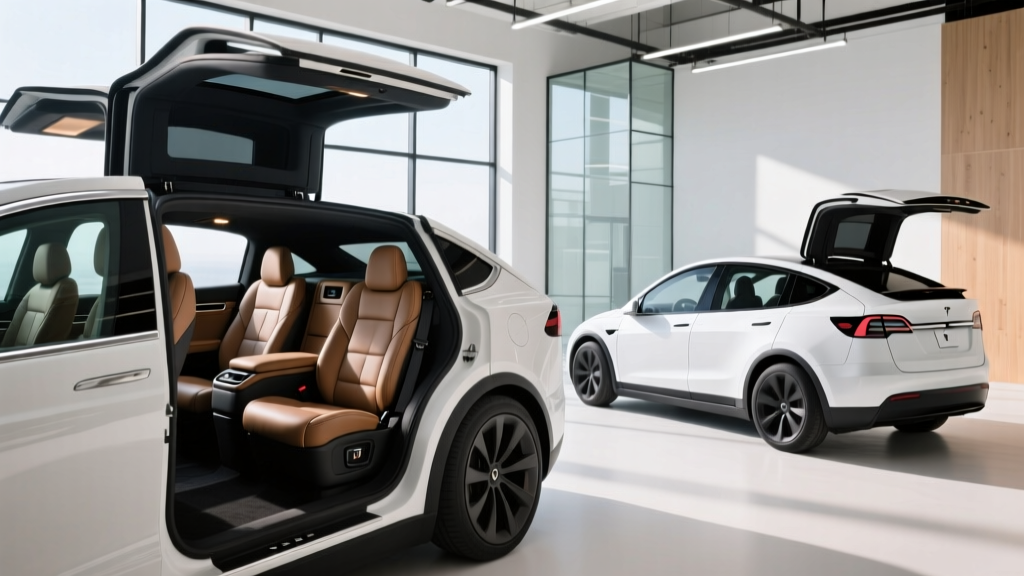
The power-folding rear seats and low load floor make the Model Y practical for everything from Costco runs to camping gear. An optional third row (available on some trims) adds two small seats, but they're best suited for children under 5'4".
Stealth Gray Paint: What You're Getting
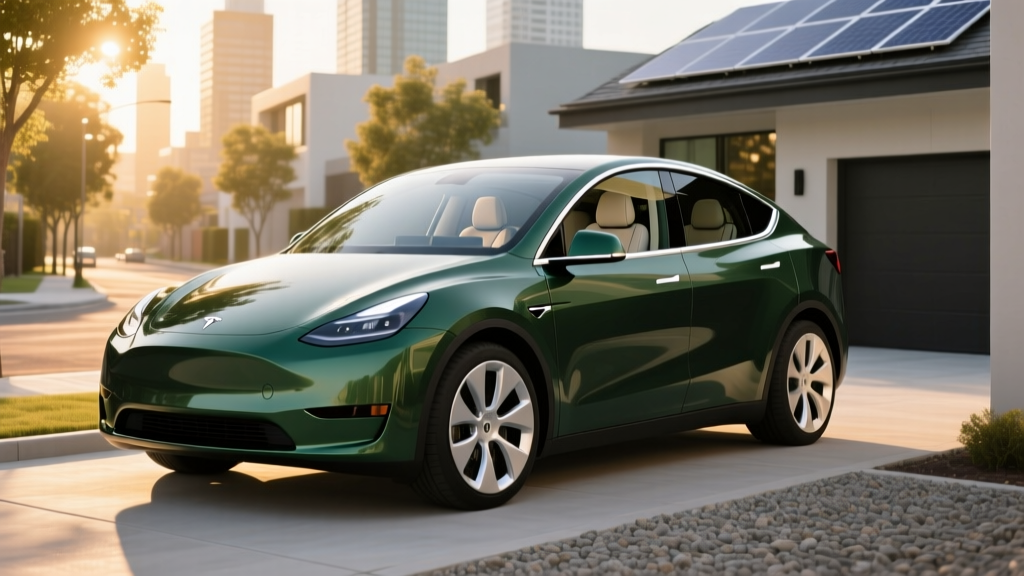
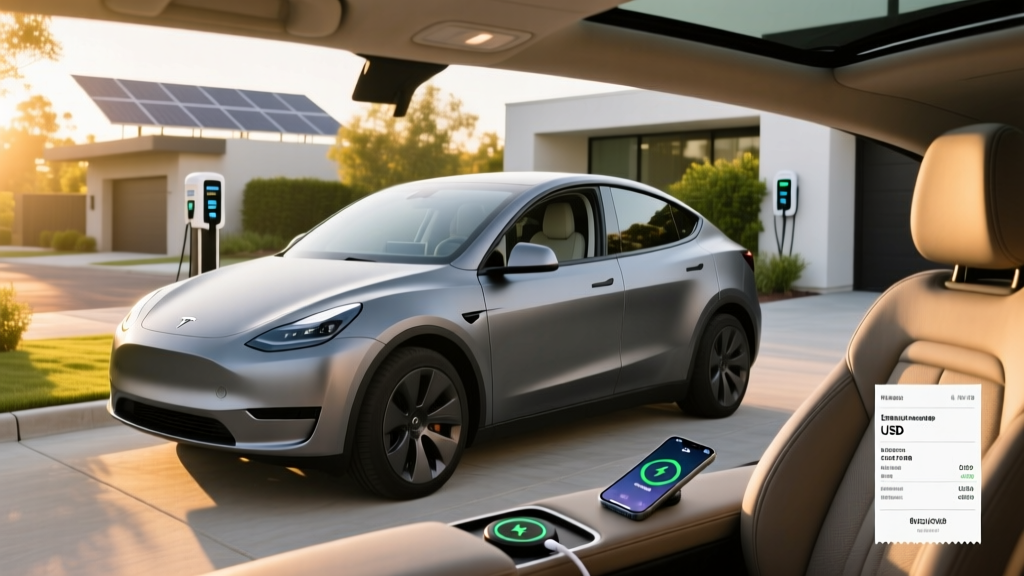
Stealth Gray is one of Tesla's standard (no-upcharge) or low-cost exterior colors depending on the current configuration options. It's a dark, muted gray with subtle metallic flake that reads as charcoal in low light and shifts to a warm graphite in direct sun. Compared to the more common Midnight Silver Metallic, Stealth Gray has a flatter, more satin-like appearance that hides road dust and minor swirl marks better than black or white.
From a resale perspective, gray tones consistently perform well in the used EV market — they appeal to a broad buyer base and photograph well in listings. If you're choosing a stealth gray Tesla for its understated look, it pairs particularly well with the black interior and 19-inch Gemini wheels for a monochromatic, stealthy aesthetic.
Pricing, Trim Levels, and Federal Tax Credit Eligibility
| Trim | Base MSRP | Est. After §30D Credit | Credit Eligible? |
|---|---|---|---|
| RWD | $44,990 | ~$37,490 | Potential* (see rules) |
| Long Range AWD | $48,990 | ~$41,490 | Potential* (see rules) |
| Performance | $53,990 | ~$46,490 | Potential* (see rules) |
*Prices exclude destination fee (~$1,390) and options. Tax credit eligibility is not guaranteed and depends on multiple IRS §30D requirements.
The federal EV tax credit under IRS §30D offers up to $7,500 for qualifying new EVs. However, eligibility for any Tesla Model Y in 2026 hinges on several factors:
- MSRP Cap: SUVs must have an MSRP at or below $80,000 — all Model Y trims clear this.
- Buyer Income Cap: Modified AGI must not exceed $150,000 (single), $225,000 (head of household), or $300,000 (joint).
- Battery Sourcing: A percentage of critical minerals and battery components must be sourced from the US or free-trade-agreement partners. These thresholds tighten annually. Verify current-year compliance on the IRS clean vehicle credit page or fueleconomy.gov.
- Point-of-Sale Transfer: As of 2024+, you can transfer the credit to the dealer at purchase, reducing your out-of-pocket cost immediately rather than waiting for a tax refund.
- Final Assembly: Must occur in North America. The Model Y is assembled at the Fremont, CA factory, satisfying this requirement.
Critical note: Battery sourcing requirements change annually and by model. Always verify the specific VIN's eligibility on the IRS portal or with your tax professional before relying on the credit in your purchase decision.
Technology, Driver Assistance, and the Autopilot Reality Check
The Model Y comes standard with Tesla's 15.4-inch center touchscreen, which handles all vehicle controls, navigation, media, and climate. The 2026 model continues with Tesla's AMD Ryzen-based infotainment processor, which is responsive and supports over-the-air updates, streaming, and gaming while parked.
Standard Autopilot includes Traffic-Aware Cruise Control and Autosteer (lane centering on marked roads). The optional FSD (Supervised) package — currently $8,000 or $99/month — adds Navigate on Autopilot (highway on/off-ramp handling), Auto Lane Change, Autopark, and Smart Summon. While impressive in capability, FSD still requires constant driver supervision and can behave unpredictably in construction zones, on poorly marked roads, or during heavy rain.
- Stop at all red lights or stop signs without driver confirmation
- Navigate unmapped or poorly marked rural roads reliably
- Handle construction zones, emergency vehicles, or debris without intervention
- Replace an attentive, sober, licensed driver
Other tech highlights include the Tesla mobile app (remote climate control, charging status, vehicle location), Dashcam and Sentry Mode (surveillance recording), and a HEPA air filtration system with Bioweapon Defense Mode on higher trims.
Warranty Coverage and Long-Term Battery Outlook
Tesla provides the following warranty coverage for the 2026 Model Y:
- Basic Vehicle: 4 years / 50,000 miles
- Battery & Drive Unit: 8 years / 120,000 miles (Long Range/Performance); 8 years / 100,000 miles (RWD)
- Battery Capacity Retention: Tesla warrants a minimum of 70% capacity retention over the warranty period
Real-world battery degradation data from Tesla's fleet shows that NMC batteries (Long Range/Performance) typically lose 5–8% capacity in the first 50,000 miles, then degrade more slowly. LFP batteries (RWD) show slightly higher initial degradation but tend to flatten out, and their tolerance for 100% daily charging simplifies ownership. Out-of-warranty battery replacement for the Model Y currently ranges from $12,000–$16,000 depending on the pack, though this cost has been trending downward as cell manufacturing scales.
Pros, Cons, and Who Should Buy a Stealth Gray Tesla Model Y
Pros
- Supercharger network access — still the most reliable public DC charging ecosystem in the US
- Strong efficiency (26–30 kWh/100mi) keeps per-mile costs low
- Excellent cargo volume (72.1 cu ft folded) for the segment
- Over-the-air updates continuously add features
- Stealth Gray hides dirt and swirl marks well, broad resale appeal
- Quick performance across all trims (3.5–6.5 sec 0–60)
Cons
- No physical buttons or stalks — everything routes through the touchscreen
- Rear visibility is compromised by the sloping roofline and small rear window
- FSD is expensive ($8,000) and still requires full driver attention
- RWD trim's lower DC charge rate (170 kW) adds time on road trips
- Insurance premiums run 15–25% higher than comparable gas SUVs
- Ride quality on 21-inch wheels (Performance) can be firm on rough pavement
- You want access to the most mature DC fast-charging network for road trips
- You value OTA updates and tech-forward features over traditional controls
- You need strong cargo capacity in a compact electric SUV footprint
- You can charge at home (Level 2) for daily driving needs
- You prefer physical buttons, a traditional instrument cluster, or Apple CarPlay/Android Auto
- You want a more comfortable, compliant ride over sporty handling
- You're uncomfortable with Tesla's camera-only (no LiDAR/radar) ADAS approach
- You need a longer warranty or more established dealer service network
Frequently Asked Questions
What is the real-world range of a stealth gray Tesla Model Y?
The Long Range AWD carries a 320-mile EPA rating. Expect 260–280 miles at highway speeds in moderate weather, and 225–255 miles in sustained freezing temperatures. The RWD trim (310 EPA) delivers slightly less in absolute terms but similar percentage losses.
How fast does the Model Y charge at home and on the road?
On a 48-amp Level 2 home charger, the Long Range and Performance trims add roughly 44 miles of range per hour, reaching a full charge overnight in 7–8 hours. On a V3 Supercharger, a 10–80% session takes about 25 minutes. The RWD trim charges at 7.7 kW at home (~30 mi/hr) and 170 kW DC (~30 minutes 10–80%).
How much does a 2026 Model Y cost after the federal tax credit?
If you qualify for the full $7,500 §30D credit, the RWD drops to approximately $37,490, the Long Range AWD to ~$41,490, and the Performance to ~$46,490. Eligibility depends on income limits, battery sourcing requirements, and MSRP caps — always verify before purchasing.
Is the Tesla Model Y worth buying vs. competitors in 2026?
The Model Y's Supercharger access, efficiency, and cargo space remain compelling. However, the Hyundai Ioniq 5 offers faster 800V charging (10–80% in ~18 min), the Ford Mustang Mach-E provides a more conventional interior, and the Chevrolet Equinox EV undercuts on price. The best choice depends on your priorities — charging network, interior preference, or budget.
Does the stealth gray Tesla Model Y qualify for the federal EV tax credit?
The Model Y meets the MSRP cap ($80,000 for SUVs) and North American assembly requirement. However, buyer income limits ($150K single / $300K joint) and annual battery-sourcing thresholds determine final eligibility. Check the IRS clean vehicle credit page for the current status before committing to a purchase.
Is Stealth Gray a premium color on the Model Y?
Tesla periodically adjusts its color lineup and pricing. As of 2026, Stealth Gray is typically offered as a standard or low-cost option, avoiding the $1,500–$2,500 upcharge associated with premium colors like Ultra Red or Quicksilver. Confirm the current configuration pricing on Tesla.com before ordering.