Can You Actually Buy a Tesla in Every State?
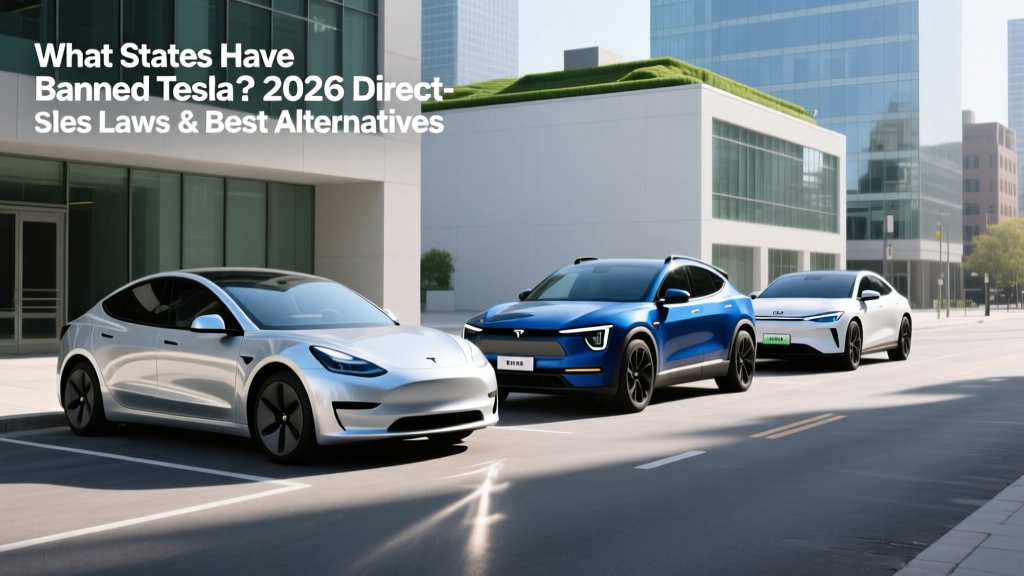
Tesla's direct-to-consumer sales model has been a lightning rod since the company skipped traditional dealerships. If you've been searching what states have banned Tesla from selling directly, the answer is more nuanced than a simple yes-or-no list. Some states prohibit direct sales entirely, others allow limited operations, and a few have carved out special exemptions. As of 2026, the patchwork of franchise dealer laws continues to shape where Tesla can open showrooms, deliver vehicles, and service cars — and it's pushing many buyers in restricted states toward compelling EV alternatives from legacy automakers who already have dealer networks in place.
This guide maps the current state-by-state restrictions, explains the legal mechanics behind them, and then profiles the strongest EV alternatives available through traditional dealerships — complete with EPA range, charging specs, pricing, and tax-credit eligibility so you can make an informed purchase regardless of where you live.
The Direct-Sales Ban: Which States Restrict Tesla in 2026?
Most state-level bans on Tesla's direct-sales model stem from decades-old franchise dealer protection laws. These statutes were originally designed to prevent automakers like Ford or GM from opening factory stores that would undercut their independent dealer partners. Because Tesla never adopted a dealer network, these laws effectively block the company from selling cars directly in certain jurisdictions.
States With Full or Near-Full Direct-Sales Restrictions
| State | Restriction Level | Practical Impact for Buyers |
|---|---|---|
| Texas | Direct sales prohibited | Tesla operates "galleries" where you can view cars but cannot complete a purchase on-site. Transactions must be processed online and vehicles are delivered from out-of-state. Texas has Tesla's Gigafactory Austin, yet state law still restricts in-store sales. |
| Connecticut | Direct sales prohibited | No Tesla stores can sell vehicles. Buyers must order online and take delivery in a neighboring state or through workaround arrangements. |
| Louisiana | Direct sales prohibited | Tesla cannot operate retail locations. Service centers exist, but vehicle purchases must go through out-of-state channels. |
| Alabama | Direct sales prohibited | Franchise law blocks manufacturer-owned retail. Buyers order online; delivery logistics vary. |
| South Carolina | Limited (cap on stores) | Tesla received a limited exemption allowing a small number of stores, but expansion is capped by statute. |
| New Mexico | Direct sales restricted | Franchise laws limit direct retail. Tesla has pursued legal workarounds but full retail operations remain constrained. |
| West Virginia | Direct sales prohibited | No company-owned stores permitted. Buyers rely on online ordering and cross-state delivery. |
States With Partial Restrictions or Ongoing Legal Battles
Several states fall into a gray zone. In Michigan, a long-running legal dispute has resulted in a settlement allowing Tesla limited operations, but the framework remains fragile. Oklahoma has seen legislative back-and-forth, with franchise law enforcement varying by administration. Mississippi and Arkansas have franchise statutes that create friction for direct sales, though enforcement and Tesla's operational workarounds differ.
Meanwhile, states like Virginia, Colorado, New York, and Massachusetts have either passed exemptions for Tesla or have legal frameworks that accommodate the direct-sales model — though some (like New York) originally restricted it before granting carve-outs.
What This Means for EV Buyers in Restricted States
If you live in a state that restricts Tesla's direct sales, you have two practical paths:
- Order a Tesla online anyway. Tesla processes all transactions through its website regardless of state. You can configure, order, and finance a vehicle from your laptop. The complication is delivery — in some restricted states, Tesla ships the vehicle to a nearby unrestricted state for pickup, or arranges third-party transport. Service access may also be limited if Tesla cannot operate service centers in your state.
- Buy from a legacy automaker with a dealer network. This is where the market has shifted dramatically. By 2026, virtually every major automaker sells EVs through traditional franchise dealers — meaning you can walk into a showroom, test drive, negotiate, and take delivery locally. For many buyers in restricted states, this convenience outweighs Tesla's brand cachet.
Top EV Alternatives You Can Buy at a Dealership in Any State
Below are the strongest EV alternatives to Tesla available through franchise dealer networks in 2026. Each profile includes the exact specs buyers need: EPA range, battery chemistry, charging speed, pricing, and tax-credit eligibility.
Hyundai Ioniq 5 (2026 Model Year)
The Ioniq 5 remains one of the most well-rounded EVs on the market, with an 800-volt architecture that delivers class-leading charging speed and a comfortable, spacious interior.
| Spec | Value |
|---|---|
| EPA Range | 303 mi (SEL/Limited AWD) / 361 mi (SE RWD) |
| Battery | 84.0 kWh usable, NMC lithium-ion |
| Max DC Fast Charge | ~240 kW peak (800V architecture) |
| 10-80% DC Time | ~18 minutes (on 350 kW charger) |
| Level 2 Home Charging | 10.9 kW (44 mi/hr added) |
| 0-60 mph | 4.5 sec (AWD) / 7.2 sec (RWD) |
| Horsepower | 320 hp (AWD) / 168 hp (RWD) |
| Efficiency | 110 MPGe combined (AWD) |
| Cargo Volume | 27.2 cu ft (rear seats up) / 59.3 cu ft (folded) |
| Battery Warranty | 10 years / 100,000 miles |
| Base MSRP | ~$42,600 (SE RWD) to ~$54,000 (Limited AWD) |
Tax Credit: The Ioniq 5 is assembled in Georgia at Hyundai's Metaplant, and as of early 2026, eligible buyers can claim the §30D federal tax credit of up to $7,500 — subject to income caps ($150K single / $300K joint), MSRP limits ($55K for SUVs), and battery-sourcing requirements. The credit can now be transferred to the dealer at point of sale, reducing your purchase price directly. Verify current eligibility on the IRS clean vehicle credit page, as battery component sourcing rules tighten annually.
Ford Mustang Mach-E (2026 Model Year)
Ford's electric crossover continues to compete directly with the Tesla Model Y, offering engaging driving dynamics, Ford BlueCruise hands-free highway driving, and widespread dealer support.
| Spec | Value |
|---|---|
| EPA Range | 250 mi (Select RWD) / 320 mi (Premium Ext Range AWD) |
| Battery | 75.7 kWh (Standard) / 98.0 kWh (Extended Range), NMC |
| Max DC Fast Charge | ~150 kW peak (Ext Range) |
| 10-80% DC Time | ~38 minutes (150 kW charger) |
| Level 2 Home Charging | 10.5 kW (37 mi/hr) |
| 0-60 mph | 5.1 sec (AWD Ext Range) / 3.5 sec (GT) |
| Horsepower | 290 hp (AWD) / 480 hp (GT) |
| Efficiency | 101 MPGe combined (AWD Ext Range) |
| Cargo Volume | 29.7 cu ft (rear seats up) / 59.7 cu ft (folded) |
| Battery Warranty | 8 years / 100,000 miles |
| Base MSRP | ~$39,995 (Select) to ~$59,995 (GT) |
Real-World Range: The Extended Range AWD's 320-mile EPA rating holds up well in moderate climates — expect 280-300 miles in real highway driving. Cold weather drops this to approximately 220-250 miles. The Mach-E's charging speed is its weak point relative to Hyundai/Kia's 800V platform; the 150 kW peak means longer stops on road trips.
Tax Credit: The Mach-E is assembled in Cuautitlán, Mexico. Battery component and critical mineral sourcing determine §30D eligibility, which has become more restrictive under 2025-2026 sourcing rules. Check the fueleconomy.gov tax credit tracker for the latest status before purchasing.
Kia EV6 (2026 Model Year)
Built on the same E-GMP platform as the Ioniq 5, the EV6 offers a sportier design and the same exceptional 800V charging architecture, making it ideal for road-trippers who need fast DC stops.
| Spec | Value |
|---|---|
| EPA Range | 310 mi (GT-Line RWD) / 274 mi (GT-Line AWD) |
| Battery | 84.0 kWh usable, NMC |
| Max DC Fast Charge | ~240 kW peak (800V) |
| 10-80% DC Time | ~18 minutes |
| Level 2 Home Charging | 10.9 kW (44 mi/hr) |
| 0-60 mph | 5.1 sec (AWD) / 3.4 sec (GT) |
| Horsepower | 320 hp (AWD) / 576 hp (GT) |
| Efficiency | 117 MPGe combined (RWD Long Range) |
| Cargo Volume | 24.4 cu ft (rear up) / 50.2 cu ft (folded) |
| Battery Warranty | 10 years / 100,000 miles |
| Base MSRP | ~$42,900 (Light RWD) to ~$61,600 (GT) |
Chevrolet Equinox EV (2026 Model Year)
For buyers who want an affordable electric crossover from a brand with dealers on seemingly every corner, the Equinox EV hits a price point that undercuts most competitors while delivering solid range.
| Spec | Value |
|---|---|
| EPA Range | 319 mi (LT FWD) / 285 mi (RS AWD) |
| Battery | 85.0 kWh usable, NMC (Ultium platform) |
| Max DC Fast Charge | ~190 kW peak |
| 10-80% DC Time | ~27 minutes |
| Level 2 Home Charging | 11.5 kW (38 mi/hr) |
| 0-60 mph | 7.9 sec (FWD) / 5.9 sec (AWD RS) |
| Horsepower | 213 hp (FWD) / 288 hp (AWD) |
| Efficiency | 109 MPGe combined (FWD) |
| Cargo Volume | 26.4 cu ft (rear up) / 57.2 cu ft (folded) |
| Battery Warranty | 8 years / 100,000 miles |
| Base MSRP | ~$34,900 (LT FWD) to ~$44,900 (RS AWD) |
Real-World Range: The 319-mile FWD rating is impressive on paper. In highway driving at 70-75 mph, expect approximately 270-290 miles. Cold weather (sub-freezing) will reduce this to roughly 220-250 miles. The Equinox EV lacks a heat pump on lower trims, which contributes to greater winter range loss than Hyundai/Kia competitors.
Side-by-Side: How Do These Alternatives Compare?
| Metric | Hyundai Ioniq 5 | Ford Mach-E | Kia EV6 | Chevy Equinox EV |
|---|---|---|---|---|
| Best EPA Range | 361 mi | 320 mi | 310 mi | 319 mi |
| Fastest 10-80% | ~18 min | ~38 min | ~18 min | ~27 min |
| Starting MSRP | $42,600 | $39,995 | $42,900 | $34,900 |
| Battery Warranty | 10yr/100K | 8yr/100K | 10yr/100K | 8yr/100K |
| NACS Port (2026) | Yes (native) | Yes (native) | Yes (native) | Yes (native) |
| Best For | Road trips | Driving fun | Sport + charge speed | Budget buyers |
Federal Tax Credit Eligibility: What You Need to Know
Under IRS §30D, the federal clean vehicle credit offers up to $7,500 for qualifying new EVs — but eligibility depends on multiple factors that tighten each year:
- Buyer income caps: Adjusted gross income must not exceed $150,000 (single), $225,000 (head of household), or $300,000 (joint filers).
- MSRP caps: The vehicle's manufacturer's suggested retail price cannot exceed $55,000 for sedans or $80,000 for SUVs, vans, and pickups.
- Battery component sourcing: Increasing percentages of battery components must be manufactured or assembled in North America. Critical minerals must be sourced from the U.S. or free-trade-agreement partners. These thresholds increase annually, meaning a vehicle eligible in 2024 may not qualify in 2026.
- Point-of-sale transfer: As of 2024, you can transfer the credit to the dealer at purchase, reducing your out-of-pocket cost immediately rather than waiting for a tax refund.
- Final assembly: The vehicle must undergo final assembly in North America.
Always confirm a specific vehicle's eligibility on the DOE fueleconomy.gov credit lookup tool before signing a purchase agreement. Dealers can also verify eligibility through the IRS energy credit portal.
Who Should Consider These Alternatives Over Tesla?
Choose a Hyundai Ioniq 5 or Kia EV6 if:
- You take frequent road trips and want the fastest possible DC charging (18-minute 10-80% stops)
- You want a 10-year battery warranty for long-term peace of mind
- You value a spacious interior with V2L (vehicle-to-load) capability for powering devices
Choose a Ford Mustang Mach-E if:
- You prioritize driving dynamics and want available hands-free BlueCruise on highways
- You want a sporty brand identity without the Tesla association
- You need maximum cargo space in the crossover segment
Choose a Chevrolet Equinox EV if:
- Price is your top priority — starting under $35,000 before incentives
- You want the simplest dealership experience with a brand that has the largest U.S. dealer network
- You're a first-time EV buyer who wants a familiar brand and straightforward ownership
Pros and Cons of Buying Outside Tesla's Ecosystem
✓ Pros of Dealer-Network EVs
- Available in every state — no direct-sales restrictions
- In-person test drives, negotiation, and same-day delivery
- Local service departments with EV-trained technicians
- Establishated trade-in and financing processes
- Multiple brands competing on price at the dealer lot
✗ Cons vs. Tesla
- No access to the full Tesla Supercharger network natively (though NACS adoption is closing this gap by 2026)
- Dealer markups and negotiation friction vs. Tesla's fixed pricing
- Software and OTA updates generally lag behind Tesla's integration
- Public charging reliability varies — no single unified network experience
- Franchise dealer service may be less EV-specialized than Tesla service centers
Frequently Asked Questions
Has any state fully banned Tesla vehicles from being driven or registered?
No. No U.S. state has banned Tesla vehicles from being driven, registered, or owned. The restrictions apply only to Tesla's direct retail sales model. You can legally own, register, insure, and drive a Tesla in all 50 states. The bans affect how you purchase the vehicle, not whether you can use it.
Can I still order a Tesla online if I live in a restricted state?
Yes. Tesla accepts online orders from all states. The complication is delivery logistics — in some restricted states, you may need to pick up your vehicle in a neighboring state or arrange third-party transport. Service access may also be limited depending on whether Tesla can operate service centers in your jurisdiction.
Why do these direct-sales bans exist?
Franchise dealer protection laws were enacted decades ago to prevent automakers from competing directly with their own independent dealers. These laws were designed for the traditional dealership model (Ford, GM, Toyota, etc.) and were never updated to accommodate manufacturer-direct sales. Dealer lobby groups actively defend these laws in state legislatures.
Do Hyundai, Kia, Ford, and Chevy EVs qualify for the $7,500 federal tax credit?
It depends on the specific model year, trim, battery sourcing, your income, and the vehicle's MSRP. The Ioniq 5 (assembled in Georgia) has generally qualified, while the Mach-E (assembled in Mexico) faces more variable eligibility depending on battery sourcing compliance. Always verify on fueleconomy.gov before purchasing.
What's the fastest-charging EV alternative to Tesla available at dealerships?
The Hyundai Ioniq 5 and Kia EV6 both use 800-volt architectures that peak at approximately 240 kW, enabling 10-80% charges in roughly 18 minutes on a 350 kW DC fast charger. This is among the fastest in the industry and significantly outpaces the Ford Mach-E's ~150 kW peak (~38 minutes for 10-80%).
Will more states lift their Tesla direct-sales bans?
Several states have debated or enacted exemptions in recent years (Colorado, Virginia, and New York among them). However, dealer associations continue to lobby aggressively in other states. The trend is slowly moving toward more access, but changes are state-by-state and politically dependent. Check your state legislature's current session for pending bills.