Quick Answer: Which Electric Ford Vehicle Fits You?
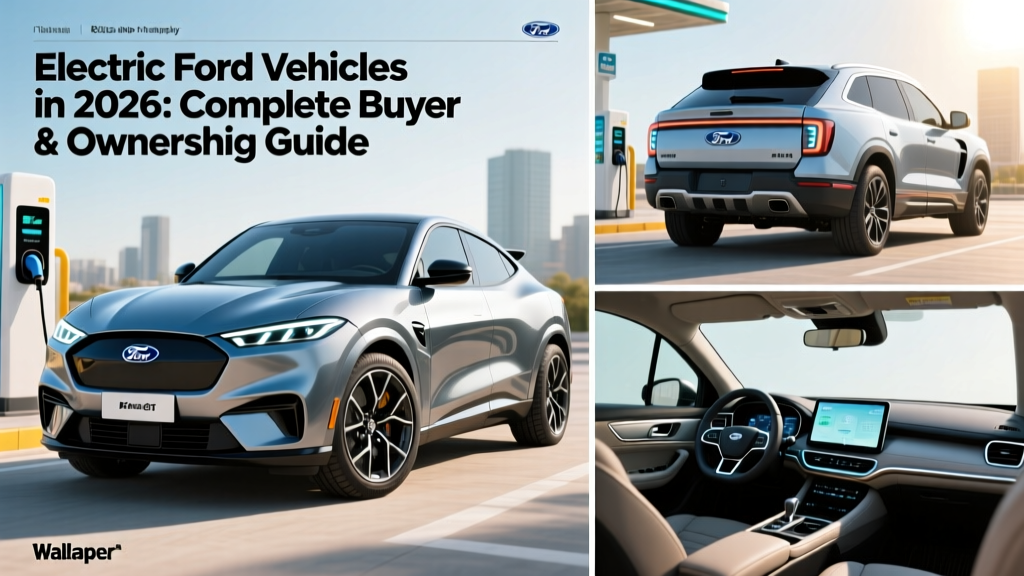
Ford currently sells three core electric vehicles in the US: the F-150 Lightning (full-size pickup, EPA range up to 320 miles, starting ~$54,995), the Mustang Mach-E (crossover SUV, EPA range up to 320 miles, starting ~$42,995), and the E-Transit (commercial van, EPA range ~126 miles, starting ~$46,895). For most buyers, the Mach-E offers the best balance of price, efficiency, and daily usability. The Lightning is the choice for truck capability with zero tailpipe emissions. Your real-world range will typically run 10–20% below EPA estimates on the highway, and more in cold weather — plan accordingly.
Ford's 2026 Electric Vehicle Lineup at a Glance
Ford has streamlined its EV strategy after cutting some planned electric models. As of the 2026 model year, the lineup centers on two consumer vehicles and one commercial offering. Here's how they stack up on paper:
| Spec | F-150 Lightning (Ext. Range) | Mustang Mach-E (Ext. Range RWD) | E-Transit (Low Roof) |
|---|---|---|---|
| EPA Range | 320 mi | 320 mi | 126 mi |
| Battery (usable) | 131 kWh, NMC | 91 kWh, NMC | 68 kWh, NMC |
| Peak DC Fast Charge | ~150 kW | ~150 kW | ~115 kW |
| 10–80% DCFC Time | ~41 min | ~36 min | ~45 min |
| Level 2 Charge Rate | 19.2 kW (80A) | 10.5 kW (48A) | 10.5 kW |
| Horsepower | 580 hp | 290 hp (RWD) | 269 hp |
| 0–60 mph | ~3.8 sec | ~6.1 sec | N/A |
| Towing (max) | 10,000 lbs | 1,500 lbs | N/A |
| Starting MSRP | ~$54,995 | ~$42,995 | ~$46,895 |
| Battery Warranty | 8 yr / 100,000 mi | 8 yr / 100,000 mi | 8 yr / 100,000 mi |
Sources: fueleconomy.gov, Ford Motor Company official specifications. Real-world range varies with temperature, terrain, and driving style.
Real-World Range: What the EPA Sticker Doesn't Tell You
EPA range estimates are a useful baseline, but they represent a blended city/highway test cycle under moderate conditions. In practice, your mileage will differ based on three major variables:
Highway Driving
EVs are least efficient at sustained highway speeds because there's no regenerative braking to recover energy. Expect the F-150 Lightning Extended Range to deliver roughly 260–280 miles at 70–75 mph on a flat interstate, compared to its 320-mile EPA rating. The Mach-E Extended Range RWD typically achieves 270–290 miles in the same conditions.
Cold-Weather Impact
Battery chemistry (NMC in all Ford EVs) becomes less efficient below freezing. In temperatures around 20°F, expect a 20–30% range reduction. The Lightning's 320-mile sticker could shrink to 220–250 miles in deep winter without preconditioning. Both the Lightning and Mach-E include a heat pump, which helps mitigate cabin heating losses — but it doesn't eliminate them.
Towing (Lightning-Specific)
If you bought the Lightning to tow, know this: pulling a 5,000-lb trailer at highway speeds can cut range nearly in half. Ford's own testing and independent reviews have shown 150–180 miles of practical range when towing near the truck's mid-capacity rating. This isn't a defect — it's physics. A gas F-150 also loses significant range when towing, but refueling takes 5 minutes instead of 40+.
Rule of thumb: Plan trips using 75–80% of the EPA range as your practical ceiling. For the Mach-E Extended Range, that's ~240–255 miles between charges on the highway. For the Lightning, ~240 miles. Always leave a buffer for detours and charger availability.
Charging Speeds, Networks, and the NACS Transition
Ford made a pivotal move by adopting the North American Charging Standard (NACS) for its EVs, giving Ford owners access to Tesla's Supercharger network — the most reliable DC fast-charging network in the US. Here's what that means in practice:
| Level | Power | Mach-E Miles/Hour | Lightning Miles/Hour | Where |
|---|---|---|---|---|
| Level 1 (120V) | ~1.4 kW | ~3–4 mi/hr | ~2–3 mi/hr | Standard outlet |
| Level 2 (240V) | 10.5–19.2 kW | ~30–36 mi/hr | ~30–52 mi/hr | Home / public |
| DC Fast Charge | Up to 150 kW | ~180 mi in 36 min (10–80%) | ~210 mi in 41 min (10–80%) | Supercharger / public |
Understanding the Charge Curve
Peak charge rate (150 kW) is only sustained between roughly 10–40% State of Charge (SoC). Above 60%, the rate tapers significantly to protect battery longevity. An 80–100% top-up can take as long as the 10–80% session. For road trips, charge to 80% and move on — it's faster overall.
Home Charging Setup
The single biggest ownership advantage is home Level 2 charging. For the Mach-E, a 48-amp (10.5 kW) wall connector adds roughly 30–36 miles per hour — enough to fully recharge overnight. The Lightning supports up to 80 amps (19.2 kW) with the optional Pro Power Onboard system, but this requires a 100-amp dedicated circuit and likely a panel upgrade. Expect home installation costs of $800–$2,500 depending on your electrical panel, run length, and local permit fees. Consult a licensed electrician for a site-specific quote.
Cost of Ownership: Electric Ford vs. Gas Equivalent
The purchase price is only the start. Here's a 5-year cost comparison between the Mustang Mach-E Select (base Extended Range) and a comparably equipped Ford Edge (gas midsize crossover), assuming 12,000 miles/year, $0.14/kWh home electricity, and $3.40/gallon gas:
| Cost Category (5 yr / 60k mi) | Mach-E Ext. Range | Ford Edge AWD (Gas) |
|---|---|---|
| Purchase Price (MSRP) | $42,995 | $39,500 |
| Estimated §30D Tax Credit | $0–$7,500* | $0 |
| Fuel / Electricity | $2,520 (home charging) | $8,500 |
| Maintenance | $1,200 | $3,400 |
| Insurance (avg) | $9,600 | $7,800 |
| Estimated Depreciation | $18,000 | $14,500 |
| Estimated 5-Year Total | $56,315 – $63,815 | $73,700 |
*Tax credit eligibility depends on MSRP caps, buyer income limits, battery sourcing, and critical mineral requirements under IRS §30D. Check irs.gov for current-year rules. Credit may be applied at point of sale.
Key takeaways: The Mach-E saves significantly on fuel and maintenance (no oil changes, fewer brake replacements due to regen braking). Insurance is typically 15–25% higher for EVs due to repair costs and parts pricing. Depreciation on EVs has been steeper than gas vehicles in recent years, though this is stabilizing as the used EV market matures.
Federal Tax Credit Eligibility: What You Actually Qualify For
The §30D clean vehicle credit offers up to $7,500, but qualification is not automatic. Here's the checklist for 2026:
- MSRP Cap: Vans/SUVs/pickups must be under $80,000. All current Ford EV consumer models qualify on MSRP.
- Buyer Income Cap: Modified AGI must not exceed $300,000 (joint), $225,000 (head of household), or $150,000 (single).
- Battery Sourcing: Battery components must be manufactured or assembled in North America (phased thresholds increase yearly). Critical minerals must be sourced from the US or FTA partners.
- Point-of-Sale Transfer: You can transfer the credit to the dealer at purchase, reducing your out-of-pocket cost immediately — even if you have no tax liability to offset.
- FEOC Restriction: Vehicles with battery components from a Foreign Entity of Concern (e.g., certain Chinese suppliers) may be disqualified.
Because sourcing requirements tighten annually, a vehicle that qualifies in January may not qualify by December. Always verify at the point of purchase and consult a tax professional for your specific situation.
Common Misconceptions About Electric Ford Vehicles
| Myth | Fact |
|---|---|
| "The Lightning can't really tow." | It's rated for up to 10,000 lbs. Range drops significantly while towing, but capability is genuine. Plan charging stops for long hauls. |
| "EV batteries need replacing every 5 years." | Ford warranties its EV batteries for 8 years/100,000 miles against dropping below 70% capacity. Real-world NMC degradation data shows most EV batteries retain 85–92% capacity at 100,000 miles. |
| "You can't charge in the rain or cold." | EV charging connectors are sealed and weather-rated. Charging works in rain, snow, and extreme cold — though charging speed slows when the battery is cold (preconditioning helps). |
| "Public charging is always broken." | Tesla Superchargers (now accessible to Ford EVs via NACS adapter or native port) consistently report 97%+ uptime. Electrify America and other networks have improved but remain less reliable. Plan around Superchargers for road trips. |
| "The Mach-E isn't a real Mustang." | It shares no mechanical parts with the gas Mustang. It's a performance-oriented electric crossover with Mustang branding. The GT trim does 0–60 in ~3.5 seconds — faster than most gas Mustangs. |
Decision Framework: Which Electric Ford Should You Buy?
Choose the Mustang Mach-E if:
- You need a daily-driver crossover with 250+ real-world highway miles
- You want the lowest entry price in Ford's EV lineup
- Your commute is under 100 miles round-trip and you can charge at home
- You value efficiency (Mach-E RWD achieves ~99 MPGe combined per fueleconomy.gov)
Choose the F-150 Lightning if:
- You need truck utility — towing, hauling, job-site power (Pro Power Onboard provides up to 9.6 kW of 240V output)
- You have a garage or driveway for a Level 2 charger (the 131 kWh battery is impractical on Level 1 alone)
- You're willing to accept 240–280 real-world highway miles and plan road trips around charging
- You want a frunk (front trunk) with 14.1 cu ft of lockable, weather-sealed storage
Choose the E-Transit if:
- You operate a commercial fleet with predictable daily routes under 100 miles
- You can depot-charge overnight at your business
- You want to reduce fleet fuel costs and meet emissions targets
- 126 miles of EPA range covers your typical day with margin
Skip a Ford EV for now if:
- You have no access to home or workplace Level 2 charging (relying solely on public DCFC is expensive and time-consuming)
- You regularly drive 350+ miles in a single day in extreme cold (consider a PHEV like the Ford Escape Plug-In Hybrid instead)
- Your budget is below $35,000 and you need a new vehicle (explore the used EV market and the separate §25E used-EV credit of up to $4,000)
What First-Time Ford EV Buyers Should Know Before Signing
Before you finalize your purchase, run through these practical checkpoints:
- Get an electrical panel assessment. A licensed electrician should evaluate whether your panel can support a 40–80 amp Level 2 circuit. A 200-amp panel is usually sufficient; older 100-amp panels may require a $1,500–$3,000 upgrade.
- Test-charge before you buy. Visit a Supercharger or public DCFC near your home and try the charging process. Understand the FordPass app, plug-in process, and payment flow before delivery day.
- Check your insurance rate first. Get a quote for the specific trim you're considering. EV insurance can be 15–25% higher — factor this into your monthly budget.
- Verify tax credit eligibility at the dealership. The dealer should provide the IRS-required seller report confirming the vehicle's battery sourcing and your eligibility. Don't assume — confirm in writing.
- Understand BlueCruise limitations. Ford's BlueCruise is an SAE Level 2 driver-assistance system that allows hands-free driving on pre-mapped divided highways. It is not self-driving. You must remain attentive, and the system monitors your eyes. It does not handle city streets, construction zones, or unmapped roads.
BlueCruise = SAE Level 2. The driver must remain engaged and ready to take over at any time. This is comparable to GM Super Cruise or Tesla Autopilot — advanced driver assistance, not autonomous driving. True driverless (Level 4) services like Waymo operate only in geofenced urban areas and are not available in consumer vehicles.
Frequently Asked Questions
How long does it take to charge a Ford EV at home?
With a Level 2 (240V) charger, the Mustang Mach-E charges from empty to full in roughly 9–10 hours at 10.5 kW. The F-150 Lightning with the standard 19.2 kW onboard charger takes about 7–8 hours on an 80-amp circuit, or ~13 hours on a 48-amp circuit. Most owners plug in nightly and never deplete the battery fully.
Can I use Tesla Superchargers with a Ford EV?
Yes. Newer 2025+ Ford EVs are equipped with the native NACS charge port. Owners of earlier-model Ford EVs with CCS ports can use a Ford-approved NACS adapter to access Tesla Superchargers. The Supercharger network is widely regarded as the most reliable public charging network in the US.
Will Ford's EV battery need replacing, and what does it cost?
Out-of-warranty battery replacement for the Mach-E or Lightning is estimated at $12,000–$20,000 depending on the pack. However, NMC battery degradation data from high-mileage EVs shows most packs retain 85%+ capacity at 100,000 miles. Ford's 8-year/100,000-mile warranty covers drops below 70% capacity. Full pack replacement is rare and typically only needed after physical damage or extreme degradation.
Is the F-150 Lightning good for cold climates?
It performs well, with some compromises. The heat pump helps with cabin heating efficiency, and the battery thermal management system preconditioning mitigates cold-weather charging slowdowns. Expect 20–30% range loss in sub-freezing temperatures. If your winter commute is under 80 miles round-trip and you charge at home, the Lightning handles cold climates without issue. For 200+ mile winter highway drives, plan one charging stop.
How does the Mach-E compare to a Tesla Model Y?
The Model Y Long Range offers slightly more EPA range (330 mi vs. 320 mi), faster DC charging (~250 kW peak vs. ~150 kW), and access to Tesla's software ecosystem. The Mach-E counters with a more traditional interior layout, physical controls, generally better build quality ratings, and a lower starting price on base trims. Both are strong choices — the decision often comes down to charging network preference and UI philosophy.