If you have been following financial news or EV forums lately, you have likely encountered speculation about a SpaceX merger with Tesla. Whether driven by Elon Musk's overlapping leadership, shared supply-chain interests, or investor fantasies of a unified aerospace-and-energy conglomerate, the idea generates intense curiosity. But for the person actually shopping for an electric vehicle in 2026, the real question is practical: does any of this affect what I can buy, what I pay, or what technology ends up in my driveway?
This article separates verifiable facts from rumor, examines how deeper SpaceX-Tesla integration could influence battery chemistry, manufacturing, and vehicle pricing, and grounds the conversation in the EVs you can actually order today — using the 2026 Tesla Model Y as our reference platform.
Is a SpaceX Merger With Tesla Actually Happening?
As of early 2026, no formal merger between SpaceX and Tesla has been announced, filed, or approved. Both companies remain legally separate entities. Tesla (TSLA) is a publicly traded company on the NASDAQ; SpaceX remains private, funded through venture capital, secondary markets, and Starlink revenue. Any corporate combination would require SEC filings, shareholder votes, and antitrust review — none of which have occurred.
What has happened is a steady deepening of operational overlap:
- Shared executive talent — engineers and operations leaders have moved between the two companies, particularly in materials science and thermal management.
- Starlink integration in Tesla vehicles — satellite connectivity for over-the-air updates and navigation in low-cell-coverage areas has been tested in select fleets.
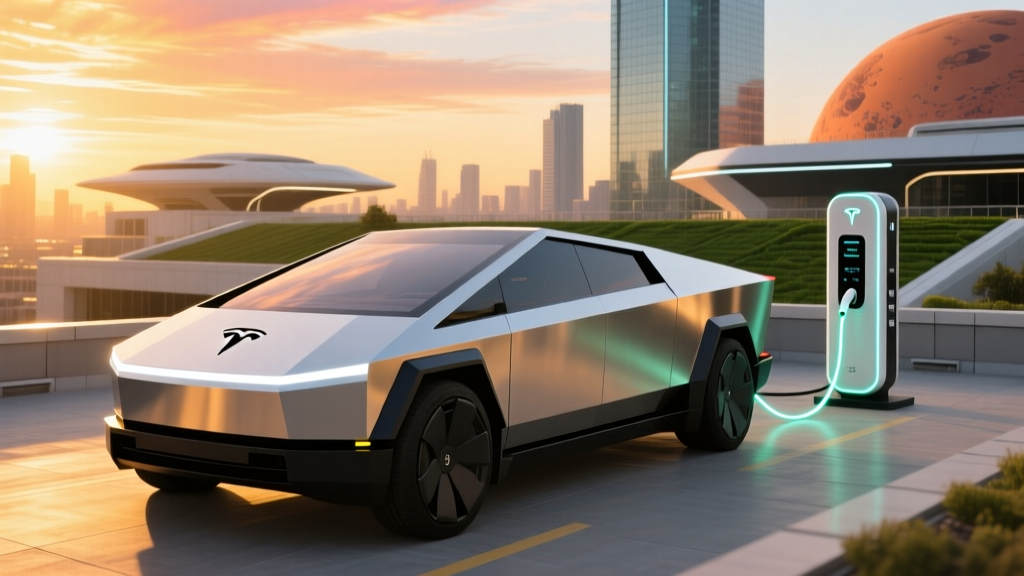
- Advanced manufacturing techniques — SpaceX's expertise in gigacasting alloys and friction-stir welding has informed Tesla's gigafactory processes, particularly for the Cybertruck and refreshed Model Y.
- Battery chemistry research — SpaceX's demand for high-energy-density, radiation-tolerant cells for satellite power systems has reportedly influenced Tesla's 4680 cell development roadmap.
For EV buyers, these cross-pollination effects matter more than a headline-grabbing merger. Let us look at what they mean for the cars on the showroom floor.
2026 Tesla Model Y: The EV You Can Actually Buy Today
Rather than speculate about corporate structures, let us anchor this conversation in hard specs. The 2026 Tesla Model Y (refreshed "Juniper" generation) remains Tesla's highest-volume vehicle and the most relevant product for anyone researching the Tesla ecosystem.
| Spec | Long Range AWD | Performance |
|---|---|---|
| EPA Range | 320 mi | 295 mi |
| Battery (usable) | ~78 kWh, NMC | ~78 kWh, NMC |
| Drivetrain | Dual-Motor AWD | Dual-Motor AWD |
| Horsepower | 384 hp | 456 hp |
| 0–60 mph | 4.8 sec | 3.5 sec |
| Peak DC Charge Rate | 250 kW | 250 kW |
| 10–80% DC Time | ~24 min | ~24 min |
| Level 2 Home Rate | 11.5 kW (~44 mi/hr) | 11.5 kW (~44 mi/hr) |
| MPGe (combined) | 122 MPGe | 111 MPGe |
| Efficiency | 27 kWh/100 mi | 30 kWh/100 mi |
| Cargo (rear seats up) | 30.2 cu ft | 30.2 cu ft |
| Cargo (rear seats folded) | 72.1 cu ft | 72.1 cu ft |
| Rear Legroom | 41.6 in | 41.6 in |
| Base MSRP | $44,990 | $52,490 |
| Battery Warranty | 8 yr / 120,000 mi | 8 yr / 120,000 mi |
Source: fueleconomy.gov and Tesla specifications, 2026 model year.
The EPA rates the 2026 Model Y Long Range at 320 miles. In real-world driving, expect approximately 270–290 miles on the highway at 70–75 mph, and as low as 230–250 miles in cold weather (below 32°F) due to cabin heating demands and increased battery internal resistance. City driving with frequent regenerative braking can match or slightly exceed the EPA figure. Plan road-trip charging stops at roughly 200-mile intervals for a comfortable buffer.
Charging Speed: DC Fast Charging and Home Setup
Charging infrastructure remains the number-one concern for EV buyers, and the Model Y's charging profile is competitive but not class-leading.
| Charging Level | Power | Miles Added Per Hour | Notes |
|---|---|---|---|
| Level 1 (120V) | ~1.4 kW | ~4–5 mi/hr | Emergency/trickle only |
| Level 2 (240V, 48A) | 11.5 kW | ~44 mi/hr | Home Wall Connector; full charge in ~7 hr |
| DC Fast (Tesla Supercharger V3) | 250 kW peak | ~1,000 mi/hr (peak) | 10–80% in ~24 min; tapers above 80% |
| DC Fast (Supercharger V4) | Up to 325 kW | Higher sustained rate | Available at select corridors; Model Y capped by onboard architecture |
A critical detail many buyers miss: peak kW is not sustained kW. The Model Y hits 250 kW only between roughly 10–30% state of charge, then the charge curve tapers progressively. From 50–80%, expect an average rate closer to 100–120 kW. This is why the 10–80% time of ~24 minutes is a more useful metric than the headline peak number.
For home charging, a Tesla Wall Connector on a 60-amp circuit (48A continuous) delivers 11.5 kW — enough to fully replenish the 78 kWh battery overnight. Installation costs typically range from $800–$2,000 depending on your electrical panel capacity and run length. If your home has a 100-amp main panel, a panel upgrade to 200 amps may be necessary, adding $1,500–$3,000.
How SpaceX-Tesla Cross-Pollination Could Affect Future Battery Tech
Here is where the SpaceX merger with Tesla conversation gets technically interesting — even without a formal corporate combination.
4680 Cell Development
Tesla's 4680 cylindrical cells (46mm diameter, 80mm height) are central to its cost-reduction and energy-density strategy. SpaceX's satellite power systems require cells that tolerate extreme thermal cycling and radiation exposure. Materials science advances in cathode coatings and electrolyte stability developed for space applications have potential automotive benefits:
- Improved cycle life — radiation-resistant cathode coatings could extend battery longevity beyond current 1,500–2,000 full-cycle expectations.
- Thermal resilience — electrolyte formulations designed for the vacuum-temperature swings of orbit could improve cold-weather performance and reduce the energy spent on battery preconditioning.
- Structural battery packs — SpaceX's experience with load-bearing composite structures aligns with Tesla's structural pack strategy, reducing vehicle weight and improving efficiency.
Gigacasting and Manufacturing
SpaceX pioneered large-scale friction-stir welding and advanced aluminum alloys for the Falcon 9 and Starship. Tesla's adoption of mega-ton gigacasting presses (6,000–9,000 ton) for single-piece front and rear underbodies draws directly from this knowledge base. A tighter corporate relationship could accelerate:
- Fewer parts per vehicle (reducing weight and assembly cost)
- Stronger, lighter alloys that improve range without increasing battery size
- Faster production ramp at new gigafactories
None of this changes what you can buy today, but it does suggest that Tesla's manufacturing cost advantages — already significant — may widen further, potentially enabling price reductions or margin-funded technology upgrades in future model years.
Pricing, Tax Credits, and Total Cost
The 2026 Model Y Long Range starts at $44,990 before destination fees and options. The Performance trim starts at $52,490. Here is how federal incentives interact with those numbers.
| Trim | Base MSRP | Destination | Federal Credit (§30D) | Effective Price* |
|---|---|---|---|---|
| Long Range AWD | $44,990 | $1,390 | Up to $7,500 | ~$38,880 |
| Performance AWD | $52,490 | $1,390 | Up to $7,500 | ~$46,380 |
*Effective price assumes full §30D credit eligibility. Actual credit depends on battery sourcing, buyer income, and MSRP caps. See IRS rules below.
Federal Tax Credit Eligibility (§30D)
The IRS §30D Clean Vehicle Credit offers up to $7,500, but eligibility in 2026 depends on several requirements:
- MSRP cap: SUVs must be priced at or below $80,000 — both Model Y trims qualify.
- Buyer income cap: Modified AGI must not exceed $150,000 (single), $225,000 (head of household), or $300,000 (joint).
- Battery sourcing: A percentage of critical minerals and battery components must be sourced from the U.S. or free-trade-agreement partners. This threshold increases annually. Tesla's shift toward U.S.-refined lithium and North American cathode production has kept the Model Y eligible for the full $7,500 for most buyers, but always verify current-year rules on irs.gov before purchasing.
- Point-of-sale transfer: Since 2024, buyers can transfer the credit to the dealer at purchase, reducing the upfront price rather than waiting for a tax refund.
Pros, Cons, and Who This EV Suits Best
Pros
- 320-mile EPA range covers most commutes and road trips comfortably
- Access to the Tesla Supercharger network — still the most reliable DC fast-charging ecosystem in the U.S.
- Strong efficiency (27 kWh/100 mi) keeps charging costs low
- Over-the-air updates continuously add features
- Spacious cargo area (72.1 cu ft with seats folded) rivals midsize SUVs
- Autopilot standard; FSD (Supervised) available for those who want advanced driver assist
- Full $7,500 federal tax credit eligibility for qualifying buyers
Cons
- 250 kW peak DC charge rate trails Hyundai Ioniq 5 (350 kW) and Porsche Macan EV (270 kW)
- No Apple CarPlay or Android Auto — Tesla's proprietary infotainment only
- FSD (Supervised) remains a Level 2 system requiring full driver attention — not autonomous driving
- Insurance premiums run 15–25% higher than comparable gas SUVs
- Minimal physical controls — everything routes through the center touchscreen
- Ride quality on 20-inch wheels can be firm on rough pavement
Who Should Buy the 2026 Model Y?
Ideal for: Two-adult households with home charging access who need a practical daily driver with road-trip capability. The 320-mile range and Supercharger access make it one of the most versatile EVs for mixed city/highway use. Families with one or two children will find adequate rear-seat space and cargo room.
Consider alternatives if: You need three rows of seating (look at the Kia EV9), you prioritize ultra-fast charging (Hyundai Ioniq 5 or Genesis GV60), or you prefer traditional infotainment with smartphone mirroring.
Is It Worth Buying vs. Key Competitors?
The Model Y competes in the most crowded EV segment. Here is how it stacks up on the metrics that matter:
| Metric | Tesla Model Y LR | Hyundai Ioniq 5 LR | Ford Mustang Mach-E ER |
|---|---|---|---|
| EPA Range | 320 mi | 305 mi | 312 mi |
| Peak DC Charge | 250 kW | 350 kW | 150 kW |
| 10–80% Time | ~24 min | ~18 min | ~36 min |
| 0–60 mph | 4.8 sec | 5.1 sec | 5.2 sec |
| Cargo (seats up) | 30.2 cu ft | 27.2 cu ft | 29.7 cu ft |
| Base MSRP | $44,990 | $46,650 | $43,995 |
| Federal Credit | $7,500 | $7,500 | $7,500 |
The Model Y wins on range, cargo space, and charging-network access. The Ioniq 5 charges significantly faster. The Mach-E undercuts on price but trails on charging speed. Your decision should hinge on which factor dominates your use case.
FAQ: SpaceX Merger With Tesla and the Model Y
What is the real-world range of the 2026 Tesla Model Y?
The EPA rates it at 320 miles (Long Range AWD). Real-world highway driving at 70–75 mph yields approximately 270–290 miles. In freezing temperatures, expect 230–250 miles. City driving with regenerative braking can match or exceed the EPA sticker.
How fast does the Model Y charge at home and on DC fast chargers?
On a Level 2 home charger (11.5 kW), you gain about 44 miles per hour, fully recharging overnight in ~7 hours. On a Tesla V3 Supercharger, the 10–80% charge takes approximately 24 minutes at a peak rate of 250 kW. Remember that charge speed tapers significantly above 50% state of charge.
How much does the Model Y cost after the federal tax credit?
The Long Range AWD starts at $44,990 plus $1,390 destination. With the full $7,500 §30D credit, the effective price drops to approximately $38,880. Eligibility depends on your income, the vehicle's battery sourcing, and MSRP caps — verify on irs.gov before purchasing.
Is the Model Y worth buying vs. the Ioniq 5 or Mach-E?
It depends on your priorities. The Model Y leads in range, cargo space, and charging-network reliability. The Ioniq 5 charges faster (350 kW peak, 18-minute 10–80%). The Mach-E is slightly cheaper but charges slower. If Supercharger access matters to you, the Model Y has no direct rival.
What are the biggest pros and cons?
Pros: 320-mile range, Supercharger network, strong efficiency, spacious cargo, OTA updates. Cons: 250 kW charge rate trails rivals, no CarPlay/Android Auto, higher insurance costs, FSD is Level 2 (not self-driving), touchscreen-only controls.
Does a SpaceX merger with Tesla change anything for current buyers?
No formal merger has been announced or filed as of 2026. However, deepening operational overlap — shared manufacturing techniques, battery chemistry research, and Starlink connectivity testing — may yield incremental technology benefits in future Tesla vehicles. For now, buy based on today's specs, not tomorrow's corporate restructuring.