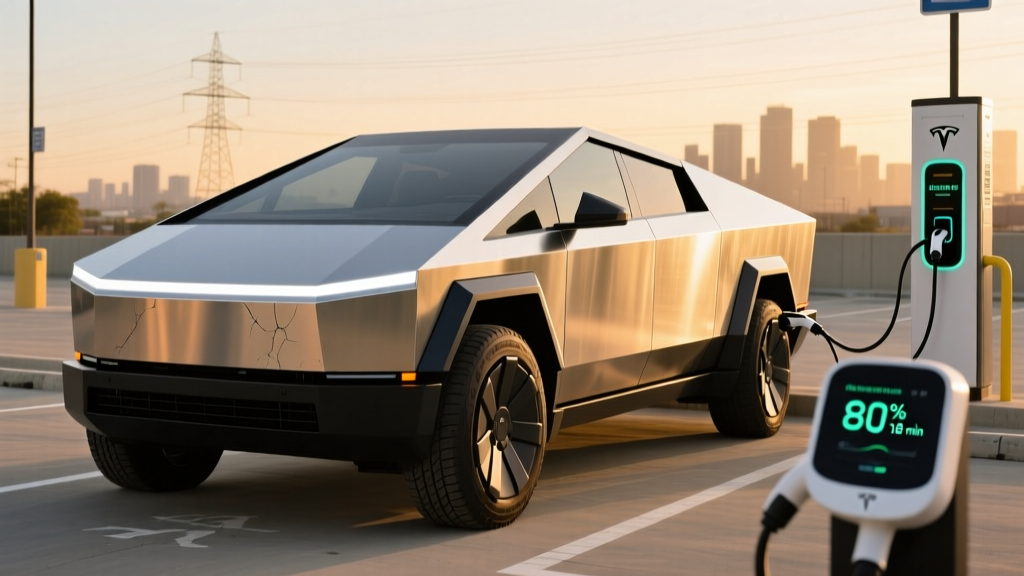
The Tesla Cybertruck occupies a strange space in the electric-pickup segment: it's simultaneously the most futuristic-looking truck on the road and one of the most scrutinized. After more than a year of deliveries, real-world data has replaced speculation. This review covers the 2026 Cybertruck lineup — AWD, Cyberbeast, and the newly available Long Range — with exact specs, charging realities, and the ownership economics that matter to buyers.
Range Reality Check
EPA Estimate: 315–340 miles (depending on trim and wheel configuration)
Real-World Expectation: 240–280 miles at sustained highway speeds (70–80 mph); 200–230 miles in sub-freezing temperatures. The stainless-steel exoskeleton and angular profile create a high drag coefficient (~0.38 Cd), which hits efficiency harder at speed than most rounded EV pickups.
Cybertruck Specs at a Glance
| Specification | AWD | Cyberbeast | Long Range |
|---|---|---|---|
| EPA Range | 315 mi | 320 mi | 340 mi |
| Battery (usable) | ~112 kWh (NMC) | ~112 kWh (NMC) | ~123 kWh (NMC) |
| Horsepower | 600 hp | 845 hp | 600 hp |
| 0–60 mph | 4.1 sec | 2.6 sec | 3.9 sec |
| Drivetrain | Dual-Motor AWD | Tri-Motor AWD | Dual-Motor AWD |
| Max DC Charge Rate | 350 kW | 350 kW | 350 kW |
| 10–80% DCFC Time | ~17 min | ~17 min | ~19 min |
| Level 2 Rate (11.5 kW) | ~34 mi/hr | ~34 mi/hr | ~34 mi/hr |
| MPGe (combined) | 67 MPGe | 65 MPGe | 70 MPGe |
| Efficiency | 50 kWh/100mi | 52 kWh/100mi | 48 kWh/100mi |
| Towing Capacity | 11,000 lbs | 11,000 lbs | 11,000 lbs |
| Payload | 2,500 lbs | 2,500 lbs | 2,500 lbs |
| Bed Length | 6 ft (72 in) | 6 ft (72 in) | 6 ft (72 in) |
| Cargo Volume (bed) | ~74 cu ft | ~74 cu ft | ~74 cu ft |
| Frunk | ~7 cu ft | ~7 cu ft | ~7 cu ft |
| Base MSRP | $79,990 | $99,990 | $84,990 |
Source: EPA Fuel Economy and Tesla specifications. Efficiency figures based on EPA combined cycle. Real-world highway efficiency can exceed 55 kWh/100mi at 80 mph.
Battery Chemistry and Architecture
The Cybertruck uses an 800-volt structural battery pack with NMC (nickel-manganese-cobalt) chemistry — not the LFP cells Tesla employs in the standard-range Model 3/Y. The choice is deliberate: NMC offers higher energy density, which is necessary to move a 6,800–7,000 lb stainless-steel truck to 300+ miles of range.
The structural pack integrates 4680-format cells directly into the chassis, reducing weight and increasing torsional rigidity. Usable capacity sits around 112 kWh for the AWD and Cyberbeast trims, with the Long Range pushing to approximately 123 kWh through additional cell rows.
Degradation context: NMC packs in Tesla's architecture have demonstrated roughly 10–12% capacity loss over 150,000 miles based on fleet data from Model S/X. The Cybertruck's thermal management system is among the most aggressive in the industry, which should keep degradation comparable. Tesla's battery warranty covers 8 years or 150,000 miles with a minimum 70% capacity retention threshold.
Charging Speed and Infrastructure
The Cybertruck's 800V architecture enables peak DC fast-charging at 350 kW on V4 Superchargers and compatible CCS stations (via the included NACS adapter). Here's how that translates to actual charging sessions:
| Charging Method | Power / Rate | Miles Added per Hour |
|---|---|---|
| Level 1 (120V, 12A) | ~1.4 kW | ~3 mi/hr |
| Level 2 (240V, 48A) | 11.5 kW | ~34 mi/hr |
| DC Fast (V4 Supercharger) | Peak 350 kW | ~150 mi in 10 min (peak) |
| DC Fast (150 kW CCS station) | ~150 kW sustained | ~85 mi in 15 min |
Charging-curve reality: The 350 kW peak is not sustained. In testing, the Cybertruck holds above 300 kW only between roughly 10–25% State of Charge (SoC), then tapers progressively. By 60% SoC, you're looking at ~180 kW; by 80%, roughly 80–90 kW. The 10–80% time of ~17 minutes is legitimate at a V4 Supercharger, but expect 22–25 minutes on older 250 kW V3 stalls.
Preconditioning matters: Navigate to a Supercharger using the truck's built-in navigation, and the battery will precondition to optimal temperature. Skip this step (e.g., arriving at a non-navigated charger in cold weather), and your peak charge rate could be cut in half for the first several minutes.
Performance and Driving Dynamics
The Cyberbeast's 2.6-second 0–60 mph time makes it the quickest production pickup ever built. The tri-motor layout — one front, two rear — provides torque vectoring that makes a 6,800-lb truck corner with startling composure. The AWD dual-motor, at 4.1 seconds, is still quicker than nearly every gas truck on the market.
But the numbers don't capture the full experience. The steer-by-wire system (no mechanical connection between the steering yoke and the wheels) requires an adjustment period. At low speeds, it feels artificially quick; at highway speeds, it's precise but lacks the feedback of a traditional rack. Tesla has refined this through over-the-air updates, but it remains a love-it-or-adapt-to-it feature.
The adaptive air suspension provides up to 12 inches of ground clearance in Off-Road mode and drops the truck 2 inches at highway speeds for efficiency. Ride quality is firm — this is a heavy truck on 35-inch tires — but body control is excellent.
Tax Credit Eligibility and Pricing
The Cybertruck's pricing places it in a complicated position for the federal §30D tax credit. Here's the breakdown based on current IRS rules:
| Trim | Base MSRP | §30D MSRP Cap for Trucks | Credit Eligible? | Effective Price (with $7,500 credit) |
|---|---|---|---|---|
| AWD | $79,990 | $80,000 | Yes (if income + sourcing met) | ~$72,490 |
| Cyberbeast | $99,990 | $80,000 | No — exceeds MSRP cap | $99,990 |
| Long Range | $84,990 | $80,000 | No — exceeds MSRP cap | $84,990 |
Critical caveats:
- Income caps: The buyer's modified adjusted gross income must not exceed $150,000 (single), $225,000 (head of household), or $300,000 (joint filers).
- Battery sourcing: The full $7,500 credit requires meeting both critical-minerals and battery-component sourcing requirements. Tesla's supply chain has been evolving — the point-of-sale transfer tool at the dealer will confirm the exact credit amount before you sign.
- Point-of-sale transfer: Eligible buyers can transfer the credit to the dealer at purchase, reducing the upfront cost rather than waiting for a tax refund.
Only the base AWD trim squeaks under the $80,000 truck MSRP cap. Cyberbeast and Long Range buyers will pay full MSRP regardless of income or sourcing.
Interior, Cargo, and Daily Usability
The Cybertruck seats five with a 3-across rear bench. Rear legroom measures approximately 38 inches — adequate for adults on longer trips but not class-leading versus the Rivian R1T or Ford F-150 Lightning. The minimalist interior centers on an 18.5-inch touchscreen that handles everything from climate controls to the glovebox release.
Cargo: The 6-foot bed offers roughly 74 cu ft of volume with the tonneau cover closed. The motorized retractable cover is a standout feature — it's lockable, weather-sealed, and can support distributed loads up to 300 lbs. The front trunk (frunk) adds ~7 cu ft of lockable storage.
The yoke: The standard steering yoke (no round wheel option) is the Cybertruck's most divisive feature. It provides an unobstructed view of the slim instrument display but makes hand-over-hand maneuvers like parking or tight U-turns awkward. Most owners adapt within a week, but test-drive before committing.
Driver Assistance: Autopilot and FSD (Supervised)
SAE Automation Level: Level 2
Tesla's Autopilot and Full Self-Driving (Supervised) are Level 2 driver-assistance systems, not autonomous driving. The driver must remain attentive, keep hands on the yoke, and be prepared to take over at any moment. Tesla's "FSD" branding is misleading — no consumer Tesla can drive itself without supervision. Only Level 4 robotaxi services (Waymo, Zoox) operate without a human driver.
The Cybertruck's camera-only Tesla Vision system handles adaptive cruise control, lane centering, and automatic lane changes competently on highways. FSD (Supervised) adds traffic-light recognition, city-street navigation, and parking assist. It works well in many scenarios but still requires intervention for construction zones, faded lane markings, and complex intersections.
Unlike Ford's BlueCruise or GM's Super Cruise, Tesla does not restrict its system to pre-mapped highways — it operates on virtually any road. This flexibility comes with the trade-off of less predictability in edge cases.
Pros, Cons, and the Competition
Pros
- 350 kW peak charging — among the fastest in the EV pickup segment
- Cyberbeast performance (2.6s 0–60) is unmatched by any production truck
- Stainless-steel exoskeleton is dent-resistant and eliminates paint costs
- Standard air suspension with 12 inches of adjustable ground clearance
- Motorized retractable tonneau cover with integrated storage
- Access to Tesla Supercharger network (17,000+ stalls in North America)
Cons
- Highway efficiency suffers from angular aerodynamics — range drops significantly at 80 mph
- Steering yoke is polarizing and not everyone adapts comfortably
- Rear visibility is compromised by the sloped bed design — rely heavily on cameras
- Only the base AWD qualifies for the $7,500 federal tax credit
- Panel-gap and build-quality inconsistencies reported by early owners
- 6-foot bed is shorter than most full-size pickups (F-150 Lightning: 5.5 ft standard, 6.5 ft available)
Cybertruck vs. Key Competitors
vs. Rivian R1T: The R1T offers a more conventional interior, a quad-motor option with 1,025 hp, and a full-size spare tire. Range is comparable (up to 410 mi with Max Pack), but DC charging peaks at 220 kW. The R1T starts around $69,900 and qualifies for the tax credit on select trims. Choose the R1T for adventure-focused utility and a more traditional truck layout.
vs. Ford F-150 Lightning: The Lightning offers a more familiar truck experience, a larger frunk (14 cu ft), and available Pro Power Onboard for job-site use. Extended-range models reach 320 miles EPA. Charging peaks at ~150 kW — significantly slower than the Cybertruck. The Lightning starts around $55,000 and has broader tax-credit eligibility. Choose the Lightning for fleet use, worksite duty, and buyers who want a conventional truck feel.
vs. GMC Sierra EV: The Sierra EV Denali Edition 1 boasts 440 miles of range and 754 hp, with 350 kW charging capability. Starting above $99,000, it competes directly with the Cyberbeast on price but offers a more traditional luxury-truck interior. Choose the Sierra EV for maximum range and a premium cabin.
Warranty and Ownership Costs
| Coverage | Term |
|---|---|
| Basic Vehicle | 4 years / 50,000 miles |
| Battery & Drive Unit | 8 years / 150,000 miles (min 70% retention) |
| Roadside Assistance | 4 years / 50,000 miles |
The 8-year/150,000-mile battery warranty is competitive with the industry standard (Rivian offers 8/175,000; Ford offers 8/100,000 on the Lightning). Tesla's 70% retention threshold is standard — if the pack drops below 70% capacity within the warranty window, Tesla will repair or replace it.
Insurance: Cybertruck insurance premiums are notably higher than the segment average. Early data from major carriers places average annual premiums between $2,800–$4,200 depending on state, driving record, and trim. The Cyberbeast's performance profile and stainless-steel repair complexity are driving factors. Get quotes before purchasing.
Maintenance: Like all EVs, the Cybertruck requires no oil changes, spark plugs, or transmission fluid. Scheduled maintenance is limited to cabin air filters, wiper blades, tire rotation, and brake-fluid checks. Tesla recommends a tire rotation every 6,250 miles — budget for premium 35-inch tire replacements every 30,000–40,000 miles ($350–$500 per tire).
Who the Cybertruck Is For
Choose the Cybertruck if:
- You want the fastest production pickup available (Cyberbeast)
- You value access to the Tesla Supercharger network for road trips
- You want a truck that doubles as a design statement
- You charge primarily at home and take road trips 2–4 times per year
- You prioritize acceleration and tech over traditional truck utility
Look elsewhere if:
- You need a full-size bed for frequent hauling (consider F-150 Lightning or Silverado EV)
- You want round-steering-wheel normalcy (Rivian R1T, Lightning)
- You need maximum federal tax-credit eligibility across all trims
- You regularly tow more than 8,000 lbs (range drops 40–50% at max tow weight)
- You want a proven worksite truck with onboard power (F-150 Lightning with Pro Power)
Frequently Asked Questions
What is the real-world range of the Tesla Cybertruck?
The EPA rates the Cybertruck at 315–340 miles depending on trim. In real-world highway driving at 70–80 mph, expect 240–280 miles. In freezing temperatures, that can drop to 200–230 miles due to battery chemistry limitations and increased cabin heating demands. If your commute is 100 miles round-trip with highway driving, you'll charge every 2 days in winter.
How fast does the Cybertruck charge at home and on the road?
At home on a 240V/48A Level 2 charger (11.5 kW), the Cybertruck adds approximately 34 miles of range per hour — a full overnight charge from 20% restores roughly 280 miles in 8–9 hours. On a V4 Supercharger, it peaks at 350 kW and charges from 10–80% in about 17 minutes. On older 150 kW CCS chargers, expect 10–80% in roughly 35–40 minutes.
Does the Cybertruck qualify for the $7,500 federal EV tax credit?
Only the base AWD trim at $79,990 MSRP falls under the $80,000 truck cap for §30D eligibility. The Cyberbeast ($99,990) and Long Range ($84,990) exceed the cap and are ineligible regardless of buyer income. Even for the AWD trim, the buyer must meet income caps ($150K single / $300K joint) and the vehicle must satisfy battery-sourcing requirements. Confirm eligibility via the IRS and the dealer's point-of-sale credit tool before purchasing.
Is the Cybertruck worth buying over the Rivian R1T or F-150 Lightning?
It depends on your priorities. The Cybertruck wins on charging speed (350 kW vs 220 kW for Rivian, 150 kW for Ford), Supercharger network access, and raw performance (Cyberbeast). The R1T wins on adventure utility, conventional ergonomics, and broader tax-credit eligibility. The Lightning wins on price, worksite features, and traditional truck familiarity. None of these are wrong choices — they serve different buyers.
What are the biggest Cybertruck problems reported by owners?
Early owner reports (sourced from NHTSA filings and owner forums) cite panel-gap inconsistencies, windshield durability concerns (cracking from small debris), and steering-yoke adaptation difficulty. Tesla has addressed several of these through production-line changes and OTA software updates. The stainless-steel body, while dent-resistant, is difficult and expensive to repair if damaged — a factor in elevated insurance premiums.
How long will the Cybertruck battery last?
Tesla warranties the battery for 8 years or 150,000 miles with at least 70% capacity retention. Based on fleet data from Model S/X vehicles using similar NMC chemistry, expect roughly 10–12% degradation over 150,000 miles. With proper care (avoiding frequent 100% charges, using preconditioning for DC fast charging), the pack should deliver 250,000+ miles before approaching replacement territory. A full pack replacement out of warranty is estimated at $15,000–$20,000 based on current Tesla service pricing for large packs.