Quick Answer: Is a Solo Electric Car Worth It?
A solo electric car—used primarily for commuting, errands, and single-occupant daily driving—makes financial sense in 2026 if you can charge at home and drive 15,000 miles or fewer per year. Expect to pay $28,000–$42,000 before incentives for top single-driver models like the Chevrolet Equinox EV, Hyundai Kona Electric, or Volvo EX30. With the federal §30D tax credit (up to $7,500 if you meet income, MSRP, and battery-sourcing requirements) and home charging at the national average of $0.16/kWh, a solo EV driver saves roughly $1,200–$1,800 annually on fuel versus a comparable 30 MPG gas car. Payback on the EV price premium typically occurs within 3–5 years depending on your state's electricity rate and annual mileage.
What Is a "Solo Electric Car" and Who Is It For?
The term solo electric car describes an EV purchased primarily for single-occupant use—think daily commuting, solo road trips, and personal errands rather than family hauling. This buyer profile drives specific priorities: you don't need three rows of seats or 80 cubic feet of cargo space, but you do want strong range, fast charging, low running costs, and a comfortable driver-centric cockpit.
In 2026, the best solo EVs share a common formula: a usable battery between 58–85 kWh (NMC or LFP chemistry), EPA range of 240–320 miles, DC fast charging from 10–80% in roughly 18–30 minutes, and a base MSRP under $45,000 to stay within the federal tax credit's vehicle price cap. Models like the Tesla Model 3, Hyundai Kona Electric, Chevrolet Equinox EV, and Volvo EX30 fit this profile closely.
Solo EV vs Gas Car: The Real Cost Comparison
Let's run the numbers that matter most for a solo driver covering 12,000 miles per year. We'll compare a 2026 Hyundai Kona Electric (our stand-in solo EV) against a 2026 Honda Civic—both popular commuter vehicles.
| Category | Hyundai Kona Electric | Honda Civic (Gas) |
|---|---|---|
| EPA Efficiency | 129 MPGe / 28 kWh/100mi | 33 MPG combined |
| Fuel/Energy Cost | $605/yr (home charging @ $0.16/kWh) | $1,309/yr (gas @ $3.60/gal) |
| Annual Fuel Savings (EV) | $704/year | |
| Maintenance/yr | ~$350 (no oil, fewer brakes) | ~$650 (oil, filters, brakes) |
| Insurance/yr (avg) | ~$1,850 | ~$1,550 |
| Total Annual Operating Cost | $2,805 | $3,509 |
Sources: fueleconomy.gov for efficiency data; insurance averages via industry estimates; electricity at U.S. residential average.
The EV saves about $704 per year on energy alone. Factor in lower maintenance (no oil changes, regenerative braking extends pad life to 80,000+ miles) and the total annual advantage reaches roughly $1,000. However, EV insurance premiums run 15–25% higher due to repair costs and battery replacement exposure—this narrows the gap by about $300.
Real-World Range for the Solo Commuter
EPA range stickers assume a mix of city and highway driving at moderate temperatures. Solo commuters who drive predominantly highway or live in cold climates should plan for less.
Real-World Range Expectations (2026 Solo EVs)
| Model | EPA Range | Highway (75 mph) | Cold Weather (20°F) | Battery (Usable kWh) |
|---|---|---|---|---|
| Tesla Model 3 Long Range | 341 mi | ~280 mi | ~240 mi | 79 kWh (NMC) |
| Hyundai Kona Electric | 261 mi | ~215 mi | ~185 mi | 63 kWh (NMC) |
| Chevy Equinox EV 3RS | 319 mi | ~260 mi | ~225 mi | 85 kWh (NMC) |
| Volvo EX30 (Extended Range) | 265 mi | ~220 mi | ~190 mi | 69 kWh (NMC) |
| Nissan Leaf (SV Plus) | 212 mi | ~175 mi | ~150 mi | 60 kWh (NMC) |
Cold-weather estimates assume cabin heating at 20°F with no heat pump. Models with heat pumps (Model 3, Equinox EV) lose ~20–25%; those without lose 30–40%.
For a solo commuter with a 30-mile round trip, even the lowest real-world figure (150 miles in extreme cold) provides enough buffer for 4+ days between charges. Range anxiety diminishes rapidly once you experience daily home charging—it's like plugging in your phone.
Charging at Home: What a First-Time Buyer Needs to Know
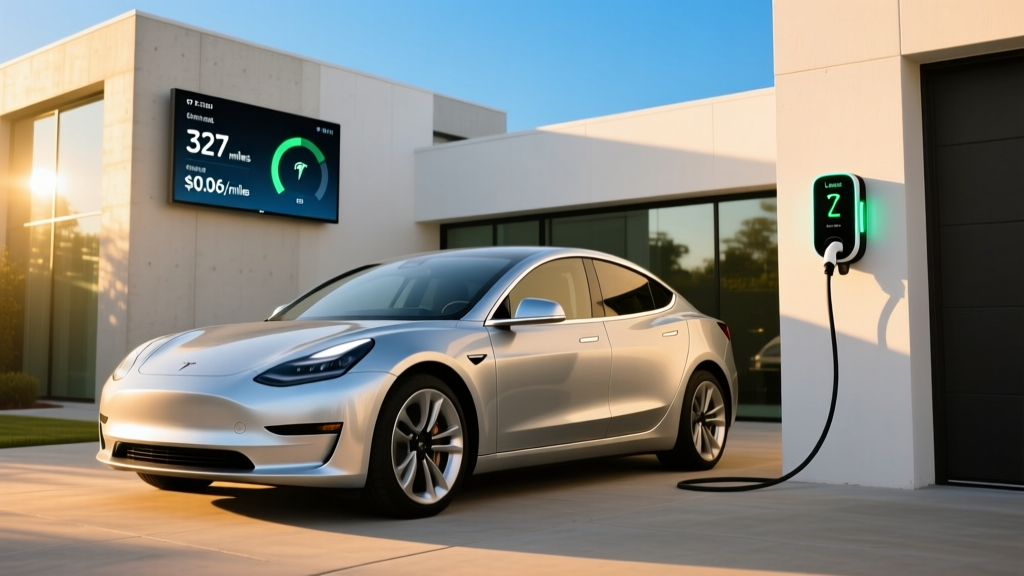
Home charging is the backbone of solo EV ownership. Over 80% of EV charging happens at home, and for a single driver, a Level 2 setup is usually all you need.
| Level | Power (kW) | Miles Added/Hour | Best For | Typical Cost |
|---|---|---|---|---|
| Level 1 (120V outlet) | 1.2–1.9 kW | 3–5 mi/hr | Low-mileage solo drivers (<30 mi/day) | $0 (included cord) |
| Level 2 (240V, home) | 7.2–11.5 kW | 20–40 mi/hr | Daily top-up for most solo commuters | $500–$1,800 installed |
| DC Fast Charge (public) | 50–350 kW | 150–800 mi/hr | Road trips, emergency top-ups | $0.30–$0.55/kWh |
Level 2 installation breakdown: A 48-amp hardwired Level 2 charger (like the ChargePoint Home Flex or Emporia Level 2) costs $500–$700 for the unit. Electrician labor runs $300–$1,200 depending on panel proximity and whether you need a 200-amp service upgrade ($1,500–$3,000 additional). Permit fees are typically $50–$150. Total: $850–$2,050 for most homes with adequate panel capacity.
If you live in an apartment or lack a dedicated parking spot with electrical access, public-only charging is viable but costs 2–3× more per mile and requires planning around DC fast-charger availability. Apps like PlugShare and A Better Routeplanner are essential in this scenario.
Federal Tax Credits and Incentives: The §30D Rules in 2026
The IRS §30D Clean Vehicle Credit remains available in 2026 with several requirements that solo EV buyers must verify before assuming eligibility:
- MSRP Cap: Cars (sedans, hatchbacks, wagons) must have an MSRP ≤ $55,000; SUVs, trucks, and vans ≤ $80,000.
- Buyer Income Cap: Modified AGI ≤ $150,000 (single), $225,000 (head of household), $300,000 (married filing jointly).
- Battery Sourcing: Increasing percentages of critical minerals and battery components must be sourced from the U.S. or free-trade-agreement countries. This disqualifies some models in 2026 that qualified in prior years.
- Point-of-Sale Transfer: You can transfer the credit to the dealer at purchase, reducing your out-of-pocket cost immediately rather than waiting for tax filing.
- Final Assembly: Vehicle must undergo final assembly in North America (verify via VIN at fueleconomy.gov).
Not every 2026 EV qualifies for the full $7,500. Some models receive $3,750 (meeting only the critical-minerals or battery-component requirement, not both). Always confirm a specific VIN's eligibility before signing a purchase agreement. Your tax professional should validate income and credit applicability—this is general guidance, not tax advice.
5-Year Cost of Ownership: Solo EV vs Gas vs Hybrid
Solo buyers often ask: "Should I get an EV, a hybrid, or just stick with gas?" Here's a 5-year total cost of ownership (TCO) comparison assuming 12,000 miles/year, 60% highway driving, and national-average fuel/electricity prices.
| Cost Category | Hyundai Kona Electric (EV) | Toyota Prius (HEV) | Honda Civic (Gas) |
|---|---|---|---|
| Purchase Price (base MSRP) | $34,975 | $29,445 | $25,345 |
| Federal Tax Credit | −$3,750 (partial 2026) | $0 | $0 |
| Net Purchase | $31,225 | $29,445 | $25,345 |
| Fuel/Energy (5 yr) | $3,025 | $4,860 | $6,545 |
| Maintenance (5 yr) | $1,750 | $2,800 | $3,250 |
| Insurance (5 yr) | $9,250 | $7,750 | $7,750 |
| Estimated Depreciation | $13,500 | $10,800 | $11,200 |
| Total 5-Year Cost | $58,750 | $55,655 | $54,090 |
Depreciation estimates based on 2026 industry resale-value data. EV depreciation has narrowed significantly as the used-EV market matures, but gas and hybrid cars still hold value slightly better over 5 years. Tax credit amount varies by model and buyer eligibility.
The EV's higher insurance and depreciation offset much of the fuel and maintenance savings over 5 years. The break-even point against the gas Civic typically arrives around year 6–7, assuming stable electricity and gas prices. Against the Prius hybrid, the EV is cost-competitive but rarely cheaper in a pure TCO sense unless you drive significantly more miles or benefit from state-level rebates and free HOV-lane access.
Common Solo EV Misconceptions — Fact vs Myth
| Myth | Fact |
|---|---|
| "I'll need to replace the battery for $20,000 in a few years." | Modern NMC and LFP batteries degrade 10–15% over 150,000–200,000 miles. Federal law mandates a minimum 8-year/100,000-mile battery warranty (capacity retention ≥70%). Most 2026 EV batteries will outlast the car's useful life. |
| "Charging takes too long for daily use." | Home Level 2 charging adds 25–40 miles per hour. Plug in overnight, wake up to a full battery every morning—zero trips to a gas station for daily commuting. |
| "EVs don't work in cold weather." | Cold reduces range by 20–40% depending on heat-pump availability, but a 261-mile EPA EV still delivers 155–200 real-world miles in sub-freezing conditions—ample for most solo commutes. Preconditioning while plugged in restores efficiency. |
| "The grid can't handle more EVs." | Most solo EV charging occurs overnight during off-peak hours, when grid capacity is underutilized. A single EV drawing 7.2 kW is comparable to running an electric dryer. |
| "I need a home garage to own an EV." | While home charging is ideal, workplace charging, public Level 2 stations, and DC fast-charger networks make EV ownership feasible for apartment dwellers—though at higher per-mile cost and more planning. |
Decision Framework: Is a Solo Electric Car Right for You?
Choose a Solo Electric Car If:
- You have access to Level 1 or Level 2 charging at home or work (dedicated parking with an outlet).
- Your daily round-trip commute is under 80 miles (well within real-world range, even in cold weather).
- You drive 10,000–18,000 miles per year (enough mileage for fuel savings to offset the price premium).
- You qualify for the §30D tax credit or a state-level EV rebate, reducing the net purchase price.
- You value low maintenance, instant torque for merging, and never visiting a gas station again.
Consider a Hybrid or Gas Car Instead If:
- You lack any reliable charging access (no home outlet, no workplace charger, and sparse public infrastructure in your area).
- You regularly drive more than 250 miles between stops in rural areas or charging deserts.
- Your annual mileage is under 6,000 miles (fuel savings won't justify the EV premium within a reasonable payback period).
- You need maximum cargo versatility or frequent 4+ passenger capacity (a solo EV's compact footprint may not suffice for multi-role use).
- Your budget is strictly under $25,000 and you cannot access the used-EV credit (§25E, up to $4,000 for qualifying pre-owned EVs).
Frequently Asked Questions
How much does it cost to charge a solo electric car per month?
At the U.S. residential average of $0.16/kWh and a typical solo commute of 1,000 miles/month, expect to spend about $45–$60/month on home charging. Public DC fast charging costs roughly 2–3× more per kWh, so rely on home charging whenever possible.
Can I use a regular 120V outlet to charge my EV?
Yes. Level 1 charging from a standard household outlet delivers 3–5 miles of range per hour. For a solo driver covering 30–40 miles daily, plugging in for 10–12 hours overnight recovers your full commute. It's slow but viable as a primary method for low-mileage drivers.
Do solo EVs hold their resale value?
EV depreciation has improved significantly. A 2026 Tesla Model 3 or Hyundai Kona Electric retains roughly 50–60% of its value after 3 years, compared to 55–65% for a comparable gas sedan. Battery health reports (via the car's State of Health readout) help reassure used buyers. LFP chemistry batteries (found in some trims) degrade even less and may command a resale premium.
What happens if the battery degrades over time?
EV batteries lose roughly 1–2% of capacity per year under normal use. After 8 years, expect 85–90% of original capacity. The federal warranty guarantees at least 70% retention for 8 years or 100,000 miles. Full battery replacements are rare but cost $8,000–$18,000 depending on the model and kWh size.
Is a solo electric car safe in a crash?
Yes. EVs consistently earn top ratings from IIHS and NHTSA. The battery pack's low placement reduces rollover risk, and the absence of a front engine block allows for larger crumple zones. The Tesla Model 3, Hyundai Kona Electric, and Volvo EX30 all hold IIHS Top Safety Pick or equivalent NHTSA 5-star ratings.