When SolarCity was acquired by Tesla in a $2.6 billion all-stock deal that closed in November 2016, skeptics called it a distraction. Nearly a decade later, that acquisition has become the backbone of Tesla's home energy ecosystem — and a major reason why Tesla owners enjoy some of the lowest per-mile charging costs in the EV market. In 2026, the integration of Tesla Solar Roof, Solar Panels, and Powerwall 3 with Tesla electric vehicles creates a closed-loop energy system that no other automaker can match.
This isn't an EV review in the traditional sense. Instead, we're profiling the home energy and charging ecosystem that the SolarCity acquisition made possible — examining real numbers, real costs, and whether pairing Tesla solar with a Tesla EV actually delivers the savings Tesla promises.
Why Tesla Bought SolarCity: The EV Charging Connection
SolarCity, co-founded by Elon Musk's cousins Lyndon and Peter Rive in 2006, was the largest residential solar installer in the United States before the acquisition. Tesla's rationale was straightforward: if EVs are going to scale, owners need affordable, clean electricity to charge them. Owning the solar installation pipeline gave Tesla vertical integration from panel to plug.
By 2026, the integration is complete. Tesla offers three solar products:
- Tesla Solar Panels — conventional rack-mounted panels (most affordable)
- Solar Roof — integrated solar tiles replacing traditional roofing
- Powerwall 3 — 13.5 kWh usable home battery with integrated inverter
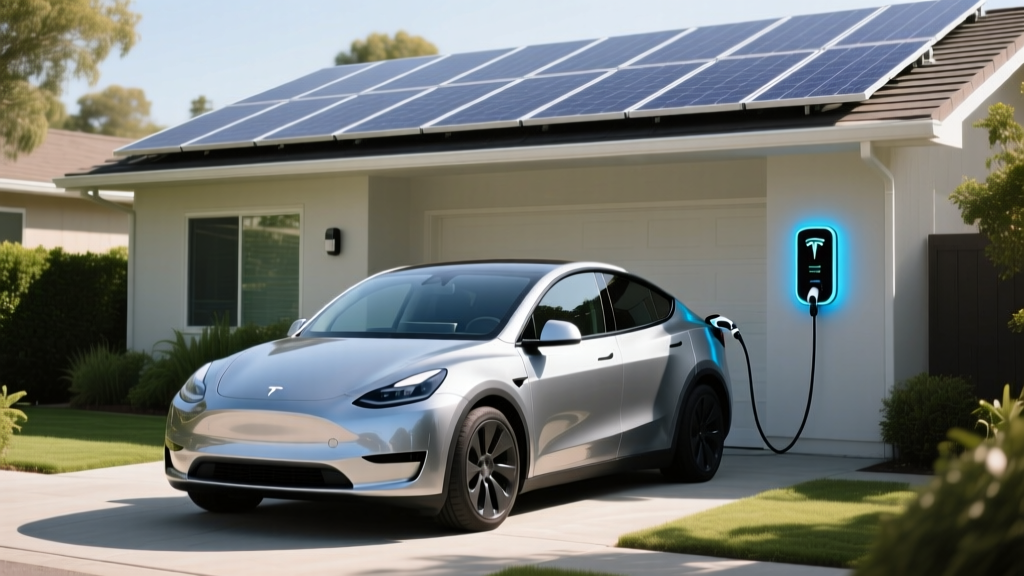
Pair any of these with a Tesla Wall Connector (Level 2 home charger) and a Tesla EV, and you get a system where your car charges on sunlight you generate — often for an effective cost of $0.02–$0.05 per kWh after the system is paid off.
The 2026 Tesla Home Energy + EV Charging Spec Sheet
| Component | Specification | Notes |
|---|---|---|
| Tesla Solar Panels | ~400W per panel, 22%+ efficiency | System sizes 4–20 kW typical |
| Solar Roof | Integrated tiles, ~70% solar coverage | Premium aesthetic, higher cost |
| Powerwall 3 | 13.5 kWh usable, 11.5 kW continuous output | Stackable up to 3 units |
| Wall Connector (Level 2) | Up to 11.5 kW (48A), ~44 mi/hr on Model 3 | Requires 60A circuit |
| Mobile Connector (Level 1) | 1.2 kW (12A), ~3–5 mi/hr | Included with vehicle |
| Supercharger (DC Fast) | Up to 250 kW (V3), 350 kW (V4 emerging) | 10–80% in ~18–25 min depending on model |
| Federal Solar Tax Credit | 30% of system cost (§25D, through 2032) | No cap on system cost |
| Federal EV Tax Credit | Up to $7,500 (§30D) | Subject to MSRP, income, sourcing rules |
Real-World Charging Economics: Solar + EV vs. Grid + EV vs. Gas
The financial case for the SolarCity acquisition rests on one question: how much does it actually cost to charge a Tesla EV at home on solar versus grid power versus filling a gas car?
Here's a breakdown using a Tesla Model 3 Long Range AWD (2026) as the baseline vehicle, driven 12,000 miles per year at an efficiency of 26 kWh/100 mi (per fueleconomy.gov):
| Energy Source | Cost per kWh | Annual Fuel Cost (12k mi) | 5-Year Cost |
|---|---|---|---|
| Tesla Solar (owned, paid off) | ~$0.02–$0.04 (maintenance only) | $62–$125 | $310–$625 |
| Tesla Solar (financed, typical) | ~$0.06–$0.09 effective | $187–$281 | $935–$1,405 |
| US Grid Average | ~$0.16/kWh (EIA 2025) | $499 | $2,495 |
| Gas Vehicle (25 MPG, $3.40/gal) | $0.136/mi | $1,632 | $8,160 |
The numbers are stark. A solar-charged Tesla costs roughly 80–90% less to "fuel" over five years than a comparable gas car, and 60–75% less than the same EV charging on grid power. This is the core value proposition the SolarCity acquisition unlocked.
What It Costs to Install: Solar + Powerwall + Wall Connector in 2026
Tesla's current pricing (as of early 2026) for a typical residential installation:
| Component | Estimated Cost (Before Credits) | After 30% Federal Credit |
|---|---|---|
| 8.16 kW Solar Panel System | $18,000–$22,000 | $12,600–$15,400 |
| Solar Roof (equivalent system) | $35,000–$55,000 | $24,500–$38,500 |
| Powerwall 3 (single unit, installed) | $9,200–$12,000 | $6,440–$8,400 |
| Wall Connector + Electrical Install | $1,200–$2,800 | N/A (not covered by §25D alone) |
| Total Typical System (Panels + Powerwall + Charger) | $28,400–$36,800 | $19,040–$25,760 |
Important: The 30% federal solar tax credit (IRS §25D) applies to solar panels, Solar Roof, and Powerwall battery storage. It is separate from the §30D EV tax credit and has no dollar cap. According to IRS guidance on the Residential Clean Energy Credit, the credit applies through 2032 at 30%, then steps down to 26% in 2033 and 22% in 2034.
Many states and utilities offer additional rebates. California's SGIP program, for example, can rebate $2,000–$4,000 on a Powerwall installation. Check your local utility for specifics.
How Solar Charging Actually Works Day-to-Day
A common misconception is that solar panels charge your EV directly in real time. In practice, the workflow looks like this:
- Daytime generation: Solar panels produce DC electricity, converted to AC by the inverter (integrated in Powerwall 3).
- Home load priority: Your home's electrical loads consume solar power first.
- Battery storage: Excess solar charges the Powerwall for use after sunset.
- EV charging: You can schedule your Wall Connector to charge during peak solar hours (via the Tesla app) or charge overnight from the Powerwall.
- Grid export: If net metering is available in your area, surplus energy goes back to the grid for credits.
The Tesla app now includes a "Charge on Solar" feature that automatically adjusts your EV's charging rate to match real-time solar production, ensuring you charge only on excess solar without pulling from the grid. This feature requires a Tesla solar system + Powerwall + Tesla vehicle — the full ecosystem the SolarCity acquisition was designed to build.
Tesla EV Charging Specs: What the Ecosystem Supports
The solar system only matters if your EV can actually absorb the energy efficiently. Here's how current 2026 Tesla models handle charging across the ecosystem:
| Vehicle (2026) | Battery (kWh Usable) | Level 2 Max (kW) | DC Fast Peak (kW) | 10–80% DC Time | EPA Range |
|---|---|---|---|---|---|
| Model 3 LR AWD | 78.1 (NMC) | 11.5 kW | 250 kW | ~22 min | 341 mi |
| Model 3 RWD | 57.5 (LFP) | 11.5 kW | 170 kW | ~25 min | 272 mi |
| Model Y LR AWD | 78.1 (NMC) | 11.5 kW | 250 kW | ~23 min | 320 mi |
| Model S LR | 95.0 (NMC) | 11.5 kW | 250 kW | ~28 min | 402 mi |
| Cybertruck AWD | 123.0 (NMC est.) | 17.0 kW | 250+ kW | ~30 min | 340 mi |
Charging curve reality: Peak DC fast-charge rates (e.g., 250 kW on the Model 3 LR) are sustained only between roughly 10–30% State of Charge. Above 50%, the rate tapers significantly — typically to 50–80 kW by 70% SoC, and below 25 kW past 85%. This is why Tesla quotes 10–80% times rather than 0–100%. For home Level 2 charging, the taper matters less because you're charging overnight at a steady 7–11.5 kW.
LFP vs. NMC note: The Model 3 RWD uses an LFP (lithium iron phosphate) battery, which Tesla recommends charging to 100% regularly — a unique advantage for solar owners who want to fully charge daily from excess production. NMC-equipped models (LR, Performance) are best kept at 80% for daily use.
Tax Credit Eligibility: Solar + EV in 2026
One of the most powerful financial aspects of the Tesla ecosystem is that solar and EV incentives stack — they're separate credits under different sections of the tax code.
- Solar + Powerwall (§25D Residential Clean Energy Credit): 30% of total installed cost, no dollar cap, no income cap. Applies through 2032. Battery storage qualifies independently even without solar. File IRS Form 5695.
- EV Purchase (§30D Clean Vehicle Credit): Up to $7,500, but subject to strict rules:
- Buyer AGI cap: $150k single / $225k head of household / $300k joint
- MSRP cap: $55,000 for sedans (Model 3) / $80,000 for SUVs and trucks (Model Y, Cybertruck)
- Battery components and critical minerals must meet phased sourcing thresholds (increasing yearly)
- Available as point-of-sale transfer to dealer (reduces purchase price at sale)
- Used EV (§25E): Up to $4,000 or 30% of sale price (whichever is lower) on qualifying pre-owned EVs. Income caps apply.
- Home Charger (§30C): Up to $1,000 credit for residential EV charger installation, but limited to census tracts not classified as "eligible" — many suburban/urban areas no longer qualify as of 2023 rules.
Always consult a tax professional and verify current-year rules at IRS.gov's clean vehicle credits page. Eligibility depends on your specific vehicle configuration, income, and the manufacturer's battery sourcing compliance at time of purchase.
Pros and Cons of the Tesla Solar + EV Ecosystem
Pros
- Lowest possible per-mile fuel cost ($0.02–$0.05/kWh effective)
- Single-app control: solar, battery, charger, and vehicle all in Tesla app
- "Charge on Solar" feature prevents grid draw automatically
- Powerwall provides home backup during outages (critical in CA, TX, FL)
- Federal tax credits stack: 30% on solar/battery + up to $7,500 on EV
- Increases home resale value (solar + EV-ready garage)
- Supercharger network access for road trips (250 kW DC widely available)
Cons
- High upfront cost: $28k–$37k before credits for full system
- Solar production drops 40–60% in winter (northern states)
- Tesla solar installation wait times can stretch 2–4 months
- Solar Roof is significantly more expensive than conventional panels
- Ecosystem lock-in: best features require all-Tesla hardware
- Net metering policies vary by state — some utilities offer poor buyback rates
- Powerwall does not qualify for §30D (only §25D) — no overlap confusion, but separate filing
Who Should Buy Into the Tesla Solar + EV Ecosystem?
The SolarCity acquisition created a product stack that isn't for everyone. Here's our decision framework:
Buy into the full ecosystem if:
- You own your home and plan to stay 7+ years (payback period)
- You live in a high-sun state (CA, AZ, TX, FL, NV, CO, NC)
- Your utility electricity rate is above $0.14/kWh
- You drive 10,000+ miles per year (more driving = faster payback)
- You want backup power for outages
- You're already buying a Tesla EV and want to minimize charging cost
Consider alternatives if:
- You rent or live in a condo/apartment (no roof access)
- Your roof is heavily shaded or needs replacement soon
- You live in a northern state with low solar production and cheap grid power
- You plan to move within 5 years
- You prefer a non-Tesla EV (solar still works, but you lose "Charge on Solar" integration)
Frequently Asked Questions
When was SolarCity acquired by Tesla, and how much did it cost?
Tesla completed its acquisition of SolarCity in November 2016 for approximately $2.6 billion in an all-stock transaction. The deal was controversial at the time — SolarCity carried significant debt — but it gave Tesla control of the largest residential solar installation network in the US.
Can I use Tesla Solar Panels with a non-Tesla EV?
Yes. Tesla solar and Powerwall work with any EV. You can use a Tesla Wall Connector with a J1772 adapter for non-Tesla vehicles, or install a third-party Level 2 charger. However, you lose the "Charge on Solar" automatic scheduling feature, which currently requires a Tesla vehicle communicating with the Tesla energy app.
How long does a Tesla solar system take to pay for itself?
Payback periods range from 6–10 years depending on your state's solar production, local electricity rates, net metering policies, and available incentives. After payback, your effective charging cost drops to near-zero (maintenance and monitoring only). With a 25-year panel warranty, that's 15+ years of essentially free EV fuel.
Does the Powerwall charge my EV during a power outage?
Yes — if configured correctly. A single Powerwall 3 (13.5 kWh usable) can provide roughly 50 miles of range to a Model 3 during an outage. Multiple Powerwalls extend this. The system automatically islanded from the grid during outages and continues to supply power to designated circuits, including your Wall Connector.
Is Tesla solar cheaper than third-party installers?
Tesla's per-watt pricing ($2.20–$2.70/W before incentives in 2026) is generally competitive with or slightly below national averages for premium installers. However, Tesla's installation timelines and customer service have historically drawn mixed reviews. Get at least 3 quotes — from Tesla, a local installer, and a national competitor like Sunrun — before committing.
What happens if I need a new roof after installing solar?
Tesla offers a removal and reinstallation service, but it costs $2,000–$5,000+ depending on system size. If your roof is within 5–7 years of needing replacement, replace it before installing solar panels. The Solar Roof product replaces your roof entirely, eliminating this issue but at a premium cost.
The SolarCity acquisition was one of the most debated corporate moves in the EV industry's history. In 2026, the verdict is measurable in kilowatt-hours and cents per mile: for homeowners with the right conditions, the Tesla solar-energy-vehicle ecosystem delivers the lowest total cost of transportation available today. The numbers don't lie — but they do require a rooftop, patience for installation, and a willingness to invest upfront for long-term savings.