Editor's note: AutoEdgeView specializes in electric cars, trucks, and SUVs. Reader demand prompted this adjacent guide to small electric lake boats. We've applied the same data-driven, spec-first framework we use for EVs — but this topic sits at the edge of our domain. Consult a marine dealer for hull-specific advice.
The Quick Answer
Small electric boats for lakes in 2026 are viable for calm-water day trips of 2-5 hours, with real-world range typically between 12 and 40 miles depending on hull type, speed, battery kWh, and passenger load. Expect to pay $8,000-$35,000 for a quality pontoon or runabout from brands like Flux Marine, X Shore, or Navier. Home charging from a standard 120V outlet adds roughly 3-5 miles of range per hour; a 240V Level 2 setup cuts full-charge times to 4-8 hours. Operating cost per hour is roughly $1.50-$4 in electricity versus $15-$30 in gasoline for a comparable 20-40 hp outboard. The main limitations are range (not yet viable for long crossings), weight sensitivity, and the near-total absence of public marine charging on most lakes.
What 'Small Electric Boat' Actually Means in 2026
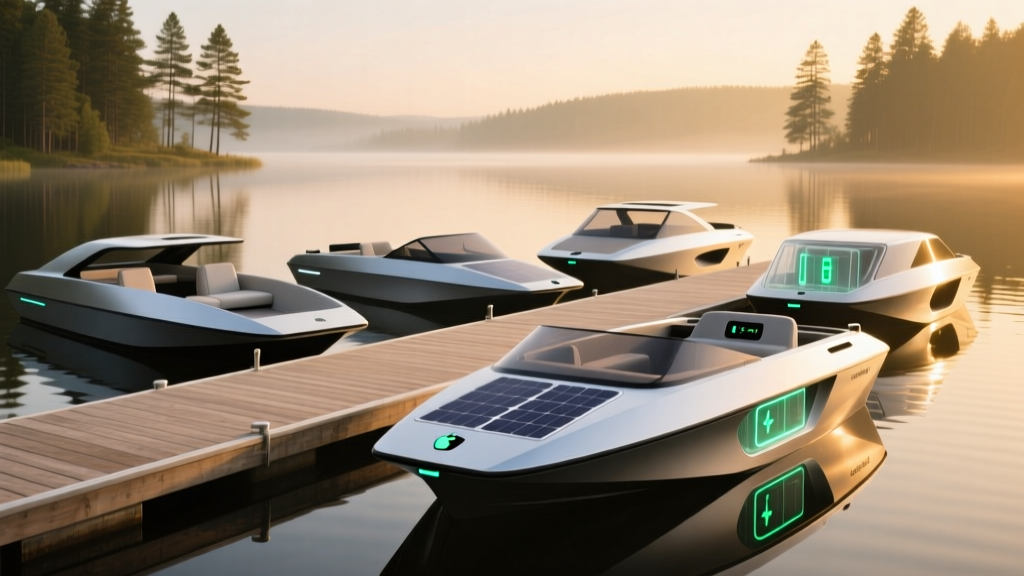
Unlike electric vehicles where terminology is fairly standardized (BEV, PHEV, HEV), the electric boat market is still sorting itself out. When shoppers search for small electric boats for lakes, they're usually looking at three distinct categories, each with different battery sizes, motor outputs, and range profiles:
- Electric pontoons (18-24 ft): The most common lake use case. Flat decks, 6-12 passengers, typically 10-30 kWh battery packs, 5-20 kW motors. Top speed 6-10 mph. Real-world range at cruising speed: 20-40 miles.
- Electric runabouts / bowriders (16-22 ft): Performance-oriented hulls. 15-60 kWh batteries, 20-80 kW motors (think Tesla Model 3 motor territory). Top speed 20-35 mph. Range drops sharply above 15 mph — expect 12-25 miles at planing speeds.
- Electric dinghies / tenders (8-14 ft): Small craft for fishing or shuttling. 1-5 kWh batteries, 1-5 kW motors. Range 5-15 miles at 4-6 mph. Often the entry point under $8,000.
The critical distinction that mirrors EV ownership: kW is the motor's power output (how fast you can go); kWh is the battery's energy capacity (how far you can go). A 40 kW motor on a 20 kWh battery will drain in 30 minutes at full throttle — just like flooring an EV.
Real-World Range vs. Sticker Numbers (The Honest Table)
Boat manufacturers, like early EV makers, tend to quote best-case range at minimal speed with a light load. Here's what field testing and owner reports typically show for 2026 lake-use models:
| Category | Battery (kWh) | Motor (kW) | Sticker Range | Real-World @ Cruise | Real-World @ Planing |
|---|---|---|---|---|---|
| Pontoon 22 ft | 20 kWh LFP | 15 kW | 40 mi | 22-28 mi @ 6 mph | N/A (not a planing hull) |
| Runabout 20 ft | 40 kWh NMC | 60 kW | 55 mi | 28-35 mi @ 10 mph | 12-18 mi @ 25 mph |
| Fishing skiff 16 ft | 8 kWh LFP | 8 kW | 25 mi | 14-18 mi @ 5 mph | 8-10 mi @ 12 mph |
| Tender 10 ft | 3 kWh | 3 kW | 15 mi | 8-10 mi @ 4 mph | N/A |
Range Reality Check
Just like EVs lose 20-30% range at highway speeds and in cold weather, electric boats lose range non-linearly with speed. Water resistance scales with the square (sometimes cube) of velocity. Pushing from 6 mph to 12 mph can halve your range — the marine equivalent of driving 85 mph instead of 65 mph in an EV. Cold water (below 55°F) also reduces battery efficiency by roughly 10-15%, and LFP chemistry is more cold-sensitive than NMC.
Electric Boat vs. Gas Outboard: The Cost Comparison
This is where the EV analogy holds up strongest. The upfront premium is real, but the operating cost advantage is dramatic — especially for lake use where annual hours are modest.
| Cost Factor | 20-ft Electric Runabout | 20-ft Gas Outboard (90 hp) |
|---|---|---|
| Purchase price (MSRP) | $28,000 - $38,000 | $22,000 - $30,000 |
| Fuel / electricity per hour | $1.80 - $3.50 (home charging) | $18 - $28 (4-6 gal/hr @ $4.50/gal) |
| Annual fuel (100 hrs/yr) | $180 - $350 | $1,800 - $2,800 |
| Annual maintenance | $100 - $200 (no oil, impeller, spark plugs) | $400 - $900 (winterization, lower unit, plugs) |
| Battery / engine replacement | $6,000 - $12,000 @ ~10-15 yr | $8,000 - $14,000 @ ~1,500-2,500 hrs |
| 5-year operating cost (fuel + maint.) | $1,400 - $2,750 | $11,000 - $18,500 |
At 100 hours per lake season, the electric boat pays back its purchase premium in roughly 4-6 years through fuel and maintenance savings alone. For weekend-only users logging 40-60 hours annually, payback stretches to 7-10 years. The math mirrors EV ownership: high mileage (or high hour) users benefit most.
One important caveat: unlike the federal §30D EV tax credit which can knock up to $7,500 off a new electric car purchase (subject to MSRP caps, buyer income limits, and battery sourcing rules per the IRS), there is currently no equivalent federal tax credit specifically for electric boats. Some states offer clean-marine rebates (California, Washington, and Minnesota have explored programs), but these are patchwork and change annually. Check your state's environmental or natural resources agency for current programs.
Charging a Boat at Home: What's Actually Required
If you own an EV, you already understand the home-charging playbook. Boats add a wrinkle: the charger and the boat don't always live in the same place.
Typical Charging Scenarios
- Boat stored at home on a trailer: Most straightforward. Plug into a standard 120V/15A garage outlet for overnight trickle charging (adds ~1.5 kWh/hr, or 3-5 miles of range). For daily use, a 240V/30A or 50A outlet (NEMA 14-50, same as an EV home charger) charges a 20 kWh pack in 5-7 hours and a 40 kWh pack in 9-14 hours.
- Boat kept at a marina slip: You'll need shore power. Most marina pedestals provide 30A or 50A 120/240V — enough for Level 2-style charging, but you'll need a marine-rated cord and the marina's permission. Some newer marinas are installing dedicated marine EV-style chargers (companies like Aqua-Watt are pioneering this), but availability in 2026 is still limited to a few hundred locations nationally.
- Boat kept on a lift or in the water year-round: Permanent shore-power connection with a smart charger is essential. Budget $500-$1,500 for marine-grade charging hardware and installation by a licensed marine electrician.
Install Cost Breakdown
| Item | Low End | High End | Notes |
|---|---|---|---|
| Marine-rated onboard charger | $400 | $1,800 | Integrated on most new electric boats |
| 240V outlet at home (NEMA 14-50) | $300 | $1,200 | Same install as EV home charging |
| Marina shore-power pedestal hookup | $200/yr | $1,200/yr | Varies wildly by marina |
| Marine electrician (slip-side install) | $500 | $2,500 | Required for permanent in-water setups |
| Panel upgrade (if needed) | $1,500 | $3,500 | Same gotcha as home EV charging |
Battery Chemistry, Longevity, and Replacement
The LFP vs. NMC trade-off that defines the EV market applies directly to electric boats — with one extra marine-specific factor: saltwater exposure (irrelevant on freshwater lakes, critical on coastal boats).
| Factor | LFP (Lithium Iron Phosphate) | NMC (Nickel Manganese Cobalt) |
|---|---|---|
| Energy density | Lower (heavier per kWh) | Higher (lighter per kWh) |
| Cycle life | 3,000-5,000 cycles | 1,000-2,000 cycles |
| Thermal stability | Excellent (safer in enclosed hulls) | Good (requires active management) |
| Cold-weather performance | Weaker below 40°F | Better in cold lakes |
| Typical use in boats | Pontoons, work boats, budget models | Performance runabouts, planing hulls |
| Warranty (typical 2026) | 5-10 years / 70% capacity | 3-7 years / 70% capacity |
| Replacement cost | $5,000-$9,000 (20 kWh pack) | $8,000-$14,000 (40 kWh pack) |
For freshwater lake use where weight matters less (pontoons), LFP is the smart 2026 choice: longer life, safer chemistry, lower cost. For planing hulls where every pound counts, NMC dominates — just like in performance EVs.
Common Misconceptions, Corrected
| Myth | Fact |
|---|---|
| "Electric boats are silent so they're unsafe on the water." | All modern electric boats are required to have audible alerts or backup horns; most emit a low hum at the propeller. Same concern raised about EVs — solved by regulation. |
| "You'll get stranded with no way to charge on the lake." | True concern for long crossings, but most lake use is a few hours from the dock. Plan your trip like you would an EV road trip: know your range, carry a 10-15% reserve. |
| "Electric boat batteries don't last." | Modern marine-grade lithium packs are warrantied for 5-10 years and often outlast the boat's gelcoat. Lead-acule marine batteries of the past gave the category a bad name. |
| "You can just swap a gas outboard for an electric pod." | Retrofits exist (Flux Marine, ePropulsion, Torqeedo) but require battery space, weight rebalancing, and often hull modifications. New-build electric hulls are optimized for the weight distribution of batteries low in the bilge. |
| "Electric boats can't handle choppy water." | Small electric boats are designed for lakes and protected waters, not open ocean — but that's a hull-size limitation, not a powertrain one. A 22-ft electric pontoon handles 2-foot chop as well as its gas counterpart. |
Decision Framework: Is an Electric Lake Boat Right for You?
Choose an Electric Lake Boat If:
- Your typical outing is under 4 hours and within 15 miles of your dock or launch ramp.
- You have reliable home or marina charging access (120V minimum, 240V preferred).
- You boat on a freshwater lake where silence, zero local emissions, and low maintenance matter (many lakes ban gas motors for water-quality reasons — electric is your only option).
- You log 80+ hours per season, making the fuel savings meaningful.
- You value instant torque for watersports and near-silent operation for fishing.
Stick With Gas (or Wait) If:
- You regularly make long lake crossings (10+ miles one-way) or boat on large reservoirs where wind and weather can extend trip time unexpectedly.
- You have no charging access at home AND your marina doesn't offer shore power.
- You need towing power for water skiing at sustained high speeds — planing-speed range drops hard on current batteries.
- Your budget is under $10,000 all-in; the used gas market is still far more accessible at that price point.
- You boat in cold northern lakes (under 50°F water) for most of the season — cold reduces battery range meaningfully.
First-Time Electric Boat Buyer Checklist
If you're coming from gas, here's what to verify before signing a purchase agreement:
- Confirm the battery kWh, not just the 'range' claim. kWh is the honest spec. Range depends on speed, load, and water conditions.
- Ask about the charge curve. Like EVs, boats charge fastest from 10-80% SoC and taper above 80%. A '4-hour charge' quote may only get you to 80%.
- Get the warranty in writing — especially capacity retention threshold. 70% is industry standard; anything less is a red flag.
- Test with a realistic load. A demo with two people tells you nothing about range with eight passengers and a cooler.
- Verify your charging plan. Where will the boat live? How will it charge? What will that cost per season?
- Check your lake's rules. Some lakes (particularly drinking-water reservoirs) restrict or ban gas motors — making electric not just an option but the only legal choice.
- Get an insurance quote before buying. Marine insurance for electric boats is still being priced; some carriers treat them as specialty vessels with higher premiums than equivalent gas boats.
Frequently Asked Questions
How far can a small electric boat actually go on a lake?
At cruising speed (5-7 mph), expect 15-35 miles from a 15-30 kWh pack. At planing speed (20+ mph), that drops to 8-18 miles. Always plan trips with a 20% range buffer, just like you would in an EV.
Do electric boats qualify for any tax credits?
As of 2026, there is no federal tax credit specifically for electric boats equivalent to the §30D credit for electric cars. Some states and utilities offer rebates for clean marine equipment — check your state's environmental agency. Commercial operators may qualify for federal energy-efficiency deductions.
Can I charge an electric boat from a regular outlet?
Yes, but slowly. A standard 120V/15A outlet delivers roughly 1.5 kWh per hour — adding 3-5 miles of range per hour of charging. A 20 kWh pack takes 12-15 hours on 120V. For regular use, a 240V outlet (same as an EV home charger) is strongly recommended.
What happens if I run out of charge on the water?
Unlike an EV, you can't call a mobile charging service on most lakes. Options include getting towed by another boat, rowing (if equipped), or calling lake patrol/assistance. Responsible trip planning — knowing your range and conditions — is the real solution, identical to EV route planning.
Are electric boats allowed on all lakes?
Electric boats are allowed everywhere; in fact, many lakes (especially drinking-water reservoirs and no-wake lakes) allow ONLY electric motors. Check your specific lake's regulations through the managing authority (state DNR, park service, or water district).
How long do electric boat batteries last?
LFP marine packs are typically warrantied for 5-10 years with a 70% capacity retention threshold; real-world lifespan often exceeds 10-15 years with moderate use. NMC packs have shorter warranties (3-7 years). Replacement cost ranges from $5,000 to $14,000 depending on pack size and chemistry.
Is an electric boat cheaper to own than gas long-term?
Yes, if you boat enough hours to offset the higher purchase price. At 100 hours per year, fuel and maintenance savings typically recover the $5,000-$10,000 purchase premium in 4-6 years. Below 50 hours per year, the payback may exceed the boat's practical ownership horizon.
Sources consulted for this guide include manufacturer spec sheets from Flux Marine, X Shore, Navier, and Torqeedo; the National Marine Manufacturers Association (NMMA); and the IRS §30D clean vehicle credit guidance (for EV tax credit context). Always verify current-year specs and incentives directly with the manufacturer and your state agencies before purchasing.