Quick Verdict: Should You Buy a Small Electric BMW?
If you want premium-badge compact electric mobility, BMW's two main "small" EVs in 2026—the iX1 compact SUV and the i4 Gran Coupe—deliver 240–304 miles of EPA range, DC fast charging up to 150–205 kW, and genuinely engaging driving dynamics. But expect to pay $52,000–$58,000+ before incentives, and know that the federal §30D tax credit eligibility is uncertain for German-assembled BMWs due to final-assembly and battery-sourcing rules. Real-world highway range drops 10–15% below the EPA sticker, and winter driving can shave another 20–30%. These EVs make sense if you have home Level 2 charging, drive under 300 miles daily, and value a luxury compact package over maximum range per dollar.
What Counts as a "Small Electric BMW" in 2026?
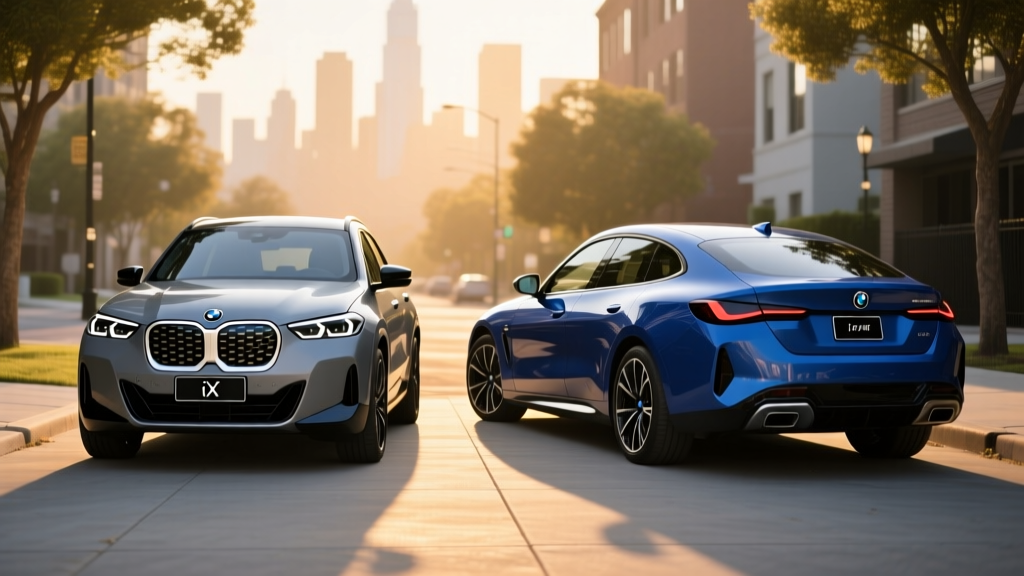
BMW's EV portfolio has expanded significantly, but shoppers searching for a compact, city-friendly electric BMW typically land on two models:
- BMW iX1 (xDrive30) — A subcompact luxury crossover (think X1, but electric). Wheelbase: 106.0 inches. Cargo: ~25 cu ft rear, ~52 cu ft folded.
- BMW i4 (eDrive40 / M50) — A low-slung Gran Coupe based on the 4 Series. Sleeker, sportier, but less cargo room (~16.6 cu ft trunk).
Both are built on BMW's flexible CLAR/FAAR platforms rather than a dedicated EV skateboard, which means packaging compromises (like a slight floor hump in the i4) but also familiar BMW driving feel. Neither qualifies as "affordable" in the broader EV market, but they compete directly with the Volvo EX40, Audi Q4 e-tron, Tesla Model 3, and Genesis GV60 in the compact luxury EV segment.
| Spec | iX1 xDrive30 | i4 eDrive40 | i4 M50 |
|---|---|---|---|
| EPA Range | ~240 mi | ~304 mi | ~269 mi |
| Battery (usable) | 64.7 kWh (NMC) | 80.7 kWh (NMC) | 80.7 kWh (NMC) |
| Horsepower | 313 hp | 335 hp | 536 hp |
| 0–60 mph | 5.3 sec | 5.5 sec | 3.7 sec |
| Peak DC Charge Rate | 130 kW | 205 kW | 205 kW |
| 10–80% DCFC Time | ~29 min | ~31 min | ~31 min |
| Level 2 (AC) Rate | 11 kW | 11 kW | 11 kW |
| Drivetrain | AWD (dual motor) | RWD (single motor) | AWD (dual motor) |
| Base MSRP | ~$52,000 | ~$58,000 | ~$68,000 |
| Battery Warranty | 8 yr / 100,000 mi | 8 yr / 100,000 mi | 8 yr / 100,000 mi |
Sources: fueleconomy.gov, BMW USA specifications. Real-world range typically 10–25% below EPA depending on conditions.
Real-World Range: What the EPA Sticker Doesn't Tell You
The EPA numbers above are useful starting points, but they represent a blended cycle. Here's what to actually expect:
- City / mild-weather driving: You'll meet or slightly exceed EPA range. Regenerative braking recovers energy in stop-and-go traffic.
- Sustained highway (70–80 mph): Expect 10–15% less than EPA. The i4 eDrive40's 304-mile sticker becomes roughly 260–275 miles on an interstate run.
- Cold weather (below 30°F): Plan for 20–30% reduction. The iX1's 240-mile EPA range can drop to 170–190 miles in freezing temperatures, even with the heat pump engaged.
- Mountain / high-speed driving: Elevation climbs and aggressive acceleration further reduce efficiency. BMW's onboard navigation estimates range based on route terrain—use it.
Both models use NMC (nickel manganese cobalt) lithium-ion chemistry, which offers strong energy density but is more sensitive to extreme cold than LFP batteries found in some competitors. BMW's thermal management system and standard heat pump mitigate this, but physics still applies. Preconditioning the battery before DC fast charging—either manually or via navigation to a charger—is essential to hitting peak charge rates.
Charging Speed and Infrastructure: What Ownership Looks Like
One of the most significant ownership decisions for a small electric BMW is your charging setup. Here's a realistic breakdown:
| Level | Power | Miles Added per Hour | Typical Use Case |
|---|---|---|---|
| Level 1 (120V outlet) | ~1.4 kW | ~4–5 mi/hr | Emergency / overnight trickle only |
| Level 2 (240V home) | 11 kW max | ~32–38 mi/hr | Daily home charging — full charge in 7–8 hours |
| DC Fast Charge | 130–205 kW peak | ~180–250 mi in 30 min | Road trips; tapers significantly above 80% SoC |
Key charging insights:
- Charge curve taper: The i4's 205 kW peak rate only sustains roughly up to 40–50% SoC, then progressively tapers. Charging from 80–100% on DCFC is painfully slow—plan to charge to 80% and go.
- NACS adapter: BMW has committed to adopting the NACS (Tesla) connector for future models. For 2026, BMW EVs still use CCS1 in North America but can access Tesla Superchargers via a BMW-approved CCS-to-NACS adapter. Confirm adapter availability and compatibility with your specific model year before relying on the Supercharger network.
- Home charging is essential: Relying solely on public DCFC is expensive ($0.35–$0.55/kWh in many markets) and time-consuming. A Level 2 home installation (typically $1,200–$2,500 including equipment and electrician labor) is the foundation of practical BMW EV ownership. If you live in an apartment without charging access, weigh this carefully.
Cost of Ownership: Electric BMW vs. Gas BMW
The purchase price of an iX1 or i4 stings compared to their gas counterparts (the X1 xDrive28i starts around $41,000; the 430i Gran Coupe around $50,000). But the ownership equation shifts over time:
| Cost Category | BMW i4 eDrive40 (EV) | BMW 430i Gran Coupe (Gas) |
|---|---|---|
| Purchase Price (base MSRP) | $58,000 | $50,000 |
| Federal Tax Credit (§30D) | $0–$7,500* | $0 |
| Fuel/Energy (60k miles) | $3,600–$5,400** | $7,800–$9,600*** |
| Maintenance (5 years) | $1,500–$2,200 | $3,500–$5,000 |
| Insurance (avg. annual) | $2,200–$2,800/yr | $1,800–$2,400/yr |
| Estimated 5-Year Total | $64,100–$79,600 | $65,300–$77,000 |
* Federal §30D credit eligibility for BMWs assembled outside the US is restricted under current IRS rules. Check IRS §30D guidelines and the vehicle's VIN on fueleconomy.gov for current eligibility. Some state incentives may apply regardless of assembly location.
** Based on $0.12–$0.18/kWh home charging and 3.0–3.5 mi/kWh efficiency.
*** Based on $3.50–$4.00/gallon premium fuel and 28 MPG combined.
The EV doesn't always win on pure 5-year cost—it depends heavily on your local electricity rates, whether you qualify for incentives, and annual mileage. High-mileage drivers (15,000+ miles/year) benefit most from EV fuel savings. Low-mileage drivers may not recoup the price premium.
Federal Tax Credit Reality for BMW EVs
This is where many BMW EV buyers face disappointment. Under current §30D rules enforced by the IRS:
- Final assembly must occur in North America — BMW's iX1 and i4 are assembled in Germany (Regensburg/Dingolfing plants), which disqualifies them from the new-vehicle §30D credit in most cases.
- Battery component and critical-mineral sourcing thresholds further restrict eligible vehicles, even those assembled in the US.
- MSRP caps apply: $55,000 for sedans (i4 qualifies), $80,000 for SUVs/vans (iX1 qualifies if classified as SUV).
- Buyer income caps: AGI must not exceed $150,000 (single) or $300,000 (joint filing).
Workarounds to investigate:
- Leasing: The commercial clean vehicle credit (§45W) applies to leased EVs regardless of assembly location, and dealerships often pass this through as a lease incentive (sometimes called a "lease loophole"). Ask the dealer if the $7,500 is applied to the lease.
- State incentives: California, Colorado, New York, and others offer state rebates that don't require US assembly. Check your state's energy office.
- Used EV credit: If you buy a qualifying pre-owned i4 or iX1 (model year at least 2 years old, under $25,000), you may qualify for up to $4,000 under §25E.
Common Misconceptions About Small Electric BMWs
| Myth | Fact |
|---|---|
| "BMW EVs have unreliable batteries" | BMW's Gen5 eDrive battery packs have shown strong durability. The 8-year/100,000-mile warranty covers capacity below 70%. Independent fleet data shows less than 8% average degradation at 60,000 miles for similar NMC packs. |
| "I'll save $7,500 on taxes" | German-assembled BMW EVs generally do NOT qualify for the §30D new-vehicle credit. Leasing may unlock the commercial credit. Always verify before purchase. |
| "The iX1 is just an electric X1" | While sharing the FAAR platform, the iX1 has a reinforced floor for the battery, different weight distribution (lower center of gravity), and unique powertrain calibration. It drives noticeably differently—firmer, quieter, with instant torque. |
| "DC fast charging damages the battery" | Occasional DCFC is fine. BMW's thermal management actively protects cells. However, daily DCFC at maximum rates can accelerate degradation slightly over many years. Home Level 2 charging is gentler and should be your primary method. |
| "Electric BMWs cost more to insure" | Generally true—10–25% higher premiums than gas equivalents due to repair costs and battery replacement value. Get quotes before purchasing. |
Decision Framework: Is a Small Electric BMW Right for You?
Choose the BMW iX1 if:
- You want a compact luxury crossover with AWD and reasonable cargo space
- Your daily commute is under 100 miles round-trip
- You have access to Level 2 home or workplace charging
- You value a higher seating position and easier ingress/egress
- You live in a moderate climate (the 240-mile range gets tight in deep winter)
Choose the BMW i4 eDrive40 if:
- You prioritize maximum range (304 miles EPA) and driving efficiency
- You prefer a sport-sedan driving position and handling balance
- You take occasional 250-mile road trips and want DCFC confidence
- Cargo space is secondary (trunk only, no hatchback)
- You're in a state with EV purchase incentives that offset the assembly-location issue
Choose the BMW i4 M50 if:
- Performance is the priority (536 hp, 3.7-second 0–60)
- You accept the range trade-off (~269 miles) and higher MSRP
- You want M-badge dynamics without M4-level pricing
Look elsewhere if:
- You need over 320 miles of range (consider Tesla Model 3 Long Range or Hyundai Ioniq 6)
- The federal tax credit is essential to your budget (consider US-assembled EVs like the Tesla Model 3, Ford Mustang Mach-E, or Chevrolet Equinox EV)
- You lack any form of reliable home or workplace charging
- Your budget tops out at $45,000 (the compact luxury EV segment starts higher)
First-Time EV Buyer Checklist
If this is your first electric vehicle, confirm these before signing:
- Home charging feasibility: Do you have a 240V outlet or the ability to install one? Get a licensed electrician's quote—panel upgrades can add $1,500–$3,000 if your home has a 100-amp service.
- Insurance quotes: Call your insurer with the specific VIN. EV premiums vary wildly.
- Charging network apps: Download PlugShare, Electrify America, EVgo, and ChargePoint before delivery. Map out DCFC stations along your regular routes.
- Tax credit verification: Check the VIN on fueleconomy.gov and consult a tax professional. Do not assume credit eligibility.
- Maintenance schedule: EVs need less maintenance (no oil, fewer brake replacements due to regen), but BMW still requires annual inspections, cabin air filter changes, brake fluid service, and tire rotations. Budget ~$400–$600/year.
- Tire costs: EV-specific tires (low rolling resistance, higher load rating) wear faster due to vehicle weight and instant torque. Expect replacement every 25,000–35,000 miles at $250–$400 per tire.
Frequently Asked Questions
Does the BMW iX1 or i4 qualify for the $7,500 federal tax credit?
Under current §30D rules, likely not for new purchases—both are assembled in Germany, which fails the North American final-assembly requirement. Leasing may unlock the commercial clean vehicle credit (§45W), which dealers often pass through as a capitalized-cost reduction. Always verify current eligibility on the IRS website and with your dealer.
How long does it take to charge a BMW i4 at home?
On a Level 2 charger at 11 kW, the i4 eDrive40's 80.7 kWh battery charges from 0–100% in approximately 8 hours. For a typical daily top-up from 30% to 80% SoC, plan on about 3.5–4 hours—easily handled overnight.
Is the BMW iX1 big enough for a family?
It's tight. Rear legroom is adequate for children but snug for tall adults on long trips. Cargo space (~25 cu ft) handles groceries and strollers but not much more. Families needing more room should consider the BMW iX (midsize SUV) or a competitor like the Kia EV6.
What happens if the battery degrades significantly?
BMW warrants the high-voltage battery for 8 years or 100,000 miles against capacity dropping below 70% of original. Out-of-warranty replacement for the i4's 80.7 kWh pack currently ranges from $15,000–$22,000 depending on labor and parts availability—though prices are expected to decline as the battery supply chain matures.
Can I use Tesla Superchargers with a BMW i4 or iX1?
Yes, with a CCS-to-NACS adapter. BMW has supported Supercharger access via approved adapters, and the broader industry is transitioning to NACS natively. Confirm adapter compatibility and purchase from BMW or an approved supplier—cheap third-party adapters can cause communication errors or damage.
How does a small electric BMW compare to a hybrid alternative?
BMW does not currently offer a plug-in hybrid version of the X1 or 4 Series Gran Coupe in the US. Compared to a non-BMW PHEV like the Lexus NX 450h+ (37 miles electric-only, 36 MPG after), the BMW EVs offer zero tailpipe emissions and lower running costs but less range flexibility for drivers who can't charge at home. If charging access is uncertain, a PHEV from another brand may be a more practical stepping stone.