Quick Answer: Should You Buy a Small Electric Car in 2026?
A small electric car makes financial and practical sense if you drive under 40 miles daily, have access to home or workplace Level 2 charging, and live in a moderate climate. Models like the 2026 Chevrolet Bolt EV (EPA 259 miles, starting ~$28,000) and Nissan LEAF (EPA 212 miles, ~$29,500) deliver real-world ranges of 200–230 miles in mixed driving, cost roughly $0.04–$0.06 per mile to charge at home, and qualify for up to $4,000 in used-EV or $7,500 in new-EV federal tax credits depending on sourcing and income. However, if you regularly road-trip over 250 miles, live in an apartment without charging access, or face sub-20°F winters, a small hybrid like the Toyota Prius (57 MPG combined) may serve you better with zero range compromise.
The Small Car Electric Landscape in 2026
The subcompact and compact EV segment has matured considerably. Battery costs have declined enough that you no longer have to sacrifice range to keep the purchase price under $35,000. The current crop of small electric cars offers between 200 and 270 miles of EPA-rated range, DC fast charging from 50 kW to 100 kW peak, and interiors that rival larger crossovers in technology. The trade-off remains physical: smaller battery packs (typically 40–65 kWh) mean less buffer for cold weather, highway speeds, and mountain driving.
Here are the key 2026 small electric cars and how they stack up:
| Spec | 2026 Chevy Bolt EV | 2026 Nissan LEAF S+ | 2026 Hyundai Kona Electric | 2026 Toyota Prius (Hybrid) | 2026 Honda Civic (Gas) |
|---|---|---|---|---|---|
| Powertrain | BEV | BEV | BEV | HEV | ICE |
| EPA Range / MPG | 259 mi | 212 mi | 261 mi | 57 MPG combined | 35 MPG combined |
| Battery / Tank | 65 kWh (NMC) | 60 kWh (NMC) | 64.8 kWh (NMC) | 1.1 kWh + 10.6 gal | 12.4 gal |
| Horsepower | 200 hp | 214 hp | 201 hp | 196 hp combined | 158 hp |
| 0–60 mph | 6.5 sec | 6.9 sec | 7.2 sec | 7.2 sec | 8.1 sec |
| Max DC Charge Rate | 115 kW (CCS) | 100 kW (CHAdeMO) | 100 kW (CCS) | N/A | N/A |
| 10–80% DC Charge | ~30 min | ~40 min | ~43 min | N/A | N/A |
| Base MSRP | $27,895 | $29,490 | $33,550 | $29,445 | $25,745 |
| Fed. Tax Credit (est.) | Up to $7,500* | Up to $7,500* | Up to $7,500* | N/A (gas) | N/A (gas) |
* §30D credit eligibility depends on buyer income, MSRP caps, and battery critical-mineral sourcing. Verify at irs.gov before purchasing.
Real-World Range: What the EPA Sticker Doesn't Tell You
EPA range estimates assume a mix of city and highway driving at moderate temperatures. In practice, your mileage will vary based on three major factors:
- Highway driving (70–80 mph): Expect a 15–20% reduction from EPA range. A Bolt EV rated at 259 miles will deliver roughly 210–220 miles on an all-highway trip at 75 mph.
- Cold weather (below 32°F): Lithium-ion batteries lose efficiency in cold temperatures, and cabin heating draws significant energy. Expect 20–35% range loss in sub-freezing conditions. A LEAF rated at 212 miles may deliver as little as 140–165 miles at 10°F without a heat pump.
- Elevation and terrain: Sustained mountain climbs can cut range by 25% or more, though regenerative braking recovers some energy on descents.
Real-World Range Expectations (Small Electric Cars, 2026):
EPA 259 mi (Bolt EV) → ~215 mi highway, ~180 mi cold-weather highway
EPA 212 mi (LEAF) → ~175 mi highway, ~150 mi cold-weather highway
EPA 261 mi (Kona Electric) → ~220 mi highway, ~185 mi cold-weather highway
For daily commuting under 40 miles round-trip, even the most pessimistic real-world estimate leaves ample buffer. Range becomes a genuine concern only on road trips exceeding 200 miles between charging stops.
Charging Speed and Infrastructure Reality
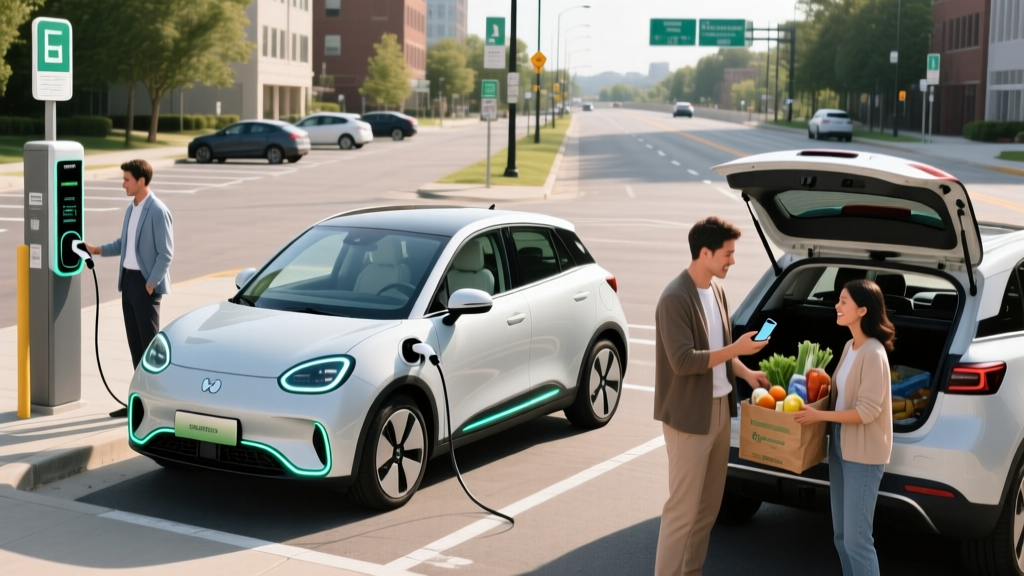
This is where small electric cars show their biggest limitation compared to larger, more expensive EVs. Most subcompact EVs use 400-volt architectures and peak at 50–115 kW on DC fast chargers — significantly slower than the 250–350 kW peaks available on vehicles like the Hyundai Ioniq 5 or Tesla Model 3.
Here's what charging actually looks like:
| Charge Level | Power (kW) | Miles Added Per Hour | Typical Use Case |
|---|---|---|---|
| Level 1 (120V household) | 1.2–1.4 kW | 3–5 mi/hr | Overnight trickle; emergency only |
| Level 2 (240V home/work) | 7.2–11.5 kW | 25–40 mi/hr | Daily charging; full charge in 6–9 hours |
| DC Fast (public) | 50–115 kW peak | 150–280 mi/hr (at peak) | Road trips; 10–80% in 30–45 min |
Critical detail on charge curves: A "115 kW peak" does not mean you charge at 115 kW the entire session. Most small EVs sustain peak rate only between 10–50% State of Charge (SoC), then taper progressively. A Bolt EV at a 150 kW station will peak around 115 kW early, drop to ~70 kW by 60% SoC, and slow to ~40 kW above 80%. Plan road-trip stops for 30–40 minutes per charge session, not 20.
Connector compatibility matters: The Nissan LEAF still uses CHAdeMO for DC fast charging, a standard with declining public infrastructure support in the U.S. as networks shift to CCS and NACS (Tesla). The Bolt EV and Kona Electric use CCS1, which remains widely available. If you rely on public fast charging, CCS or NACS is the safer long-term bet.
True Cost of Ownership: EV vs Gas vs Hybrid
The sticker price of a small electric car is typically $2,000–$8,000 higher than an equivalent gas subcompact. But purchase price is only part of the equation. Here's a 5-year cost breakdown assuming 12,000 miles/year, home charging at $0.14/kWh national average, and gas at $3.40/gallon:
| Cost Category | Chevy Bolt EV | Toyota Prius (HEV) | Honda Civic (Gas) |
|---|---|---|---|
| Purchase Price (base MSRP) | $27,895 | $29,445 | $25,745 |
| Federal Tax Credit (§30D est.) | –$7,500* | $0 | $0 |
| Effective Purchase Price | $20,395 | $29,445 | $25,745 |
| Fuel/Energy (5 yrs) | $2,520 (home charging) | $4,295 (gas) | $5,829 (gas) |
| Maintenance (5 yrs) | ~$1,800 | ~$2,800 | ~$3,200 |
| Insurance (5 yrs avg) | ~$7,500 | ~$6,800 | ~$6,500 |
| Estimated Depreciation | ~$8,500 | ~$7,200 | ~$7,800 |
| 5-Year Total | ~$40,715 | ~$50,540 | ~$49,074 |
| Cost Per Mile | ~$0.68 | ~$0.84 | ~$0.82 |
* Tax credit shown as point-of-sale reduction per §30D rules. Actual eligibility depends on income caps ($150K single / $300K joint), MSRP limits, and battery sourcing requirements. Consult IRS §30D guidelines or a tax professional. Insurance premiums for EVs tend to run 10–15% higher due to repair costs. Source: fueleconomy.gov for efficiency data.
The Bolt EV wins on 5-year total cost primarily because the federal tax credit dramatically lowers the effective purchase price. Without the credit, the math tightens considerably — the Prius becomes the cost leader due to lower insurance and strong resale value.
Common Misconceptions About Small Electric Cars
| Myth | Fact |
|---|---|
| "Small EV batteries need replacing every few years and cost $15,000." | Federal law mandates battery warranties of at least 8 years/100,000 miles. Real-world degradation data shows most NMC packs retain 85–92% capacity after 8 years. Full replacement is rare; most issues involve individual module repairs under warranty. |
| "You can't road-trip a small electric car." | You can, but it requires planning. With 200+ miles of real-world range and DC fast charging, a Bolt EV can cover 500 miles in a day with two 35-minute charge stops. It's slower than a gas car — but entirely feasible for 2–3 road trips per year. |
| "Small EVs are slow and underpowered." | Electric motors deliver instant torque. A 200-hp Bolt EV hits 0–60 in 6.5 seconds — faster than most gas-powered compacts. The low center of gravity (battery pack under the floor) also improves handling. |
| "Charging is more expensive than gas." | At the $0.14/kWh national average, home charging costs roughly $0.04 per mile. Public DC fast charging ($0.30–$0.48/kWh) costs $0.09–$0.14 per mile — still cheaper than a 35-MPG gas car at $3.40/gallon ($0.10/mi). Exclusive public charging narrows the gap but rarely exceeds gas cost. |
| "I need a special electrical panel to charge at home." | Most homes with a 200-amp panel can support a Level 2 charger (32–48 amp circuit) without a panel upgrade. Installation costs range from $500–$2,000 depending on wiring distance. A 120V outlet (Level 1) requires no installation and adds 3–5 miles per hour — enough for low-mileage drivers. |
First-Time EV Buyer Checklist
If you've never owned an electric vehicle, these are the practical realities that spec sheets don't emphasize:
- Confirm your charging situation before buying. Do you have a garage, carport, or driveway with access to a 240V outlet or the ability to install one? Apartment dwellers without workplace charging should carefully evaluate public charger density within 2 miles of home using apps like PlugShare.
- Understand the tax credit rules before committing. The §30D new clean vehicle credit has income caps ($150,000 single / $300,000 married filing jointly), MSRP caps ($55,000 for cars), and battery sourcing requirements that change annually. As of 2026, some models may not qualify due to critical-mineral sourcing rules. The credit can now be transferred to the dealer at point of sale, reducing your out-of-pocket cost immediately.
- Install a Level 2 home charger early. Budget $800–$1,500 for a quality Level 2 station (Emporia, ChargePoint, or Wallbox) plus electrician installation. A licensed electrician should verify your panel capacity — a 200-amp service handles most installs, but older 100-amp panels may require an upgrade ($1,500–$3,000).
- Learn to precondition your battery. Most small EVs allow you to set a departure time while plugged in. The car warms or cools the battery to optimal temperature using grid power rather than battery power, improving both range and charging speed.
- Plan for cold weather. If you live where temperatures regularly drop below 32°F, look for a model with a heat pump (the Kona Electric includes one; the base LEAF does not). Heat pumps use 30–50% less energy for cabin heating than resistive heaters, preserving range in winter.
Decision Framework: Which Small Car Powertrain Is Right for You?
Choose a small electric car (BEV) if:
- You drive under 60 miles per day and can charge at home or work
- You qualify for the §30D federal tax credit (check income and sourcing rules)
- You want the lowest per-mile operating cost and minimal maintenance
- You take fewer than 5 road trips over 250 miles per year
- You live in a moderate or warm climate (or accept 20–30% winter range loss)
Choose a hybrid (HEV) like the Prius if:
- You lack reliable access to home or workplace charging
- You regularly drive 300+ miles without stopping
- You live in extreme cold (sub-zero winters) and need consistent range
- You want lower purchase complexity with no charging behavior change
- You value strong resale value and proven long-term reliability
Choose a plug-in hybrid (PHEV) like the Toyota Prius Prime if:
- You want electric-only commuting (44 miles EPA electric range) with gas-engine backup
- You can charge at home but want road-trip flexibility without planning
- You're not ready to commit fully to electric but want to reduce fuel consumption
Frequently Asked Questions
How long do small electric car batteries last?
Federal law requires EV battery warranties of at least 8 years or 100,000 miles (10 years/150,000 miles in CARB states like California). Real-world data from Recurrent Auto shows that most NMC battery packs in small EVs retain 85–92% of original capacity after 8 years of typical use. Degradation is most rapid in the first 2 years (3–5% loss), then slows significantly. You are unlikely to need a battery replacement within typical ownership periods.
Is a small electric car safe in a crash?
Yes. The heavier battery pack gives small EVs a mass advantage over equivalent gas subcompacts in collisions. The 2026 Chevrolet Bolt EV and Hyundai Kona Electric have both earned IIHS Top Safety Pick ratings in prior model years. Check current ratings at iihs.org and nhtsa.gov before purchasing, as ratings update annually.
Can I charge a small EV on a regular household outlet?
Yes — Level 1 charging on a standard 120V outlet delivers roughly 3–5 miles of range per hour. If you drive 30 miles per day and plug in for 10 hours overnight, you'll recover your daily usage. It's slow, but viable for low-mileage commuters. For anything beyond that, a 240V Level 2 installation is strongly recommended.
Do small electric cars qualify for the $7,500 federal tax credit?
Potentially, but it depends on several factors. Under IRS §30D rules for 2026, the vehicle must meet critical-mineral and battery-component sourcing thresholds (which tighten annually), the buyer must fall under income caps ($150K single / $300K joint), and the vehicle MSRP must not exceed $55,000 for cars. The credit can be applied at point of sale as a price reduction. Always verify eligibility on the IRS clean vehicle credit page before finalizing a purchase, as qualifying models change throughout the year.
What's the cheapest small electric car available in 2026?
The 2026 Chevrolet Bolt EV starts at approximately $27,895 before incentives, making it the most affordable new EV with over 250 miles of EPA range. If the full §30D credit applies, the effective price drops to roughly $20,395 — undercutting nearly every gas or hybrid compact on the market.