If you've ever scrolled through vanlife forums or EV camping groups, you've probably encountered the phrase sleeping in Tesla Model 3 — and wondered whether it's actually practical or just internet hype. The answer, after spending dozens of nights in a refreshed Model 3 (2024–2026 Highland and current production), is that it's one of the most capable sedan-based camping platforms available, provided you understand the energy math, space limitations, and climate-control realities that separate a comfortable night from a miserable one.
This guide breaks down everything an EV owner or prospective buyer needs to know about overnight stays in the Model 3: Camp Mode power consumption, real-world range impact, interior dimensions for mattress fit, charging logistics for multi-night trips, and whether the 2026 Model 3 lineup makes financial sense as a dual-purpose commuter-and-camping vehicle.
Why the Model 3 Works for Overnight Sleeping
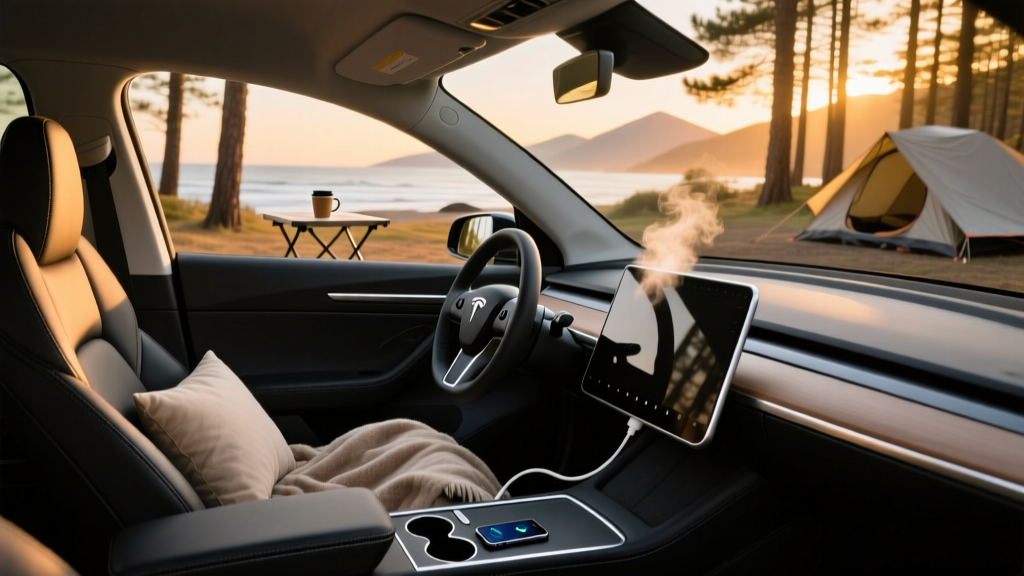
Tesla's Camp Mode is the feature that makes sleeping in a Model 3 viable. When activated, it maintains cabin temperature, keeps USB ports powered, sustains airflow through the HVAC system, and prevents the car from entering deep sleep — all while drawing from the high-voltage traction battery rather than a 12V auxiliary system. On the current-generation Model 3, the heat pump (standard on all trims since the Highland refresh) makes cold-weather camping dramatically more efficient than the resistive heaters used in earlier EVs.
The cabin's flat floor behind the folded rear seats, combined with the absence of a transmission tunnel, creates a usable sleeping surface roughly 72–76 inches long (depending on front seat positioning) and about 40 inches wide at the narrowest point between the wheel wells. That's enough for a single adult comfortably, or two adults snugly, on a purpose-built EV mattress like those from Tesa Living or Exped.
The panoramic glass roof (standard on all 2026 Model 3 trims) provides stargazing that no tent can match, though it also means you'll want a sunshade cover for summer mornings — the cabin heats up fast once the sun rises.
Energy Consumption: The Real Math of Camp Mode
This is where most first-time EV campers miscalculate. Camp Mode energy draw varies dramatically based on outside temperature, target cabin temperature, and whether you're running accessories like a laptop or CPAP machine.
- Mild weather (55–70°F): ~4–6% of battery capacity (~3–5 kWh)
- Cool weather (35–50°F): ~8–12% (~6–9 kWh)
- Cold weather (15–30°F): ~14–20% (~10–15 kWh)
- Hot weather (85–100°F, A/C running): ~6–10% (~5–8 kWh)
These figures assume a target cabin temp of 68°F with one occupant. Add ~1–2% for a second occupant (more body heat reduces heating load but increases cooling load in summer).
For a Long Range AWD with its 75 kWh usable battery, an 8-hour night in 45°F weather will consume roughly 7–8 kWh, leaving you with about 90% of your starting charge in the morning. That translates to roughly 25–30 miles of "lost" range — a manageable trade-off for a warm, quiet, climate-controlled sleeping environment that no rooftop tent or ground setup can match.
2026 Model 3 Specifications: Range, Battery, and Performance
| Specification | RWD (Base) | Long Range AWD | Performance |
|---|---|---|---|
| EPA Range | 272 mi | 341 mi | 315 mi |
| Battery (usable) | 57.5 kWh (LFP) | 75 kWh (NMC) | 75 kWh (NMC) |
| Drivetrain | RWD, single motor | AWD, dual motor | AWD, dual motor |
| Horsepower | 271 hp | 346 hp | 510 hp |
| 0–60 mph | 5.8 sec | 4.2 sec | 2.9 sec |
| MPGe (combined) | 132 MPGe | 132 MPGe | 119 MPGe |
| Efficiency | 25 kWh/100 mi | 25 kWh/100 mi | 28 kWh/100 mi |
| Base MSRP | $38,990 | $45,990 | $52,990 |
Source: fueleconomy.gov and Tesla's official specifications.
The EPA numbers above assume mixed driving. Expect ~290–310 miles highway in the Long Range AWD at 70 mph in moderate temperatures. In cold weather (below 30°F), plan for 20–30% range loss, bringing effective highway range down to 220–260 miles. The LFP battery in the RWD model is more resistant to cold-weather degradation over time but still suffers immediate range reduction in freezing temps. For camping trips, always plan routes with charging stops at 20% remaining — not 5%.
Charging Speed: Getting Back on the Trail Fast
| Charging Level | RWD (LFP) | Long Range / Performance (NMC) |
|---|---|---|
| Level 1 (120V, 12A) | ~3 mi/hr (1.4 kW) | ~3 mi/hr (1.4 kW) |
| Level 2 (240V, 48A) | ~30 mi/hr (11.5 kW) | ~44 mi/hr (11.5 kW) |
| DC Fast Charge (peak) | 170 kW peak | 250 kW peak (V3 Supercharger) |
| 10–80% DCFC Time | ~25 min | ~22 min (preconditioned) |
| Connector | NACS (native Tesla) | NACS (native Tesla) |
The key advantage for campers: Tesla's Supercharger network remains the most reliable DC fast-charging infrastructure in the U.S., with over 6,500 V3/V4 stalls as of early 2026. When you're two nights into a backcountry trip and need a quick top-up, a 22-minute stop at a Supercharger adds roughly 200 miles of range to the Long Range model — enough to get you back to civilization or on to the next campsite.
One critical note: preconditioning matters enormously. Navigate to a Supercharger using the Tesla navigation system and the car will warm the battery en route, enabling peak charge rates. Cold-soak the battery overnight without preconditioning and your 10–80% time could stretch to 35+ minutes in winter conditions.
Interior Space: Will You Actually Fit?
The Model 3 is a midsize sedan, not a van — and this is where expectations need calibration. Here are the hard numbers:
- Cargo volume (rear seats folded): ~22.6 cu ft behind rear seats + trunk = ~64 cu ft total usable
- Rear legroom: 35.2 inches (seats upright)
- Sleeping surface length (seats folded, front seats pushed forward): ~72–76 inches
- Sleeping surface width (between wheel wells): ~40 inches
- Sleeping surface width (max, over wheel wells): ~48 inches
- Vertical clearance at head position: ~28 inches (sedan roofline limits sitting up)
If you're under 6 feet tall, you can sleep diagonally or straight with room to spare. At 6'2" and above, you'll need to push the front passenger seat fully forward and may still find your feet touching the seatback. Couples sleeping together will find 40 inches between the wheel wells tight — most two-person setups use a custom platform that bridges the wheel wells for the full 48-inch width.
The front trunk (frunk) adds 3.1 cu ft of gear storage, useful for keeping cooking equipment or shoes out of the sleeping area. The rear trunk, with seats folded, accommodates a rolled sleeping bag, pillow, and a compact camp kitchen box.
Tech Features That Make or Break the Camping Experience
Beyond Camp Mode itself, several Model 3 features directly impact overnight usability:
Sentry Mode integration: You can run Sentry Mode alongside Camp Mode for exterior camera monitoring — valuable if you're sleeping in an unfamiliar parking area or trailhead. Expect an additional ~1–2% battery drain over 8 hours for Sentry Mode's periodic camera activations.
15.4-inch touchscreen: The center display handles Netflix, YouTube, and gaming while you wind down. Audio routes through the 17-speaker premium system (Long Range/Performance) or 9-speaker system (RWD), both of which are impressively immersive in the quiet cabin.
Autopilot (standard) and FSD Supervised (optional, $8,000): For the drive to and from your campsite, Tesla's Level 2 driver-assistance system reduces highway fatigue significantly. Neither system is self-driving — you must keep your hands on the wheel and eyes on the road at all times. SAE Level 2 means the car assists with steering and speed, but full responsibility remains with you.
Notable drawbacks for campers:
- No 120V AC outlet built in — you'll need a separate inverter or portable power station for AC appliances
- No roof rack on the current Model 3 (Tesla removed the option), limiting external gear storage
- Glass roof creates condensation issues in humid conditions — crack a window slightly with rain guards
- Low ground clearance (5.5 inches) limits access to rough forest roads
2026 Pricing and Federal Tax Credit Eligibility
| Trim | Base MSRP | Est. §30D Credit | Effective Price* |
|---|---|---|---|
| RWD | $38,990 | Up to $3,750 | ~$35,240 |
| Long Range AWD | $45,990 | Up to $7,500 | ~$38,490 |
| Performance | $52,990 | Up to $7,500 | ~$45,490 |
*Effective price assumes full credit eligibility. Your actual credit may differ.
- MSRP cap: Sedans must be ≤$55,000 (all Model 3 trims qualify)
- Buyer income cap: AGI ≤$150,000 (single), ≤$225,000 (head of household), ≤$300,000 (joint)
- Battery sourcing: Critical minerals and battery component requirements phase in annually — the RWD trim's LFP battery (sourced from CATL in China) may only qualify for the $3,750 partial credit due to critical-mineral sourcing rules. The Long Range and Performance NMC batteries assembled in Nevada generally qualify for the full $7,500.
- Point-of-sale transfer: You can apply the credit at purchase rather than waiting until tax filing
Always verify current eligibility at IRS.gov before purchasing. Rules change and your tax professional should confirm your specific situation.
How the Model 3 Compares to Other EVs for Sleeping
The honest truth: a sedan is a compromise for sleeping compared to an SUV or wagon. If overnight camping is a primary use case, the Tesla Model Y offers substantially more interior volume (~76 cu ft with seats folded, ~42-inch vertical clearance for sitting up). The Hyundai Ioniq 5 provides a flatter, wider floor and a V2L (vehicle-to-load) outlet that can power AC devices directly — a significant advantage for running a CPAP, laptop charger, or small electric blanket without a separate inverter.
Where the Model 3 wins: efficiency (25 kWh/100 mi vs ~28–30 for competitors), Supercharger network access, Camp Mode software maturity, and the lowest per-mile operating cost in its class. If you already own a Model 3 and want to camp occasionally, the investment in a mattress platform ($150–$300) and window covers ($80–$150) makes it highly capable. If you're buying specifically for frequent camping, the Model Y or Ioniq 5 are stronger platforms.
Battery Warranty and Long-Term Camping Impact
A common concern: does frequent Camp Mode use degrade the battery faster? The short answer is no, not meaningfully. Camp Mode draws are small relative to total capacity, and Tesla's battery management system keeps the pack within safe thermal and voltage limits during climate control operation.
Tesla's battery and drive unit warranty covers:
- RWD (LFP): 8 years / 100,000 miles, minimum 70% capacity retention
- Long Range & Performance (NMC): 8 years / 120,000 miles, minimum 70% capacity retention
LFP batteries (RWD trim) are notably more tolerant of sustained 100% state-of-charge, meaning you can charge to full before a camping trip without the long-term degradation concerns that apply to NMC packs. Tesla recommends charging NMC batteries to 80% for daily use but allows 100% for trips — just don't leave the car sitting at 100% for extended periods.
Frequently Asked Questions
Is it safe to sleep in a Tesla Model 3 with the climate system running?
Yes. Unlike internal combustion vehicles, there is no carbon monoxide risk from an EV's electric HVAC system. Camp Mode is designed specifically for extended occupancy. Ensure at least slight ventilation in humid conditions to manage condensation on the glass roof and windows.
How many nights can I camp before needing to recharge?
In a Long Range AWD starting at 100%, you can comfortably run Camp Mode for 4–5 nights in mild weather (consuming ~5% per night) before reaching 20% remaining. In cold weather, plan for 2–3 nights maximum. Always know where your nearest Supercharger or Level 2 station is located.
Can I run a CPAP machine from the Model 3 overnight?
Yes, using the USB-C ports (up to 65W on the refreshed Model 3) with a USB-C to DC adapter for most travel CPAP models. For standard AC-outlet CPAP machines, you'll need a portable power station (like a Jackery or EcoFlow) charged from the car's USB ports during the day, as the Model 3 lacks a built-in 120V outlet.
Does the Model 3 have enough ground clearance for forest camping?
At 5.5 inches, ground clearance is limited to maintained gravel and dirt roads. Deep ruts, rocky trails, and unmaintained forest service roads are not advisable. The Model 3 is best suited for established campgrounds, trailhead parking areas, and dispersed camping sites accessible by passenger vehicles.
What mattress fits best in a Model 3 for sleeping?
Purpose-built EV mattresses from brands like Tesa Living, Dreamseek, and EXPED are cut to fit the Model 3's rear cargo area with the seats folded. A typical setup is a 3-inch memory foam or self-inflating pad, approximately 72×40 inches, with extensions that bridge the wheel wells for couples. Budget option: a standard twin XL foam mattress trimmed to fit (~$60–$100).
Final Verdict: Sleeping in the Model 3
The Tesla Model 3 is a surprisingly capable platform for occasional to moderate overnight camping, thanks to Camp Mode's mature software, the efficiency of the heat pump, and the Supercharger network that makes multi-day trips practical. It's not a replacement for a dedicated camper van or even a Model Y for serious car-camping enthusiasts — the sedan roofline and limited width are real constraints for two-person setups.
Choose the Model 3 for camping if: You're a solo traveler or occasional couple camper who values efficiency, driving dynamics, and lower cost; you camp 10–20 nights per year; your campsites are accessible by paved or well-maintained roads.
Look at the Model Y or Ioniq 5 instead if: You camp frequently (30+ nights/year), regularly sleep with a partner, need to sit upright inside, or want V2L capability for AC appliances.