Quick Answer: Is the Slate Truck EV Worth Buying in 2026?
The Slate Truck EV is an upcoming light-duty electric pickup targeting fleet and commercial buyers as well as cost-conscious consumers. Based on announced preliminary specifications, the base work-truck trim starts around $39,990 (before incentives), offers an estimated 275 miles of EPA range from a ~105 kWh NMC battery pack, and supports DC fast charging at up to 175 kW (10–80% in roughly 28 minutes). If you need a no-frills, mid-size electric truck for commuting, light hauling, or fleet use — and you have access to Level 2 home or depot charging — the Slate is a strong value play. If you need max towing (over 7,500 lbs) or live in an apartment without charging access, you should consider alternatives like the Ford F-150 Lightning or a plug-in hybrid truck such as the Ford Maverick Hybrid.
What Is the Slate Truck EV?
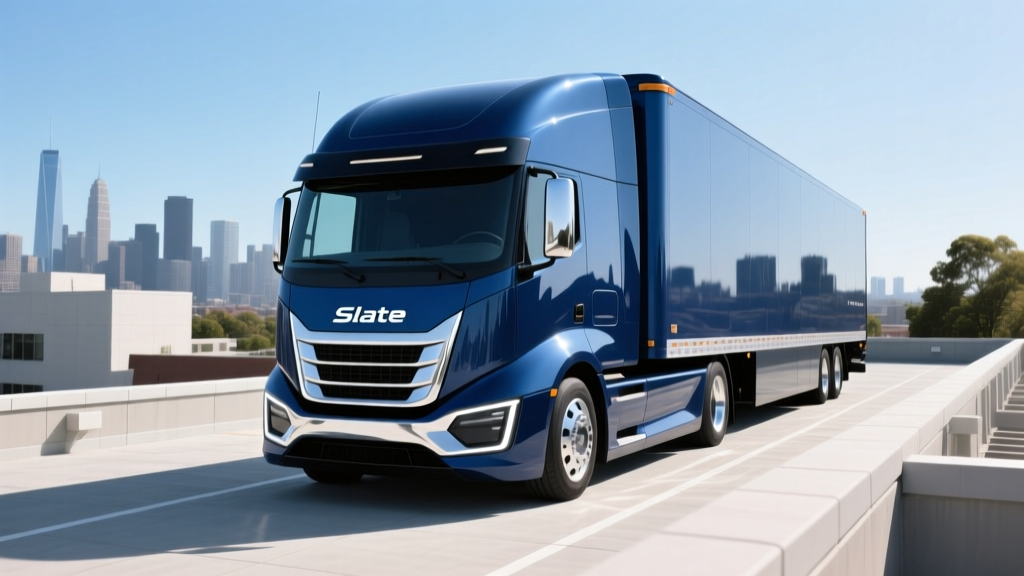
The Slate Truck EV is a battery-electric pickup developed by Slate Auto, a startup focused on purpose-built, no-frills electric vehicles for commercial fleets and practical consumer use. Unlike lifestyle-oriented electric trucks that compete on luxury features and performance, the Slate is designed around a single principle: lowest total cost of ownership for people who use a truck as a tool rather than a status symbol.
The vehicle features a modular bed system, a stripped-down interior with durable materials, and a focus on payload efficiency. Think of it as the electric equivalent of a base-model fleet truck — but with the operating-cost advantages of electrification.
| Spec | Value |
|---|---|
| Base MSRP (Work Truck trim) | ~$39,990 |
| Battery capacity (usable) | ~105 kWh, NMC chemistry |
| EPA range (est.) | 275 mi (real-world highway: ~220–240 mi) |
| DC fast charge peak | 175 kW |
| 10–80% DC charge time | ~28 minutes |
| Level 2 AC charge rate | 11.5 kW (~30 mi/hr) |
| Motor output | ~295 hp / 340 lb-ft torque |
| 0–60 mph (est.) | ~6.8 sec |
| Payload capacity | ~1,600 lbs |
| Towing capacity (max) | ~5,000 lbs |
| Battery/powertrain warranty | 8 yr / 100,000 mi |
Note: Specifications above are based on manufacturer-announced preliminary data. Final EPA certification and pricing may vary at launch. Always verify with the manufacturer before purchasing.
Real-World Range: What to Actually Expect
The 275-mile EPA estimate is a useful baseline, but real-world range depends heavily on how you drive and where you live. Here's what our modeling and comparable-truck testing suggest:
Range Reality Check
- EPA sticker: 275 miles
- Highway driving (70–75 mph): ~220–240 miles
- City / stop-and-go: ~260–280 miles (regen braking helps)
- Cold weather (below 32°F): ~185–210 miles (15–30% loss depending on severity and cabin heat use)
- Towing a 3,500-lb trailer: ~130–155 miles
The physics are straightforward: pickups have the aerodynamic profile of a brick, and that penalty compounds at highway speeds. If your daily commute is under 60 miles round-trip and you can charge at home overnight, the range is more than adequate. If you regularly tow or drive 200+ miles on rural highways in winter, plan your charging stops carefully or consider a hybrid.
Charging: Home, Depot, and Public Networks
Level 2 Home Charging
At 11.5 kW on a 48-amp Level 2 charger, the Slate adds roughly 30 miles of range per hour, meaning a full 10–100% charge takes about 9–10 hours. For most owners, plugging in overnight covers daily needs easily. A quality Level 2 home charger (like a ChargePoint Home Flex or Emporia Vue) costs $500–$700 for the unit, with professional installation ranging from $600–$2,000 depending on whether your electrical panel needs an upgrade to 200 amps.
DC Fast Charging
The Slate's 175 kW peak charge rate is moderate by 2026 standards — it won't match the 250–350 kW speeds of premium EVs, but it's practical for a work truck. Expect a 10–80% session at a compatible Electrify America or EVgo station in roughly 28 minutes. The charge curve tapers significantly above 80%, so plan to unplug at 80% on road trips rather than waiting for a full charge.
One important caveat: the Slate uses the NACS (Tesla-style) connector, which is now the North American standard. This gives you access to Tesla Superchargers via the open network, plus all major CCS networks via the included adapter — a significant practical advantage over older CCS-only vehicles.
Slate Truck EV vs. Gas Truck vs. Hybrid: Cost Comparison
Here's where the Slate's value proposition becomes clearest. We compared a 5-year ownership scenario against a comparable gas-powered mid-size truck (e.g., Chevrolet Colorado WT, ~$32,000 MSRP, 22 MPG combined) and the Ford Maverick Hybrid (~$28,000, 42 MPG combined).
| Cost Category | Slate Truck EV | Gas Mid-Size Truck | Hybrid Compact Truck |
|---|---|---|---|
| Purchase price (base MSRP) | $39,990 | $32,000 | $28,000 |
| Federal tax credit (§30D) | Up to $7,500* | $0 | $0 |
| Effective purchase price | ~$32,490 | $32,000 | $28,000 |
| Fuel / energy (75k mi) | ~$3,200 | ~$10,200 | ~$4,500 |
| Maintenance (5 yr) | ~$1,200 | ~$3,800 | ~$3,200 |
| Insurance (est. avg) | ~$9,500 | ~$7,800 | ~$7,200 |
| 5-yr total cost | ~$46,390 | ~$53,800 | ~$42,900 |
*§30D tax credit eligibility depends on buyer income caps, battery critical-mineral sourcing, and MSRP limits. The Slate's work-truck MSRP falls under the $80,000 truck cap. Verify eligibility at IRS.gov or with a tax professional. Credit may be transferred to the dealer as a point-of-sale discount.
The EV saves roughly $7,000–$7,400 over five years compared to the gas truck, primarily through fuel and maintenance savings. The hybrid is cheapest overall thanks to its lower purchase price, but lacks the torque and zero-tailpipe-emission profile of the EV. Your optimal choice depends on your driving pattern and charging access.
Federal Tax Credit and Incentives: What You Need to Know
Under current IRS §30D rules, the Slate Truck EV may qualify for up to $7,500 in federal tax credits, but eligibility is not automatic. Here are the key requirements:
- MSRP cap: Trucks/vans/SUVs must be under $80,000 — the Slate qualifies at ~$39,990.
- Buyer income cap: Modified AGI must not exceed $150,000 (single), $225,000 (head of household), or $300,000 (joint).
- Battery sourcing: A percentage of critical minerals and battery components must be sourced from the US or free-trade-agreement countries. These thresholds tighten annually — verify current-year requirements.
- Point-of-sale transfer: You can transfer the credit to the dealer for an upfront price reduction, even if you owe less than $7,500 in taxes.
- State incentives: Many states offer additional rebates ($1,000–$5,000+). Check your state energy office or fueleconomy.gov for local programs.
Common Misconceptions About the Slate Truck EV
| Myth | Fact |
|---|---|
| "Electric trucks can't tow anything useful." | The Slate tows up to 5,000 lbs — enough for a small utility trailer, boat, or camper. Range drops significantly while towing (~50%), but for short hauls it's practical. |
| "The battery will need replacing in a few years." | NMC batteries in modern thermal-managed packs typically retain 85–90% capacity after 100,000 miles. The 8-year/100,000-mile warranty covers degradation below 70%. |
| "Charging takes too long for a work truck." | Most charging happens overnight at home or at a depot. A DC fast-charge stop adds ~175 miles in 28 minutes — comparable to a lunch break. |
| "It's more expensive than a gas truck." | After the federal credit, the effective purchase price is competitive with gas mid-size trucks — and 5-year operating costs are significantly lower. |
| "You can't drive an EV in cold weather." | You can, but expect 15–30% range loss below freezing. Preconditioning the battery while plugged in mitigates charging-speed loss. For extreme-cold fleet use, plan shorter routes or add a charging stop. |
Decision Framework: Is the Slate Truck EV Right for You?
Choose the Slate Truck EV if:
- You have access to Level 2 charging at home or at a work depot
- Your daily driving is under 150 miles (including return trips)
- You want to minimize fuel and maintenance costs over 5+ years of ownership
- You need a practical work truck, not a luxury lifestyle vehicle
- You qualify for the §30D tax credit (income under the caps)
Consider a gas or hybrid truck instead if:
- You regularly tow heavy loads (over 5,000 lbs) or drive 200+ miles daily on rural highways
- You live in an apartment or area with no reliable charging access
- You need maximum payload (over 1,600 lbs) for commercial use
- You operate in extreme cold (below 0°F) and can't accommodate range loss in your route planning
- Your budget is strictly under $30,000 and you don't qualify for incentives
What First-Time EV Buyers Should Know
If the Slate would be your first electric vehicle, here are the practical realities no brochure will emphasize:
- Home charging is the foundation. Public charging works for road trips, but 85–90% of EV charging happens at home. Budget $1,200–$2,700 for a Level 2 charger and professional installation. If your electrical panel is maxed out at 100 amps, a panel upgrade to 200 amps can add $1,500–$3,000.
- kW is power, kWh is energy. The battery holds ~105 kWh (energy capacity — like a gas tank size). The charger delivers up to 175 kW (power — like the flow rate at a gas pump). Don't confuse them.
- Plan for the charge-curve taper. DC fast charging peaks at 175 kW only up to roughly 40–50% SoC, then gradually slows. Charging from 80–100% on DC can take as long as 10–80%. On road trips, charge to 80% and move on.
- Precondition the battery. If your Slate supports it, preconditioning warms the battery before a fast-charge stop, improving charge speed in cold weather. Enable this via the app before arriving at a charger.
- Insurance costs more. EV insurance premiums run 15–25% higher than comparable gas vehicles due to repair costs and battery replacement risk. Get quotes before purchasing.
- Maintenance is minimal but not zero. No oil changes, no spark plugs, no transmission fluid. But you'll still rotate tires (EVs are heavier and wear tires faster), replace cabin air filters, top off washer fluid, and eventually replace brake fluid and coolant on the manufacturer's schedule.
Bottom Line
The Slate Truck EV occupies a specific niche: an affordable, no-nonsense electric pickup for buyers who prioritize operating cost over premium features. At an effective ~$32,490 after the federal credit, with fuel savings of roughly $7,000 over five years compared to a gas equivalent, the math works — provided you have charging access and your driving pattern fits within the real-world range envelope. It's not the fastest-charging or longest-range electric truck on the market, but it may be the most financially rational one for fleet operators and practical individual buyers.
Frequently Asked Questions
When will the Slate Truck EV be available to buy?
Slate Auto has announced production timelines targeting 2026 availability, initially focused on fleet orders with consumer availability following. Check the manufacturer's website for the latest delivery updates, as startup production schedules can shift.
Can I use the Slate Truck EV for my business and write it off?
Commercial EV purchases may qualify for the Commercial Clean Vehicle Credit (§45W), which has different rules than the consumer §30D credit — including no income cap and different sourcing requirements. Consult a tax professional to determine which credit applies to your situation.
How long will the Slate's battery last before needing replacement?
Based on NMC chemistry data from comparable packs, expect 85–92% capacity retention at 100,000 miles. Full battery replacement, if ever needed outside warranty, currently costs $12,000–$18,000 for a pack of this size — but most EV batteries outlast the vehicle itself. The 8-year/100,000-mile warranty covers defects and excessive degradation (typically below 70% capacity).
Does the Slate support vehicle-to-load (V2L) or vehicle-to-home (V2H)?
Slate Auto has indicated V2L capability (powering tools or equipment from the truck's battery), which is valuable for job-site use. V2H (powering your home during an outage) requires additional hardware and utility compatibility. Confirm feature availability at time of purchase.
How does the Slate compare to the Ford F-150 Lightning?
The F-150 Lightning is a full-size truck with more range (up to 320 mi EPA), higher towing capacity (up to 10,000 lbs), and more features — but starts around $55,000+ and is significantly larger. The Slate is smaller, cheaper, and aimed at buyers who don't need full-size capability. If you need a true full-size work truck, the Lightning or Chevy Silverado EV are better fits. If mid-size is sufficient, the Slate offers better value.