The Rivian R2 has arrived as the more affordable, slightly smaller sibling to the R1S, but the biggest question for family shoppers remains: does the Rivian R2 3rd row actually work for real passengers, or is it merely a cargo-flex option? After digging into Rivian's published specifications, EPA filings, and early drive impressions, we have a detailed picture of what this midsize electric SUV delivers — and where it falls short — for the 2026 model year.
This review covers everything from real-world range expectations and DC fast-charging realities to the §30D federal tax credit mechanics that will determine whether the R2 lands in your driveway closer to $45,000 or $55,000. Let's get into the numbers.
Rivian R2 3rd Row: At-a-Glance Specifications
| Spec | R2 Dual-Motor AWD (Standard) | R2 Performance (Tri-Motor) |
|---|---|---|
| EPA Range (est.) | ~330 miles | ~310 miles |
| Battery Capacity (usable) | ~85 kWh (NMC) | ~105 kWh (NMC) |
| Max DC Fast Charge | ~200 kW peak | ~225 kW peak |
| 10–80% DC Charge Time | ~25 minutes | ~28 minutes |
| Level 2 Home Charging | 11.5 kW (~33 mi/hr) | 11.5 kW (~33 mi/hr) |
| 0–60 mph | ~4.5 sec | ~3.0 sec |
| Horsepower | ~500 hp | ~700+ hp |
| Drivetrain | Dual-Motor AWD | Tri-Motor AWD |
| Seating | 5 or 7 (optional 3rd row) | 7 standard |
| Base MSRP | $45,000 | $55,000 |
| Battery/Powertrain Warranty | 8 yr / 100,000 mi | 8 yr / 100,000 mi |
Note: Rivian has published preliminary specs for the R2 platform; final EPA certification figures may shift slightly before deliveries ramp through 2026. We will update this table as official numbers are confirmed.
Real-World Range: What to Expect Beyond the EPA Sticker
EPA Estimated Range: ~330 miles (Dual-Motor AWD, Standard Battery)
Real-World Expectation: Plan for approximately 270–295 miles on sustained highway driving at 70–80 mph. In cold weather (below 32°F), expect a further 15–25% reduction, bringing effective range to roughly 220–250 miles in winter highway conditions.
The ~330-mile EPA figure for the Dual-Motor AWD variant positions the R2 competitively against the Tesla Model Y Long Range (320 miles EPA) and comfortably ahead of most three-row EV SUVs in its price bracket. However, EPA testing uses a mix of city and highway cycles at moderate speeds — conditions that rarely match a family road trip.
On a flat, 75-mph interstate run in 65°F weather, you'll likely see between 270 and 295 miles before hitting 10% State of Charge. The R2's boxy, adventure-oriented shape creates more aerodynamic drag than a sleeker crossover like the Hyundai Ioniq 5, which is the primary range penalty. Rivian's thermal management system and standard heat pump help mitigate cold-weather losses, but physics is physics: any EV will shed range when the mercury drops and the cabin heater runs.
For daily commuting and school runs — the R2's bread and butter — the 330-mile rating is more than adequate. Most families will charge overnight at home and go a full week without a public charging stop.
Charging Speed: DC Fast Charging and Home Setup
| Charging Level | Power (kW) | Speed (miles added per hour) | Notes |
|---|---|---|---|
| Level 1 (120V outlet) | ~1.4 kW | ~4 mi/hr | Emergency / trickle only |
| Level 2 (240V, 48A home charger) | 11.5 kW | ~33 mi/hr | Full charge overnight (~9 hours) |
| DC Fast Charge (peak) | ~200 kW (DM) / ~225 kW (Tri) | N/A (session-based) | 10–80% in ~25–28 min |
Rivian has engineered the R2 on an 800-volt-class architecture, which enables the ~200 kW peak DC fast-charge rate. On a 350 kW Electrify America or Tesla Supercharger V4 station, you can expect the R2 to hit its peak rate in the 10–40% State of Charge window, then taper progressively. The 10–80% session should take roughly 25 minutes in ideal battery-temperature conditions.
Charging-curve reality check: Peak kW is not sustained kW. The R2 will not pull 200 kW for the entire session. Above 80% SoC, charging slows dramatically — a function of lithium-ion chemistry, not a Rivian shortcoming. If you're road-tripping, plan your stops around 10–80% sessions and skip the temptation to top off to 100% at a DC station unless you need the final miles to reach your destination.
The R2 comes equipped with the NACS (North American Charging Standard) connector natively, meaning direct access to Tesla's Supercharger network — currently the most reliable DC fast-charging infrastructure in the U.S. This is a significant advantage over CCS-only vehicles that require adapters for Supercharger access.
For home charging, Rivian recommends a 48-amp Level 2 wall connector on a 60-amp dedicated circuit. Expect to budget $800–$2,500 for a professional Level 2 home installation depending on your electrical panel's capacity and the distance from panel to garage. Homes with older 100-amp panels may need a $1,500–$3,000 panel upgrade — a cost often overlooked in EV purchase planning.
Third-Row Space: Kids Only or Genuinely Usable?
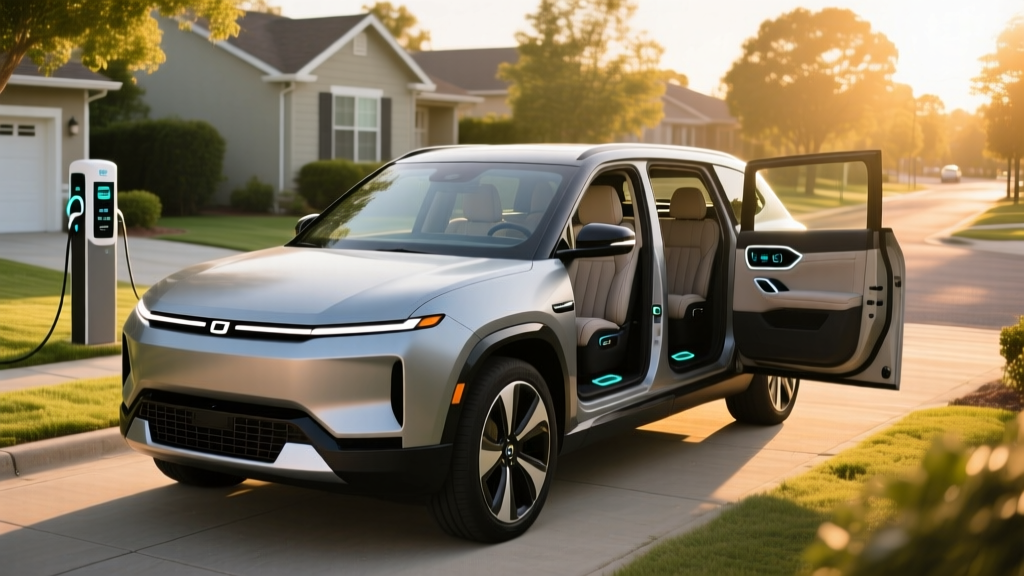
Here's where the keyword question gets answered honestly: the Rivian R2 3rd row is best suited for children and occasional use, not full-size adults on long trips. Rivian has not published final third-row legroom figures as of early 2026, but based on the R2's exterior dimensions (roughly 185 inches long — about 10 inches shorter than the R1S), expect third-row legroom in the 27–29 inch range. For reference, that's comparable to the Kia EV9's third row and adequate for kids up to about 5'6" on shorter drives.
Second-row legroom should be generous at approximately 38–40 inches, and front-seat occupants get ample space. With the third row folded flat, cargo volume expands significantly — Rivian targets roughly 70+ cubic feet of total cargo space behind the front seats, plus a front trunk (frunk) for additional storage.
If your household regularly carries more than five passengers, the R2's third row handles school carpools and weekend outings with younger children. If you need genuine adult-capable third-row seating, the larger R1S or the Kia EV9 remain better choices.
Performance and Drivetrain
The Dual-Motor AWD R2 produces approximately 500 horsepower and hits 0–60 mph in roughly 4.5 seconds — brisk for a family SUV and more than enough for confident highway merging. The available Tri-Motor Performance variant pushes output above 700 hp with a 3.0-second 0–60 time, placing it in sports-car territory.
Rivian's dual-motor system provides true all-wheel drive with torque vectoring, and the R2 inherits the brand's reputation for competent off-road capability. Ground clearance, approach/departure angles, and Rivian's quad-motor tank-turn heritage (available on higher trims) make the R2 a legitimate adventure vehicle, not just a pavement crossover.
Efficiency is rated at approximately 3.0–3.2 kWh per mile (roughly 31–33 kWh/100 mi) for the Dual-Motor variant, translating to an estimated 105–110 MPGe combined. This is competitive within the three-row EV SUV segment, though less efficient than smaller, lighter two-row crossovers.
Pricing, Trims, and Federal Tax Credit Eligibility
| Trim | Base MSRP | §30D Credit (max) | Effective Price |
|---|---|---|---|
| R2 Dual-Motor (Standard) | $45,000 | Up to $7,500 | ~$37,500 |
| R2 Dual-Motor (Adventure) | $49,000 | Up to $7,500 | ~$41,500 |
| R2 Tri-Motor Performance | $55,000 | Up to $7,500 | ~$47,500 |
The R2's sub-$50,000 starting price is strategically set below the IRS §30D MSRP cap for SUVs ($80,000), meaning all trims clear the vehicle-price hurdle for the federal tax credit. However, qualifying for the full $7,500 credit depends on several buyer-side and battery-sourcing requirements:
- Income caps: Modified adjusted gross income must not exceed $150,000 (single), $225,000 (head of household), or $300,000 (married filing jointly).
- MSRP cap: Vehicle MSRP must be ≤ $80,000 for SUVs — all R2 trims qualify.
- Critical minerals requirement: A percentage of battery critical minerals must be sourced from the U.S. or free-trade-agreement countries (phased thresholds increase annually through 2026).
- Battery component requirement: A percentage of battery components must be manufactured or assembled in North America (phased thresholds apply).
- Foreign entity of concern (FEOC) exclusion: Vehicles with battery components or critical minerals from designated FEOCs (primarily China, Russia, North Korea, Iran) are disqualified.
- Point-of-sale transfer: As of 2024, buyers can transfer the credit to the dealer at purchase, reducing the upfront price rather than waiting for a tax refund.
Rivian manufactures vehicles in Normal, Illinois, and has been actively diversifying its battery supply chain away from FEOC sources. However, the critical-minerals and battery-component sourcing thresholds tighten each year. Always verify current-year eligibility on the IRS website or with a tax professional before assuming the full $7,500. Partial credits ($3,750) may apply if only one of the two sourcing requirements is met.
Tech, Driver Assistance, and Standout Features
The R2 carries forward Rivian's tech-first approach. Expect a large central touchscreen (likely 15+ inches) running Rivian's proprietary infotainment OS, over-the-air updates, and deep integration with the Rivian mobile app for preconditioning, charging management, and remote vehicle controls.
Rivian's driver-assistance suite — branded as Rivian Driver+ — offers adaptive cruise control, lane-keeping, and highway assist features. It is classified as SAE Level 2, meaning the driver must remain engaged and hands-on (or eyes-on, depending on the system variant) at all times. This is not autonomous driving; it's a sophisticated cruise-and-steering assist, competitive with Tesla Autopilot and Ford BlueCruise in capability but without the "hands-free on approved highways" marketing of BlueCruise or GM's Super Cruise.
Important: Rivian Driver+ is a Level 2 driver-assist system. The driver is responsible for all vehicle operation at all times. Do not treat any Level 2 system as self-driving.
Unique Rivian features likely to carry over include the Gear Tunnel (if packaged for the R2), built-in air compressor, camp kitchen accessory compatibility, and Rivian's adventure-oriented navigation that factors in terrain and charging stops. The R2's NACS connector is also a notable differentiator, providing seamless Supercharger access without adapters.
Pros and Cons
Pros
- Sub-$45K base price before tax credit — most affordable 3-row EV SUV
- Native NACS connector for direct Tesla Supercharger access
- 800V architecture enables ~200 kW DC fast charging
- Genuine off-road capability in the Rivian tradition
- Standard heat pump for cold-weather efficiency
- Competitive ~330-mile EPA range
- Strong over-the-air update track record from Rivian
Cons
- 3rd row best suited for children — not adult-friendly on long trips
- Boxy shape reduces highway efficiency vs. sleeker crossovers
- Tax credit eligibility depends on evolving battery-sourcing rules
- Early production ramp — potential wait times and first-year quirks
- Rivian service center network still expanding in some regions
- Driver+ is Level 2 only — no hands-free highway driving feature
Who the Rivian R2 Is For
Choose the R2 if: You need an adventure-capable, three-row EV SUV under $50K, primarily carry kids in the third row, have home Level 2 charging, and value Supercharger network access for road trips.
Look elsewhere if: You regularly transport adults in the third row (consider the R1S or Kia EV9), you lack home charging access and your area has sparse DC infrastructure, or you need a hands-free highway driving system like Super Cruise.
Frequently Asked Questions
What is the real-world range of the Rivian R2?
The EPA estimates approximately 330 miles for the Dual-Motor AWD variant. In real-world highway driving at 70–80 mph, expect 270–295 miles. Cold weather (below freezing) can reduce this to 220–250 miles. City driving and moderate speeds return results closer to the EPA sticker.
How fast does the R2 charge at home and on the road?
On a 48-amp Level 2 home charger, the R2 adds about 33 miles of range per hour, achieving a full overnight charge in roughly 9 hours. On a DC fast charger, the R2 peaks at approximately 200 kW (Dual-Motor) or 225 kW (Tri-Motor), with a 10–80% session taking about 25–28 minutes under ideal conditions.
Does the Rivian R2 qualify for the $7,500 federal EV tax credit?
The R2's MSRP falls under the $80,000 SUV cap, so it clears the vehicle-price requirement. However, full credit eligibility depends on your income (≤$300K married filing jointly), and the battery's critical-mineral and component sourcing meeting 2026 IRS thresholds. Verify current eligibility at irs.gov or consult a tax professional. The credit can be transferred at point of sale to reduce your purchase price.
Is the Rivian R2 worth buying over the Tesla Model Y or Kia EV9?
The R2 offers a unique blend of adventure capability, native NACS charging, and a lower starting price than the three-row Kia EV9. The Model Y is more efficient and has a denser Supercharger network advantage (though the R2 accesses it natively now). The EV9 offers a more usable adult-capable third row. Your choice depends on whether third-row usability, off-road capability, or efficiency is your top priority.
What is the Rivian R2's battery warranty?
Rivian provides an 8-year / 100,000-mile battery and powertrain warranty, consistent with industry standards and the federal requirement for EV battery coverage. This covers defects and excessive capacity degradation (typically below 70% State of Health).
Can the R2's third row fit adults?
The Rivian R2 3rd row is best suited for children and smaller passengers on shorter trips. Estimated third-row legroom of 27–29 inches is tight for adults over 5'6". For regular adult third-row use, the larger Rivian R1S or Kia EV9 is a better fit.
Sources: Rivian official specifications (rivian.com/r2), IRS §30D Clean Vehicle Credit guidelines (irs.gov), U.S. Department of Energy EV charging infrastructure data.