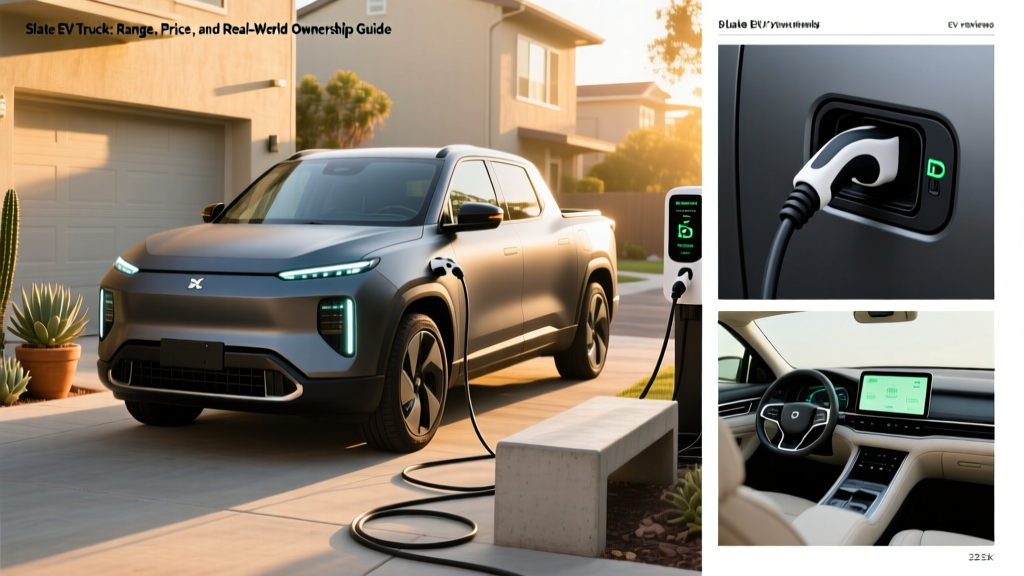
The Short Answer on the Slate EV Truck
As of early 2026, the Slate EV truck remains an announced vehicle from Slate Auto, a startup aiming to deliver a compact, affordable electric pickup targeted at a sub-$30,000 base price before incentives. The truck is designed as a no-frills, utilitarian work-and-commute platform with a projected EPA range of approximately 150–200 miles on a smaller LFP battery pack. Final EPA certification, battery capacity (kWh), and DC fast-charge rates have not been officially published. If you're researching the Slate EV truck today, treat all specs as preliminary, and focus on whether a compact, short-range electric pickup fits your driving pattern before placing a reservation.
What Is the Slate EV Truck, Exactly?
Slate Auto has positioned itself as a challenger to the growing-expensive trend in electric pickups. While the Ford F-150 Lightning, Rivian R1T, and Chevrolet Silverado EV push toward $70,000–$90,000 territory, Slate's concept targets urban and suburban buyers who need a truck bed for hardware-store runs, light job-site duty, or weekend hauling — not 10,000-pound towing or 400-mile road trips.
The Slate EV truck is expected to feature:
- A compact footprint (shorter wheelbase than a midsize Ranger or Tacoma)
- A modular flatbed with configurable storage
- A smaller battery pack (estimated 50–65 kWh usable, LFP chemistry) to keep weight and cost down
- Rear-wheel or all-wheel-drive powertrain options
- Minimalist interior with durable, wipe-clean materials
This is a deliberate contrast to the luxury-truck trend. Think of it as the electric equivalent of a 1990s Ford Ranger or Chevy S-10 — basic, affordable, functional.
Projected Specs: What We Know and What's Preliminary
Because the Slate EV truck has not yet received final EPA certification, the table below reflects announced targets and industry estimates based on Slate Auto's public statements and comparable compact-EV platforms. These numbers may shift before production begins.
| Specification | Estimated / Target | Notes |
|---|---|---|
| Base MSRP | ~$25,000–$30,000 | Before any federal or state incentives |
| EPA Range (est.) | 150–200 miles | Varies by drivetrain and battery option |
| Battery Chemistry | LFP (Lithium Iron Phosphate) | Lower energy density but longer cycle life, no cobalt/nickel |
| Battery Capacity (est.) | 50–65 kWh usable | Final kWh unconfirmed |
| DC Fast Charge (peak) | ~100–130 kW (est.) | 10–80% in ~30–40 minutes (est.) |
| Level 2 Charge Rate | ~7.7–11.5 kW (est.) | Full charge overnight on a 240V/32–48A circuit |
| 0–60 mph | ~7–9 seconds (est.) | Adequate for a work truck; not a performance vehicle |
| Horsepower | ~150–250 hp (est.) | Depends on RWD vs AWD configuration |
| Towing Capacity | ~2,000–3,500 lbs (est.) | Light-duty only; not a heavy-hauler |
| Payload Capacity | ~1,000–1,500 lbs (est.) | Compact truck class |
| Battery/Powertrain Warranty | 8 years / 100,000 miles (est.) | Standard for EVs per federal mandate minimums |
Real-World Range Expectations
If the Slate EV truck achieves an EPA-estimated 180 miles on the larger battery option, expect real-world range to land closer to 140–160 miles on the highway at 70+ mph, and potentially 110–130 miles in freezing temperatures (below 30°F) due to cabin heating demands and reduced battery efficiency. LFP chemistry is more resilient to daily 100% charging than NMC, but cold-weather range loss is a physics reality for all lithium-ion packs. For a 40-mile round-trip commute with errands, 180 EPA miles is comfortable. For a 150-mile one-way highway trip in January, it's not.
Cost Breakdown: Slate EV Truck vs. a Gas Compact Truck
The core appeal of the Slate EV truck is total cost of ownership. Let's compare it against a plausible gas alternative — a base-model compact/midsize gasoline pickup like the Ford Maverick hybrid or a Chevrolet Colorado — over a 5-year, 75,000-mile ownership period.
| Cost Category | Slate EV Truck (est.) | Gas Compact Truck (e.g., Maverick Hybrid) |
|---|---|---|
| Purchase Price (base) | $28,000 | $28,000 |
| Federal Tax Credit (§30D) | $0–$7,500 (see eligibility below) | $0 |
| Effective Purchase Price | $20,500–$28,000 | $28,000 |
| Fuel / Electricity (75k mi) | $2,250–$3,750 (home + public mix) | $7,500 (gas at $3.50/gal, 30 MPG combined) |
| Maintenance (5 years) | $800–$1,200 | $2,500–$3,500 |
| Insurance (5 years) | $7,500–$9,000 | $6,000–$7,500 |
| Estimated Total (5-yr) | $31,050–$41,950 | $44,000–$46,500 |
Key assumptions: Electricity at $0.14/kWh average (home charging) and $0.40/kWh (public DC fast charging), with 80% of charging done at home. Gas at $3.50/gallon. EV insurance is typically 10–20% higher due to repair-cost data; actual premiums vary by state, driver profile, and insurer. Maintenance for EVs excludes oil changes, spark plugs, and transmission fluid — you're mainly looking at tire rotation, cabin air filter, wiper blades, and brake-fluid checks (regen braking extends pad life significantly).
Federal Tax Credit Eligibility: What Applies to the Slate EV Truck?
The federal §30D Clean Vehicle Credit can reduce your tax burden by up to $7,500 — but eligibility is not automatic. For 2026, the IRS rules require all of the following:
- MSRP cap: The truck must have a base MSRP under $80,000 (pickup truck classification). Slate's target price clears this easily.
- Buyer income cap: Modified adjusted gross income must not exceed $150,000 (single), $225,000 (head of household), or $300,000 (joint). Check your most recent tax return.
- Battery sourcing: At least a specified percentage of critical minerals and battery components must be sourced from the U.S. or free-trade-agreement partners. This threshold increases annually. Slate's LFP supply chain (likely involving Chinese-processed minerals) is the biggest wildcard — this alone could disqualify the truck from the full credit.
- Final assembly: The vehicle must undergo final assembly in North America. Slate has indicated U.S. production plans, but the specific factory and timeline are unconfirmed.
- Point-of-sale transfer: As of 2024+, you can transfer the credit to the dealer at purchase, reducing your out-of-pocket cost immediately rather than waiting for tax filing. This requires the dealer to be registered with the IRS Energy Credits Online portal.
Bottom line: Do not assume you'll receive $7,500. The LFP battery supply chain is the most uncertain variable. Consult a tax professional and check the fueleconomy.gov credit tracker once the Slate EV truck is EPA-certified and listed.
Charging the Slate EV Truck: Home and Public Realities
Charging access is the single biggest ownership variable for any EV. Here's what a Slate EV truck owner should plan for:
Level 2 Home Charging (240V)
This is where most EV owners do 80–90% of their charging. A 48-amp Level 2 home charger (like a ChargePoint Home Flex or Emporia Level 2) on a 240V/60A circuit will add roughly 25–35 miles of range per hour of charging. For a ~60 kWh battery, a full 10–100% charge takes approximately 6–8 hours — easily done overnight.
Installation cost: If your electrical panel has capacity and the charger is near the panel, expect $500–$1,500 for electrician labor and permitting. If you need a panel upgrade (100A to 200A service), add $1,500–$3,000. Always get a quote from a licensed electrician before committing.
DC Fast Charging (Public)
At an estimated peak rate of 100–130 kW, the Slate EV truck would add roughly 80–100 miles of range in 20 minutes at a compatible DC fast charger. However, charging curves taper significantly above 80% state of charge — a 10–80% session might take 30–40 minutes, while 80–100% could take another 25–30 minutes. Plan road-trip stops around the 10–80% window for efficiency.
| Charging Level | Power (kW) | Miles Added per Hour | 10–80% Time |
|---|---|---|---|
| Level 1 (120V standard outlet) | ~1.4 kW | ~4–5 miles | ~30+ hours |
| Level 2 (240V, 32A) | ~7.7 kW | ~25 miles | ~8 hours |
| Level 2 (240V, 48A) | ~11.5 kW | ~35 miles | ~5.5 hours |
| DC Fast (peak ~120 kW) | Up to 120 kW | ~250+ miles/hr (peak) | ~30–40 minutes |
Critical caveat: If you live in an apartment or lack access to a dedicated parking spot with a 240V outlet, daily EV ownership becomes significantly harder. Public-charging reliance means higher per-mile costs ($0.35–$0.50/kWh at DC stations vs. $0.10–$0.18/kWh at home) and time spent waiting. The Slate EV truck's smaller battery means more frequent public-charging stops on road trips.
Who Should (and Shouldn't) Consider the Slate EV Truck?
Decision Framework
Consider the Slate EV truck if:
- Your daily driving is under 80 miles round-trip (commute, errands, school runs)
- You have access to Level 2 home charging (garage, driveway, or employer-provided)
- You need a truck bed occasionally but don't tow heavy loads (under 3,000 lbs)
- You want to minimize fuel and maintenance costs and are comfortable with a no-frills interior
- You're willing to wait for a startup to ramp production and honor reservations
Look elsewhere if:
- You regularly drive 200+ miles one-way without time for charging stops
- You tow a boat, camper, or horse trailer (the Slate is not built for heavy towing)
- You live in a region with sparse public DC charging infrastructure and lack home charging
- You need a vehicle now — Slate's production timeline remains uncertain
- You prefer a proven brand with an established dealer and service network
Common Misconceptions About the Slate EV Truck
| Myth | Fact |
|---|---|
| "It'll get the full $7,500 tax credit automatically." | Credit eligibility depends on battery sourcing, buyer income, MSRP, and North American assembly. The LFP supply chain may limit the credit amount. Check IRS rules at purchase time. |
| "180 miles of range isn't enough for any real truck work." | The average American drives ~37 miles per day (FHWA data). For local job-site runs, hardware-store trips, and commuting, 150–180 real-world miles covers most needs. It's not a cross-country hauler, and it doesn't pretend to be. |
| "LFP batteries degrade faster." | The opposite is generally true. LFP chemistry typically offers 2,000–3,000+ full charge cycles before reaching 80% capacity retention, compared to ~1,000–1,500 cycles for many NMC packs. LFP also tolerates regular 100% charging better, which is useful in a smaller-battery vehicle. |
| "A cheap EV truck must be unsafe." | Price does not determine crash safety. The Slate EV truck will need to pass NHTSA crash-testing and IIHS evaluation before it reaches consumers. Withhold judgment until crash-test ratings are published — but don't assume affordability equals poor safety. |
| "I can charge it from any regular outlet in 8 hours." | A standard 120V outlet (Level 1) delivers ~1.4 kW, adding about 4–5 miles of range per hour. A full charge from near-empty would take over 30 hours. Level 2 (240V) home charging is practically essential for daily use. |
Real-World Ownership Considerations
Beyond the spec sheet, here are the practical factors that determine whether the Slate EV truck works in your life:
Climate and Cold-Weather Range
If you live in the upper Midwest, Northeast, or mountain states, expect 25–40% range loss in sustained sub-freezing temperatures. A truck with 180 EPA miles might deliver only 110–135 miles on a 20°F January day, especially if you're using resistive cabin heat (less efficient than a heat pump, which may or may not be included in the Slate's design). Preconditioning the battery while plugged in helps mitigate this, but it requires home charging access.
Insurance Costs
EV insurance premiums run 10–20% higher than comparable gas vehicles, driven by higher repair costs (specialized body-shop training, battery protection requirements) and higher total-loss write-off thresholds. Get a quote from your insurer before committing — the savings on fuel and maintenance can be offset by a $200–$400/year insurance premium increase.
Startup Risk
Slate Auto is a new entrant. The EV startup graveyard includes Lordstown Motors, Bollinger Motors (pivoted), and Fisker Inc. Reserving a vehicle from a pre-production company carries real risk: delays, spec changes, and in the worst case, the company failing to reach production. Keep your reservation deposit small (ideally refundable) and don't plan your transportation around a delivery date until vehicles are actually rolling off the line and being delivered to customers.
Resale Value Uncertainty
Depreciation for EVs from unproven brands is unpredictable. A used Slate EV truck's value in 2030 will depend on the company's longevity, parts availability, and battery health data. Established brands (Ford, Hyundai, Tesla) offer more predictable residual values.
Frequently Asked Questions
Is the Slate EV truck available to buy right now?
No. As of early 2026, the Slate EV truck is in pre-production. Reservations may be open, but customer deliveries have not begun. Treat all delivery timelines as estimates until the company confirms production start and EPA certification.
How does the Slate EV truck compare to the Ford Maverick?
The Ford Maverick (hybrid) starts around $28,000, gets an EPA-estimated 42 MPG city, and offers a ~500-mile range on a tank. It's available now from an established dealer network. The Slate EV truck targets a similar price but offers lower operating costs (electricity vs. gas), fewer moving parts, and zero tailpipe emissions — at the trade-off of shorter range, charging time, and startup risk. If you need a truck today, the Maverick is the pragmatic choice. If you can wait and want to minimize long-term fuel/maintenance costs, the Slate is worth monitoring.
Can I tow a trailer with the Slate EV truck?
Light towing, yes — the estimated 2,000–3,500 lb capacity handles a small utility trailer, a pair of dirt bikes, or a light pop-up camper. It is not designed for boat trailers, travel trailers, or horse trailers. Towing also dramatically reduces EV range; expect a 30–50% range drop when towing near max capacity.
Will the Slate EV truck qualify for my state's EV rebate?
State incentives vary widely. California's CVRP, Colorado's innovative motor vehicle credit, and New York's Drive Clean rebate all have different eligibility rules, income caps, and price limits. Check your state energy office or DMV website for current programs. Many state rebates stack on top of the federal §30D credit.
What happens if Slate Auto goes out of business?
This is a real risk with any startup. If the company fails, you could be left with a vehicle that has no dealer support, limited parts availability, and poor resale value. Only reserve what you can afford to lose, and have a backup transportation plan.
Note: All specifications in this article are based on Slate Auto's announced targets and industry estimates as of early 2026. Final EPA-certified range, battery capacity, charging speeds, pricing, and tax-credit eligibility may differ. Always verify with the manufacturer and fueleconomy.gov before making a purchase decision.