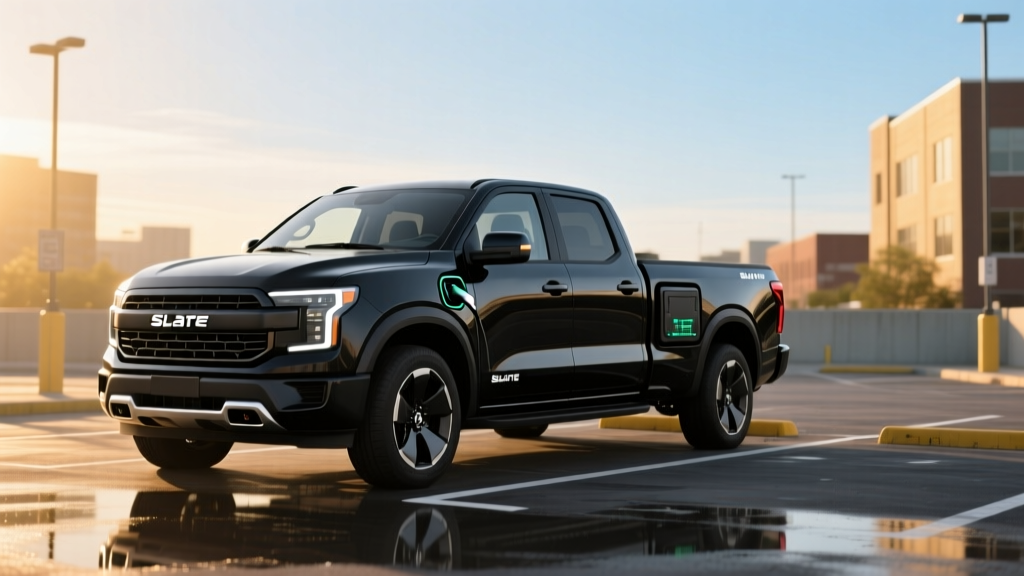
Slate Auto's Electric Pickup: What the 2026 Price Changes Mean for Buyers
Slate Auto's entry into the compact electric truck segment has drawn attention for its stripped-down, utility-first approach — and its aggressive pricing. But recent Slate Auto electric truck price changes for the 2026 model year have shifted the calculus for prospective buyers. The base MSRP has been adjusted upward from the originally announced target, reflecting supply-chain realities, battery sourcing costs, and added standard equipment. At the same time, federal incentive rules under IRS §30D continue to evolve, making eligibility anything but guaranteed.
This guide breaks down exactly what the Slate Auto electric truck costs in 2026, what you'll spend over five years of ownership, and where the real savings — and real costs — land compared to a gas-powered compact pickup.
| Spec | Value |
|---|---|
| Base MSRP (Work trim) | $42,000 (est.) |
| Mid-tier MSRP (Everyday trim) | $48,500 (est.) |
| Battery capacity (usable) | ~75 kWh, LFP chemistry |
| EPA-estimated range | ~240 miles (preliminary) |
| Real-world range (highway/cold) | ~190–215 miles |
| Peak DC fast charge rate | ~150 kW |
| 10–80% DC fast charge time | ~28–32 minutes (est.) |
| Level 2 charge rate | ~11.5 kW |
| Horsepower | ~250 hp (est.) |
| 0–60 mph | ~6.5 seconds (est.) |
| Towing capacity | ~5,000 lbs (est.) |
| Battery/powertrain warranty | 8 years / 100,000 miles |
Note: As of early 2026, Slate Auto's production truck specifications remain preliminary. Final EPA certification, pricing, and availability are subject to change. Always confirm with the manufacturer before purchasing.
5-Year Total Cost of Ownership Breakdown
The sticker price is just the starting point. To understand the Slate Auto electric truck's true cost, we modeled five years / 75,000 miles of ownership against a comparably priced gas compact pickup (e.g., Ford Maverick Hybrid at ~$30,000 MSRP, 37 MPG combined). Here's what the numbers look like:
| Category | Slate Auto EV Truck | Gas Compact Pickup (37 MPG) |
|---|---|---|
| Purchase price (MSRP) | $42,000 | $30,000 |
| Federal tax credit (§30D) | −$7,500 (if eligible) | $0 |
| Effective purchase price | $34,500 | $30,000 |
| Fuel/charging (75k mi) | $3,375 ($0.135/kWh, 3.0 mi/kWh) | $6,757 ($3.50/gal, 37 MPG) |
| Maintenance | $1,200 | $3,000 |
| Insurance (5 years) | $9,500 | $7,000 |
| Depreciation (est.) | $16,800 (~40%) | $12,000 (~40%) |
| Total 5-Year Cost | $65,375 | $58,757 |
| Cost per mile | $0.87 | $0.78 |
The EV's fuel and maintenance savings are substantial — roughly $5,182 over five years — but they don't fully close the gap created by the higher purchase price and steeper insurance premiums. The federal tax credit is the critical swing factor: without it, the EV's 5-year cost jumps to $72,875. With it, the total-cost gap narrows to about $6,600, or roughly $110/month.
Federal Tax Credit: Do You Qualify for §30D?
The federal EV tax credit under IRS §30D offers up to $7,500 for qualifying new electric vehicles. But "up to" is the operative phrase. For 2026, eligibility depends on a stack of requirements that eliminate many buyers and some vehicles:
- Income caps (modified AGI): $150,000 single / $225,000 head of household / $300,000 joint filers
- MSRP cap: Vans, SUVs, and pickup trucks must have an MSRP at or below $80,000 (the Slate Auto truck clears this easily)
- Battery component sourcing: A percentage of battery components must be manufactured or assembled in North America (threshold increases annually)
- Critical minerals sourcing: A percentage of critical minerals must be sourced from the U.S. or FTA partners (threshold increases annually)
- Point-of-sale transfer: As of 2024, buyers can transfer the credit to the dealer at purchase, receiving it as an immediate price reduction rather than waiting for tax filing — but you must still meet all income and sourcing requirements
- Final assembly: Vehicle must undergo final assembly in North America
- One credit per VIN, two credits per taxpayer per year (one new, one used, or two new)
The battery-sourcing requirements are the most volatile variable. As of 2026, the critical-minerals threshold sits at 80% and the battery-components threshold at 100%. If Slate Auto's LFP battery cells are sourced from Chinese manufacturers (a common scenario for LFP chemistry), the vehicle may qualify for only the $3,750 critical-minerals half-credit — or potentially neither half if sourcing doesn't meet the bar. Always verify current eligibility on the IRS website and with the dealer before assuming the full $7,500.
Charging vs. Gas: The Per-Mile Math
This is where the Slate Auto electric truck delivers its most tangible savings. Let's run the numbers with concrete assumptions:
| Scenario | EV (Slate Auto Truck) | Gas Pickup (37 MPG) |
|---|---|---|
| Home charging (avg $0.135/kWh) | $0.045/mile | — |
| Public DC fast charging (avg $0.40/kWh) | $0.133/mile | — |
| Gasoline ($3.50/gal, 37 MPG) | — | $0.095/mile |
| Gasoline ($4.00/gal, 37 MPG) | — | $0.108/mile |
At home on a Level 2 charger using the national average residential electricity rate of ~$0.135/kWh, and assuming the Slate Auto truck achieves roughly 3.0 miles per kWh (about 33 kWh/100mi — typical for a compact EV truck), you're paying $0.045 per mile. That's less than half the cost of a 37 MPG gas truck burning $3.50/gallon fuel.
The catch: if you rely heavily on public DC fast charging at $0.35–$0.48/kWh (common on Electrify America or EVgo networks), your cost per mile jumps to $0.12–$0.16, which can exceed gasoline. Home charging access is the single biggest determinant of EV fuel savings. If you can't install a Level 2 charger at home or charge at work for free/cheap, the fuel-cost advantage shrinks dramatically.
Maintenance Savings: Where EVs Pull Ahead
Electric vehicles eliminate a long list of routine maintenance items that gas-vehicle owners take for granted. The Slate Auto truck's single-speed reduction gear and electric motor have far fewer wear components than an internal-combustion powertrain.
| Service Item | EV (Slate Auto) | Gas Pickup |
|---|---|---|
| Oil changes | $0 (none needed) | $600–$900 |
| Transmission fluid | $0 (sealed unit) | $150–$300 |
| Brake pads (regen extends life) | $200–$400 | $600–$1,000 |
| Spark plugs | $0 | $200–$400 |
| Engine air filter | $0 | $100–$200 |
| Coolant flush | $100–$200 | $200–$400 |
| Tire rotation/replacement | $800–$1,200 (EVs wear tires faster) | $600–$1,000 |
| Cabin air filter, wipers, misc. | $300–$500 | $300–$500 |
| Total (est.) | $1,200–$2,000 | $2,750–$4,700 |
The net savings: roughly $1,500–$2,700 over five years. Regenerative braking is the unsung hero here — it significantly reduces mechanical brake wear, often pushing pad replacement past 100,000 miles. The one area where EVs cost more is tires: the instant torque and heavier curb weight of electric trucks accelerate tread wear, so budget for tire replacement sooner than you would on a gas truck.
Insurance Costs: The Uncomfortable Truth
EV insurance premiums are typically 15–30% higher than equivalent gas vehicles. For the Slate Auto electric truck, expect annual premiums in the range of $1,700–$2,200 depending on your state, driving record, and coverage level, versus $1,200–$1,600 for a gas compact pickup.
The reasons are structural, not arbitrary:
- Higher repair costs: EV battery packs, power electronics, and specialized body structures require certified technicians and OEM parts. A minor fender-bender that would cost $2,000 to fix on a gas truck can run $5,000+ on an EV if battery-adjacent components are involved.
- Total-loss thresholds: Insurers are more likely to declare an EV a total loss after collision damage if the battery pack integrity is in question, even when the damage appears cosmetic.
- Limited actuarial data: Newer EV models from startups like Slate Auto have less claims history, so insurers price in more uncertainty.
Shop quotes from EV-friendly insurers (Geico, Progressive, and State Farm have improved their EV pricing models) and ask about low-mileage or telematics-based discounts. If you drive under 10,000 miles per year, usage-based insurance can offset some of the premium gap.
Depreciation and Resale Value Trends
EV depreciation has been a sore spot. Industry data from sources like iSeeCars and Kelley Blue Book shows that electric vehicles have depreciated faster than gas vehicles in recent years, particularly as aggressive price cuts from Tesla and new market entrants compressed used-EV values.
For the Slate Auto truck, expect roughly 40–50% depreciation over five years — comparable to other EV trucks but steeper than the best-resale gas trucks (Tacoma, Ranger). Key factors:
- Battery health concerns: Used-EV buyers discount heavily for battery uncertainty, even though LFP chemistry degrades more slowly than NMC and the 8-year/100,000-mile warranty provides coverage.
- Rapid tech obsolescence: Charging speeds, range, and software features improve quickly. A 2026 truck with 150 kW charging may feel dated by 2031 when 350 kW is standard.
- Price-cut contagion: When new EV prices drop (as they have across the industry), used values follow.
On the positive side, the Slate Auto truck's low starting price means there's less absolute dollar depreciation than a $70,000+ EV truck. And if gasoline prices spike, used-EV demand tends to rebound.
State, Local, and Utility Incentives
- State rebates: California's CVRP, Colorado's innovative motor vehicle credit, Massachusetts' MOR-EV, and New York's Drive Clean rebate can add $1,500–$5,000+ depending on income and vehicle price.
- Utility rebates: Many electric utilities offer $250–$1,000 rebates for EV purchase or Level 2 home charger installation. Check with your local provider.
- HOV lane access: States like California, New York, and Virginia offer carpool-lane stickers for qualifying EVs — a non-monetary but high-value perk in congested metros.
- Time-of-use rates: Some utilities offer discounted overnight charging rates ($0.06–$0.09/kWh) that dramatically lower your per-mile fuel cost.
Decision Framework: Is the Slate Auto Truck Worth It?
- You qualify for the full or partial §30D federal tax credit
- You have reliable home Level 2 charging access
- Your daily driving is under 150 miles (well within real-world range)
- You value low running costs and minimal maintenance over lowest purchase price
- State/local incentives stack to further reduce your effective cost
- You cannot install a home charger and lack free workplace charging
- You regularly tow near max capacity or drive long highway routes in cold weather
- You don't meet the federal income caps or the truck fails battery-sourcing requirements
- Lowest upfront cost and strongest resale value are your top priorities
Frequently Asked Questions
How much does it really cost to own the Slate Auto electric truck over 5 years?
With the full $7,500 federal tax credit, home charging, and average insurance, expect roughly $65,000–$68,000 in total 5-year cost including depreciation, fuel, maintenance, and insurance. Without the tax credit, that figure jumps to $72,000–$76,000. A comparably priced gas compact pickup runs about $58,000–$62,000 over the same period.
Do I qualify for the $7,500 federal EV tax credit on the Slate Auto truck?
It depends on three factors: your modified adjusted gross income (must be under $150K single / $300K joint), the truck's MSRP (must be under $80,000 — it qualifies), and whether its battery components and critical minerals meet the 2026 North American/FTA sourcing thresholds. LFP batteries often face challenges with the component-sourcing requirement. Verify on irs.gov and with your dealer before purchase.
How much do I save on fuel and maintenance versus a gas truck?
Combined fuel and maintenance savings typically run $4,500–$6,000 over five years / 75,000 miles, assuming home charging at national-average electricity rates. Fuel savings alone are roughly $3,000–$3,500; maintenance savings add another $1,500–$2,500. These savings are real but don't fully offset the higher purchase price and insurance costs.
Are EVs more expensive to insure than gas trucks?
Yes, typically 15–30% more expensive. For the Slate Auto truck, expect $1,700–$2,200/year versus $1,200–$1,600/year for a gas compact pickup. Higher repair costs, battery-damage total-loss risk, and limited actuarial data on startup brands drive the premium gap.
How well do electric trucks hold their resale value?
EV trucks have depreciated faster than gas trucks in recent years, with 5-year depreciation in the 40–50% range. Battery health uncertainty, rapid technology improvements, and new-EV price cuts all pressure used values. The Slate Auto truck's lower starting price limits absolute dollar loss, but percentage depreciation will likely match or exceed comparable gas trucks.
What happens if I can't charge at home?
Public DC fast charging at $0.35–$0.48/kWh costs $0.12–$0.16 per mile — potentially more than gasoline. Without home or workplace charging, the Slate Auto truck's fuel-cost advantage largely disappears, and the convenience penalty of frequent charging stops makes ownership significantly less practical. Home Level 2 installation typically costs $500–$2,000 depending on electrical panel capacity.