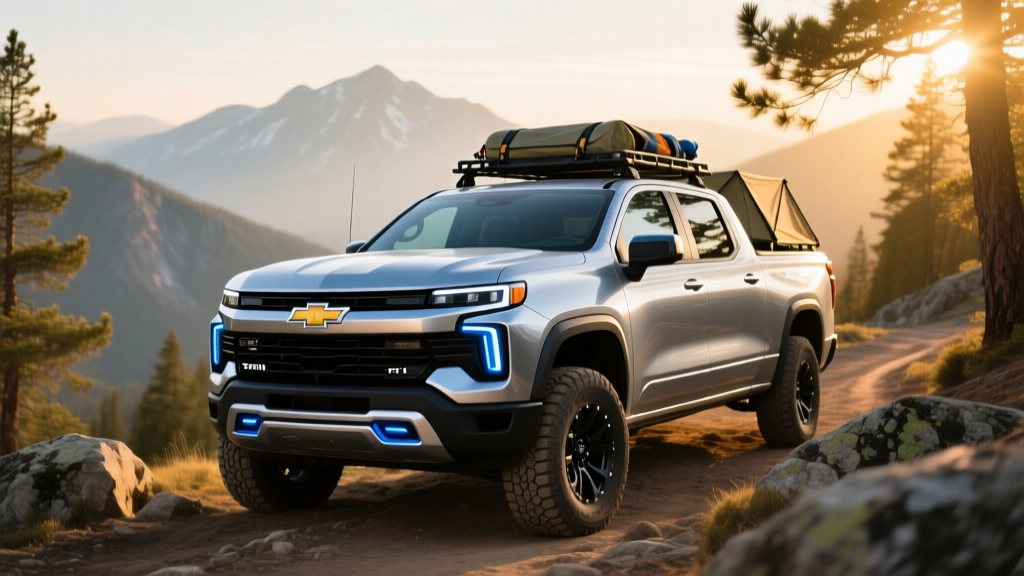
The 2026 Chevrolet Silverado EV Trail Boss is GM's answer to buyers who want full-size electric truck capability without sacrificing off-road credibility. Sitting between the luxury-oriented RST and the fleet-focused Work Truck in Chevy's electric pickup lineup, the Trail Boss brings factory off-road hardware, a massive Ultium battery pack, and the kind of torque that makes a 9,000-pound truck feel surprisingly quick. But with a base price pushing well past $80,000 and real-world range that falls short of the EPA sticker at highway speeds, the Trail Boss demands careful consideration before you sign the paperwork.
After spending time with the Silverado EV Trail Boss across highway, city, and light off-road conditions, here's what the spec sheet doesn't tell you.
Silverado EV Trail Boss: Core Specifications at a Glance
| Specification | Value |
|---|---|
| EPA Estimated Range | ~380 miles (2WT max battery); Trail Boss est. ~340-360 miles |
| Battery Capacity (Usable) | ~200 kWh (max pack, NMC chemistry) |
| Drivetrain | Dual-motor e4WD (AWD) |
| Horsepower | ~655 hp (estimated, trim-dependent) |
| 0-60 mph | ~4.5 seconds (estimated) |
| Max DC Fast Charge Rate | 350 kW (peak) |
| 10-80% DC Fast Charge | ~45 minutes |
| Level 2 Home Charging | 19.2 kW / ~52 miles per hour |
| Max Towing Capacity | ~10,000 lbs (properly equipped) |
| Bed Length | 5'11" (with Multi-Flex Midgate open: ~9'7") |
| Base MSRP (est.) | ~$82,000 |
| Federal Tax Credit (§30D) | Up to $7,500 (eligibility varies) |
| Battery Warranty | 8 years / 100,000 miles |
Real-World Range: What the EPA Number Doesn't Tell You
EPA Estimate: ~340-360 miles (Trail Boss, estimated based on GM's published 2WT fleet data of 460+ mi for lighter trims; Trail Boss carries off-road equipment penalty and heavier wheel/tire package)
Real-World Highway (70-75 mph, moderate temps): Expect ~280-310 miles. The Silverado EV's brick-like aerodynamic profile and 9,000+ lb curb weight punish efficiency at sustained speed. In EPA testing methodology, highway cycles represent a smaller share of the combined rating than most buyers assume.
Cold Weather (below 32°F): Plan for 20-30% range reduction, dropping usable range to ~200-250 miles. The Ultium platform's thermal management system helps, but physics wins — heating a cabin this large and keeping a ~200 kWh pack at optimal temperature draws substantial energy.
City / Mixed Driving: Closest to EPA estimates. Regenerative braking recovers significant energy in stop-and-go conditions, and lower speeds reduce aerodynamic drag exponentially.
The Trail Boss trim specifically trades some range for capability. The factory off-road tires (typically all-terrain rated) increase rolling resistance versus the highway-oriented rubber on RST trims, and the off-road suspension adds weight. If your daily driving is predominantly highway commuting above 70 mph, budget your charging stops around 250 miles of usable range for comfort.
Battery, Chemistry, and Long-Term Degradation
The Silverado EV Trail Boss uses GM's Ultium platform with an NMC (nickel manganese cobalt) lithium-ion battery pack. The max-capacity pack holds approximately 200 kWh of usable energy — one of the largest battery packs in any production vehicle sold in the US. For context, that's roughly 2.5x the capacity of a Tesla Model Y Long Range.
NMC chemistry was chosen here for its energy density advantages over LFP (lithium iron phosphate). In a truck this heavy, maximizing kWh per kilogram matters for both range and payload. The trade-off: NMC packs are generally more sensitive to sustained high state-of-charge storage and extreme heat. For daily use, GM recommends charging to 80-90% unless you need full range for a trip, which is standard NMC best practice.
Degradation expectations: Based on early Ultium fleet data and GM's warranty commitment, expect roughly 8-12% capacity loss over 8 years / 100,000 miles under normal use. The battery warranty guarantees the pack will retain a minimum threshold (typically ~60-70% of original capacity) for the warranty period. Per Chevrolet's warranty documentation, coverage includes defects and excessive capacity loss.
Charging Speed: DC Fast and Home Level 2
| Charging Level | Power (kW) | Speed | Notes |
|---|---|---|---|
| Level 1 (120V household) | ~1.4 kW | ~3 miles/hour | Emergency only; ~120+ hours for full charge |
| Level 2 (240V home, 19.2 kW) | 19.2 kW | ~52 miles/hour | Full charge in ~11-12 hours; requires 100A circuit |
| Level 2 (240V home, 11.5 kW) | 11.5 kW | ~31 miles/hour | More common residential setup (50A circuit) |
| DC Fast Charge (peak) | 350 kW | ~100 miles in 10 min (peak) | Only at 350 kW-capable stations; rate tapers significantly above 80% SoC |
| DC Fast Charge (10-80%) | Avg ~200 kW | ~45 minutes | Realistic expectation at 350 kW stations |
| DC Fast Charge (50 kW station) | 50 kW | ~135 miles/hour | Common older infrastructure; expect 1.5-2 hours for 10-80% |
Charging curve reality check: The Silverado EV's 350 kW peak rate is only achievable at low state-of-charge (typically 10-25% SoC) and only at stations that can actually deliver 350 kW — which limits you to select Electrify America, EVgo, and Tesla Supercharger V4 stalls (via NACS adapter). As the battery fills, charge rate tapers aggressively. From 80-100%, you're looking at speeds closer to 30-50 kW, which is why GM and most EV owners recommend stopping fast-charge sessions at 80%.
Home charging setup: The Silverado EV's onboard charger supports up to 19.2 kW on Level 2, which is among the fastest in any EV. However, extracting that rate requires a dedicated 100-amp circuit and a hardwired Level 2 EVSE rated for at least 80 amps continuous. Most residential panels (200A total service) can support this, but older homes or those with high existing electrical loads may need a panel upgrade — budget $1,500-$3,500 for that work alone. A more typical 50-amp circuit (11.5 kW charge rate) still adds ~31 miles per hour, which covers most daily needs overnight.
Performance, Drivetrain, and Off-Road Hardware
The Trail Boss uses a dual-motor all-wheel-drive configuration producing an estimated 655 horsepower and well over 600 lb-ft of torque. In a truck that weighs over 9,000 pounds, that translates to a 0-60 mph time of approximately 4.5 seconds — genuinely quick for any full-size pickup, electric or otherwise.
Trail Boss-specific hardware includes:
- Factory 2-inch lift over standard Silverado EV ride height
- Off-road tuned dampers (GM's Z71-derived tuning with revised valving)
- All-terrain tires on 18-inch wheels (thicker sidewall for trail compliance)
- Underbody skid plates protecting the battery pack, front motor, and rear differential
- Terrain mode selector with specific calibration for mud, sand, and rock crawling
- eAWD torque vectoring — individual wheel torque management via brake-based torque vectoring and motor-side control
Ground clearance increases meaningfully over the RST and WT trims, and the approach/departure angles improve thanks to revised front and rear fascia geometry. That said, the Ultium battery pack sits low in the chassis (structural, between the frame rails), so while skid plates provide protection, this isn't a rock-crawling specialist in the Wrangler Rubicon sense. It's a high-speed desert and fire-road truck that can handle moderate trails with confidence.
Towing: Rated at approximately 10,000 pounds when properly equipped. Electric trucks tow with impressive low-speed torque, but be aware: towing at capacity will slash range by 40-50%. Plan for 150-180 miles of range when pulling a heavy trailer at highway speeds.
Interior, Technology, and the Multi-Flex Midgate
The Silverado EV cabin is a significant departure from the current Silverado 1500 ICE truck. A 17.7-inch diagonal infotainment touchscreen dominates the dash, running GM's latest Ultifi software platform with Google Built-In (Maps, Assistant, Play Store). The driver faces an 11-inch digital instrument cluster, and a head-up display projects speed, range, and navigation onto the windshield.
Driver assistance: The Trail Boss comes equipped with Chevy's Super Cruise on compatible mapped highways — this is an SAE Level 2 hands-free system, meaning the driver must remain attentive and eyes on the road (monitored via infrared camera). Super Cruise covers over 750,000 miles of divided highways in the US and Canada. It is not self-driving; it's an advanced lane-centering and adaptive cruise system that removes the need for hands on the wheel in specific conditions.
The Multi-Flex Midgate is the Silverado EV's party trick. The partition between the cabin and bed can fold down (with the rear window retracting), extending the effective load floor from ~5'11" to over 9'7" — enough to carry lumber, kayaks, or ladders inside the vehicle's footprint while maintaining a closed tailgate (or using the Multi-Flex tailgate for additional reach). This is genuinely useful for contractors and outdoor enthusiasts who don't want a full 8-foot bed year-round.
Cargo and passenger space:
- Front headroom: ~43 inches
- Front legroom: ~45 inches
- Rear legroom: ~43 inches (crew cab configuration)
- Bed volume (Midgate closed): ~55 cu ft
- Frunk (front trunk): ~10.7 cu ft — lockable, drainable, with available power outlets
Pricing, Trims, and Federal Tax Credit Eligibility
| Item | Amount |
|---|---|
| Base MSRP (Trail Boss, est.) | ~$82,000 |
| As-tested (loaded with options) | ~$90,000-$95,000 |
| Federal Tax Credit (§30D) — Max | $7,500 |
| Effective Price After Max Credit | ~$74,500 |
| Point-of-Sale Transfer | Available (credit applied at dealer, reducing out-of-pocket) |
Federal tax credit eligibility is not guaranteed. Under current IRS §30D rules, the Silverado EV Trail Boss must clear several hurdles:
- MSRP cap: Trucks/vans/SUVs must have an MSRP at or below $80,000 to qualify. The Trail Boss base price hovers right at this threshold — higher trims or option packages may push it above the cap, disqualifying the vehicle. Verify the specific VIN's MSRP with the dealer before assuming eligibility.
- Buyer income limits: Modified adjusted gross income must not exceed $300,000 (joint filers), $225,000 (head of household), or $150,000 (individual).
- Battery sourcing requirements: The credit is split into two $3,750 halves — one for critical minerals sourcing and one for battery component manufacturing. GM has been progressively shifting Ultium battery supply chains to North American and FTA-partner sources, but the exact credit amount ($3,750 or $7,500) depends on the specific battery batch and model year. Check the DOE/FuelEconomy.gov eligible vehicle list for the current determination.
- Point-of-sale transfer: As of 2024, buyers can transfer the credit to the dealer at purchase, reducing the purchase price directly rather than waiting for a tax refund. This is available for the Silverado EV if the credit applies.
Consult a tax professional before relying on credit eligibility — rules have changed annually since the Inflation Reduction Act passed, and battery sourcing determinations shift as supply chains evolve.
Efficiency: MPGe and Energy Consumption
The Silverado EV Trail Boss is not an efficiency champion — and it doesn't pretend to be. Expect combined efficiency in the range of ~55-65 MPGe (approximately 50-60 kWh per 100 miles). For comparison, a Tesla Model Y achieves ~120 MPGe, and even the Ford F-150 Lightning lands in the 66-70 MPGe range depending on trim and battery.
The Silverado EV's higher consumption comes from its mass (~9,000+ lbs curb weight), large frontal area, and the Trail Boss's all-terrain tires and lift. If you're coming from a gas Silverado 1500 getting 16-19 MPG combined, the EV still represents a significant per-mile energy cost reduction — especially on home electricity. At $0.15/kWh (national average residential rate), fueling costs roughly $0.08-$0.09 per mile versus $0.18-$0.22 per mile for a gas truck at $3.50/gallon and 17 MPG.
Pros, Cons, and the Verdict
✅ Pros
- Massive battery delivers usable 280+ real-world highway miles
- Genuine off-road hardware, not just an appearance package
- Multi-Flex Midgate offers unmatched bed versatility
- 350 kW peak DC charging among fastest in production
- Super Cruise for hands-free highway driving
- Quiet, torque-rich driving experience
- Frunk adds secure, weatherproof storage
- Lower per-mile fuel cost vs gas Silverado
❌ Cons
- Base MSRP near $82K pushes against the $80K §30D tax credit cap
- Real-world highway range well below EPA estimate
- 10-80% DC charge still takes ~45 minutes (massive battery)
- Requires 100A home circuit for max Level 2 speed
- Towing cuts range by 40-50%
- Heavier than F-150 Lightning, reducing efficiency
- Off-road tires increase road noise on pavement
- Limited public 350 kW charger availability
Who Should Buy the Silverado EV Trail Boss?
Buy it if: You need a full-size truck with genuine off-road capability, want the lowest daily fueling cost in the segment, regularly carry long cargo (Midgate), and have reliable home Level 2 charging. The Trail Boss works best for owners who drive 50-150 miles daily, charge at home overnight, and take occasional road trips where they can plan around DC fast-charger locations.
Consider alternatives if: Your budget is strictly under $70K (look at the Silverado EV WT or F-150 Lightning Pro), you tow heavy trailers regularly (range becomes impractical without frequent stops), you lack home charging access, or your state has limited DC fast-charger coverage. If highway range is your top priority, the Rivian R1T with Max Pack or the Silverado EV RST with its more aero-friendly setup may serve you better.
Frequently Asked Questions
What is the real-world range of the Silverado EV Trail Boss?
While the EPA estimate sits around 340-360 miles (final Trail Boss certification pending), real-world highway driving at 70-75 mph yields approximately 280-310 miles. In cold weather below freezing, expect 200-250 miles. City and mixed driving comes closest to the EPA figure thanks to regenerative braking.
How fast does the Silverado EV Trail Boss charge?
At a 350 kW DC fast charger, the Trail Boss peaks at 350 kW and charges from 10-80% in approximately 45 minutes. At home on a 19.2 kW Level 2 charger (requires 100A circuit), it adds ~52 miles per hour, fully recharging overnight in about 11-12 hours. On a standard 50A home circuit (11.5 kW), expect ~31 miles per hour.
Does the Silverado EV Trail Boss qualify for the $7,500 federal tax credit?
Possibly, but it's not guaranteed. The §30D credit requires the truck's MSRP to be at or below $80,000, the buyer's income to be under IRS thresholds ($300K joint / $150K individual), and the battery to meet critical-mineral and component sourcing requirements. The Trail Boss's base price sits near the cap, and options may push it over. Verify eligibility on fueleconomy.gov and with a tax professional before purchasing.
Is the Silverado EV Trail Boss worth it versus the F-150 Lightning or Rivian R1T?
The Trail Boss offers more battery capacity (~200 kWh vs Lightning's ~131 kWh Max Range) and the unique Midgate, but at a higher price and weight. The F-150 Lightning is lighter, more efficient, and starts lower. The Rivian R1T is more compact, more agile off-road, and offers a quad-motor option, but with less bed space and no Midgate. If you prioritize range potential and bed versatility in a full-size package, the Trail Boss has a strong case. If efficiency and price matter more, the Lightning wins.
Can I tow with the Silverado EV Trail Boss?
Yes — it's rated for approximately 10,000 pounds when properly equipped. However, towing at or near capacity will reduce range by 40-50%, meaning realistic towing range is 150-180 miles at highway speeds. Plan charging stops accordingly and be aware that most DC fast chargers don't accommodate pull-through towing, requiring you to unhitch.
How long will the Ultium battery last?
GM warranties the battery for 8 years or 100,000 miles against defects and excessive capacity loss. Based on NMC chemistry degradation patterns, expect roughly 88-92% capacity retention at 100,000 miles under normal use. Avoid routinely charging to 100% and storing the truck at full charge for extended periods to maximize longevity.