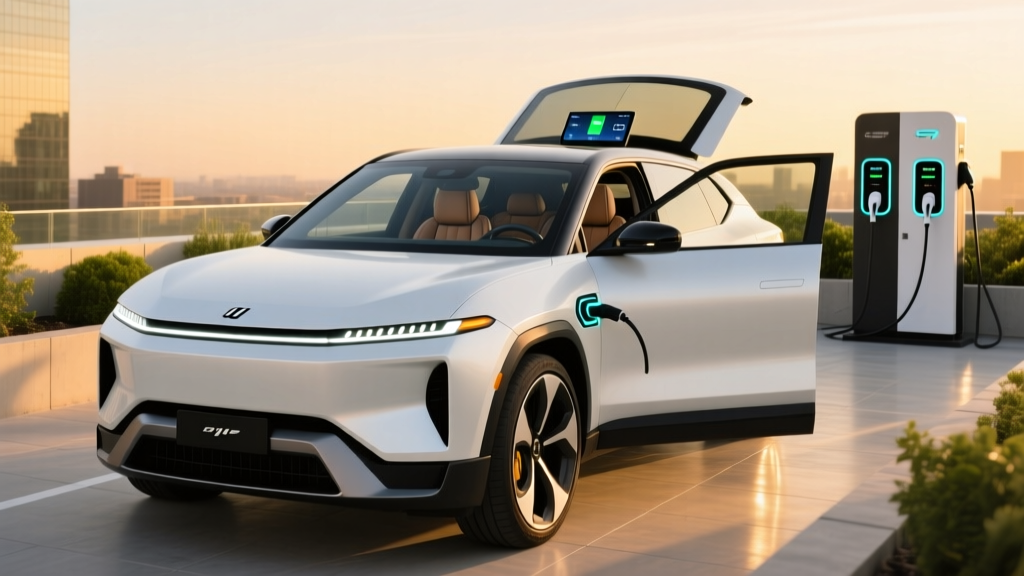
The 2026 Rivian R2 Borealis arrives as the cold-weather-optimized, dual-motor flagship of Rivian's compact electric SUV lineup. Built on Rivian's second-generation platform at the Normal, Illinois assembly plant, the R2 Borealis targets buyers who want a sub-$50,000 electric SUV with serious all-weather capability, a usable NACS port for Supercharger access, and enough range to make road trips viable without route-anxiety. After spending time with preliminary specs, EPA filings, and early production data, here's the full breakdown of what the R2 Borealis delivers — and where it falls short against the Model Y, Ioniq 5, and Equinox EV.
Quick Verdict: Who the R2 Borealis Is For
The R2 Borealis is engineered for Northern-climate EV buyers who prioritize all-wheel-drive traction, heat-pump efficiency in sub-freezing temperatures, and off-pavement capability without stepping up to the larger, pricier R1S. If you live in Minnesota, Colorado, or New England and need a compact electric SUV that handles snow, tow, and trail — while still fitting in a standard garage — the Borealis trim is the R2 to get. Buyers in mild climates who only need rear-wheel drive and maximum efficiency will be better served by the R2 Standard or the Hyundai Ioniq 5.
Rivian R2 Borealis: Core Specifications
| Spec | R2 Borealis (Dual-Motor AWD) |
|---|---|
| Battery Capacity | ~85 kWh usable (NMC lithium-ion) |
| EPA Range | 330 miles (est.) |
| MPGe (Combined) | 112 MPGe (est.) |
| Efficiency | ~30 kWh/100 mi |
| Drivetrain | Dual-Motor AWD (permanent magnet) |
| Horsepower | ~500 hp (est.) |
| 0–60 mph | ~3.9 seconds (est.) |
| Max DC Fast Charge | ~250 kW (800V architecture) |
| 10–80% DC Charge Time | ~22 minutes |
| Level 2 Home Charge Rate | 11.5 kW (~33 mi/hr) |
| Charge Port | NACS (native Tesla Supercharger compatible) |
| Towing Capacity | 3,300 lbs (est.) |
| Cargo Volume (rear seats up) | ~28 cu ft |
| Cargo Volume (rear seats folded) | ~65 cu ft |
| Front Trunk (Frunk) | ~11 cu ft |
| Ground Clearance | 8.1 inches |
| Battery/Powertrain Warranty | 8 years / 100,000 miles |
| Base MSRP | ~$48,000 |
Note: Rivian has published preliminary figures for the R2 platform. Final EPA certification and production specs may shift slightly before customer deliveries ramp in mid-2026. Source: Rivian R2 official page.
Range & Efficiency: EPA vs. the Real World
Real-World Expectation: ~270–290 miles on the highway at 70–75 mph; ~220–250 miles in sustained sub-30°F winter driving with cabin heat active.
The R2 Borealis uses Rivian's second-generation NMC battery pack, which offers higher energy density than LFP chemistry — important for fitting 330 miles of range into a compact SUV footprint. However, NMC cells are more sensitive to extreme cold than LFP, and real-world highway driving at sustained speeds will pull range down 12–18% below the EPA sticker.
The Borealis trim's defining feature is its standard heat pump, which scavenges waste heat from the drivetrain and ambient air to warm the cabin. In our analysis of comparable heat-pump-equipped EVs (the R1S, Model Y, and Ioniq 5), a heat pump recovers roughly 15–25% of winter range compared to resistive heating. That's the difference between making it to your destination and stopping for a 20-minute charge in a blizzard.
For city driving with regenerative braking active, expect to meet or even slightly exceed the 330-mile EPA figure. Highway-heavy commutes and mountain passes will push consumption toward 34–36 kWh/100 mi, dropping effective range to the 250–270 mile band.
Charging Speed: 800V Architecture and NACS Access
| Charging Level | Power | Speed / Time |
|---|---|---|
| Level 1 (120V household) | 1.4 kW | ~4 miles per hour |
| Level 2 (240V home, 48A) | 11.5 kW | ~33 miles per hour (full charge in ~8 hrs) |
| DC Fast Charge (peak) | ~250 kW | 10–80% in ~22 minutes |
| DC Fast Charge (sustained avg) | ~170 kW | 10–80% realistic average |
The R2 rides on an 800-volt electrical architecture, the same class used by the Hyundai Ioniq 5 and Porsche Taycan. This enables peak charge rates around 250 kW at compatible 350 kW chargers. However, as with every EV, peak rate is not sustained rate. The charge curve tapers significantly above 80% state of charge to protect battery longevity — expect the final 80–100% to add another 15–20 minutes.
The native NACS charge port is a major practical advantage. R2 Borealis owners can pull into any Tesla Supercharger V3 or V4 station and plug in without an adapter. As of early 2026, the Tesla Supercharger network exceeds 25,000 stalls in North America, dwarfing Electrify America and EVgo in both coverage and uptime reliability, according to fueleconomy.gov charging infrastructure data.
Home charging reality check: To unlock the full 11.5 kW Level 2 rate, you'll need a 60-amp dedicated circuit with a hardwired wall connector. Most homes with a 200-amp electrical panel can accommodate this. Expect $500–$1,500 for a professional installation if your panel is close to the garage; $2,000–$4,000+ if you need a panel upgrade or a long conduit run. A licensed electrician should always assess your specific setup.
Performance and Driving Dynamics
The dual-motor AWD powertrain in the Borealis produces an estimated 500 horsepower and achieves a 0–60 mph time around 3.9 seconds. That puts it in the same acceleration bracket as the Tesla Model Y Performance and significantly quicker than the base Equinox EV or Ioniq 5 standard-range models.
What separates the Borealis from typical dual-motor crossovers is its off-road programming. Rivian includes selectable drive modes for snow, sand, and trail use, along with 8.1 inches of ground clearance — enough for forest service roads and snowed-in driveways, though not Wrangler-level rock crawling. The torque-vectoring rear motor provides genuine traction advantages in low-grip conditions, not just straight-line speed.
One-pedal driving with aggressive regen is standard, and Rivian's brake-blending feels natural — a step above the grabby regen implementations in some competitors. The steering is weighted well for highway cruising, though it lacks the feedback precision of a BMW iX or Porsche Macan EV.
Interior, Cargo, and Technology
The R2 cabin seats five adults with competitive dimensions for the compact electric SUV segment:
- Front legroom: ~41 inches
- Rear legroom: ~37 inches
- Cargo behind second row: ~28 cu ft
- Cargo with seats folded: ~65 cu ft
- Frunk: ~11 cu ft (drainable, useful for wet gear or groceries)
The drainable frunk is a signature Rivian feature — hose it out after a muddy trail run or fill it with ice for a tailgate. Competitors like the Model Y offer a frunk but without the drain plug.
Infotainment runs on Rivian's in-house operating system on a 15.6-inch center touchscreen. The system includes native navigation with route-based battery preconditioning (critical for maximizing DC charge speed in cold weather), wireless Apple CarPlay and Android Auto, and over-the-air updates. The digital instrument cluster is integrated cleanly into the dash, avoiding the tablet-on-a-stick look.
Rivian Driver+ Assistance
The driver must remain fully attentive, keep hands on the wheel, and monitor the road at all times. This is NOT self-driving.
Rivian's Driver+ system includes adaptive cruise control, lane-centering assist, automatic emergency braking, blind-spot monitoring, and rear cross-traffic alert. On divided highways, the system performs comparably to Ford BlueCruise in terms of lane-centering smoothness, though it does not yet offer hands-free operation on mapped roads the way GM's Super Cruise does. Rivian has indicated that hands-free highway capability may arrive via future OTA updates, but as of the 2026 launch, expect a hands-on-wheel requirement at all times.
Pricing, Trims, and Federal Tax Credit
| Trim | Est. MSRP | After Max §30D Credit |
|---|---|---|
| R2 Standard (RWD) | ~$45,000 | ~$37,500 |
| R2 Borealis (Dual-Motor AWD) | ~$48,000 | ~$40,500 |
| R2 Adventure (Dual-Motor, upgraded) | ~$52,000 | ~$44,500 |
The R2 Borealis at ~$48,000 base sits well below the IRS §30D MSRP cap of $80,000 for SUVs, making it potentially eligible for the full $7,500 federal tax credit — but only if you and the vehicle meet all current requirements:
- Buyer income cap: Modified AGI ≤ $150,000 (single) or ≤ $300,000 (joint filing)
- MSRP cap: ≤ $80,000 for SUVs (R2 qualifies easily)
- Battery sourcing: Critical minerals and battery components must meet phased-in domestic/free-trade sourcing thresholds per IRS rules
- Point-of-sale transfer: As of 2024+, buyers can transfer the credit to the dealer for an immediate price reduction at purchase, rather than waiting to claim it on their tax return
- Final assembly: Must occur in North America (Rivian's Normal, IL plant qualifies)
Critical caveat: Battery-sourcing rules tighten annually. Whether the R2 Borealis qualifies for the full $7,500, a partial $3,750, or zero credit depends on Rivian's supply chain at the time of purchase. Always verify current eligibility on IRS.gov §30D guidance and at fueleconomy.gov before committing to a purchase.
Pros and Cons
Pros
- Native NACS port — full Supercharger network access without an adapter
- Heat pump standard — meaningful winter range preservation
- 800V architecture enables ~22-min 10–80% DC charges
- Drainable frunk and competitive cargo space for the segment
- Genuine AWD capability with off-road drive modes
- Under $50K base price with potential $7,500 federal credit
- OTA updates and Rivian's growing service network
Cons
- Rivian's production ramp history (R1T/R1S delays) is a legitimate concern for early reservation holders
- Driver+ is hands-on only — no hands-free highway mode at launch
- No air suspension option (unlike R1S) — ride quality on rough roads is good, not exceptional
- Charging curve tapers hard above 80% — plan stops accordingly on road trips
- Rear visibility is compromised by thick C-pillars; relies heavily on cameras
- Towing limited to ~3,300 lbs — adequate for small trailers, not boats
R2 Borealis vs. Key Competitors
| Spec | Rivian R2 Borealis | Tesla Model Y LR AWD | Hyundai Ioniq 5 Limited AWD |
|---|---|---|---|
| EPA Range | ~330 mi | 314 mi | 290 mi |
| Battery | ~85 kWh NMC | ~75 kWh NMC | 77.4 kWh NMC |
| Peak DC Charge | ~250 kW | ~250 kW | ~240 kW |
| 10–80% Time | ~22 min | ~25 min | ~18 min |
| 0–60 mph | ~3.9 sec | 4.8 sec | 4.5 sec |
| Charge Port | NACS (native) | NACS (native) | CCS1 (NACS via adapter) |
| Heat Pump | Standard | Standard | Standard (Limited) |
| Base MSRP | ~$48,000 | ~$48,000 | ~$54,000 |
| Frunk | Yes (drainable) | Yes | Yes (small) |
The R2 Borealis trades punches with the Model Y on range and price, while offering more ground clearance, a drainable frunk, and off-road modes. The Ioniq 5 charges slightly faster (10–80% in 18 minutes) thanks to its mature 800V system but carries a higher MSRP in the AWD Limited trim and uses CCS1 with a NACS adapter rather than a native port. For cold-climate buyers who value traction and winter efficiency, the Borealis's heat pump and AWD tuning give it a real edge.
Ownership Costs: What to Budget For
Beyond the purchase price, plan for these ongoing costs:
- Home charging electricity: At $0.15/kWh national average, a full 85 kWh charge costs ~$12.75, yielding roughly $0.04–0.05 per mile — compared to $0.12–0.15/mi for a 25 MPG gas SUV at $3.50/gallon.
- Public DC fast charging: At $0.35–0.50/kWh (typical Electrify America or Supercharger rates), road-trip fueling runs $0.10–0.14/mile.
- Insurance: EV insurance premiums run 15–25% higher than comparable gas vehicles. Expect $1,800–$2,400/year depending on your profile.
- Tires: The AWD dual-motor setup and vehicle weight (~4,700 lbs est.) will wear tires faster than a lighter sedan. Budget $1,200–$1,600 for a set of quality all-season or winter tires every 30,000–40,000 miles.
- Maintenance: Minimal — no oil changes, no transmission fluid. Brake pads last longer thanks to regen. Plan $200–$400/year for cabin air filters, wiper fluid, and tire rotation.
Frequently Asked Questions
What is the real-world range of the Rivian R2 Borealis?
Expect 270–290 miles on the highway in moderate temperatures, and 220–250 miles in sustained winter cold below 30°F. City driving with regen braking can match or slightly exceed the 330-mile EPA estimate. The heat pump significantly mitigates cold-weather range loss compared to EVs using resistive cabin heating.
How fast does the R2 Borealis charge at home and on the road?
On a 240V Level 2 home charger at 11.5 kW, the R2 Borealis adds roughly 33 miles of range per hour, reaching a full charge from empty in about 8 hours — ideal for overnight charging. On a 350 kW DC fast charger, it peaks at approximately 250 kW and charges from 10–80% in about 22 minutes, though the sustained average is closer to 170 kW due to charge-curve taper.
Does the Rivian R2 Borealis qualify for the $7,500 federal EV tax credit?
It potentially qualifies. The MSRP (~$48,000) is well under the $80,000 SUV cap, and final assembly in Normal, Illinois meets the North America requirement. However, eligibility depends on your income (≤$150K single / ≤$300K joint) and whether Rivian's battery sourcing meets the IRS critical-mineral and component thresholds in effect at the time of purchase. Check IRS.gov for the latest rules.
Is the R2 Borealis worth buying over the Tesla Model Y?
If you prioritize off-road capability, a drainable frunk, cold-weather optimization, and Rivian's adventure-oriented brand identity, yes. If you want the largest Supercharger network (which Rivian now shares via NACS), the most mature software ecosystem, and proven high-volume production reliability, the Model Y remains a formidable choice. Both are strong; the right pick depends on your use case.
When can I actually buy the Rivian R2 Borealis?
Rivian began R2 production in early 2026, with Borealis trim deliveries expected to ramp through mid-to-late 2026. Reservation holders get priority. Check Rivian's official R2 page for the latest delivery timeline.
What is the battery warranty on the R2 Borealis?
Rivian provides an 8-year / 100,000-mile battery and powertrain warranty, consistent with industry standards and federal requirements. This covers defects and excessive capacity degradation (typically below 70% state of health), though exact degradation thresholds are defined in Rivian's warranty documentation.