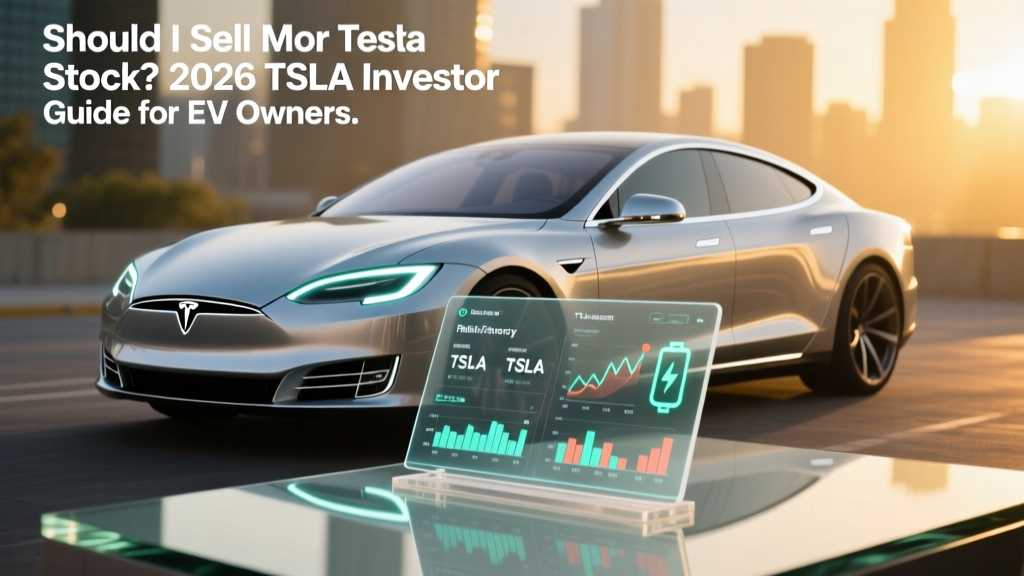
The EV Owner's Dilemma: Should I Sell My Tesla Stock?
If you own a Tesla — or have been following the brand's vehicles for years — you've likely asked yourself: should I sell my Tesla stock? It's a question that sits at the intersection of personal experience with Tesla products and the cold calculus of equity valuation. As an EV analyst who has owned a Model 3, charged at hundreds of Superchargers, and tracked every quarterly delivery number, I approach this question differently than a Wall Street analyst who has never preconditioned a battery in freezing weather.
This guide won't give you a buy/sell/hold rating — we're not a licensed financial advisory service. Instead, we'll examine Tesla's business through the lens that EV owners and enthusiasts understand best: the product, the competition, the technology moat, and the real-world ownership experience. These are the fundamentals that ultimately drive the stock. We'll use 2026 data to help you form your own thesis.
Tesla's 2026 Vehicle Lineup: The Product Foundation
Any stock thesis starts with what the company actually sells. In 2026, Tesla's revenue remains overwhelmingly driven by vehicle sales, and the lineup has evolved significantly from the Model S/X days. Here's what's on the showroom floor:
| Model | EPA Range | Battery (kWh/Chemistry) | Max DC Charge (kW) | 0-60 mph | Base MSRP |
|---|---|---|---|---|---|
| Model 3 RWD | 272 mi | ~60 kWh / LFP | 170 kW | 5.8s | $38,990 |
| Model 3 Long Range AWD | 341 mi | ~82 kWh / NMC | 250 kW | 4.2s | $42,490 |
| Model Y Long Range AWD | 320 mi | ~78 kWh / NMC | 250 kW | 4.8s | $44,990 |
| Cybertruck AWD | 340 mi | ~123 kWh / NMC | 250 kW | 4.1s | $79,990 |
| Model S LR | 402 mi | ~100 kWh / NMC | 250 kW | 3.1s | $74,990 |
Source: fueleconomy.gov and Tesla's official 2026 spec pages. Specs vary by model year and trim. Always verify current pricing at Tesla.com.
The critical takeaway for investors: Tesla's volume now rides on Model 3 and Model Y. The Cybertruck remains a low-volume halo product, and the Model S/X are essentially legacy vehicles kept in limited production. If you're evaluating Tesla's stock, you're really evaluating the company's ability to sell millions of Model 3s and Model Ys against an increasingly crowded field.
The Competitive Moat: Is Tesla Still Winning on Product?
The strongest argument for holding Tesla stock has always been the product moat. In 2020, there was no serious alternative. In 2026, that's no longer true. Let's break down where Tesla stands against key competitors:
Charging Infrastructure — Still Tesla's Biggest Advantage
The Supercharger network remains Tesla's most durable competitive advantage. With over 6,500 Supercharger stations and 60,000+ individual stalls in North America as of early 2026, Tesla's DC fast-charging network dwarfs Electrify America, EVgo, and ChargePoint combined in reliability and uptime. The network's 99%+ uptime rate is something competitors still can't match.
However, Tesla opened the Supercharger network to non-Tesla NACS-equipped vehicles in 2024-2025, which means the moat is now shared. Ford, GM, Rivian, Hyundai, and others now access Superchargers via NACS adapters or native NACS ports. Tesla earns revenue from these sessions, but the exclusivity advantage that once drove Tesla purchases has eroded.
| Metric | Tesla Model Y LR | Hyundai Ioniq 5 LR | Ford Mustang Mach-E ER | Chevrolet Equinox EV |
|---|---|---|---|---|
| EPA Range | 320 mi | 310 mi | 320 mi | 319 mi |
| Max DC Charge | 250 kW | 240 kW (800V) | 150 kW | 150 kW |
| 10-80% Time | ~25 min | ~18 min | ~36 min | ~35 min |
| Connector | NACS (native) | NACS (native '26) | NACS (native '26) | NACS (native '26) |
| Base MSRP | $44,990 | $42,400 | $42,995 | $33,600 |
The 800V Problem
Here's a technical concern Tesla investors should understand: Tesla still uses a 400-volt battery architecture, while Hyundai/Kia's E-GMP platform and upcoming competitors use 800V. The practical result? The Ioniq 5 can charge from 10-80% in roughly 18 minutes on a 350 kW charger, while the Model Y takes about 25 minutes at 250 kW. That 7-minute gap matters on road trips, and it represents a genuine technology disadvantage that Tesla hasn't addressed in the Model 3/Y platform.
Tesla's rumored next-generation platform (potentially for a more affordable compact model) may adopt 800V, but as of 2026, the volume vehicles remain 400V. This is a data point worth watching.
FSD and the Autonomy Thesis: What's Actually Shipping?
No Tesla stock analysis is complete without addressing Full Self-Driving (FSD). This is the single most speculative component of Tesla's valuation — the piece that bulls say justifies a premium and bears say is overpromised.
Here's what Tesla FSD (Supervised) actually does in 2026:
- City Streets: Handles most intersections, left turns, and lane changes in urban environments — but requires constant driver supervision and occasional intervention at complex construction zones or unmapped areas.
- Highway Driving: Solid on-ramp to off-ramp autonomy on well-marked highways. Lane changes, speed adjustments, and merging are handled competently.
- Parking: Smart Summon and auto-park features work in many lots but are inconsistent in tight or poorly marked spaces.
- Cost: FSD remains an $8,000 one-time purchase or $99/month subscription as of 2026.
The investor question: Is Tesla closer to true unsupervised autonomy than Waymo? Waymo has logged over 30 million driverless miles in commercial service across Phoenix, San Francisco, Los Angeles, and Austin. Tesla has millions of supervised miles but zero unsupervised commercial deployments. If your investment thesis depends on Tesla solving Level 4 autonomy at scale before 2028, that's a high-conviction bet against the current evidence.
Tesla's Financial Health: Margins, Deliveries, and the Price War
As an EV owner, you experience Tesla's financial decisions directly through pricing. The 2023-2025 price cuts that boosted volume also crushed automotive gross margins, dropping them from a peak of ~28% to roughly 16-18% by late 2025. In 2026, margins have stabilized somewhat, but Tesla is no longer the margin king of the auto industry it once was.
Key financial metrics to understand (based on 2025 full-year and early 2026 quarterly reports):
- Annual deliveries: ~1.8 million vehicles globally (2025), targeting 2+ million in 2026
- Automotive gross margin: ~17% (down from ~28% peak in 2022)
- Energy generation/storage revenue: Growing rapidly — Megapack deployments have become a meaningful revenue stream
- Services and other: Supercharger revenue, FSD subscriptions, and insurance growing but still a small percentage of total revenue
The delivery growth story is what the stock trades on. Tesla needs to demonstrate it can sell significantly more vehicles year over year — not just maintain volume through price cuts. The introduction of refreshed Model Y ("Juniper") and potential new compact models are the catalysts bulls point to.
Tax Credits, Incentives, and Demand Tailwinds
One thing EV owners understand intimately: the federal tax credit dramatically affects purchase decisions. Tesla models' eligibility under IRS §30D rules has fluctuated as battery sourcing requirements tighten.
- Maximum credit: $7,500 (up to $3,750 for critical minerals + $3,750 for battery components)
- MSRP caps: $55,000 for sedans (Model 3), $80,000 for SUVs/trucks (Model Y, Cybertruck)
- Income caps: $150,000 single / $300,000 married filing jointly (modified AGI)
- Battery sourcing: Increasingly strict critical-mineral and battery-component requirements — vehicles with Chinese-sourced minerals may lose partial or full credit
- Point-of-sale transfer: Eligible buyers can apply the credit at purchase, reducing the effective price immediately
Source: IRS.gov — Credits for New Clean Vehicles. Eligibility changes frequently. Verify current status at fueleconomy.gov before purchasing.
As of early 2026, the Model 3 RWD and Long Range AWD generally qualify for the full or partial credit, depending on the buyer's income and the specific battery batch. The Model Y Long Range typically qualifies under the $80,000 SUV cap. However, battery-sourcing rules have tightened annually, and partial credit disqualifications have occurred mid-year. This is a demand variable Tesla cannot fully control.
The Bull Case vs. The Bear Case: An Owner's Framework
After years of driving Teslas, charging at Superchargers, and watching the competitive landscape shift, here's how I frame the investment decision:
The Bull Case (Hold/Buy)
- Supercharger network generates recurring revenue from the entire EV industry now that NACS is the standard
- Manufacturing efficiency — Tesla's cost per vehicle remains among the lowest in the industry
- Energy storage (Megapack/Powerwall) is a high-growth segment most auto analysts underweight
- Software/FSD revenue has near-zero marginal cost once developed
- Global factory footprint (Fremont, Shanghai, Berlin, Austin) provides geographic diversification
- Brand loyalty among existing owners remains strong — repeat purchase rates are high
The Bear Case (Sell/Reduce)
- Competition has caught up — Model Y now competes on specs, not dominance, against Ioniq 5, Mach-E, and Equinox EV
- 400V architecture lags behind 800V competitors on charging speed
- Automotive margins compressed and unlikely to return to 2022 peaks
- FSD Level 4 autonomy remains unproven — the timeline keeps slipping
- Brand perception damage in some demographics may suppress demand
- Valuation assumes growth that requires selling 3-5x current volumes — execution risk is enormous
- Regulatory risk: tariff changes, credit eligibility shifts, and safety investigations can move the stock overnight
Practical Questions Every Tesla Owner-Investor Asks
Does my personal experience with Tesla products predict stock performance?
Not directly. Loving your Model 3's one-pedal driving and Supercharger convenience doesn't mean the stock is undervalued. Product satisfaction and stock valuation are different things. Some of the best products come from companies with overvalued stock, and vice versa. Use your ownership experience to evaluate product competitiveness, then let financial metrics determine whether the price is right.
What if I believe in Tesla's long-term vision?
Belief in a company's mission is not an investment strategy. If you believe in the EV transition broadly, consider whether Tesla is the best way to express that thesis — or whether a diversified EV/energy ETF, or even competitors like BYD or Hyundai, might offer better risk-adjusted returns. Conviction should be paired with diversification.
How should I think about concentration risk?
If you work at Tesla, own a Tesla, and hold significant TSLA stock, your financial life is deeply concentrated in one company. A factory recall, a CEO controversy, or a tariff change impacts your income, your car's resale value, and your portfolio simultaneously. Many financial advisors recommend no single stock exceed 5-10% of a diversified portfolio.
What the Data Says: Key Metrics to Monitor
If you decide to hold, here are the metrics that should influence your ongoing evaluation:
| Metric | Why It Matters | Where to Find It |
|---|---|---|
| Quarterly deliveries | Volume growth drives revenue — price cuts alone don't sustain a stock | Tesla quarterly production/delivery reports |
| Automotive gross margin | Shows whether Tesla can sell cars profitably without constant price cuts | Quarterly earnings reports (10-Q/10-K) |
| Energy storage deployments (GWh) | Fastest-growing segment — validates Tesla as more than a car company | Quarterly earnings reports |
| FSD take rate | What % of buyers pay for FSD — indicates perceived value and software revenue potential | Analyst estimates; Tesla occasionally discloses |
| Supercharger network revenue | Non-Tesla vehicles using Superchargers = new revenue stream | Services & Other segment in earnings |
| Market share by region | Is Tesla gaining or losing share to BYD, Hyundai, Ford? | Registration data; Cox Automotive, Kelley Blue Book |
Final Framework: A Decision Checklist for Tesla Owner-Investors
Before You Decide, Ask Yourself:
- What percentage of my portfolio is TSLA? If it's more than 10%, concentration risk is real regardless of how much you love the product.
- What is my time horizon? If you need the money within 3 years, high-volatility growth stocks carry significant risk.
- Am I holding for emotional reasons? Owning a Tesla and enjoying it is not the same as having a sound investment thesis.
- Have I compared Tesla's valuation multiples to peers? P/E, P/S, and EV/EBITDA ratios tell you what the market expects.
- Do I have a plan for tax implications? Selling triggers capital gains. Consult a tax professional about harvesting losses, holding periods, and charitable giving strategies.
- Would I buy TSLA today at the current price if I didn't already own it? If the answer is no, the endowment effect may be clouding your judgment.
Frequently Asked Questions
Is Tesla still the best EV to buy in 2026?
It depends on your priorities. The Model 3 and Model Y remain excellent vehicles with best-in-class Supercharger access, strong efficiency (Model 3 LR achieves ~130 MPGe combined per fueleconomy.gov), and solid build quality post-Highland/Juniper refreshes. However, the Hyundai Ioniq 5 charges faster on 800V architecture, the Chevrolet Equinox EV costs significantly less, and the Ford Mach-E offers competitive range. "Best" depends on what you optimize for: charging network, price, charging speed, or cargo space.
Does Tesla qualify for the $7,500 federal tax credit?
Eligibility varies by model, trim, buyer income, and battery sourcing. The Model 3 (sedan, $55,000 MSRP cap) and Model Y (SUV, $80,000 MSRP cap) have generally qualified for full or partial credits in 2026, but critical-mineral sourcing requirements tighten annually. Always verify current eligibility at fueleconomy.gov and consult a tax professional. The credit can be transferred at point of sale, reducing your purchase price directly.
What's the biggest risk to Tesla's stock right now?
Margin compression from sustained competition and slowing delivery growth. Tesla's valuation assumes massive future volume increases. If deliveries plateau at 2-2.5 million annually while competitors grow, the stock's growth premium becomes hard to justify. Secondary risks include FSD regulatory scrutiny, key-person dependency, and geopolitical exposure (China factory and market).
Should I sell my Tesla stock to buy more EVs from competitors?
This conflates two separate decisions. Your investment allocation should be based on financial analysis, not product preference. If you want to experience other EVs — and as an enthusiast, I'd recommend test-driving the Ioniq 5, BMW i4, and Rivian R2 — that's a spending decision, not a portfolio strategy. Don't sell stock to fund a car purchase unless you've evaluated the tax implications and opportunity cost.
How does Tesla's warranty compare to competitors?
Tesla offers a 4-year/50,000-mile basic vehicle warranty and an 8-year/120,000-mile battery and drive unit warranty (Long Range and Performance models) or 8-year/100,000-mile (RWD models). This is competitive with Hyundai's 10-year/100,000-mile powertrain warranty when you factor in that Tesla's battery warranty guarantees 70% minimum capacity retention. Tesla's warranty is adequate but not class-leading — Hyundai and Kia offer longer coverage.
For more on EV ownership costs and comparisons, see our guides on AutoEdgeView.com. This article reflects data available as of early 2026. Vehicle specifications, pricing, and tax credit eligibility are subject to change.