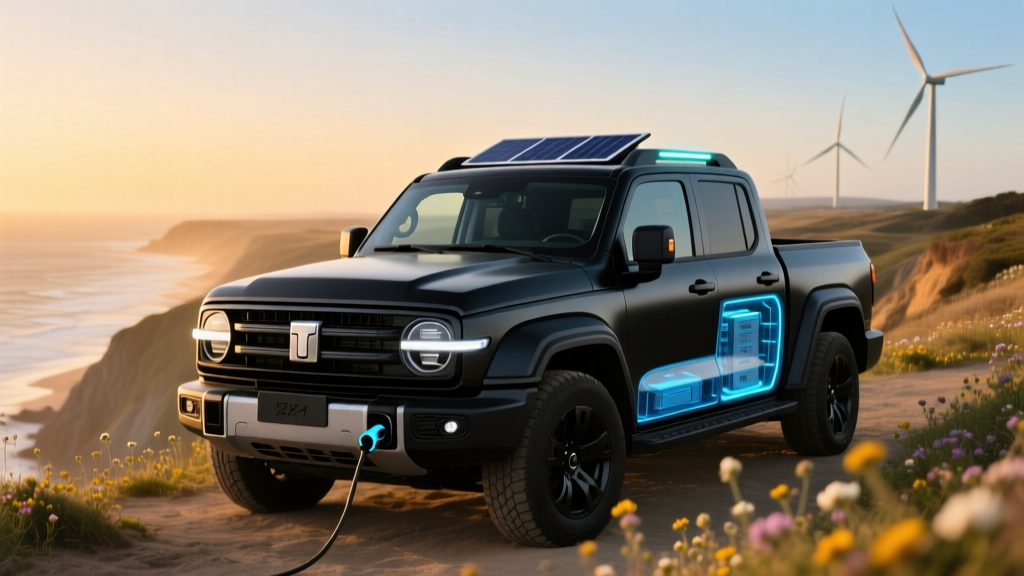
The short answer: The Scout Terra is a purpose-built electric pickup from the revived Scout Motors brand (backed by Volkswagen Group), targeting the mid-size truck segment occupied by the Ford Maverick, Rivian R1T, and Chevrolet Colorado. Based on preliminary specifications, the Terra will offer an estimated 350+ miles of EPA range, an 800-volt electrical architecture for fast DC charging, a dual-motor AWD powertrain, and a starting MSRP in the low $50,000 range before incentives. First customer deliveries are targeted for late 2027, meaning the Terra is not yet available for purchase — reservations are currently open with a refundable deposit. If you need a truck today, the Rivian R1T or Ford F-150 Lightning remain your options; if you can wait and want a rugged, boxy, body-on-frame EV truck with potential Range Extender (EREV) capability, the Terra deserves a spot on your watchlist.
Scout Terra Preliminary Specifications: What We Know
Scout Motors has been deliberate about releasing hard data, but between official teasers, executive statements, and supply-chain reporting, a credible picture of the Terra's powertrain has emerged. All figures below are preliminary or estimated and subject to change before production begins.
| Specification | Scout Terra (Estimated) |
|---|---|
| Powertrain | Dual-motor AWD (standard) |
| Horsepower | ~450+ hp (targeted) |
| 0-60 mph | ~5.0 sec (targeted) |
| Battery Chemistry | NMC (nickel manganese cobalt) expected |
| Battery Capacity | ~100-120 kWh usable (estimated) |
| EPA Range (BEV) | 350+ miles (targeted) |
| Range Extender (EREV option) | Gasoline engine-generator; total range TBD (potentially 500+ mi) |
| DC Fast Charge Architecture | 800V nominal |
| Peak DC Charge Rate | ~250-350 kW (estimated) |
| 10-80% Charge Time | ~20-25 min (targeted at 350 kW-capable station) |
| Level 2 AC Charging | ~11-19.2 kW onboard charger |
| Towing Capacity | ~7,500+ lbs (targeted) |
| Payload Capacity | ~1,500+ lbs (targeted) |
| Bed Length | ~5 ft (standard) |
| Starting MSRP | ~$50,000-$55,000 (base BEV, estimated) |
| Battery/Powertrain Warranty | 8 years / 100,000 miles (expected, per federal minimum) |
| Production Start | Late 2027 (targeted) |
The headline feature is the available Range Extender — a small gasoline engine that acts as a generator to recharge the battery on the move, never directly driving the wheels. This EREV (Extended-Range Electric Vehicle) configuration is similar to the approach used by the original Chevrolet Volt and the current Ram 1500 REV. It's a pragmatic solution for buyers who want electric daily driving but need insurance against charging deserts on long hauls or remote job sites.
Real-World Range Expectations: Beyond the EPA Sticker
A 350-mile EPA estimate sounds strong for a mid-size pickup, but truck buyers need to plan for conditions that erode that number. Here's how the Terra's range is likely to perform in practice:
EPA Estimate: ~350 miles (BEV, preliminary)
Real-World Highway (70-80 mph): ~270-300 miles
Cold Weather (below 32°F): ~230-270 miles (30-35% reduction typical for NMC packs without aggressive preconditioning)
Towing (5,000 lb trailer): ~150-180 miles (towing roughly halves efficiency in most EV trucks)
These reductions aren't unique to Scout — they reflect the physics of moving a heavy, boxy vehicle through air and cold. The EPA's fueleconomy.gov testing includes a mix of city and highway driving at moderate temperatures. Sustained 80 mph interstate travel, headwinds, and sub-freezing temperatures all increase energy consumption (measured in kWh/100mi) substantially.
The 800V architecture helps on the charging side: higher voltage means lower current for the same power, reducing heat in the battery and cables, which translates to more sustained charging speeds rather than sharp taper curves. If Scout delivers on ~350 kW peak charging, the Terra could add roughly 100 miles of range in under 10 minutes at a compatible Electrify America or Tesla Supercharger (NACS) station — though sustained rates above 80% State of Charge will drop significantly, as they do in all lithium-ion packs.
Scout Terra vs. Gas Trucks and EV Competitors
The Terra doesn't exist in a vacuum. Here's how it stacks up against the gas-powered mid-size trucks it targets and the EV trucks already on the road:
| Vehicle | Powertrain | Est. Range | Starting Price | Energy/Fuel Cost per Mile | Towing |
|---|---|---|---|---|---|
| Scout Terra (BEV) | Dual-motor EV | ~350 mi (est.) | ~$50,000 (est.) | $0.04-$0.06 (home charging) | ~7,500 lbs (est.) |
| Scout Terra (EREV) | EV + gas generator | ~500+ mi (est.) | ~$55,000+ (est.) | $0.04-$0.08 mixed | ~7,500 lbs (est.) |
| Ford Maverick Hybrid | HEV | ~500 mi (37 MPG) | ~$28,000 | $0.10-$0.14 | 2,000 lbs |
| Chevrolet Colorado (2.7L Turbo) | Gas | ~430 mi (22 MPG) | ~$32,000 | $0.13-$0.17 | 7,700 lbs |
| Rivian R1T (Dual-Motor) | BEV | 270-420 mi (pack dependent) | ~$71,700 | $0.04-$0.06 | 11,000 lbs |
| Ford F-150 Lightning (Std Range) | BEV | 240 mi | ~$55,000 | $0.04-$0.06 | 7,700 lbs |
Key takeaways:
- The Terra aims to undercut the Rivian R1T substantially on price while offering competitive or better range.
- Against gas mid-size trucks (Colorado, Tacoma), the Terra will cost significantly more upfront but deliver dramatically lower per-mile energy costs — especially for owners who charge at home on residential electricity rates (~$0.13-$0.18/kWh national average).
- The EREV option is the Terra's differentiator: no other current mid-size EV truck offers a factory range-extender, making it uniquely suited to buyers in charging-sparse regions.
- Towing with any EV truck cuts range roughly in half. The EREV mitigates this by allowing the gas generator to extend range on long towing trips — a genuine practical advantage.
Total Cost of Ownership: 5-Year Breakdown
Sticker price is only the start. Here's a realistic 5-year / 75,000-mile ownership cost model comparing the Scout Terra BEV (estimated) against a comparable gas mid-size truck:
| Cost Category | Scout Terra BEV (Est.) | Gas Mid-Size Truck (e.g., Colorado) |
|---|---|---|
| Purchase Price (base MSRP) | $52,000 | $35,000 |
| Federal Tax Credit (§30D, if eligible) | -$7,500 (see caveats below) | $0 |
| Effective Purchase Price | $44,500 | $35,000 |
| Home Charger Install (Level 2, 240V/48A) | $1,200-$2,500 | $0 |
| Fuel/Energy (75,000 mi) | $3,000-$4,500 (home charging) | $9,000-$12,500 (gas at $3.50-$4.00/gal, 22 MPG) |
| Maintenance (5 years) | $800-$1,500 (no oil changes, fewer moving parts) | $3,000-$5,000 (oil, filters, transmission fluid, belts) |
| Insurance (5-year avg) | $9,000-$12,000 (EV trucks carry higher premiums) | $6,500-$9,000 |
| Tires (heavier EV wear) | $2,000-$3,000 | $1,500-$2,500 |
| 5-Year Total Cost | ~$60,500-$68,000 | ~$55,000-$64,000 |
The gap narrows significantly when you factor in the federal tax credit and energy savings. If you qualify for the full $7,500 credit and charge primarily at home, the Terra's 5-year cost approaches parity with a gas truck — and you get a quieter, more torque-rich driving experience, a frunk, and zero tailpipe emissions. However, the higher insurance premiums and potential home charger installation cost are real additions that gas-truck buyers don't face.
§30D Federal Tax Credit: Eligibility Is Not Guaranteed
Under current IRS §30D rules, the Terra's eligibility for the $7,500 credit depends on several factors that may shift before 2027 production:
- MSRP Cap: Pickup trucks must be under $80,000 MSRP. The Terra's estimated pricing clears this easily.
- Buyer Income Cap: Modified AGI must not exceed $150,000 (single), $225,000 (head of household), or $300,000 (joint). If your income exceeds these thresholds, no credit.
- Battery Sourcing: Increasingly strict critical-mineral and battery-component requirements must be met. Scout's VW Group backing and planned South Carolina production suggest strong domestic sourcing intent, but final compliance depends on 2027 supply-chain realities.
- Point-of-Sale Transfer: Eligible buyers can transfer the credit to the dealer at purchase, reducing the out-of-pocket price immediately rather than waiting for a tax refund.
Always consult a tax professional before relying on credit eligibility. Rules have changed annually since 2023 and may shift again before Terra deliveries begin.
Charging the Scout Terra: Home, Public, and the 800V Advantage
Charging infrastructure access is the single most important variable in EV truck ownership. Here's what Terra buyers should plan for:
| Charging Level | Power | Miles Added per Hour | Use Case |
|---|---|---|---|
| Level 1 (120V standard outlet) | ~1.4 kW | ~4-5 mi/hr | Emergency top-up, overnight trickle |
| Level 2 (240V home charger, 48A) | ~11.5 kW | ~35-40 mi/hr | Daily home charging; full overnight refill |
| DC Fast Charge (350 kW station) | Up to ~350 kW (peak) | ~600-800+ mi/hr (peak) | Road trips; 10-80% in ~20-25 min (est.) |
Home charging is essential for truck owners. A Level 2 home charger (240V, hardwired, 48-amp circuit) will refill the Terra's estimated 100-120 kWh battery in roughly 8-10 hours — perfectly suited for overnight charging. Installation costs typically range from $1,200 to $2,500 for a straightforward setup (existing 200A panel, short run to garage), but can reach $4,000-$6,000 if a panel upgrade to 200A or 400A service is needed. Always get a quote from a licensed electrician before purchasing a charger.
Public DC fast charging is where the 800V architecture matters. At a 350 kW-capable Electrify America station, the Terra should accept peak charging rates that most 400V vehicles (like the current F-150 Lightning) cannot fully utilize. However, real-world charging involves a charge curve taper: the battery accepts peak power only between roughly 10-50% State of Charge, then progressively slows. Expect the 50-80% portion to take nearly as long as 10-50%.
Scout has not confirmed its charging connector, but given the industry's 2024-2025 shift toward the NACS (Tesla) standard, and VW Group's confirmed adoption of NACS for North American vehicles, the Terra is highly likely to ship with a native NACS port, granting access to Tesla Supercharger stations alongside Electrify America and other networks.
Real-World Ownership Considerations Before You Reserve
| Myth | Fact |
|---|---|
| "EV trucks can't tow." | They can — but towing cuts range by ~40-50%. The Terra's EREV option mitigates this with a gas generator for long hauls. |
| "The battery will need replacing in 5 years." | Modern NMC and LFP packs are engineered for 200,000+ miles with <20% degradation. Federal warranty mandates require 8 years/100,000 miles minimum coverage on battery capacity. |
| "I'll save $7,500 no matter what." | Income caps, MSRP caps, and battery-sourcing rules all apply. Many buyers will qualify, but not all. Verify before budgeting. |
| "Public charging is everywhere now." | Urban and interstate corridors are well-covered, but rural areas, apartment complexes, and street-parking neighborhoods still face significant charging gaps. |
| "Cold weather makes EVs useless." | Range drops 20-35% in sub-freezing temps — real, but manageable with preconditioning and trip planning. The EREV option eliminates this concern entirely. |
Who Should Reserve the Scout Terra?
Reserve the Terra if:
- You want an EV truck but live in a region with sparse DC fast charging and need the EREV safety net.
- You can wait until late 2027+ for delivery and are comfortable with first-year production risk.
- You have home charging access (garage or driveway with 240V capability) or can install it.
- Your daily driving is under 150 miles round-trip, making the BEV range more than sufficient for weekday use.
- You value a rugged, body-on-frame design with off-road capability over car-like crossover comfort.
Look elsewhere if:
- You need a truck within the next 6 months — the Terra is not yet in production.
- You live in an apartment or condo with no charging access and no realistic path to installing a Level 2 charger.
- Your budget is strictly under $40,000 — even with the tax credit, the Terra will likely land above that threshold.
- You tow heavy trailers (>7,000 lbs) regularly and don't want to manage range limitations or rely on a range extender.
Scout Terra FAQ
Is the Scout Terra available to buy right now?
No. Scout Motors is targeting production start in late 2027 from its new facility in Blythewood, South Carolina. Reservations are open with a refundable deposit, but no customer vehicles have been delivered. All specifications remain preliminary.
What is the Scout Terra's estimated range?
Scout targets 350+ miles of EPA range for the pure BEV version. The available Range Extender (EREV) with a gasoline generator is expected to push total range potentially beyond 500 miles. Real-world highway range will be lower — expect roughly 270-300 miles for the BEV at sustained highway speeds, and significantly less when towing or in extreme cold.
Will the Scout Terra qualify for the $7,500 federal tax credit?
It's likely but not guaranteed. The Terra's expected MSRP is well under the $80,000 truck cap, and Scout's domestic manufacturing plans align with sourcing requirements. However, buyer income limits, final battery-component sourcing, and any rule changes between now and 2027 will determine eligibility. Consult a tax professional and check IRS.gov closer to purchase.
Does the Scout Terra use NACS or CCS for charging?
Scout has not officially confirmed, but the VW Group has committed to the NACS (Tesla) connector for North American vehicles. Expect the Terra to ship with a native NACS port, providing access to Tesla Superchargers, Electrify America (via adapter or native cable), and the growing NACS-equipped public charging network.
How does the Range Extender (EREV) work?
The EREV option adds a small gasoline engine that functions solely as a generator — it never drives the wheels directly. When the battery depletes to a set threshold, the generator activates to produce electricity, extending the vehicle's range. You drive on electric power at all times; the gas engine simply ensures you don't run out of electricity on long trips or in areas without chargers. Think of it as a built-in backup generator for your battery.
What will insurance cost for the Scout Terra?
EV trucks typically carry insurance premiums 15-30% higher than comparable gas trucks, driven by higher repair costs (specialized body panels, battery protection, sensor calibration). Based on current EV truck averages, expect annual premiums of $1,800-$2,400 depending on your state, driving record, and coverage level. Get quotes from your insurer before committing.
Can I charge the Scout Terra at home on a regular outlet?
Yes, but slowly. A standard 120V household outlet (Level 1) delivers roughly 1.4 kW, adding about 4-5 miles of range per hour. For a truck with a ~100+ kWh battery, a full charge from empty would take 3+ days. A 240V Level 2 home charger is strongly recommended for practical daily use and can fully replenish the battery overnight.