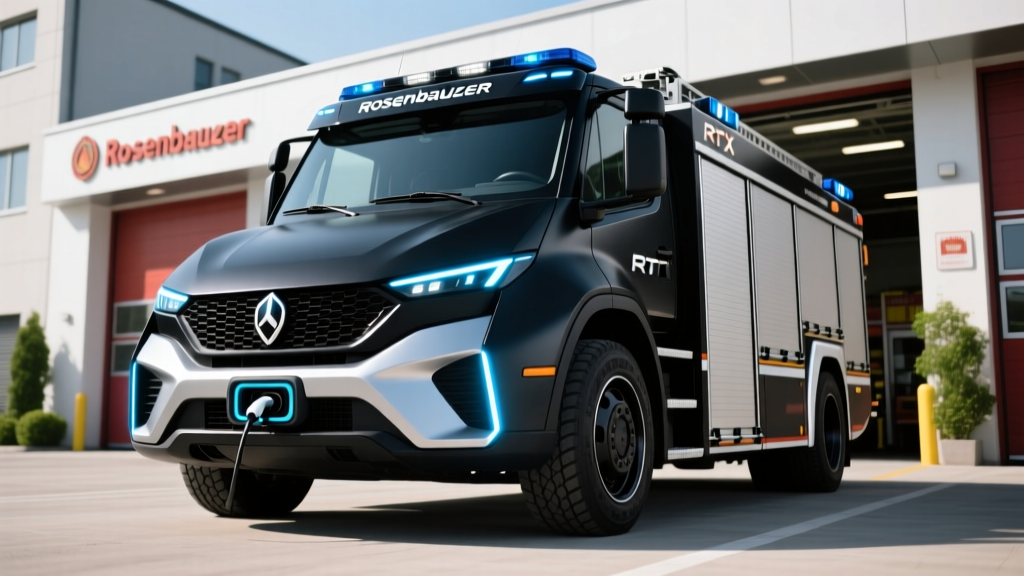
Quick Answer: What Is the Rosenbauer RTX Electric Fire Truck?
The Rosenbauer RTX is a fully electric fire apparatus built on a custom Rosenbauer chassis with an integrated battery-electric drivetrain and an onboard range extender (a compact diesel generator) for emergency scenarios that exceed battery capacity. Introduced to North American fleets beginning in 2024 and entering broader production through 2025–2026, the RTX targets urban and suburban departments that want zero tailpipe emissions at the station, reduced noise in residential areas, and lower daily operating costs — while retaining a diesel backup for extended mutual-aid responses or prolonged fireground operations.
Base price for an RTX pumper configuration sits in the $1.2–$1.5 million range depending on pump capacity, tank size, and aerial options — roughly 1.8× to 2.2× the cost of a comparable diesel pumper. Departments typically recover the premium over 8–12 years through fuel savings, reduced maintenance, and available EPA Clean Heavy-Duty Vehicle Program grants and state electrification incentives.
RTX Drivetrain, Battery, and Real-World Range
The RTX uses a purpose-built electric chassis rather than a retrofit of an existing diesel platform. This matters because fire apparatus carry extreme loads — a fully loaded Type 1 pumper can exceed 40,000 lbs GVWR — and regenerative braking on a heavy vehicle recovers meaningful energy during the stop-and-go driving that defines urban response routes.
| Specification | Value |
|---|---|
| Battery Capacity (usable) | ~210 kWh (NMC lithium-ion) |
| Electric-Only Range (urban response cycle) | ~60–75 miles (est., varies by pump use and load) |
| Range Extender (diesel generator) | Compact diesel genset; adds ~100+ miles equivalent range |
| Peak DC Fast Charge Rate | ~150 kW (CCS2 connector) |
| 10–80% DC Charge Time | ~60–75 minutes (est.) |
| Level 2 AC Charging | ~22 kW onboard charger |
| Drivetrain | Dual electric motors, AWD; ~680 hp combined |
| 0–30 mph (loaded) | ~8–10 seconds (est.) |
| GVWR | Up to ~44,000 lbs (configuration dependent) |
| Pump Capacity | Up to 1,500 GPM (configuration dependent) |
| Water Tank | 500–750 gallons (configuration dependent) |
| Estimated Base Price | $1.2–$1.5 million (pumper configuration) |
Real-World Range Reality Check
Unlike passenger EVs, fire apparatus range isn't measured by the EPA. The RTX's ~60–75 mile electric-only range reflects a typical urban response cycle: station departure, 3–8 mile response, on-scene idle with electronics, and return. Most urban departments drive 15–30 miles per shift, meaning the battery covers an entire shift with margin. However, the onboard pump draws significant power — running at full capacity can deplete the traction battery in under 2 hours without the range extender. For structural fires requiring prolonged pump operations, the diesel genset is essential and is the reason Rosenbauer includes it as standard equipment.
RTX vs. Diesel Pumper: Cost and Ownership Comparison
The upfront premium of an electric fire truck is substantial, but fleet total cost of ownership (TCO) tells a different story over a 15–20 year apparatus lifespan. Below is a side-by-side comparison based on typical municipal fleet data and manufacturer estimates.
| Cost Category | Rosenbauer RTX (Electric + Range Extender) | Conventional Diesel Pumper |
|---|---|---|
| Purchase Price | $1,350,000 (est. mid-config) | $700,000 (est. mid-config) |
| Fuel / Energy (15 years, ~3,000 mi/yr) | ~$45,000 (electricity) + ~$15,000 (diesel for genset) | ~$135,000 (diesel at $3.80/gal, ~5 mpg avg) |
| Maintenance (15 years) | ~$60,000 (no engine oil, filters, DEF, fewer brake jobs via regen) | ~$150,000 (engine overhauls, transmission, exhaust aftertreatment, DEF, brake wear) |
| Battery Replacement Reserve | ~$80,000–$120,000 (if needed at year 12–15) | N/A |
| Federal / State Incentives | –$150,000 to –$350,000 (grants, not tax credits — see below) | $0 |
| Estimated 15-Year TCO | $1,100,000–$1,400,000 | $985,000–$1,050,000 |
Key takeaway: Without grants, the diesel pumper still wins on pure TCO over 15 years. But with EPA Clean Heavy-Duty Vehicle Program funding, state air-quality grants (California's ZEV incentives, for example), or FEMA Assistance to Firefighters Grants, the RTX can reach cost parity or come out ahead — while delivering operational benefits diesel cannot match.
Charging Infrastructure: What a Fire Station Needs
Charging a 210 kWh battery at a fire station is not a plug-and-play proposition. Most stations will require significant electrical upgrades.
Station Charging Requirements
- Level 2 (overnight): A 22 kW Level 2 charger (the RTX's onboard AC rate) adds roughly 50–60 miles of range over a 10-hour shift change. For departments driving under 30 miles per shift, this is sufficient for daily top-up.
- DC Fast Charging (in-station): A 150 kW DC fast charger can replenish the RTX from 20–80% in roughly 60 minutes. This is useful for departments with high call volumes or back-to-back responses.
- Electrical panel upgrade: Most older fire stations have 200A or 400A service. A single 150 kW DC charger requires roughly 200A of dedicated 480V three-phase service. Stations planning for multiple electric apparatus should budget for a utility service upgrade — costs range from $50,000 to $200,000+ depending on transformer proximity and trenching distance.
| Item | Level 2 (22 kW) | DC Fast Charger (150 kW) |
|---|---|---|
| Equipment | $3,000–$7,000 | $60,000–$120,000 |
| Electrical Work (conduit, wiring, panel) | $5,000–$15,000 | $30,000–$80,000 |
| Utility Service Upgrade (if needed) | $0–$20,000 | $50,000–$150,000 |
| Permits & Engineering | $2,000–$5,000 | $10,000–$25,000 |
| Total Estimated Range | $10,000–$47,000 | $150,000–$375,000 |
Departments should engage a licensed electrical contractor and their utility early in the procurement process. Lead times for utility transformer upgrades can exceed 12 months in some regions.
Grants, Incentives, and Why the §30D Tax Credit Doesn't Apply
A common misconception is that the federal §30D Clean Vehicle Credit (up to $7,500 for light-duty EVs) applies to fire trucks. It does not. The §30D credit is limited to vehicles under 14,000 lbs GVWR purchased by individuals. Fire apparatus exceed this weight threshold and are typically purchased by municipalities or fire districts, not individual taxpayers.
Instead, fleet buyers should target these funding sources:
- EPA Clean Heavy-Duty Vehicles Program: Funded by the Inflation Reduction Act, this program provides grants for Class 6–8 zero-emission vehicles, including fire apparatus. Awards can cover $150,000–$450,000+ per vehicle depending on the funding cycle and applicant priority status.
- State ZEV Incentives: California (HVIP), New York (Truck Voucher Incentive), Colorado, and others offer point-of-sale vouchers for heavy-duty electric vehicles.
- FEMA AFG / SAFER Grants: The Assistance to Firefighters Grant program has begun accepting applications that include electric apparatus, though competition is intense.
- Utility Make-Ready Programs: Many investor-owned utilities cover the infrastructure cost (wiring, panel upgrades, charger installation) for commercial fleet electrification — sometimes covering 100% of make-ready costs.
Always confirm current-year program availability and eligibility with your state energy office and the IRS clean vehicle credit pages for any tax-related questions.
Common Misconceptions About Electric Fire Trucks
| Myth | Fact |
|---|---|
| "An electric fire truck will run out of battery at a fire scene." | The RTX includes a diesel range extender specifically for prolonged pump operations. The battery handles response and initial operations; the genset sustains extended fireground work. |
| "Electric fire trucks can't pump water as effectively." | The RTX's electric pump system delivers up to 1,500 GPM — matching NFPA 1901 standards for Type 1 pumpers. Electric motors provide instant torque, which can actually improve pump responsiveness. |
| "Batteries won't last in cold climates." | NMC batteries with active thermal management retain ~80–85% of rated capacity at 20°F. The RTX's battery enclosure includes heating systems. Range reduction is real (~15–20% in deep cold) but the range extender compensates. |
| "Charging takes too long for emergency services." | Most fire apparatus return to station and sit for hours between calls. Overnight Level 2 charging covers typical daily use. DC fast charging is available for high-tempo scenarios. |
| "The battery will need replacing every 5 years." | Heavy-duty NMC packs are engineered for 3,000+ full charge cycles before reaching 80% State of Health. At 3,000 miles/year and ~50 miles/charge cycle, that's over 20 years of service before significant degradation. |
Who Should Consider the RTX — Decision Framework
Is the Rosenbauer RTX Right for Your Department?
Choose the RTX if:
- Your department operates in an urban or suburban area with average daily mileage under 40 miles
- Your station has access to three-phase power or your utility will support a service upgrade
- Your jurisdiction has air-quality mandates, sustainability goals, or access to state/federal ZEV grants
- You want reduced station noise and zero indoor diesel exhaust (a documented health hazard for firefighters)
- You can absorb a 12–18 month procurement and infrastructure lead time
Stick with diesel (or wait) if:
- Your department covers a large rural district with responses exceeding 30 miles one-way
- Your station's electrical service cannot support charging and an upgrade is cost-prohibitive
- Your budget cannot accommodate the upfront premium even with available grants
- You need immediate delivery — RTX production slots are limited and lead times run 12–18+ months
- Your mutual-aid agreements require extended off-station operations without reliable charging access
Real-World Ownership: What First-Time Fleet EV Buyers Should Know
Transitioning a fire fleet to electric involves operational changes beyond the vehicle itself:
Training and SOPs
Firefighters need training on high-voltage safety (the RTX's battery operates at ~800V nominal), emergency disconnect procedures, and charging protocols. Rosenbauer provides operator training, but departments should integrate HV safety into their regular drill schedule. NFPA 1901 and NFPA standards continue to evolve around electric apparatus safety requirements.
Maintenance Shift
Electric apparatus eliminate diesel-specific maintenance — no oil changes, no diesel particulate filter (DPF) regeneration, no diesel exhaust fluid (DEF), no transmission fluid, no exhaust system repairs. However, departments should budget for:
- Battery thermal management system service (coolant checks, pump replacement)
- High-voltage cable inspection
- Specialized diagnostic tool subscriptions
- Range extender (diesel genset) maintenance — this still requires oil, filter, and fuel system service
Insurance and Liability
Commercial fleet insurance for electric fire apparatus is still developing. Some carriers add a 5–15% premium due to battery replacement cost exposure and limited claims data. Departments should get quotes early and ensure their coverage includes battery damage from water immersion (a realistic scenario for flood response).
Cold-Weather Operations
Departments in northern climates should plan for 15–25% electric range reduction in sub-freezing temperatures. Battery preconditioning (warming the pack before departure) mitigates this but draws energy. The range extender eliminates cold-weather range anxiety for extended responses, but daily electric-only range may drop from 70 miles to ~55 miles in deep winter.
Frequently Asked Questions
How long does it take to fully charge the Rosenbauer RTX?
From near-empty to full, Level 2 charging at 22 kW takes roughly 9–10 hours. DC fast charging at 150 kW reaches 80% in approximately 60–75 minutes, with the final 20% tapering significantly to protect battery health. Most departments charge overnight at Level 2 and use DC fast charging only when needed for same-day turnaround.
What happens if the battery is depleted during an emergency?
The RTX's diesel range extender automatically activates when battery State of Charge drops below a programmed threshold. The genset provides continuous power for propulsion and pump operations, effectively converting the RTX to a series-hybrid configuration. This is by design — the range extender exists precisely for scenarios where battery capacity is insufficient.
Can the RTX operate as a purely electric vehicle without the range extender?
Yes, for responses within its electric-only range. Many departments will operate in EV-only mode for the majority of calls — EMS responses, investigations, and short-duration incidents — engaging the range extender only for extended structural fire operations or long-distance mutual aid.
What is the battery warranty on the RTX?
Rosenbauer typically offers a battery warranty covering 8 years or a defined cycle count, guaranteeing a minimum State of Health (SoH) threshold — usually 70–80% capacity retention. Exact terms vary by contract and should be negotiated during procurement. Departments should request explicit SoH guarantees in writing.
Does the RTX qualify for any federal tax credits?
No. The §30D Clean Vehicle Credit applies only to light-duty vehicles under 14,000 lbs GVWR purchased by individual taxpayers. The RTX exceeds this weight and is purchased by government entities. However, grant programs (EPA Clean Heavy-Duty, state ZEV vouchers, FEMA AFG) can offset $150,000–$450,000+ of the purchase price. Consult your state energy office for current program availability.
How does the RTX compare to other electric fire trucks?
The RTX competes with the Pierce Volterra (a battery-electric pumper with range extender from Oshkosh/Pierce Manufacturing) and the REV Fire Group E-One electric pumper. The Pierce Volterra uses a similar series-hybrid approach with a ~170 kWh battery and comparable range extender. Pricing is competitive within the $1.1–$1.6M range. The key differentiator is the Rosenbauer chassis — purpose-built for electric rather than adapted from a diesel platform — which allows a lower center of gravity and optimized weight distribution.
Sources: EPA Clean Heavy-Duty Vehicles Program, IRS Clean Vehicle Credits, NFPA Standards. Specifications based on manufacturer-published data and fleet procurement documents. Confirm exact specs, pricing, and incentive availability with Rosenbauer and your state energy office before procurement.