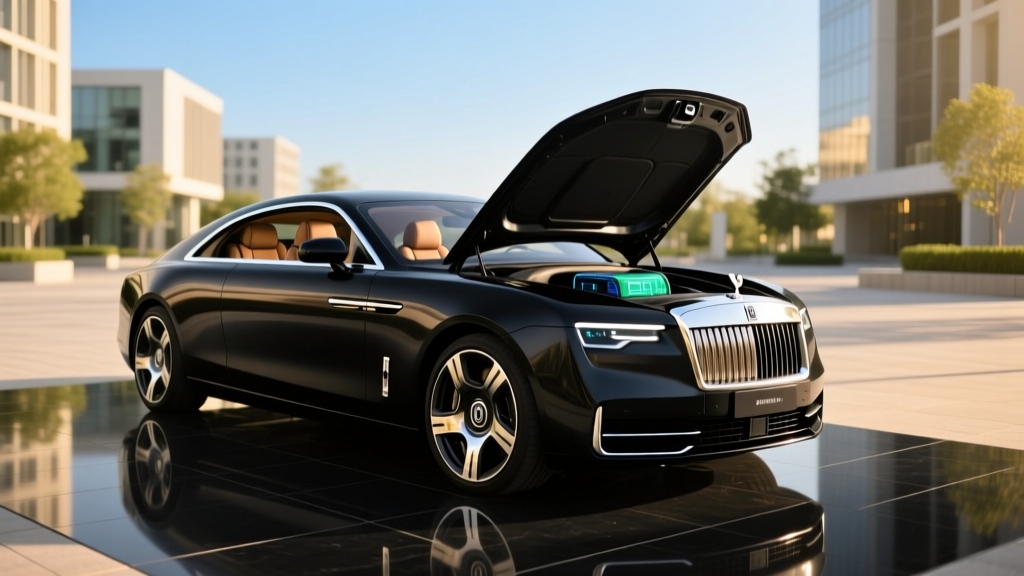
Quick Answer: The 2025 Rolls-Royce Spectre is the brand's first all-electric vehicle — a luxury coupe with an EPA-estimated 264 miles of range, a 102 kWh (usable) battery, 577 horsepower, and a starting MSRP of $422,750. It charges at up to 195 kW on DC fast chargers (10–80% in roughly 34 minutes). It does not qualify for the §30D federal tax credit due to its MSRP exceeding the $55,000 sedan/$80,000 SUV cap. Real-world highway range is closer to 210–230 miles, and cold weather will reduce that further.
The Spectre's Real-World Range and Efficiency
The 2025 Rolls-Royce Spectre uses a 102 kWh usable lithium-ion (NMC chemistry) battery pack paired with a dual-motor all-wheel-drive powertrain producing 577 hp and 664 lb-ft of torque. The EPA rates it at 264 miles of combined range with an efficiency of 77 MPGe (43 kWh/100 mi).
Those numbers tell only part of the story. In real-world highway driving at 70–75 mph, expect approximately 210–230 miles before needing to charge. The Spectre's massive 6,559-lb curb weight and wide frontal area work against highway efficiency. In cold weather (below 32°F), range drops an additional 15–25%, potentially bringing effective range to 170–195 miles on the highway in winter conditions.
EPA Range: 264 miles (combined)
Real-World Highway (70 mph): ~210–230 miles
Cold-Weather Highway Estimate: ~170–195 miles
Efficiency: 77 MPGe / 43 kWh/100 mi (EPA combined)
The Spectre does include a heat pump for cabin and battery thermal management, which helps mitigate cold-weather losses compared to resistance-heater EVs. Preconditioning the battery before arriving at a DC fast charger is essential — without it, peak charge rates drop substantially in cool weather.
Charging Speed, Connectors, and Infrastructure
The Spectre supports up to 195 kW peak on DC fast charging via a CCS1 connector. On a 350 kW charger (such as Electrify America's latest stalls), the 10–80% charge takes approximately 34 minutes. However, as with all EVs, peak rate is not sustained rate — the charge curve tapers notably above 60% state of charge, and the final 10% (80–90%) can take as long as the first 40%.
| Level | Power (kW) | Connector | Miles Added/Hour | Time Estimate |
|---|---|---|---|---|
| Level 1 (120V) | ~1.4 kW | J1772 | ~2 mi/hr | Not practical for full charge |
| Level 2 (240V, 48A) | ~11.5 kW | J1772 | ~17 mi/hr | ~15 hours (10–100%) |
| DC Fast Charge | 195 kW peak | CCS1 | ~130 mi/hr (peak) | 10–80% in ~34 min |
For Level 2 home charging, the Spectre's onboard charger accepts up to 11.5 kW (single-phase, 48 amps). A full overnight charge from near-empty takes roughly 15 hours, but most owners will arrive home with 50–70% remaining and wake to a full battery. A dedicated 60-amp circuit with a hardwired Level 2 charger (such as a ChargePoint Home Flex or Tesla Universal Wall Connector with J1772 adapter) is recommended. Installation typically runs $800–$2,500 depending on panel proximity and whether a service upgrade is needed.
One note for prospective owners: Rolls-Royce does not include NACS (Tesla Supercharger) compatibility on the 2025 Spectre. A CCS-to-NACS adapter from Ford or third-party suppliers enables Supercharger access, but confirm adapter compatibility and rated power before purchasing.
Performance and Driving Dynamics
The Spectre's dual-motor AWD system delivers 577 horsepower and 664 lb-ft of torque, achieving a 0–60 mph time of 4.4 seconds — per Rolls-Royce's official specifications. That's brisk for a vehicle weighing over three tons, though the emphasis is unmistakably on silent, effortless acceleration rather than sportscar dynamics.
Regenerative braking offers adjustable levels, but the Spectre does not provide true one-pedal driving with a complete stop. Drivers accustomed to aggressive regen in a Tesla or Hyundai Ioniq 5 will notice the Spectre's more traditional luxury calibration — it prioritizes smoothness over aggressive deceleration.
The air suspension and four-wheel steering are tuned for ride isolation. At highway speeds, cabin noise is remarkably low, aided by the absence of engine vibration and extensive sound deadening. This is a grand tourer, not a track car, and the driving experience reflects that philosophy.
Spectre vs. Gas Rolls-Royce: Cost and Ownership Comparison
How does Spectre ownership compare to a gas-powered Rolls-Royce, such as the Wraith (now discontinued but representative of the brand's V12 coupe lineage)? The comparison below uses the Wraith's approximate specifications as a baseline.
| Category | 2025 Spectre (EV) | Gas V12 Coupe (Baseline) |
|---|---|---|
| Purchase Price (base MSRP) | $422,750 | ~$350,000 (est. Wraith) |
| Federal Tax Credit (§30D) | $0 (exceeds MSRP cap) | $0 |
| Fuel/Energy (15,000 mi/yr × 5 yrs) | ~$6,450 (at $0.15/kWh home) | ~$22,500 (at 14 MPG, $4.20/gal) |
| Maintenance (5 yrs) | ~$2,500 (tire rotations, cabin filters, fluid top-offs) | ~$8,000 (oil, spark plugs, belts, brakes) |
| Insurance (est. annual avg) | ~$7,200/yr | ~$6,500/yr |
| 5-Year Total (purchase + fuel + maint + insurance) | ~$468,900 | ~$419,500 |
The Spectre's higher purchase price offsets the substantial fuel and maintenance savings over five years. Energy costs are roughly one-third of gasoline costs for the same mileage, and brake wear is minimal thanks to regenerative braking. However, insurance premiums for the Spectre run higher due to repair costs, parts pricing, and the vehicle's value. At this price point, total cost of ownership is secondary to the experience — buyers in this segment are not typically cross-shopping based on fuel economy.
Tax Credits, Incentives, and the MSRP Cap Reality
The 2025 Spectre does not qualify for the §30D federal EV tax credit. Under current IRS rules, the credit is capped at $7,500 and subject to an MSRP limit of $55,000 for sedans and $80,000 for SUVs/vans/pickups. At $422,750, the Spectre far exceeds either threshold.
Additionally, buyer income caps apply (§30D phases out at $300,000 modified AGI for joint filers, $150,000 for single filers), and battery component/critical mineral sourcing requirements must be met. Even if the Spectre were under the MSRP cap, its battery supply chain would need to satisfy the 2025/2026 sourcing percentages to qualify for the full $7,500.
Some states offer additional EV incentives that are not MSRP-capped. California's Clean Fuel Reward was discontinued in 2023, but certain utility companies offer rebates for home charger installation (typically $250–$1,000). Check with your local utility and state energy office for current programs.
Common Misconceptions About the Spectre
| Myth | Fact |
|---|---|
| "It charges at 350 kW because it uses a 350 kW station." | The Spectre peaks at 195 kW. Station capacity above that doesn't speed up charging. |
| "264 miles of range means I can drive 264 miles on the highway." | EPA is a combined cycle. Sustained highway driving yields ~210–230 miles. Cold weather reduces further. |
| "Electric means no maintenance." | Tires, cabin air filters, brake fluid, coolant, and wiper blades still need service. The Spectre's weight also increases tire wear. |
| "It qualifies for the $7,500 federal tax credit." | The §30D credit has an MSRP cap of $55K (sedans) or $80K (SUVs). The Spectre's $422,750 base price disqualifies it. |
| "Home charging is automatic." | Level 2 home charging requires a 240V/60A circuit. Older homes may need a $1,500–$4,000 electrical panel upgrade. |
Decision Framework: Is the Spectre the Right EV for You?
Choose the Spectre if:
- You have reliable home Level 2 charging (or can install it)
- Your daily driving is under 150 miles and road trips are occasional
- You prioritize silent, effortless luxury over outright performance metrics
- You want a statement vehicle with zero tailpipe emissions and are indifferent to tax credit eligibility
- You value the lowest cabin noise floor in any production automobile
Look elsewhere if:
- You live in an apartment or lack access to home or workplace charging — public-only charging at this price point is a poor experience
- You regularly drive 300+ miles in a single day — the 195 kW charge rate and 210-mile real-world highway range mean multiple 35-minute stops
- You want cutting-edge autonomous driving — the Spectre's ADAS is competent but not class-leading (Level 2 driver assist only; you must remain engaged)
- You're cross-shopping on value — a BMW i7 xDrive50 offers 318 miles of range at $120,000, or a Lucid Air Grand Touring delivers 516 miles at $138,000
Battery Warranty, Degradation, and Long-Term Ownership
Rolls-Royce provides an 8-year/100,000-mile high-voltage battery warranty, covering defects and capacity loss below 70% of original capacity — consistent with industry norms and aligned with DOE guidance on EV battery warranties. Given the Spectre's NMC chemistry and sophisticated thermal management system, degradation should be moderate under normal use. Expect approximately 8–12% capacity loss over 8 years with typical charging habits (avoiding routine 100% charges and frequent DC fast charging in extreme heat).
Battery replacement cost is not published by Rolls-Royce, but based on comparable luxury EV platforms, a full pack replacement out of warranty would likely exceed $30,000. In practice, catastrophic battery failure within the warranty period is rare; the more relevant concern is gradual range reduction over 10–15 years.
Frequently Asked Questions
Can I charge the Rolls-Royce Spectre at a Tesla Supercharger?
Not natively. The 2025 Spectre uses a CCS1 connector. However, you can use a CCS-to-NACS adapter to access Tesla's Supercharger network (V3 stalls at 150 kW or V4 at 250 kW). Confirm adapter power ratings before purchasing — some are rated only to 50 kW.
How much does it cost to charge the Spectre at home?
At the U.S. average residential rate of ~$0.16/kWh, a full 102 kWh charge costs roughly $16.32 and provides approximately 210–264 real-world miles. That's about $0.06–$0.08 per mile, compared to ~$0.30 per mile for a gas V12 Rolls-Royce at $4.20/gallon and 14 MPG combined.
Does the Spectre have self-driving capability?
No. The Spectre's driver-assistance features are SAE Level 2, meaning the car can manage steering and speed under certain conditions, but the driver must remain fully attentive with hands on or near the wheel. This is the same automation level as Tesla Autopilot, GM Super Cruise, and Ford BlueCruise. It is not autonomous driving.
What happens if I run out of charge on the road?
The Spectre's navigation system routes through available chargers and provides real-time range estimates. If you do deplete the battery, Rolls-Royce's roadside assistance includes flatbed towing to the nearest charger. Never rely on a tow with wheels on the ground — this can damage the electric motors.
Is the Spectre eligible for HOV lane access?
In most states, yes. As a zero-emission vehicle, the Spectre qualifies for clean-air decals in California (until the program sunsets), and similar HOV exemptions in states like Virginia, Maryland, and Colorado. Check your state's DMV for current eligibility and decal availability.