Where Are Rivians Made? Inside the Normal, Illinois Plant
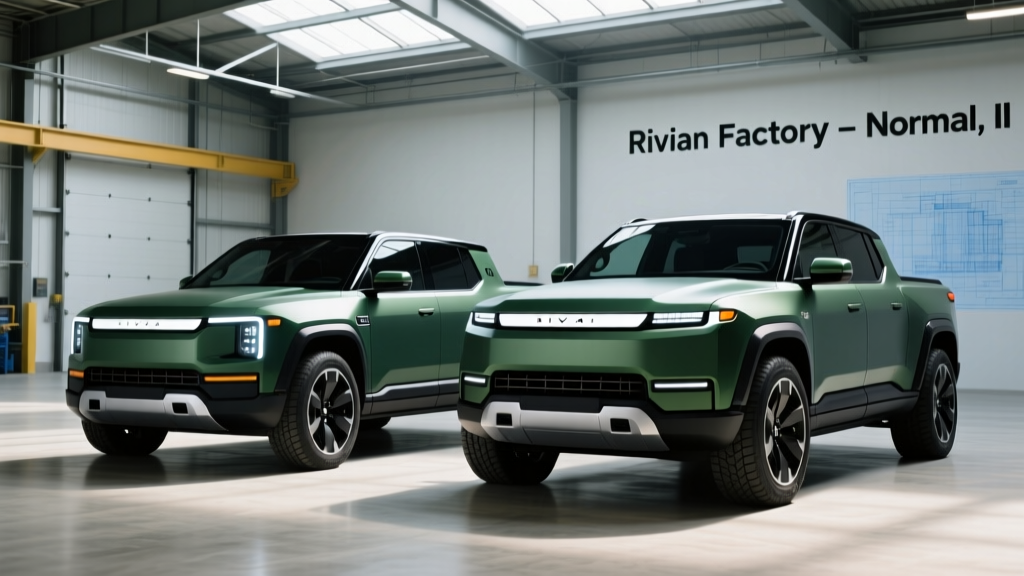
Every Rivian R1T pickup and R1S SUV rolls off the assembly line in Normal, Illinois — the same town that gives Rivian its "Rivian" name (a nod to the company's early connection to the region). The facility, formerly a Mitsubishi Diamond-Star Motors plant, spans roughly 3.3 million square feet and has been retooled into one of the most vertically integrated EV factories in North America. Rivian handles stamping, body-in-white, paint, battery pack assembly, and final vehicle assembly under one roof.
As of early 2026, the Normal plant is also preparing to build the smaller, more affordable R2 platform (R2 SUV and R3 compact), which will share the factory footprint before production expands to Rivian's planned second plant in Stanton, Georgia. Every R1T and R1S you see on U.S. roads was built in Illinois by a union-adjacent workforce — a detail that matters to buyers who prioritize domestic manufacturing and labor standards.
2026 Rivian R1T & R1S: Core Specs at a Glance
| Spec | R1T (Tri Motor AWD) | R1S (Dual Motor AWD) |
|---|---|---|
| EPA Range | ~420 mi (Max Pack) | ~352 mi (Large Pack) |
| Battery (usable) | ~141 kWh (NMC, Max Pack) | ~109 kWh (NMC, Large Pack) |
| Chemistry | NMC (nickel manganese cobalt) | NMC |
| Peak DC Fast Charge | 220 kW | 220 kW |
| 10–80% DCFC Time | ~42 min | ~34 min |
| Level 2 Home Charge | 11.5 kW (~25 mi/hr) | 11.5 kW (~25 mi/hr) |
| 0–60 mph | ~2.9 sec (Tri Motor) | ~4.5 sec (Dual Motor) |
| Horsepower | 850 hp | 533 hp |
| Drivetrain | Tri-Motor AWD | Dual-Motor AWD |
| Towing Capacity | 11,000 lb | 7,700 lb |
| MPGe (combined) | ~73 MPGe | ~76 MPGe |
| Efficiency | ~46 kWh/100 mi | ~44 kWh/100 mi |
| Battery Warranty | 8 yr / 175,000 mi | 8 yr / 175,000 mi |
| Base MSRP | $89,900 (Adventure Tri) | $75,900 (Adventure Dual) |
Source: Rivian specifications and fueleconomy.gov. Specs reflect 2026 model year configurations. Exact figures vary by wheel size and pack selection.
Real-World Range: What the EPA Sticker Doesn't Tell You
R1T Max Pack (EPA 420 mi): Expect ~330–350 mi on a 75°F highway trip at 70–75 mph. In sub-30°F winter conditions with cabin heat, plan for ~260–290 mi of usable range before needing a charge stop. The R1T's boxy aerodynamics and 6,000+ lb curb weight work against highway efficiency.
R1S Large Pack (EPA 352 mi): Real-world highway range lands around ~280–300 mi in mild weather, dropping to ~220–250 mi in deep cold. City and suburban driving with regenerative braking set to high can push close to or slightly above EPA estimates.
Rivian's heat pump (standard on 2025+ models) mitigates some cold-weather loss compared to earlier model years, but physics still governs: a heavy, aerodynamically blunt vehicle moving at highway speeds consumes more energy per mile. Towing a 5,000 lb trailer can cut range by 40–50%, bringing a Max Pack R1T down to roughly 200–220 mi between charges — a critical consideration for anyone buying the R1T as a tow rig.
Charging Speed: DC Fast Charging and Home Setup
Rivian uses the NACS (North American Charging Standard) connector on all 2025+ models, giving R1T and R1S owners native access to the Tesla Supercharger network without an adapter. Earlier CCS-equipped Rivians can use a NACS adapter, which Rivian has offered as a retrofit.
| Charging Level | Power | Miles Added per Hour | Notes |
|---|---|---|---|
| Level 1 (120V outlet) | ~1.4 kW | ~3 mi/hr | Emergency/trickle only |
| Level 2 (240V, home) | 11.5 kW (48A) | ~25 mi/hr | Full overnight recharge in 10–14 hr |
| DC Fast Charge | Peak 220 kW | ~140 mi in 15 min (10–30%) | Tapers significantly above 80% SoC |
Charging curve reality: Rivian's 220 kW peak rate holds roughly between 10–40% state of charge, then progressively tapers. The 10–80% time of ~34–42 minutes reflects this taper — you won't sustain 220 kW for the full session. Above 80%, charging slows dramatically to protect the NMC cells, so plan road-trip stops around 10–80% rather than filling to 100%.
Home charging setup: A 48-amp Level 2 charger on a 60-amp dedicated circuit will replenish an R1S Large Pack from empty in about 10 hours. Installation costs typically run $800–$2,500 depending on panel proximity and whether your electrical panel needs an upgrade to 200A service. Rivian sells a branded Wall Connector (made by a third-party partner), but any quality J1772/NACS Level 2 unit from ChargePoint, Emporia, or Grizzl-E will work.
Pricing, Trims & Federal Tax Credit Eligibility
Rivian's lineup breaks into two body styles (R1T truck, R1S SUV), each offered in Dual Motor, Performance Dual Motor, and Tri Motor configurations, with Standard, Large, and Max battery packs (availability varies by trim).
| Configuration | Base MSRP | Federal Credit (§30D) | Effective Price |
|---|---|---|---|
| R1S Dual Motor Adventure (Large Pack) | $75,900 | Up to $7,500* | ~$68,400 |
| R1T Dual Motor Adventure (Large Pack) | $69,900 | Up to $7,500* | ~$62,400 |
| R1T Tri Motor Adventure (Max Pack) | $99,900 | Up to $7,500* | ~$92,400 |
| R1S Tri Motor Ascend (Max Pack) | $109,900 | Up to $7,500* | ~$102,400 |
*Federal tax credit caveats (IRS §30D, 2026 rules):
- MSRP cap: Trucks (R1T) qualify up to $80,000 MSRP. SUVs (R1S) qualify up to $80,000 MSRP. Many Tri Motor and Ascend trims exceed this cap and are ineligible.
- Buyer income cap: Modified AGI must not exceed $150,000 (single), $225,000 (head of household), or $300,000 (joint filing).
- Battery sourcing: A percentage of critical minerals and battery components must meet North American sourcing thresholds, which tighten annually. Rivian has worked to qualify its packs, but eligibility can shift — always verify the specific VIN on the DOE/EPA tax credit lookup tool before purchasing.
- Point-of-sale transfer: You can elect to transfer the credit to the dealer at purchase, reducing your out-of-pocket cost immediately rather than waiting for tax filing.
Because many R1 configurations push past the $80,000 MSRP cap — especially with Max Pack upgrades, premium paint, and destination fees — the Dual Motor Large Pack trims are the sweet spot for federal credit eligibility. Consult a tax professional and confirm your specific build on the IRS-approved list before committing.
Performance, Cargo Space & Livability
The R1T Tri Motor's 2.9-second 0–60 time makes it one of the quickest pickups ever built, regardless of powertrain. The Dual Motor variants still hit 60 mph in under 5 seconds — more than adequate for merging and passing. All configurations feature Rivian's quad-motor-ready architecture, adaptive air suspension (3.5 inches of travel), and a wading depth of over 3 feet.
R1T cargo: The 4.5-foot bed holds ~36 cu ft, supplemented by an 11 cu ft front trunk (frunk) and a lockable Gear Tunnel (available on select configs) that runs the width of the vehicle behind the rear seats — an 11.7 cu ft pass-through ideal for skis, camping gear, or groceries. Rear-seat legroom is 38.4 inches, adequate for adults on longer trips.
R1S cargo: With all three rows in use, cargo space behind the third row is limited (~10 cu ft). Fold the third row and you get ~46 cu ft; fold both rear rows for ~97 cu ft. The R1S offers 38.2 inches of second-row legroom and a usable third row for children or short-trip adults. The R1S frunk adds ~11 cu ft.
Standout tech:
- 15.6-inch center touchscreen running Rivian's in-house software, with over-the-air updates
- Rivian's Driver+ suite (SAE Level 2) includes adaptive cruise, lane centering, and automatic lane change on mapped highways — but requires hands-on supervision at all times
- Embedded navigation with real-time charger routing and battery preconditioning
- Camp Kitchen accessory (slide-out induction cooktop system for the Gear Tunnel)
- Vehicle-to-load (V2L) capability via bed and frunk outlets, powering up to ~2.4 kW of external devices
Notable drawbacks:
- No Apple CarPlay or Android Auto — Rivian uses its own infotainment ecosystem exclusively
- Service center density still lags legacy automakers; mobile service covers many metro areas but rural owners may face longer wait times
- Towing significantly impacts range — plan for 200 mi or less with a heavy trailer
- Premium pricing: even the base Dual Motor R1T starts near $70,000 before options
Pros & Cons: The Honest Summary
- Class-leading combination of off-road capability, on-road performance, and utility
- Gear Tunnel is a genuinely unique and practical storage solution
- NACS connector = native Supercharger access (2025+ models)
- 8-year/175,000-mile battery warranty exceeds the industry-standard 100,000 miles
- Built in the USA (Normal, IL) with strong domestic content
- Over-the-air updates continue to add features post-purchase
- Most trims exceed the $80,000 MSRP cap, disqualifying them from the $7,500 federal credit
- Real-world highway and cold-weather range falls meaningfully below EPA estimates
- No phone mirroring (CarPlay/Android Auto)
- Towing range is poor relative to diesel trucks — a 5,000 lb trailer cuts range nearly in half
- 220 kW peak DCFC is slower than Hyundai/Kia's 800V platforms (~240+ kW, 10–80% in 18 min)
- Service infrastructure still growing
Who Should Buy a Rivian — And Who Shouldn't?
Buy the R1T if: You need a daily-drivable pickup with genuine off-road chops, you value the Gear Tunnel and frunk for adventure gear, and your typical trips fall within 250–300 miles (or you're willing to plan DC fast-charge stops). It's an excellent fit for outdoor enthusiasts, suburban homeowners who tow occasionally, and anyone who wants a truck that doesn't drive like a truck.
Buy the R1S if: You need three rows and want an EV SUV that can handle backcountry roads, ski trips, and family hauling without the bulk and body-on-frame feel of a traditional large SUV. The R1S competes directly with the Tesla Model X, BMW iX (two-row), and extended-range Jeep Wagoneer S.
Look elsewhere if: You regularly tow more than 6,000 lbs over long distances (a diesel remains more practical), you need the fastest possible DC charging (Hyundai Ioniq 5 or Kia EV9 on 800V architecture charge faster), or your budget tops out below $60,000 (consider the Ford F-150 Lightning or a used Rivian).
Frequently Asked Questions
Where exactly are Rivian vehicles manufactured?
All Rivian R1T and R1S vehicles are built at the company's factory in Normal, Illinois. The upcoming R2 and R3 will initially share this facility before production expands to a second plant in Stanton, Georgia (expected late 2020s).
Does the Rivian R1T qualify for the $7,500 federal EV tax credit?
It depends on the trim. The §30D credit caps eligible trucks at $80,000 MSRP. The Dual Motor Adventure (Large Pack) at $69,900 qualifies — assuming you meet income limits and the battery sourcing requirements are satisfied for that build. Tri Motor and Max Pack configurations that push past $80,000 MSRP do not qualify. Always verify your specific configuration on fueleconomy.gov.
What is the real-world range of the Rivian R1S?
The R1S Dual Motor Large Pack carries an EPA rating of ~352 miles. In real-world highway driving at 70–75 mph in mild temperatures, expect roughly 280–300 miles. In sub-freezing winter conditions, plan for 220–250 miles before needing to charge.
How fast does a Rivian charge at home?
On a 240V Level 2 charger at 11.5 kW (48 amps), a Rivian adds roughly 25 miles of range per hour. A full recharge of the Large Pack (109 kWh usable) takes about 10 hours from near-empty — easily achievable overnight. A standard 120V outlet adds only ~3 miles per hour and is impractical for regular use.
Is the Rivian R1T good for towing?
The R1T is rated to tow 11,000 lbs — impressive on paper. But towing a 5,000–7,000 lb trailer cuts real-world range by 40–50%, leaving you with roughly 180–220 miles (Max Pack) between charges. For short tows around town or to a nearby campsite, it's excellent. For long-distance heavy towing, a diesel truck remains more practical until DC fast-charging infrastructure for trailers improves.
How does Rivian's battery warranty compare?
Rivian provides an 8-year/175,000-mile battery and powertrain warranty, which exceeds the federal minimum of 8 years/100,000 miles that most competitors offer. The warranty covers battery capacity retention below a specified threshold (typically 70% of original capacity), though the exact retention guarantee varies — check your purchase agreement for specifics.
Does Rivian offer Apple CarPlay or Android Auto?
No. Rivian uses a proprietary infotainment system and does not support phone mirroring. The native system is well-designed with embedded navigation, OTA updates, and streaming apps, but if CarPlay is non-negotiable for you, this is a meaningful gap.