Quick Verdict: The Mustang Mach-E GT at a Glance
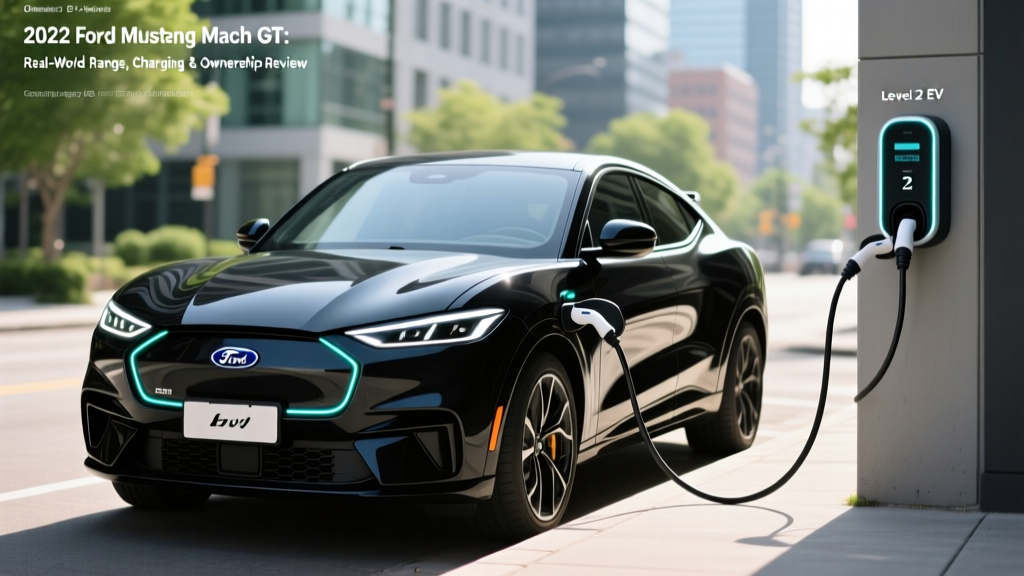
The 2022 Ford Mustang Mach-E GT remains one of the most compelling performance-oriented electric SUVs on the used market. With dual-motor all-wheel drive, up to 480 horsepower (with the Performance Edition), and a usable 91 kWh NMC battery, it threads the needle between daily-driver practicality and genuine sports-sedan acceleration. For buyers shopping the secondary market in 2026, the Mach-E GT offers a value proposition that newer rivals struggle to match — especially once you factor in depreciation and available used-EV tax credits.
This review covers the GT and GT Performance Edition trims exclusively. We'll break down real-world range versus EPA estimates, charging behavior on DC fast chargers and at home, total ownership costs, and how the Mach-E GT stacks up against the Tesla Model Y Performance and Hyundai Ioniq 5 N.
| Spec | GT | GT Performance Edition |
|---|---|---|
| EPA Range | 270 miles | 260 miles |
| Battery (Usable) | 91 kWh (NMC) | 91 kWh (NMC) |
| Horsepower | 480 hp | 480 hp |
| Torque | 600 lb-ft | 634 lb-ft |
| 0-60 mph | 3.8 seconds | 3.5 seconds |
| Drivetrain | AWD (Dual-Motor) | AWD (Dual-Motor) |
| Max DC Fast Charge | 150 kW | 150 kW |
| 10-80% DC Charge Time | ~45 minutes | ~45 minutes |
| Level 2 Home Charge Rate | 10.5 kW (32A) / ~30 mi/hr | 10.5 kW (32A) / ~30 mi/hr |
| EPA Efficiency | 84 MPGe (2.45 kWh/mi) | 81 MPGe (2.53 kWh/mi) |
| Cargo (Behind Rear Seats) | 29.7 cu ft | 29.7 cu ft |
| Frunk | 4.7 cu ft | 4.7 cu ft |
| Original Base MSRP | $61,995 | $67,995 |
| Battery/Powertrain Warranty | 8 yr / 100,000 mi | 8 yr / 100,000 mi |
Range and Efficiency: EPA vs. the Real World
The EPA rates the 2022 Mach-E GT at 270 miles of range, while the GT Performance Edition drops to 260 miles due to its stickier summer tires and more aggressive calibration. These figures come from the Extended Range battery pack, which stores 91 kWh of usable energy in an NMC (nickel manganese cobalt) lithium-ion configuration. Ford sourced cells from LG Energy Solution for this model year.
- Mild weather, mixed driving: 240–260 miles achievable with moderate regen and sensible highway speeds.
- Highway at 75+ mph: Expect 210–230 miles. The GT's dual-motor AWD and performance-tuned suspension create more rolling resistance and drag than efficiency-oriented EVs.
- Cold weather (below 32°F): Range can drop 25–35%, landing between 175–200 miles without preconditioning. The Mach-E GT uses a resistive heater (PTC), not a heat pump, which draws significantly more energy in winter.
- With preconditioning active: Cold-weather losses moderate to roughly 15–20% if you schedule departure times via the FordPass app.
The absence of a heat pump is the Mach-E GT's most consequential efficiency limitation. Competitors like the Hyundai Ioniq 5 and Tesla Model Y use heat pumps that recycle waste heat from the powertrain, reducing cabin-heating energy draw by up to 50%. If you live in a region with sustained sub-freezing winters, this matters — budget an extra charging stop on road trips or plan for more frequent Level 2 top-ups.
Efficiency on the EPA combined cycle comes in at 84 MPGe for the GT and 81 MPGe for the Performance Edition. In real-world mixed driving, owners typically report 2.4–2.7 kWh per mile, which translates to roughly 37–42 miles per 10 kWh of energy consumed. That's competitive for a 4,800-pound performance SUV but trails lighter, single-motor EVs by a wide margin.
Charging Speed: DC Fast Charging and Home Setup
The Mach-E GT supports a maximum DC fast-charge rate of 150 kW via its CCS1 connector. Ford quotes a 10-to-80% charge time of approximately 45 minutes on a capable 150 kW or higher station. Here's what that looks like in practice:
| Charging Level | Power / Rate | Time (10-80%) | Miles Added per Hour |
|---|---|---|---|
| Level 1 (120V household) | ~1.4 kW | N/A (days) | ~3–4 mi/hr |
| Level 2 (240V, 32A) | 10.5 kW | ~9 hours | ~30 mi/hr |
| Level 2 (240V, 48A w/ Ford Connected Charge Station) | 10.5 kW (vehicle-limited) | ~9 hours | ~30 mi/hr |
| DC Fast Charge (CCS1) | Peak 150 kW | ~45 minutes | ~185 mi/hr (at peak) |
A critical detail: the Mach-E GT's onboard charger caps Level 2 AC charging at 10.5 kW regardless of whether you use a 32-amp or 48-amp home charger. Ford's own Connected Charge Station (80A hardwired) costs more but won't charge the GT any faster than a quality 48A third-party unit like the ChargePoint Home Flex. Save your money on the EVSE and invest in a proper 240V/60A circuit instead.
On DC fast chargers, the 150 kW peak rate is just that — a peak. The actual charging curve tapers noticeably after 60% state of charge. From 10% to roughly 55%, you'll see sustained rates between 115–150 kW depending on battery temperature. Above 80%, the rate drops below 50 kW as the battery management system protects cell longevity. This is normal for NMC chemistry, but it means that last 10% (80-90%) can add 15–20 minutes to a charging session. Plan accordingly on road trips: charge to 80% and move on.
One advantage of the 2022 model year: Ford had begun enabling Tesla Supercharger (NACS) access via a CCS-to-NACS adapter for Mach-E owners by late 2023. As of 2026, used Mach-E GT buyers can access the Supercharger network using Ford-provided or third-party adapters, dramatically expanding fast-charging options on road trips. Check with your specific vehicle's FordPass account to confirm adapter eligibility.
Performance and Driving Dynamics
The GT's dual permanent-magnet synchronous motors produce a combined 480 horsepower in both trims, but the Performance Edition bumps torque from 600 to 634 lb-ft and adds a more aggressive drive calibration, MagneRide adaptive dampers, and Pirelli P Zero summer tires. The result is a 0-60 mph sprint of 3.5 seconds — territory occupied by the Porsche Taycan 4S and Tesla Model Y Performance.
Unleashing maximum acceleration requires activating Unbridled Extend drive mode (GT Performance Edition only), which adjusts throttle mapping, steering weight, and suspension firmness. In standard Unbridled mode, the GT hits 60 mph in approximately 3.8 seconds, which is still seriously quick.
Driving dynamics are where the Mach-E GT earns its Mustang badge more credibly than skeptics expected. The steering is direct and well-weighted, body control is tight for a 4,800-pound crossover, and the low center of gravity (courtesy of the under-floor battery pack) keeps things planted through corners. The Performance Edition's MagneRide dampers are particularly effective, absorbing sharp impacts while resisting body roll.
Regenerative braking offers a one-pedal driving mode that's among the best in the industry — smooth, predictable, and capable of bringing the GT to a complete stop without touching the friction brakes. You can also select a coasting mode that mimics a conventional automatic transmission for drivers transitioning from ICE vehicles.
Interior, Cargo, and Technology
The Mach-E GT's cabin blends Ford's mainstream material quality with a few premium touches: ActiveX synthetic leather upholstery, aluminum trim accents, and a standard panoramic fixed glass roof that floods the cabin with light. The 15.5-inch vertically oriented touchscreen dominates the center stack, running Ford's SYNC 4A infotainment system with wireless Apple CarPlay and Android Auto, over-the-air updates, and built-in navigation.
Passenger space is generous for a midsize crossover:
- Front headroom: 40.4 inches
- Front legroom: 43.3 inches
- Rear headroom: 38.9 inches
- Rear legroom: 38.1 inches
Cargo volume behind the rear seats measures 29.7 cubic feet, expanding to 59.7 cubic feet with the 60/40 split rear seats folded. The front trunk (frunk) adds 4.7 cubic feet with a drain plug — useful for storing wet gear or acting as a cooler on tailgate outings. These figures are competitive with the Tesla Model Y (30.2 cu ft rear) but trail the Hyundai Ioniq 5 (27.2 cu ft rear, though its hatch opening is wider).
The GT comes standard with Ford's Co-Pilot360 Active 2.0 suite, which includes adaptive cruise control with stop-and-go, lane-centering steering, evasive steering assist, and intersection assist. This is an SAE Level 2 driver-assistance system — the driver must keep hands on the wheel and eyes on the road at all times. Ford's BlueCruise hands-free highway driving was available as an option on 2022 models via a subscription, enabling hands-off driving on pre-mapped divided highways (over 130,000 miles of compatible roads as of 2026).
Pricing, Tax Credits, and Used-Market Value
When new, the 2022 Mach-E GT started at $61,995 (including destination), while the GT Performance Edition commanded $67,995. Popular options included the Protection Package ($2,495, including BlueCruise), upgraded B&O sound system, and premium paint colors. A fully loaded GT Performance Edition could approach $72,000 before incentives.
On the used market in 2026, the Mach-E GT has depreciated significantly from its original MSRP. Expect to find well-maintained examples with 25,000–45,000 miles in the $32,000–$42,000 range depending on trim, condition, and mileage. The GT Performance Edition commands a $3,000–$5,000 premium over the standard GT.
| Item | Amount |
|---|---|
| Used Market Price (GT, avg.) | $35,000–$40,000 |
| Used Market Price (GT Perf. Ed., avg.) | $38,000–$44,000 |
| Federal Used EV Tax Credit (§25E) | Up to $4,000 (30% of sale price, max $4,000) |
| Credit-Adjusted Price (GT, best case) | ~$31,000–$36,000 |
| Original MSRP (GT new, 2022) | $61,995 |
Tax credit details: The original $7,500 federal new-vehicle credit (§30D) is no longer available for 2022 model-year purchases made in 2026. However, the IRS §25E used clean vehicle credit applies to qualified used EV purchases. Key eligibility rules for §25E:
- Credit equals 30% of the sale price, capped at $4,000.
- The vehicle must be at least two model years old (2022 qualifies in 2026).
- Sale price must be $25,000 or less to qualify — this is the major hurdle, as most Mach-E GTs sell above this threshold.
- Buyer income caps: $75,000 single / $112,500 head of household / $150,000 joint filers (modified AGI).
- Must purchase from a licensed dealer (private-party sales don't qualify).
- The credit can be transferred to the dealer at point of sale as a price reduction.
Because the §25E credit requires a sale price of $25,000 or less, most 2022 Mach-E GTs will not qualify — the vehicle simply hasn't depreciated enough yet. Buyers watching the market should note that as these vehicles approach the $25K threshold (likely 2027–2028 for higher-mileage examples), the credit will unlock meaningful savings. Always consult a tax professional and verify eligibility via the IRS before counting on any credit.
Ownership Costs, Warranty, and Longevity
Ford backs the Mach-E GT's battery and electric powertrain with an 8-year / 100,000-mile warranty (whichever comes first), with a capacity retention threshold of 70%. If the battery degrades below 70% of its original capacity within the warranty period, Ford will repair or replace it. The basic bumper-to-bumper warranty covers 3 years / 36,000 miles.
For a 2022 model purchased in 2026, approximately 4 years and 55,000–75,000 miles of powertrain warranty remain — assuming average mileage accumulation. This is a meaningful safety net, though buyers should verify warranty transfer status with Ford directly using the VIN.
NMC battery chemistry in the Mach-E has shown favorable degradation curves based on fleet data and owner reports. Typical capacity loss after 50,000 miles is in the 5–8% range, which is well within the warranty threshold. Out-of-warranty battery replacement costs for the Extended Range pack are estimated at $15,000–$22,000 including labor — a significant sum, but one that most owners will never face given the pack's projected 150,000–200,000 mile lifespan before reaching 70% state of health.
Insurance costs for the Mach-E GT run 15–25% higher than the equivalent Select or Premium trims due to the GT's performance classification. Expect annual premiums in the $1,800–$2,600 range depending on your driving record, location, and coverage levels. Get quotes before purchasing — the GT badge carries an insurance penalty.
Maintenance costs are low relative to ICE performance vehicles. No oil changes, no transmission fluid, no spark plugs. Brake pad life extends well beyond 80,000 miles thanks to aggressive regenerative braking. Budget for cabin air filter replacement (~$50/year), tire rotation, and eventual tire replacement (the GT Performance Edition's 245/45R20 Pirellis run $280–$350 per corner).
How It Compares: Mach-E GT vs. Key Rivals
Shopping a used 2022 Mach-E GT means cross-shopping other performance EVs from the same era. Here's how the critical numbers stack up:
| Spec | Ford Mach-E GT Perf. Ed. | Tesla Model Y Performance | Hyundai Ioniq 5 (AWD Limited) |
|---|---|---|---|
| EPA Range | 260 mi | 303 mi | |
| 0-60 mph | 3.5 sec | 3.5 sec | |
| Horsepower | 480 hp | 456 hp | |
| Battery | 91 kWh NMC | ~75 kWh NMC | |
| Max DC Charge | 150 kW | 250 kW | |
| 10-80% Time | ~45 min | ~27 min | |
| Cargo (rear) | 29.7 cu ft | 30.2 cu ft | |
| Used Price (2026 avg.) | $38K–$44K | $36K–$42K |
The Model Y Performance wins on range and charging speed — its 250 kW peak rate and Supercharger network access make road trips noticeably easier. The Ioniq 5 (non-N variant) offers 800V architecture with 235 kW charging but significantly less power. The Mach-E GT's advantages lie in ride quality (MagneRide is superior to both rivals), interior material quality, and a more engaging steering feel. If highway road-trip charging is a priority, the Tesla wins. If daily-driving comfort and build quality matter more, the Ford has the edge.
- Genuine 3.5-second 0-60 mph with composed power delivery
- MagneRide adaptive suspension (Perf. Ed.) delivers excellent ride/handling balance
- Spacious cabin with competitive cargo volume and practical frunk
- SYNC 4A infotainment is responsive with wireless CarPlay/Android Auto
- One-pedal driving is smooth and intuitive
- Strong remaining factory battery warranty on 2022 examples
- BlueCruise hands-free driving available via subscription
- No heat pump — significant cold-weather range loss (25-35%)
- 150 kW peak DC charge rate trails rivals (Tesla 250 kW, Hyundai 235 kW)
- Level 2 onboard charger capped at 10.5 kW regardless of EVSE amperage
- Insurance premiums 15-25% higher than non-GT Mach-E trims
- EPA range of 260 mi (Perf. Ed.) is modest for a 91 kWh battery
- Most used examples priced above §25E used-EV credit threshold ($25K)
- CCS1 port requires adapter for Tesla Supercharger access
Who Should Buy the 2022 Mach-E GT?
The Mach-E GT is best suited for drivers who want a performance EV that doesn't sacrifice daily usability. If your use case includes commuting, weekend canyon runs, and occasional family road trips within a 200-mile radius, the GT delivers an engaging experience with enough practicality to serve as a primary vehicle.
It's less ideal for frequent long-distance road trippers (the 150 kW charge rate and 260-mile range add stops and time), drivers in extreme cold climates (no heat pump), or budget-focused buyers who prioritize lowest cost per mile above driving excitement. For those use cases, a Model Y Long Range or Ioniq 5 RWD makes more sense.
Frequently Asked Questions
What is the real-world range of the 2022 Mach-E GT?
The EPA rates the GT at 270 miles and the GT Performance Edition at 260 miles. In real-world mixed driving at moderate temperatures, expect 240–260 miles. Highway driving at 75+ mph drops this to 210–230 miles, and cold weather below freezing can reduce range to 175–200 miles due to the absence of a heat pump.
How fast does the Mach-E GT charge at home and on DC fast chargers?
On DC fast chargers, the GT peaks at 150 kW and charges from 10% to 80% in approximately 45 minutes. At home on a Level 2 (240V) charger, the onboard charger caps at 10.5 kW, adding about 30 miles of range per hour and requiring roughly 9 hours for a 10-80% session.
Does the 2022 Mach-E GT qualify for any federal tax credit in 2026?
The new-vehicle §30D credit is no longer available. The used-vehicle §25E credit offers up to $4,000 (30% of sale price), but only if the sale price is $25,000 or less and buyer income falls under IRS caps. Most 2022 Mach-E GTs currently sell above $25,000, making them ineligible for §25E at this time. Verify current rules at irs.gov.
Is the Mach-E GT worth buying over a Tesla Model Y Performance?
If you value ride quality, steering feel, interior build, and a more traditional automotive experience, the Mach-E GT is the stronger choice. If you prioritize range (303 vs. 260 miles), faster DC charging (250 kW vs. 150 kW), and seamless Supercharger network access, the Model Y Performance wins. Both hit 3.5-second 0-60 times.
What are the biggest pros and cons of the Mach-E GT?
Top pros: exhilarating acceleration, MagneRide ride quality, spacious cabin, strong infotainment, and remaining battery warranty. Top cons: no heat pump (cold-weather range penalty), slower DC charging than rivals, 10.5 kW Level 2 cap, higher insurance costs, and most used examples don't yet qualify for the used-EV tax credit.
How long will the Mach-E GT's battery last?
Ford's NMC battery pack is designed for 150,000–200,000+ miles before dropping below 70% state of health. Owner data suggests 5–8% degradation after 50,000 miles, which is favorable. The 8-year/100,000-mile warranty provides protection, and on a 2022 model purchased in 2026, roughly 4 years of coverage typically remain.