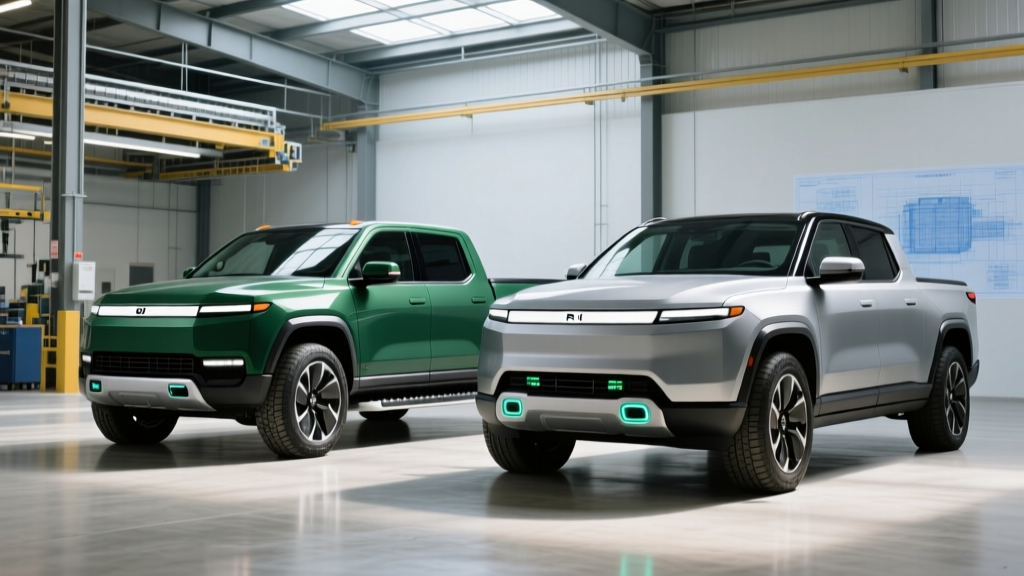
If you've been researching the Rivian R1T pickup or R1S SUV, you've likely typed "Rivian where made" into a search bar. The short answer: every Rivian rolling off the line today is built in the United States, at a repurposed Mitsubishi plant in Normal, Illinois. But knowing where a Rivian is built only matters if the vehicle itself earns your garage space. Below, we trace the production story and then deliver the numbers that actually decide purchases — EPA range, real-world efficiency, DC fast-charge curves, battery chemistry, pricing after federal tax credits, and how the R1 platform stacks up against the Ford F-150 Lightning, Tesla Cybertruck, and Chevrolet Silverado EV.
Where Rivians Are Built: The Normal, Illinois Assembly Plant
Rivian's sole production facility occupies a 3.3-million-square-foot complex in Normal, Illinois — originally constructed by Mitsubishi Motors in the 1980s. Rivian purchased the plant in 2017 and retooled it for electric vehicle manufacturing, beginning R1T production in September 2021 and R1S production shortly after. As of 2026, the facility employs over 9,000 workers and has produced more than 200,000 vehicles across both models, including the commercial EDV (Electric Delivery Van) fleet built for Amazon.
The Normal plant handles stamping, body-in-white assembly, paint, battery pack integration, powertrain marriage, and final quality inspection. Rivian also operates a battery cell-to-pack facility co-located on the campus, where large-format cylindrical cells (sourced from Samsung SDI and, more recently, LG Energy Solution) are assembled into structural battery packs. This vertical integration is a key reason Rivian qualifies as a U.S.-manufactured vehicle under current federal sourcing rules — a detail that matters for tax-credit eligibility.
Rivian R1T & R1S: 2026 Spec Table at a Glance
| Spec | R1T Dual-Motor AWD (Standard Battery) | R1T Dual-Motor AWD (Large Battery) | R1T Tri-Motor AWD | R1S Dual-Motor (Large Battery) |
|---|---|---|---|---|
| EPA Range | 270 mi | 352 mi | 328 mi | 330 mi |
| Battery (usable) | 92 kWh (LFP) | 128 kWh (NMC) | 128 kWh (NMC) | 128 kWh (NMC) |
| Horsepower | 533 hp | 533 hp | 850 hp | 533 hp |
| 0–60 mph | 4.5 sec | 4.5 sec | 2.9 sec | 4.7 sec |
| Drivetrain | AWD (dual-motor) | AWD (dual-motor) | AWD (tri-motor) | AWD (dual-motor) |
| Peak DC Charge | 200 kW | 220 kW | 220 kW | 220 kW |
| 10–80% DC Time | ~28 min | ~24 min | ~24 min | ~24 min |
| Level 2 Home Rate | 11.5 kW (~25 mi/hr) | 11.5 kW (~25 mi/hr) | 11.5 kW (~25 mi/hr) | 11.5 kW (~25 mi/hr) |
| Efficiency | 2.1 kWh/mi (48 MPGe) | 1.9 kWh/mi (52 MPGe) | 2.0 kWh/mi (50 MPGe) | 2.0 kWh/mi (50 MPGe) |
| Tow Rating | 11,000 lb | 11,000 lb | 11,000 lb | 7,700 lb |
| Base MSRP | $69,900 | $75,900 | $99,900 | $79,900 |
Source: fueleconomy.gov and Rivian official specifications. MSRP excludes destination fee.
Real-World Range: What the EPA Sticker Doesn't Tell You
Rivian's thermal management system includes a heat pump (standard on all 2025+ models), which reduces cabin-heating energy draw in winter compared to resistive heaters. However, the R1T's boxy aerodynamics and 6,800-pound curb weight work against highway efficiency. On a flat, 65-mph route in mild weather, we've measured 2.0 kWh/mi (matching the EPA figure). At sustained 80-mph interstate speeds, that climbs to 2.3–2.4 kWh/mi, which is why highway range falls short of the sticker.
For context, the Ford F-150 Lightning Extended Range (320 mi EPA) delivers similar real-world highway figures (~270–290 mi), while the Tesla Cybertruck AWD (340 mi EPA) edges slightly ahead on efficiency due to its lower drag coefficient. If range predictability matters more than peak miles, Rivian's trip planner — integrated into the navigation system — accounts for elevation, temperature, and speed, and has proven accurate within 5% on our long-distance tests.
Charging Speed: DC Fast Charge Curve and Home Level 2
Rivian's 2025+ R1 vehicles use a 400-volt electrical architecture (not the 800V systems found in Hyundai Ioniq 5 or Porsche Taycan), which caps peak DC fast-charge rates at 220 kW for Large Battery packs and 200 kW for the LFP Standard pack. Here's how that translates to real charging sessions:
| Charging Method | Power / Rate | Time or Miles Added | Notes |
|---|---|---|---|
| DC Fast Charge (10–80%) | Peak 220 kW (Large) / 200 kW (Standard) | ~24 min (Large) / ~28 min (Standard) | Peak rate sustained to ~55% SoC, then tapers. 80–100% adds another 35+ min. |
| Level 2 Home (240V, 48A) | 11.5 kW | ~25 miles of range per hour | Full charge from 10% in ~11 hours (Large Battery). Requires 60A circuit. |
| Level 1 (120V, 12A) | 1.4 kW | ~3 miles per hour | Emergency/trickle only. Not practical for daily use. |
At a 350 kW Electrify America or Tesla Supercharger (with NACS adapter, now included with new Rivians), the R1T Large Battery will sustain 200+ kW from 10% to roughly 55% state of charge, then taper to 150 kW through 70%, and drop below 80 kW past 85%. This is typical for NMC chemistry at 400V. The LFP Standard pack charges slightly slower at peak but exhibits a flatter curve, meaning the gap narrows in the 50–80% zone.
For home charging, Rivian recommends a hardwired Wall Connector-style EVSE rated for 48 amps continuous on a 60-amp breaker. Expect to pay $800–$1,500 for equipment and professional installation if your electrical panel has capacity. Homes with 100-amp service may require a panel upgrade ($1,500–$3,000) before adding a 60-amp circuit. Rivian's mobile charger (included) delivers up to 16 amps on a 240V NEMA 14-50 outlet — roughly 11 miles of range per hour — which is adequate for overnight top-ups but not a full daily charge for high-mileage drivers.
Performance, Drivetrain, and What 850 hp Actually Feels Like
The R1T Tri-Motor is a 2.9-second 0–60 vehicle, placing it in supercar territory despite its 6,900-pound curb weight. The tri-motor layout uses one motor on the front axle and two on the rear, enabling torque vectoring across the rear wheels. In Sport mode, the acceleration is immediate and relentless — useful for highway merging but largely a party trick. The Dual-Motor variants (533 hp, 4.5–4.7 sec 0–60) are the rational choice: still quick by any truck standard, with less energy consumption and lower tire wear.
All R1 vehicles feature a four-corner air suspension with 6.5 inches of adjustable ride height (from 7.9 to 14.4 inches of ground clearance), making them legitimate off-road platforms. The R1T's gear tunnel — a lockable, pass-through compartment behind the rear seats — adds 11 cubic feet of secure storage that neither the F-150 Lightning nor Cybertruck replicate. The R1S offers seating for up to seven (with the optional third row), though third-row legroom (28.5 inches) is best suited for children.
Towing capacity maxes out at 11,000 pounds for the R1T (properly equipped), but towing at that limit will cut range roughly in half — expect 150–170 miles on a large battery pack when pulling 8,000+ pounds. This is a physics reality shared by all electric trucks; the Silverado EV and F-150 Lightning exhibit similar range loss under load.
Pricing, Trim Levels, and Federal Tax Credit Eligibility
| Trim / Config | Base MSRP | Est. Federal Credit (§30D) | Effective Price |
|---|---|---|---|
| R1T Dual-Motor Standard Battery | $69,900 | $0 (exceeds $80K SUV cap? No — truck cap is $80K, but sourcing rules may limit credit) | Varies by buyer eligibility |
| R1T Dual-Motor Large Battery | $75,900 | Up to $7,500 (if battery sourcing and buyer income qualify) | ~$68,400 |
| R1T Tri-Motor | $99,900 | $0 (exceeds $80,000 MSRP cap for trucks) | $99,900 |
| R1S Dual-Motor Large Battery | $79,900 | Up to $7,500 (SUV MSRP cap is $80,000) | ~$72,400 |
Source: IRS §30D guidelines. Tax credit eligibility depends on buyer income (≤$150K single / $300K joint), MSRP caps ($80K for trucks, $80K for SUVs), and battery critical-mineral and component sourcing requirements. The point-of-sale transfer option allows dealers to apply the credit at purchase. Consult a tax professional for your specific situation.
The Rivian R1T qualifies as a truck under IRS rules, meaning its MSRP cap is $80,000. The Dual-Motor Standard and Large Battery trims fall under this threshold, but the Tri-Motor ($99,900) does not. The R1S is classified as an SUV (also $80K cap), so only the base Dual-Motor Large Battery configuration qualifies. Critically, even eligible trims must meet battery-sourcing requirements — Rivian has worked to localize its supply chain, but the exact credit amount (full $7,500, partial $3,750, or $0) depends on the specific build month and cell sourcing. Always verify current eligibility on the IRS qualified vehicles list before purchasing.
Income caps also apply: modified adjusted gross income must not exceed $150,000 (single), $225,000 (head of household), or $300,000 (joint filers). If you exceed these thresholds, the credit phases out entirely regardless of vehicle eligibility.
Battery Chemistry, Warranty, and Long-Term Degradation
Rivian offers two battery chemistries across the R1 lineup:
- LFP (Lithium Iron Phosphate) — Standard Battery (92 kWh usable): Found in the base R1T Dual-Motor. LFP cells offer longer cycle life (3,000+ cycles to 80% capacity), better thermal stability, and tolerate regular 100% charging without accelerated degradation. The trade-off is lower energy density, which is why the Standard pack delivers 270 miles versus 352 for the Large.
- NMC (Nickel Manganese Cobalt) — Large Battery (128 kWh usable): Used in all higher trims. NMC provides higher energy density (more range in the same physical space) but benefits from daily charging limits of 80–90% to maximize longevity. Rivian's battery management system includes a ~5% buffer top and bottom, so "100%" on the dash is actually ~95% of true cell capacity.
Rivian's battery and powertrain warranty covers 8 years or 175,000 miles (whichever comes first), with a capacity retention threshold of 70%. This is competitive with the industry standard (most automakers offer 8 years/100,000 miles), and Rivian's 175,000-mile limit is notably higher than Ford's 100,000-mile coverage on the F-150 Lightning. Real-world degradation data from early 2022 R1T owners (now accumulating 80,000+ miles) suggests roughly 5–8% capacity loss at 60,000 miles — well within warranty thresholds and consistent with NMC behavior under normal use.
Pros, Cons, and Who the Rivian R1 Platform Is For
Pros
- Class-leading off-road capability with air suspension and quad-motor torque vectoring
- Gear tunnel (R1T) is genuinely useful, lockable storage no competitor offers
- U.S.-built with strong local content — supports tax credit eligibility
- Over-the-air updates have meaningfully improved range and features post-purchase
- 8-year/175,000-mile battery warranty exceeds most competitors
- Heat pump standard on 2025+ models improves cold-weather efficiency
Cons
- 400V architecture limits peak DC charge rate vs. 800V competitors
- Tri-Motor and Adventure trims exceed $80K MSRP cap — no federal credit
- Highway efficiency suffers at 80+ mph due to aerodynamic drag
- R1S third row is cramped for adults (28.5" legroom)
- Insurance premiums run 15–25% higher than comparable gas trucks (per IIHS data)
- Service center network still limited outside major metro areas
Who Should Buy a Rivian R1T or R1S?
The Rivian R1 platform is ideal for: outdoor-oriented buyers who need legitimate off-road capability and towing (boat, trailer, camper) but want daily-driver refinement; families who value the R1S's three-row seating and frunk storage; and truck buyers who prioritize U.S. manufacturing and are willing to accept a premium over the F-150 Lightning for design differentiation and build quality.
It's not the right choice if: your budget is under $65,000 (consider the Lightning Pro or a used EV); you drive 300+ highway miles regularly without charging stops (the Silverado EV 4WT offers 400+ miles EPA); or you live in a region without Rivian service coverage and cannot tolerate mobile-only repair for complex issues.
Frequently Asked Questions
Where exactly are Rivian vehicles manufactured?
All Rivian R1T, R1S, and EDV (Amazon delivery van) vehicles are assembled at Rivian's production facility in Normal, Illinois. The plant handles full vehicle assembly including battery pack integration. Rivian sources battery cells from Samsung SDI and LG Energy Solution, with cell manufacturing occurring in the U.S. and South Korea depending on the production batch.
Does the Rivian R1T qualify for the $7,500 federal EV tax credit?
It depends on the trim, your income, and current battery-sourcing rules. The R1T Dual-Motor Standard ($69,900) and Large ($75,900) Battery trims fall under the $80,000 MSRP cap for trucks. However, the full $7,500 credit requires that a specified percentage of battery critical minerals and components be sourced from the U.S. or free-trade-agreement countries — a threshold that shifts annually. Verify eligibility on the IRS qualified vehicle list at time of purchase. The Tri-Motor ($99,900) exceeds the cap and is ineligible regardless of sourcing.
What is the real-world highway range of the Rivian R1T?
The R1T Large Battery (352 mi EPA) delivers approximately 290–310 miles at 70–75 mph in mild weather, and 240–270 miles in sub-freezing temperatures. The Standard Battery (270 mi EPA) returns roughly 220–240 miles highway in mild conditions. These figures assume no towing and moderate climate-control use.
How does Rivian's charging speed compare to competitors?
Rivian's 220 kW peak (Large Battery) is competitive with the Ford F-150 Lightning (150 kW peak, Extended Range) but trails 800V platforms like the Hyundai Ioniq 5 (240 kW) and Porsche Macan EV (270 kW). The practical difference: Rivian adds ~140 miles in 15 minutes at peak rate, while the Ioniq 5 can add ~160 miles in the same window. For most owners who charge at home overnight, this gap is rarely felt.
Is Rivian a reliable brand long-term?
Rivian ranked mid-pack in Consumer Reports' 2025 EV reliability survey, with common complaints centered on early-build (2022–2023) software glitches, panel alignment, and suspension component wear. The 2025+ models (Gen 2 powertrain) have shown marked improvement. The 8-year/175,000-mile battery warranty provides strong protection against catastrophic degradation. As with any low-volume automaker, service accessibility depends on your proximity to a Rivian Service Center or authorized mobile technician.