The BMW i3 remains one of the most distinctive electric vehicles ever built. With its carbon-fiber-reinforced plastic (CFRP) passenger cell, suicide-hinge rear doors, and optional gasoline range extender, it was years ahead of its time when it launched in 2014. But if you're shopping the used EV market today and typing "bmw i3 miles" into search engines, you need hard data on how far this car actually goes, how its battery holds up over time, and whether it makes financial sense in 2026.
This guide covers every model year of the BMW i3 — from the original 60 Ah pack through the final 120 Ah version — with exact EPA range figures, real-world driving expectations, charging speeds, and ownership economics. BMW ended i3 production in July 2022, so every i3 on the market is pre-owned. That changes the tax-credit math, the battery-health conversation, and the value proposition considerably.
BMW i3 Range: EPA Sticker vs. Real-World Miles
The i3 was sold with three battery sizes across its production run, each with a different EPA range rating. The numbers below come from fueleconomy.gov and represent the combined city/highway cycle.
| Model Year | Battery (Usable kWh) | Cell Rating | EPA Range (BEV) | EPA Range (with REx) |
|---|---|---|---|---|
| 2014–2016 | 18.8 kWh | 60 Ah | 81 miles | 150 miles (combined EV + gas) |
| 2017–2018 | 27.2 kWh | 94 Ah | 114 miles | 180 miles (combined EV + gas) |
| 2019–2022 | 37.9 kWh | 120 Ah | 153 miles | 200 miles (combined EV + gas) |
The 120 Ah i3's EPA rating of 153 miles assumes mixed driving at moderate temperatures. In our experience and owner reports, expect roughly 130–145 miles on the highway at 70 mph, and as low as 100–115 miles in sub-freezing winter conditions without preconditioning. The 94 Ah model delivers about 90–105 miles real-world in cold weather. The original 60 Ah car is best treated as a 60–70 mile commuter in winter.
Cold weather hits the i3 harder than liquid-cooled competitors because its battery thermal management is less aggressive. The i3 uses a refrigerant-based cooling system but relies more on passive heating strategies. If you live where winters regularly drop below 30°F, budget 25–35% range loss compared to the EPA sticker unless you precondition the cabin and battery while still plugged in.
Battery Chemistry, Degradation, and Longevity
All BMW i3 models use Samsung SDI lithium-ion cells with NMC (nickel-manganese-cobalt) chemistry. These prismatic cells are arranged in modules — eight modules in the 60 Ah, eight in the 94 Ah, and twelve in the 120 Ah. The NMC chemistry delivers strong energy density but is more sensitive to sustained high state-of-charge and extreme heat than LFP alternatives.
Battery degradation on the i3 is well-documented thanks to a large owner community. Here's what the data shows:
- 60 Ah (2014–2016): Average 10–18% capacity loss after 8–10 years. Some early packs dropped below 70% state of health (SoH), which is BMW's warranty replacement threshold.
- 94 Ah (2017–2018): Average 6–12% loss after 6–8 years. These packs are holding up better due to improved cell chemistry and larger buffers.
- 120 Ah (2019–2022): Average 3–8% loss after 3–6 years. Most 2020+ examples still show 93%+ SoH on diagnostic scans.
BMW's high-voltage battery warranty covers 8 years or 100,000 miles against defects and capacity loss below 70% of original capacity. For a 2017 model, that warranty window is closing or already expired in 2025–2026. For 2019–2022 models, factory battery coverage may still be active. Always request a battery health report from a BMW dealer or use an OBD2 scanner with an app like BimmerCode to check SoH before purchasing.
| Battery Pack | Total Capacity (kWh) | Usable Capacity (kWh) | Chemistry | Warranty |
|---|---|---|---|---|
| 60 Ah | 21.6 | 18.8 | NMC (Samsung SDI) | 8 yr / 100,000 mi |
| 94 Ah | 33.2 | 27.2 | NMC (Samsung SDI) | 8 yr / 100,000 mi |
| 120 Ah | 42.2 | 37.9 | NMC (Samsung SDI) | 8 yr / 100,000 mi |
Charging Speed: DC Fast Charge and Home Level 2
The i3's charging capabilities reflect its era. It uses a CCS1 connector for DC fast charging and a J1772 inlet for Level 1 and Level 2 AC charging. Here are the exact charge rates by model year:
| Charge Level | 60 Ah (2014–2016) | 94 Ah (2017–2018) | 120 Ah (2019–2022) |
|---|---|---|---|
| Level 1 (120V, 12A) | ~1.4 kW / ~5 mi/hr | ~1.4 kW / ~5 mi/hr | ~1.4 kW / ~5 mi/hr |
| Level 2 (240V, 32A onboard) | 7.4 kW / ~25 mi/hr | 7.4 kW / ~25 mi/hr | 7.4 kW / ~25 mi/hr |
| DC Fast Charge (CCS) | 47 kW peak | 50 kW peak | 50 kW peak |
| DC 10–80% Time | ~28 min | ~35 min | ~42 min |
The i3's 50 kW DC fast-charge ceiling is its most significant limitation by 2026 standards. Modern EVs routinely accept 150–250 kW, making the i3 noticeably slower on road trips. The charge curve is relatively flat up to about 60% state of charge, then tapers sharply — the final 20% (80–100%) can take nearly as long as the first 80%. For practical DC fast charging, plan to charge from 10% to 80% and then move on.
At home on a Level 2 charger (240V, 32-amp circuit with a 40-amp breaker), the i3 adds roughly 25 miles of range per hour. A full charge from empty takes about 4.5 hours for the 120 Ah model and about 3 hours for the 94 Ah. This is perfectly adequate for overnight home charging, which is how most i3 owners use the car.
Performance, Efficiency, and Driving Dynamics
The i3's rear-mounted electric motor produces 170 horsepower and 184 lb-ft of torque across all BEV model years. The i3s variant (2018–2022) bumps output to 184 hp and 199 lb-ft with a slightly wider track and sport-tuned suspension. Both send power to the rear wheels through a single-speed reduction gear.
| Spec | i3 BEV | i3s | i3 REx |
|---|---|---|---|
| Horsepower | 170 hp | 184 hp | 170 hp (electric) |
| 0–60 mph | 6.9 sec | 6.2 sec | 7.5 sec |
| Drivetrain | RWD | RWD | RWD |
| Curb Weight | 2,970 lbs | 3,010 lbs | 3,290 lbs |
| EPA Combined MPGe | 113 MPGe | 108 MPGe | 102 MPGe (EV mode) |
| kWh/100 mi | 30 | 31 | 33 |
Efficiency is a genuine i3 strength. At 113 MPGe combined (30 kWh per 100 miles) for the standard BEV, it is one of the most efficient EVs ever sold in the US. The lightweight CFRP and aluminum construction — the i3 weighs under 3,000 pounds without the range extender — is the reason. For context, the 2025 Chevrolet Equinox EV rates at 106 MPGe combined despite being a newer design. Lighter cars use less energy, and physics hasn't changed.
The REx (Range Extender) models pair the electric motor with a 647cc two-cylinder BMW Motorrad gasoline engine that acts as a generator. It does not drive the wheels directly. The REx adds roughly 65–80 miles of range on its 2.4-gallon fuel tank but requires premium gasoline and adds maintenance complexity (oil changes, spark plugs, emissions equipment).
Cargo, Passenger Space, and Practicality
The i3 is a subcompact hatchback, and its interior dimensions reflect that classification. Here are the concrete measurements:
- Front headroom: 39.6 inches
- Front legroom: 40.5 inches
- Rear headroom: 37.2 inches
- Rear legroom: 31.9 inches
- Cargo volume (rear seats up): 15.1 cu ft
- Cargo volume (rear seats folded): 36.0 cu ft
The rear seats use rear-hinged "coach doors" (suicide doors) that require the front door to be opened first. This makes rear-seat access awkward in tight parking spaces and is a dealbreaker for families with car seats. The 15.1 cu ft trunk is adequate for groceries and a couple of carry-on bags but won't handle a week's worth of luggage for four people. Fold the rear seats and you get a useful 36 cu ft, which accommodates a bicycle with the front wheel removed.
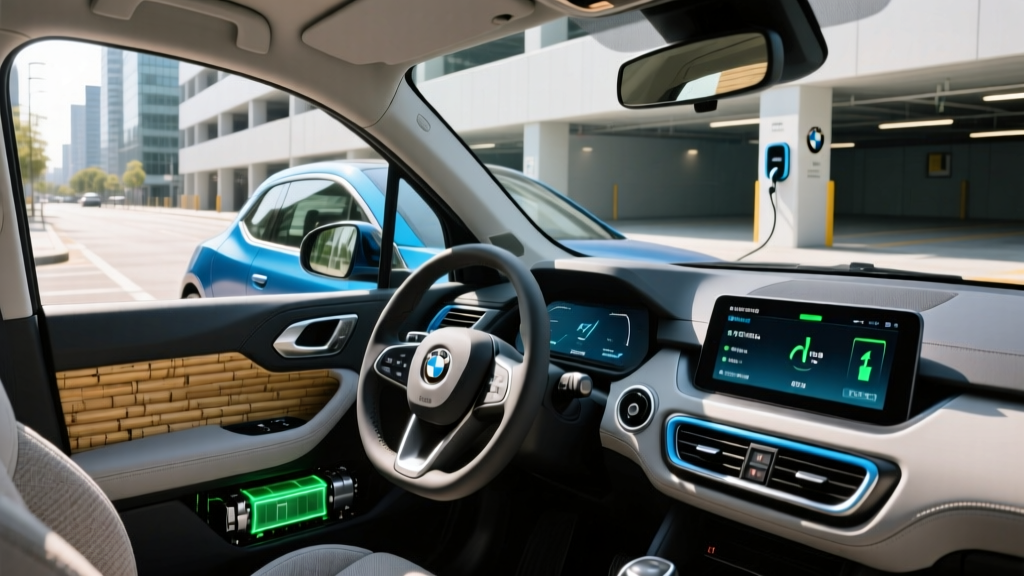
Interior materials are distinctive — BMW offered sustainable options like eucalyptus wood trim, recycled polyester upholstery, and kenaf-fiber door panels. Build quality is excellent, consistent with BMW's premium positioning, though the narrow 155/70R19 tires are an unusual size that limits replacement options and costs more than standard tire fitments.
Pricing, Used Market Values, and Tax Credits
Because BMW discontinued the i3 in 2022, there are no new units available. Used pricing varies significantly by model year, mileage, battery health, and trim:
| Model | Typical Used Price (2026) | Mileage Range | Federal Used EV Credit |
|---|---|---|---|
| 2014–2016 i3 BEV (60 Ah) | $8,000–$13,000 | 60k–110k mi | Up to $4,000 (§25E) |
| 2017–2018 i3 BEV (94 Ah) | $13,000–$19,000 | 40k–80k mi | Up to $4,000 (§25E) |
| 2019–2021 i3 BEV (120 Ah) | $19,000–$28,000 | 15k–55k mi | Up to $4,000 (§25E) |
| 2022 i3s (120 Ah) | $26,000–$33,000 | 5k–30k mi | Up to $4,000 (§25E) |
- Credit equals 30% of the sale price, capped at $4,000
- Vehicle must cost $25,000 or less to qualify
- Buyer income caps: $75,000 single / $112,500 head of household / $150,000 joint (modified AGI)
- Vehicle must be at least 2 model years old (all i3s qualify)
- Must purchase from a licensed dealer (private-party sales do not qualify)
- Credit is non-refundable — you must have sufficient tax liability to use it
- Starting 2024, the credit can be transferred to the dealer at point of sale as a discount
Source: IRS.gov §25E Used Clean Vehicle Credit. Eligibility rules are subject to change. Consult a tax professional for your specific situation.
The $25,000 price cap is the critical constraint. Most 2019–2022 i3s with the 120 Ah battery sell above $25,000, meaning they do not qualify for the used EV credit. The sweet spot for credit eligibility is the 2017–2018 94 Ah model, which typically falls in the $13,000–$19,000 range — well under the cap. A buyer in the 22% federal tax bracket purchasing an $18,000 i3 would receive the full $4,000 credit (30% of $18,000 = $5,400, but capped at $4,000), effectively reducing the cost to $14,000.
Tech, Safety, and Driver Assistance
The i3's technology suite reflects its 2013 design origin with incremental updates through 2022. Standard and available features include:
- Infotainment: 6.5-inch display (early models) upgraded to 10.25-inch touchscreen with iDrive 6 (2018+). Apple CarPlay was added for 2018; Android Auto was never officially supported.
- Navigation: BMW's EV-specific nav includes range-aware routing and charging-station locators.
- Driver assistance: Available Driving Assistant Plus package adds adaptive cruise control, lane-keeping assist, forward collision warning with automatic emergency braking, and traffic-jam assist. These are SAE Level 2 driver-assist features — the driver must remain engaged at all times.
- Parking: Available Park Assistant with rearview camera and parking sensors.
- Unique features: BMW's eDrive energy management, one-pedal driving with strong regenerative braking, optional heated seats and steering wheel (essential for cold-climate range preservation).
The i3's available Driving Assistant Plus is a Level 2 system per SAE classification. It can manage steering, acceleration, and braking in certain conditions, but the driver must continuously supervise the system and keep hands on the wheel. It is not autonomous or self-driving.
Safety ratings are mixed. The NHTSA gave the i3 an overall 4-star rating (out of 5), with 4 stars for frontal crash and 5 stars for side crash. The IIHS rated it "Good" in most crashworthiness tests but noted the small overlap front test was not performed on all model years. The CFRP passenger cell is exceptionally rigid and protective despite the car's light weight.
Who Should Buy a BMW i3 — and Who Shouldn't
- Best-in-class efficiency — 113 MPGe combined saves money on every charge
- Unique, premium interior with sustainable materials
- Excellent visibility and tight turning circle (32.3 ft) for city driving
- Strong acceleration from stoplight (170 hp in a 2,970-lb car)
- Carbon-fiber structure resists corrosion and crash damage
- 120 Ah models offer a practical 153-mile EPA range for most commutes
- 50 kW DC fast charging is slow by 2026 standards — 42 min for 10–80%
- Small rear seat and awkward coach-door access
- 153-mile max range limits road-trip usefulness
- No Android Auto support on any model year
- Unusual 155/70R19 tire size is expensive to replace
- REx models add gasoline engine maintenance complexity
- Discontinued — no new units, limited dealer support going forward
- You need a city commuter with a round-trip under 100 miles (94 Ah) or 130 miles (120 Ah)
- You can charge at home every night and rarely need DC fast charging
- You value unique design, premium materials, and efficiency above all else
- You want to stay under the $25,000 cap for the $4,000 used EV tax credit
- You regularly drive more than 150 miles in a day
- You need a family car with easy rear-seat access and car-seat compatibility
- You take frequent road trips and need fast DC charging
- You want the latest driver-assistance tech and infotainment
BMW i3 vs. Key Used EV Competitors
| Spec | BMW i3 120 Ah | Chevy Bolt EV (2020–2023) | Nissan Leaf SV Plus (2019–2023) |
|---|---|---|---|
| EPA Range | 153 mi | 259 mi | 215 mi |
| Battery (usable kWh) | 37.9 kWh | 65 kWh | 62 kWh |
| DC Fast Charge Peak | 50 kW | 55 kW | 100 kW |
| 10–80% DC Time | ~42 min | ~55 min | ~40 min |
| 0–60 mph | 6.9 sec | 6.5 sec | 6.8 sec |
| Cargo (seats up) | 15.1 cu ft | 16.9 cu ft | 23.6 cu ft |
| Typical Used Price | $19k–$28k | $16k–$24k | $15k–$22k |
| Battery Cooling | Active (refrigerant) | Active (liquid) | Passive (air) |
The Chevrolet Bolt EV is the strongest competitor on range and value — 259 EPA miles for often less money than a 153-mile i3. The Bolt also has more cargo space and a conventional five-door layout. The Nissan Leaf SV Plus offers solid range and more cargo room but suffers from passive air-cooled battery thermal management, which accelerates degradation in hot climates and limits repeated DC fast charging.
The i3 wins on efficiency, build quality, city maneuverability, and the sheer uniqueness of its carbon-fiber construction. If your commute is short, you charge at home, and you appreciate BMW's engineering and design, the i3 delivers an ownership experience that neither the Bolt nor the Leaf can match. If you need maximum range per dollar, the Bolt is the more rational choice.
Frequently Asked Questions
What is the real-world range of the BMW i3?
The 120 Ah i3 (2019–2022) delivers approximately 130–145 miles on the highway and 140–155 miles in city driving at moderate temperatures. In freezing weather, expect 100–120 miles without preconditioning. The 94 Ah model delivers about 95–110 miles real-world, and the 60 Ah is best for 60–80 miles.
How fast does the BMW i3 charge?
On a Level 2 home charger (240V, 7.4 kW), the i3 adds about 25 miles of range per hour, reaching a full charge in 3–4.5 hours depending on battery size. On a DC fast charger, it peaks at 50 kW, reaching 10–80% in approximately 28–42 minutes. The 50 kW peak is slow compared to modern EVs that charge at 150–250 kW.
Does the BMW i3 qualify for any tax credits?
The i3 is no longer sold new, so the §30D new EV credit does not apply. However, the §25E Used Clean Vehicle Credit offers up to $4,000 (30% of sale price) if the vehicle sells for $25,000 or less, you buy from a licensed dealer, and your income falls below IRS caps ($75k single / $150k joint). Most 2014–2018 i3s qualify; most 2019–2022 models exceed the price cap.
Is it worth buying a BMW i3 vs. a Chevy Bolt or Nissan Leaf?
The i3 is worth buying if you prioritize efficiency, premium build quality, city maneuverability, and unique design over maximum range. If you need 200+ miles of range, more cargo space, or faster DC charging, the Bolt EV or Leaf SV Plus are better choices. The i3's 50 kW charge rate and 153-mile max range are genuine limitations for road trips.
How long will the BMW i3 battery last?
Data from the owner community shows the 120 Ah battery typically retains 92–97% capacity after 3–5 years. The 94 Ah retains about 88–94% after 6–8 years. BMW warrants the battery for 8 years/100,000 miles against drops below 70% SoH. Replacement battery packs cost approximately $10,000–$16,000 depending on the model, though individual module replacement is possible for less.
Can I take a BMW i3 on a road trip?
It's possible but not ideal. The 50 kW DC fast charge rate means 40+ minute stops every 100–130 miles. On a 400-mile trip, you'd need three charging stops totaling over two hours of charging time. The i3 excels as a daily commuter and city car. If road trips are frequent, consider a vehicle with 150+ kW charging capability.
Sources: EPA Fuel Economy, IRS Used Clean Vehicle Credit, BMW USA press archives.