Rivian's Charging Ecosystem in 2026: Waypoints Network Meets the R1 Platform
If you're researching a Rivian R1T or R1S purchase in 2026, the truck's specs are only half the equation. The other half is how you'll actually charge it on road trips — and that's where the Rivian Waypoints Network comes into play. Originally announced as Rivian's proprietary destination and adventure charging network, Waypoints has evolved alongside the broader NACS transition and Tesla Supercharger access. This review covers what the Waypoints network offers today, how it complements Rivian's NACS port adoption, and whether the full R1 ownership experience justifies the premium price.
We'll walk through the 2026 Rivian R1T and R1S (Dual-Motor and Tri-Motor) with exact numbers: EPA range, battery chemistry, DC fast-charge curves, real-world highway and cold-weather range, pricing, and IRS §30D tax credit eligibility. No marketing fluff — just the data you need to decide.
The 2026 R1T Dual-Motor with the Standard battery carries an EPA-estimated 270 miles of range. In real-world highway driving at 70-75 mph, expect approximately 230–250 miles. In sub-freezing winter conditions (below 32°F), plan for 190–220 miles of usable range before needing a charger. The Tri-Motor Max battery variant (EPA 420 mi) delivers closer to 350–370 miles highway, and roughly 290–320 miles in cold weather. Always plan road trips around the lower bound.
2026 Rivian R1T and R1S: Full Spec Breakdown
| Spec | R1T Dual-Motor (Standard) | R1T Tri-Motor (Max) | R1S Dual-Motor (Standard) |
|---|---|---|---|
| EPA Range | 270 mi | 420 mi | 270 mi |
| Battery (usable) | ~95 kWh (NMC) | ~141 kWh (NMC) | ~95 kWh (NMC) |
| Peak DC Fast Charge | 200 kW | 220 kW | 200 kW |
| 10–80% DC Time | ~28 min | ~35 min | ~28 min |
| Level 2 Home Rate | 11.5 kW (~25 mi/hr) | 11.5 kW (~25 mi/hr) | 11.5 kW (~25 mi/hr) |
| 0–60 mph | 4.5 sec | 2.9 sec | 4.6 sec |
| Horsepower | 533 hp | 850 hp | 533 hp |
| Drivetrain | AWD (Dual-Motor) | AWD (Tri-Motor) | AWD (Dual-Motor) |
| MPGe (combined) | 73 MPGe | 69 MPGe | 73 MPGe |
| Efficiency | 46 kWh/100mi | 49 kWh/100mi | 46 kWh/100mi |
| Max Towing | 11,000 lbs | 11,000 lbs | 7,700 lbs |
| Base MSRP | $69,900 | $99,900 | $75,900 |
Source: EPA fueleconomy.gov and Rivian official specs.
The Rivian Waypoints Network: What It Actually Is in 2026
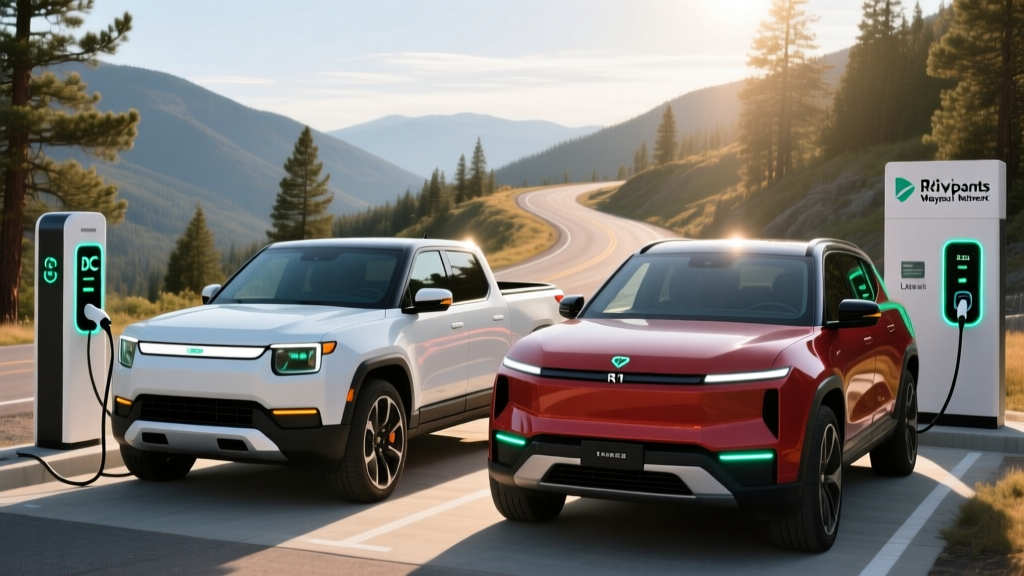
The Rivian Waypoints Network is Rivian's branded charging ecosystem, designed specifically for adventure-oriented and destination-based travel. Unlike Electrify America or EVgo — which focus heavily on highway corridor chargers — Waypoints targets trailheads, national parks, ski resorts, and campgrounds where Rivian owners are most likely to drive.
As of 2026, Waypoints stations typically feature Level 2 chargers (11.5–19.2 kW) and, at select high-traffic locations, DC fast chargers up to 150 kW. The network is integrated directly into the Rivian app and in-vehicle navigation, which automatically routes you through Waypoints locations when they're optimal for your trip.
However, Waypoints alone does not cover long-distance road-trip needs. For highway DC fast charging, Rivian owners rely on the Tesla Supercharger network (via NACS port, now standard on all 2025+ R1 vehicles) and third-party networks like Electrify America. Think of Waypoints as the "last mile" of adventure charging — the charger at the trailhead while you hike, not the 350 kW stall at a highway rest stop.
Charging Speed Deep Dive: DC Fast, Level 2, and the Charge Curve
Charging speed is the single most important spec for road-trip viability. Here's how the 2026 R1T and R1S actually perform at a charger — not just the peak marketing number.
| Charging Level | Power (kW) | Miles Added per Hour | Notes |
|---|---|---|---|
| Level 1 (120V outlet) | 1.4 kW | ~3 mi/hr | Emergency/trickle only; full charge takes days |
| Level 2 (240V, 48A) | 11.5 kW | ~25 mi/hr | Home charging standard; ~10 hrs for full Standard battery |
| Level 2 (240V, 80A) | 19.2 kW | ~42 mi/hr | Requires upgraded home charger + 100A circuit |
| DC Fast (Tesla Supercharger V3) | up to 200 kW peak | ~250+ mi/hr (peak) | 10–80% in ~28 min (Standard); tapers sharply above 80% |
| DC Fast (Waypoints select) | up to 150 kW | ~190 mi/hr (peak) | Available at select adventure locations |
Charge curve reality: The R1T's peak 200 kW rate only holds between roughly 10–40% State of Charge (SoC). From 40–60%, expect ~150 kW; from 60–80%, ~100 kW. Above 80%, charging slows dramatically to protect the NMC battery — roughly 40–50 kW. This is why the 10–80% time (~28 minutes for the Standard battery) is the meaningful metric, not the peak kW number.
Battery preconditioning matters. If you navigate to a DC fast charger in the Rivian app, the thermal management system will warm or cool the battery to optimal temperature before you arrive. Without preconditioning — especially in cold weather — your initial charge rate may start at 80–100 kW instead of 200 kW, adding 5–10 minutes to your stop.
Battery Chemistry, Degradation, and Warranty Coverage
Rivian uses NMC (nickel manganese cobalt) lithium-ion cells across the R1 lineup. NMC offers higher energy density than LFP (lithium iron phosphate), which is critical for fitting 141 kWh into the Max battery pack. The trade-off: NMC is more sensitive to sustained high SoC and extreme heat, and degrades slightly faster over thousands of cycles compared to LFP.
In practical terms, Rivian's NMC packs have shown strong durability. Real-world data from early 2022–2023 R1T owners (now at 60,000–100,000 miles) indicates approximately 5–8% capacity loss over the first 3–4 years, which is in line with industry norms for liquid-cooled NMC packs.
Warranty coverage:
- Battery: 8 years / 175,000 miles (capacity retention above 70% of original)
- Powertrain: 8 years / 175,000 miles
- Bumper-to-bumper: 5 years / 60,000 miles
The 70% capacity retention threshold is standard across the industry. If your 95 kWh Standard pack drops below 66.5 kWh of usable capacity within 8 years or 175,000 miles, Rivian will repair or replace it. In practice, very few owners have hit this threshold.
Pricing, Trim Levels, and Federal Tax Credit Eligibility
Rivian positions the R1T and R1S as premium electric adventure vehicles, and the pricing reflects that. Here's the 2026 lineup:
| Model / Trim | Base MSRP | As-Tested (Typical) | §30D Credit Eligible? |
|---|---|---|---|
| R1T Dual-Motor Standard | $69,900 | $74,000–$78,000 | No (MSRP over $80K truck cap) |
| R1T Dual-Motor Large | $75,900 | $80,000–$85,000 | No (MSRP over $80K truck cap) |
| R1T Tri-Motor Max | $99,900 | $105,000–$112,000 | No (MSRP over $80K truck cap) |
| R1S Dual-Motor Standard | $75,900 | $80,000–$85,000 | No (MSRP over $80K SUV cap) |
| R1S Tri-Motor Max | $104,900 | $110,000–$118,000 | No (MSRP over $80K SUV cap) |
Under current IRS rules (IRS §30D), the federal EV tax credit is capped at $80,000 MSRP for trucks and SUVs. Because nearly every 2026 R1T and R1S configuration exceeds $80,000 once options are added — and even the base R1T Dual-Motor at $69,900 often crosses the threshold with destination and packages — most Rivian buyers will not qualify for the $7,500 federal credit. Additionally, buyer income caps apply ($300K joint / $150K single), and battery component/critical mineral sourcing requirements must be met. Consult a tax professional and verify current-year rules at IRS.gov before assuming eligibility.
Cargo, Passenger Space, and Practical Utility
The R1T is a midsize crew-cab truck, and its dimensions reflect that. Here's what you're working with:
- R1T bed length: 4.5 feet (54 inches) — shorter than a Tacoma or Ranger, but includes the Gear Tunnel
- R1T Gear Tunnel: 11 cu ft lockable pass-through storage between cab and bed (unique to Rivian)
- R1T frunk: 11 cu ft (front trunk with drain, useful as a cooler)
- R1S cargo (behind 3rd row): ~10 cu ft
- R1S cargo (behind 2nd row): ~47 cu ft
- R1S cargo (max, all rows folded): ~104 cu ft
- Rear legroom (R1T and R1S): ~38.5 inches
- Front headroom: ~41 inches
The Gear Tunnel is Rivian's party trick — a full-width, lockable compartment that runs between the cab and bed. It's ideal for skis, camping gear, or groceries you don't want sliding around in the bed. Combined with the frunk and bed, the R1T offers more enclosed storage than any other midsize truck.
Tech, Driver Assistance, and the Rivian Software Experience
Rivian runs its own proprietary software stack, not Android Automotive or a skinned version of Apple CarPlay. The 15.6-inch center display and 12.3-inch driver cluster are responsive, with over-the-air updates adding features regularly.
Driver assistance: Rivian's Driver+ system is a SAE Level 2 driver-assist feature — meaning it offers adaptive cruise control and lane-centering on highways, but requires the driver to remain fully engaged at all times. It is not autonomous driving. Driver+ works well on divided highways but does not support hands-free operation like GM's Super Cruise or Ford's BlueCruise. Keep your hands on the wheel.
Standout tech features:
- Integrated camp kitchen option (slide-out induction cooktop and sink in the Gear Tunnel)
- Vehicle-to-load (V2L) capability — power devices or a campsite from the truck's battery
- Tank turns (Tri-Motor only) — spin the truck in place using independent motor control
- Quad-motor torque vectoring (Tri-Motor models use 3 motors with torque distribution)
- Native trail mapping and off-road navigation in the Rivian app
Notable drawbacks:
- No Apple CarPlay or Android Auto — Rivian's native system only
- Driver+ is competent but behind Super Cruise/BlueCruise in hands-free capability
- Service center network is still limited outside major metro areas
- Insurance premiums run 15–25% higher than comparable gas trucks (per IIHS data)
Pros, Cons, and the Competition
✓ Pros
- Best-in-class enclosed storage (Gear Tunnel + frunk + bed)
- 420-mile Max battery eliminates range anxiety for most trips
- Waypoints Network adds destination charging at adventure spots
- NACS port = full Tesla Supercharger access for highway trips
- 11,000-lb towing capacity (R1T)
- V2L capability for camping and job-site power
- Strong OTA update track record improving the truck over time
✗ Cons
- No federal tax credit at current MSRP levels
- No Apple CarPlay / Android Auto
- Driver+ is Level 2 only — no hands-free highway driving
- Service centers sparse in rural and mid-market areas
- High insurance costs relative to gas trucks
- 4.5-ft bed is short for traditional truck buyers
- Efficiency drops sharply when towing (expect ~1.5–2.0 mi/kWh, or roughly 50–60% range loss)
Key competitors: The R1T competes with the Ford F-150 Lightning (lower price, larger bed, less range), the Chevrolet Silverado EV (larger battery option, GM Super Cruise available), and the Tesla Cybertruck (lower starting price, polarizing design, Supercharger-native). The R1S competes with the Kia EV9 (three rows, lower price, less off-road capability) and the Jeep Wagoneer S (luxury positioning, Stellantis ecosystem).
Who Should Buy a Rivian in 2026?
Choose the R1S if: You need a three-row electric SUV with genuine off-road capability and don't want to compromise on interior quality. The R1S is the only EV SUV that can handle Moab and the school run equally well.
Look elsewhere if: You need a full-size truck bed, require the lowest possible price, depend on a robust local service network, or want hands-free highway driving (Super Cruise or BlueCruise).
Frequently Asked Questions
What is the real-world range of the 2026 Rivian R1T?
The EPA rates the R1T Dual-Motor Standard at 270 miles and the Tri-Motor Max at 420 miles. Real-world highway driving at 70–75 mph yields approximately 230–250 miles (Standard) and 350–370 miles (Max). In cold weather below 32°F, reduce those figures by 15–25%. When towing, expect range to drop by 40–50%.
How fast does the Rivian R1T charge on DC fast chargers and at home?
On a DC fast charger (Tesla Supercharger V3 or comparable), the R1T Standard peaks at 200 kW and charges from 10–80% in approximately 28 minutes. The Max battery peaks at 220 kW with a 10–80% time of roughly 35 minutes. At home on a Level 2 (240V/48A) charger, you'll add about 25 miles of range per hour, taking roughly 10 hours for a full Standard battery charge.
Does the Rivian R1T or R1S qualify for the $7,500 federal EV tax credit?
Under current IRS §30D rules, the MSRP cap for trucks and SUVs is $80,000. Most 2026 R1T and R1S configurations — especially with options, larger batteries, and destination charges — exceed this cap. The base R1T Dual-Motor at $69,900 technically falls under the cap, but once popular packages are added, it often crosses $80,000. Additionally, buyer income caps and battery sourcing requirements apply. Verify your specific eligibility at IRS.gov and consult a tax professional.
What is the Rivian Waypoints Network and how does it compare to Superchargers?
The Rivian Waypoints Network is a destination-focused charging ecosystem located at trailheads, parks, resorts, and campgrounds. It primarily offers Level 2 charging (with select DC fast locations). For highway road trips, Rivian owners use the Tesla Supercharger network via the standard NACS port. Waypoints complements Superchargers rather than replacing them — think of it as charging while you hike, not charging to get to the hike.
Is the Rivian R1T worth buying over the Ford F-150 Lightning or Chevy Silverado EV?
If premium build quality, off-road capability, the Gear Tunnel storage system, and the adventure-focused Waypoints Network matter to you, the R1T is worth the premium. If you need a full-size bed, a lower starting price, or a more established dealer/service network, the F-150 Lightning or Silverado EV may be better fits. The R1T trades utility-bed practicality for a more refined, adventure-optimized experience.
How long will the Rivian battery last?
Rivian warranties the battery for 8 years or 175,000 miles against degradation below 70% of original capacity. Real-world data from early owners suggests 5–8% capacity loss over the first 3–4 years. With proper care (avoiding frequent 100% charges on NMC, using preconditioning for DC fast charging), the battery should provide reliable service well beyond 200,000 miles.