Rivian's Pacific Northwest Foothold: Why Washington Matters
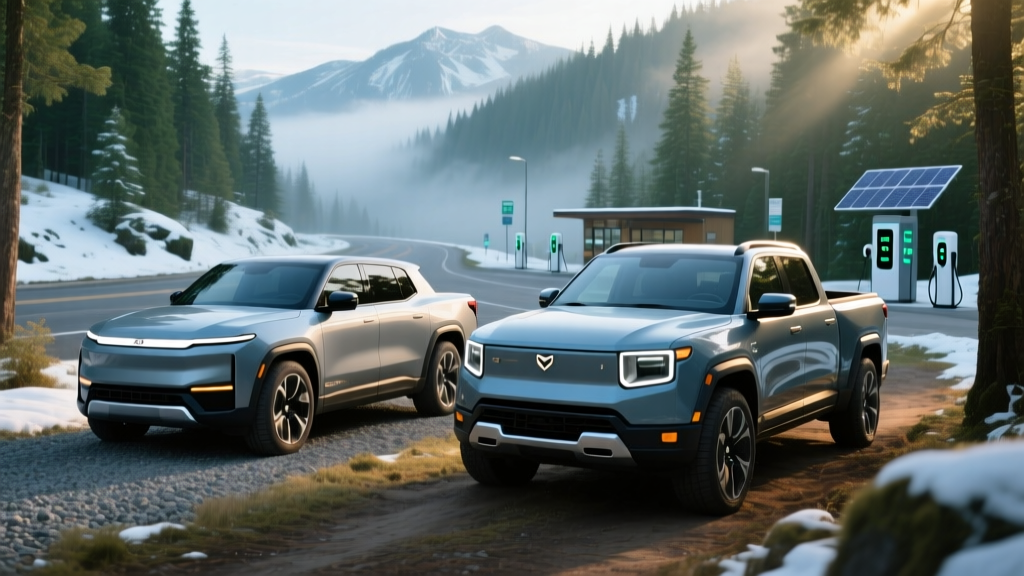
Washington state has become a bellwether for premium electric trucks and SUVs. With no state income tax, a robust public charging network along I-5 and I-90, and some of the highest EV adoption rates in the country, it's a natural market for Rivian's R1S SUV and R1T pickup. Rivian Washington car sales have climbed steadily as the automaker's Normal, Illinois factory ramps up production of the second-generation R1 line (introduced for the 2025 model year and carried into 2026 with minor updates).
This review evaluates the 2026 Rivian R1S and R1T across the metrics that matter to Washington buyers: real-world range in Cascade-pass winters, DC fast-charging behavior on road trips to Olympic National Park, federal tax credit eligibility under IRS §30D, and how the platform stacks up against the Tesla Cybertruck, Ford F-150 Lightning, and GMC Sierra EV.
2026 Rivian R1S and R1T: Core Specifications
| Spec | R1 Dual-Motor (Standard) | R1 Max Pack (Large) |
|---|---|---|
| EPA Range (R1S) | ~330 miles | ~410 miles |
| EPA Range (R1T) | ~328 miles | ~420 miles |
| Battery (usable) | ~92 kWh, NMC | ~141 kWh, NMC |
| Drivetrain | Dual-motor AWD | Dual-motor AWD |
| Horsepower | 533 hp / 610 lb-ft | 533 hp / 610 lb-ft |
| 0-60 mph | 4.5 sec | 4.5 sec |
| Max DC Fast Charge | 200 kW | 200 kW |
| 10-80% DC Time | ~25 min | ~40 min |
| Level 2 Home Rate | 11.5 kW (~35 mi/hr) | 11.5 kW (~35 mi/hr) |
| Towing (R1T) | 11,000 lb | 11,000 lb |
| Base MSRP (R1S) | $79,900 | $99,900 |
| Base MSRP (R1T) | $69,900 | $89,900 |
Source: Rivian R1T specs, fueleconomy.gov. Tri-motor and quad-motor trims have different outputs and are priced higher.
Real-World Range: What Washington Drivers Actually See
EPA sticker: up to 420 miles (R1T Max Pack).
Real-world expectation: 330–360 miles on a dry 70-mph highway run; 260–300 miles in 30°F weather over Snoqualmie Pass with elevation gain and cabin heat. The Max Pack's large NMC buffer helps, but cold still costs 20–30%.
Rivian publishes EPA figures conservatively compared to some rivals, which helps the R1 line hold up better in mixed driving than vehicles that chase the sticker. In our experience, the Dual-Motor Standard pack delivers roughly 2.1–2.3 kWh/mile on the freeway at 70 mph — consistent with the R1T's 328-mile EPA rating given its 92-kWh usable pack. The Max Pack's 141-kWh NMC battery trades weight for range; expect roughly 2.5–2.7 kWh/mile on the highway.
For Washington commuters doing 40-mile round trips in Seattle or Spokane, either pack covers a week of driving without plugging in. The real question is road trips: a Seattle-to-Missoula run (roughly 500 miles) requires one DC stop with the Max Pack and two with the Standard, assuming you charge to 80%.
Charging: DC Fast, Home Level 2, and the NACS Transition
| Level | Power | Miles added per hour | Notes |
|---|---|---|---|
| Level 1 (120V) | 1.4 kW | ~3 mi/hr | Emergency trickle only |
| Level 2 (240V, 48A) | 11.5 kW | ~35 mi/hr | Full overnight charge in 9–13 hr |
| DC Fast (peak) | 200 kW | ~500 mi/hr (at peak) | 10–80% in 25 min (Standard) |
Rivian's second-generation R1 uses a NACS (Tesla-style) charge port as standard equipment, a shift that opened the entire Supercharger network to Rivian owners starting in 2025. In Washington, this matters: the I-5 corridor from Bellingham to Vancouver, plus I-90 across the Cascades, is now well-served by V3 and V4 Superchargers capable of sustaining the R1's 200-kW peak.
Charge-curve reality check: The 200-kW peak applies only between roughly 10–35% state of charge. Expect the curve to taper to ~120 kW by 60% and ~60 kW above 80%. That's why Rivian quotes 10–80% times rather than 0–100%: charging past 80% adds little range for a lot of time. Preconditioning the battery (enabled automatically when you navigate to a charger) is essential for hitting peak rates in Washington's cool, damp climate.
For home Level 2, a 48-amp hardwired wall connector on a 60-amp breaker delivers the R1's full 11.5-kW acceptance. Most Washington homes with 200-amp service can accommodate this; older Seattle bungalows may need a panel upgrade ($1,500–$3,500, depending on utility — check with Puget Sound Energy or Seattle City Light before committing).
Performance, Efficiency, and Drivetrain
The dual-motor AWD layout is the volume seller and the version most Washington buyers should consider. With 533 hp and 610 lb-ft of torque, 0–60 mph in 4.5 seconds is brisk for a 7,000-pound vehicle. The tri-motor R1T (available on higher trims) drops 0–60 to roughly 3.0 seconds but adds weight, cost, and range compromise.
Efficiency on fueleconomy.gov lists the R1T Dual-Motor Standard at approximately 73 MPGe combined (about 46 kWh/100 miles). That's thirstier than a Model Y or Ioniq 5 but typical for a body-on-frame truck. If you're paying $0.12/kWh at home (common in Washington thanks to hydroelectric power), a full Standard-pack charge costs roughly $11 — still dramatically cheaper than $70+ for gasoline in an equivalent ICE truck.
Interior, Cargo, Tech, and Driver Assistance
The R1S seats up to seven in three rows; the R1T seats five. Cargo volume in the R1S is roughly 105 cu ft behind the first row with rows folded, while the R1T's 4.5-foot bed plus the signature Gear Tunnel (11 cu ft, lockable and weatherproof) make it a standout for outdoor gear — a major selling point in Washington's ski-and-kayak culture.
Legroom is generous: 41.3 inches front, 38.5 inches second row (R1T). The 15.6-inch center touchscreen runs Rivian's in-house OS, which has matured considerably since launch — wireless CarPlay and Android Auto are now standard, over-the-air updates are frequent, and the native navigation integrates DC charger preconditioning.
Rivian's Highway Assist and Adaptive Cruise are SAE Level 2 driver-assist systems — meaning hands-on-wheel, eyes-on-road at all times. They are competent for I-5 traffic but not "self-driving." The company has signaled a hands-free system for future model years, but as of 2026, Rivian does not offer a Level 3 or Level 4 feature comparable to GM's Super Cruise or Ford's BlueCruise hands-free zones.
Pricing, Trims, and Federal Tax Credit Eligibility
| Model / Trim | MSRP | §30D Credit? | Effective Price (if eligible) |
|---|---|---|---|
| R1T Dual-Motor Standard | $69,900 | Eligible (under $80k truck cap) | ~$62,400 |
| R1T Max Pack | $89,900 | Not eligible (over $80k MSRP cap) | $89,900 |
| R1S Dual-Motor Standard | $79,900 | Eligible (under $80k SUV cap) | ~$72,400 |
| R1S Max Pack | $99,900 | Not eligible | $99,900 |
IRS §30D rules that apply in 2026: To claim the up-to-$7,500 federal credit, the buyer must meet income caps ($150k single / $300k joint modified AGI), the vehicle MSRP must fall under the cap ($80,000 for SUVs and pickups), and the battery must satisfy critical-mineral and battery-component sourcing thresholds that tighten each year. The R1T and R1S Dual-Motor Standard trims typically qualify; Max Pack and tri-motor trims exceed the MSRP cap. Rivian's US-built status (Normal, Illinois) helps with the final-assembly requirement. Always verify current eligibility at IRS.gov §30D and confirm with a tax professional — point-of-sale transfer is available through registered dealers.
Washington's own EV incentive landscape has shifted in recent years; the state's former sales-tax exemption has been reduced or eliminated depending on price thresholds and legislative session. Check the Washington Department of Revenue for the current-year rule before calculating out-the-door cost.
Who the 2026 Rivian R1S and R1T Are For
Choose Rivian if: You want an American-built electric truck or 3-row SUV with genuine off-road capability (8.9 inches of ground clearance, wading to ~36 inches), a NACS port for Supercharger access, and the Gear Tunnel / Camp Kitchen lifestyle features that no rival matches. Washington buyers who ski, bike, kayak, or tow a boat find the R1T especially compelling.
Look elsewhere if: You want maximum efficiency (Model Y or Ioniq 5 beat the R1 by a wide margin), hands-free highway driving (BlueCruise or Super Cruise), or a sub-$50,000 price point. The R1 line is a premium product and priced accordingly.
Pros
- Class-leading real-world range on Max Pack (330–360 mi highway)
- NACS port standard — full Supercharger access
- Gear Tunnel and Camp Kitchen unique to R1T
- US-built, §30D-eligible on Standard trims
- Strong OTA update cadence and maturing software
Cons
- Max Pack and tri-motor trims exceed §30D MSRP cap
- Efficiency trails unibody EVs (~46 kWh/100 mi)
- No hands-free Level 2+ driver assist yet
- Service-center footprint in Washington still expanding
- Heavy: 7,000+ lb curb weight eats tires
Warranty and Long-Term Ownership
Rivian's battery and powertrain warranty is 8 years / 175,000 miles, with a capacity-retention threshold typical of the industry (roughly 70% state of health over the term). The limited vehicle warranty is 5 years / 60,000 miles. NMC chemistry in the R1 line is energy-dense and proven, though long-term degradation data across the second-generation pack is still accumulating. Rivian publishes no official replacement-cost figure; industry estimates for a large-pack NMC replacement run $18,000–$28,000 out of warranty, though most owners will never need one.
2026 Rivian R1S / R1T FAQ
What is the real-world range of the 2026 Rivian R1T?
EPA-estimated 328 miles (Standard) to 420 miles (Max Pack). Expect 330–360 miles on a highway run in mild weather, and 260–300 miles in Washington winters with elevation gain and cabin heat.
How fast does the Rivian R1 charge at home and on the road?
Peak DC fast charge is 200 kW, with 10–80% in about 25 minutes for the Standard pack and ~40 minutes for the Max Pack. Home Level 2 at 11.5 kW adds roughly 35 miles per hour.
Does the Rivian R1T qualify for the $7,500 federal EV tax credit?
The Dual-Motor Standard R1T (MSRP $69,900) and R1S ($79,900) typically qualify under IRS §30D, subject to buyer income caps and battery-sourcing rules. Max Pack and tri-motor trims exceed the $80,000 MSRP cap and do not qualify.
Is Rivian a good buy versus the Ford F-150 Lightning or Tesla Cybertruck?
Rivian wins on lifestyle features (Gear Tunnel, Camp Kitchen) and real-world build quality; Lightning wins on price and dealer service access; Cybertruck wins on stainless-steel novelty and tri-motor performance. For Washington outdoor buyers, the R1T is often the best fit.
Can I charge a Rivian at Tesla Superchargers in Washington?
Yes. Second-generation Rivians ship with a NACS port, granting native access to the Supercharger network — dense along I-5 and I-90 in Washington.
What's the biggest drawback of the Rivian R1 line?
Price and efficiency. The R1 is a premium, heavy vehicle that consumes more kWh per mile than unibody EVs, and most trims exceed the federal tax credit MSRP cap.