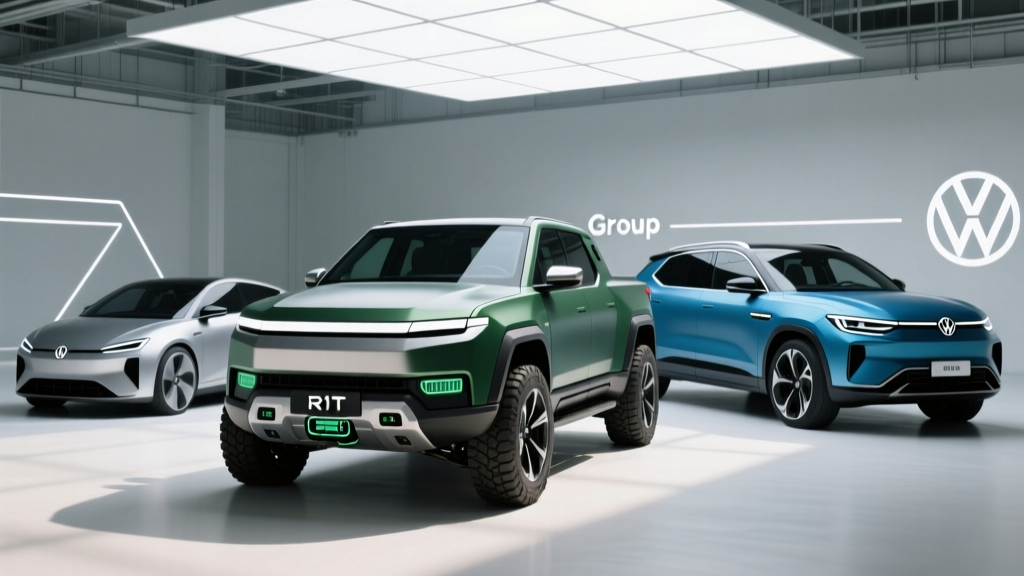
The joint venture between Rivian and Volkswagen Group, first announced in mid-2024 and now bearing fruit in 2026-model vehicles, is one of the most consequential partnerships in the modern EV industry. Rather than a simple badge-engineering deal, the Rivian and VW Group technology collaboration created an independently operated entity tasked with developing a shared, next-generation electrical architecture and software stack. That platform now underpins Rivian's updated R1 Gen 2 lineup, will form the backbone of the upcoming R2, and is being integrated into future Volkswagen Group EVs sold globally.
This article breaks down what the partnership actually delivers for buyers in 2026 — across Rivian's current models and VW's electrified future — with the exact specs, range figures, charging data, pricing, and tax-credit context you need to make an informed purchase decision.
What the Rivian-VW Joint Venture Actually Built
The partnership was structured as a true joint venture, not a licensing agreement. VW invested up to $5 billion into the venture, and both companies contributed engineering talent and IP. The goal: a zonal electrical architecture that replaces the traditional domain-controller approach with fewer, more powerful compute zones. This reduces wiring harness weight by roughly 40%, cuts the number of electronic control units (ECUs) significantly, and enables faster over-the-air (OTA) software updates across the entire vehicle.
For Rivian, the immediate payoff is the R1 Gen 2 platform (model year 2025-2026), which features a completely redesigned electrical architecture, new NVIDIA DRIVE Orin-based ADAS compute, and a revamped battery pack design. For VW Group, the technology is slated to appear in future SSP (Scalable Systems Platform) vehicles and potentially in the next-generation ID. lineup, though specific VW model timelines remain subject to production schedules.
Rivian R1T and R1S Gen 2: 2026 Specs at a Glance
The R1T pickup and R1S SUV share the same skateboard platform. The Gen 2 update, which began production in mid-2024 and continues through 2026, introduced dual-motor and tri-motor powertrains, a revised battery lineup, and the new zonal architecture born from the joint venture.
| Spec | Dual-Motor Standard | Dual-Motor Max | Tri-Motor Performance |
|---|---|---|---|
| Battery (usable, est.) | ~95 kWh (LFP) | ~141 kWh (NMC) | ~141 kWh (NMC) |
| EPA Range (R1T) | ~270 mi | ~420 mi | ~390 mi |
| EPA Range (R1S) | ~260 mi | ~410 mi | ~380 mi |
| Horsepower | 533 hp | 533 hp | 850 hp |
| 0-60 mph | ~4.5 sec | ~4.5 sec | ~2.9 sec |
| Drivetrain | AWD (dual-motor) | AWD (dual-motor) | AWD (tri-motor) |
| Peak DC Fast Charge | ~200 kW | ~220 kW | ~220 kW |
| 10-80% DC Time | ~30 min | ~42 min | ~42 min |
| Level 2 Home Charging | 11.5 kW (~25 mi/hr) | 11.5 kW (~25 mi/hr) | 11.5 kW (~25 mi/hr) |
| Efficiency (R1T, est.) | ~73 MPGe | ~73 MPGe | ~70 MPGe |
| Towing Capacity | 11,000 lbs | 11,000 lbs | 11,000 lbs |
| Base MSRP (R1T) | $69,900 | $82,900 | $99,900 |
| Battery Warranty | 8 years / 175,000 miles | ||
| Bumper-to-Bumper | 5 years / 60,000 miles | ||
The EPA numbers above reflect ideal combined-cycle testing. In real-world highway driving at 70-75 mph, expect roughly 85-90% of the EPA sticker for the Max pack (~360-380 miles highway for the R1T Dual-Motor Max). In cold weather (below 32°F), range can drop 20-30%, meaning a Standard pack R1T might deliver ~190-210 miles in freezing conditions. The heat pump standard on Gen 2 helps mitigate cabin-energy draw, but battery chemistry still governs cold-weather losses. Towing a 5,000-lb trailer cuts range roughly in half regardless of pack size.
How the VW Partnership Changed Rivian's Battery Strategy
One of the most tangible outcomes of the Rivian and VW Group technology collaboration is the shift to LFP (lithium iron phosphate) chemistry for the Standard pack. LFP offers lower energy density than NMC but provides significant advantages: longer cycle life (3,000+ full cycles vs. ~1,500 for NMC), no cobalt or nickel in the supply chain, and lower per-kWh cost. Rivian's Standard pack is now competitive on price while offering robust longevity for daily commuters who charge to 100% regularly — something LFP tolerates better than NMC.
The Max and Performance packs retain NMC chemistry for maximum energy density and range. Both chemistries are covered under the same 8-year/175,000-mile battery warranty, which guarantees a minimum of 70% capacity retention over that period.
| Factor | LFP (Standard Pack) | NMC (Max/Performance Pack) |
|---|---|---|
| Energy Density | Lower (~160 Wh/kg cell) | Higher (~250 Wh/kg cell) |
| Cycle Life | 3,000+ cycles | ~1,500-2,000 cycles |
| Recommended Daily Charge | 100% OK | 80% recommended for daily |
| Cold-Weather Performance | Moderate loss | Better low-temp output |
| Cost per kWh | Lower | Higher |
| Best For | Daily commuting, frequent 100% charging | Road trips, max range, towing |
Charging Speed: DC Fast Charge and Home Level 2
Charging remains a top concern for truck and SUV buyers, especially those planning road trips or towing. Here's the full picture for the Gen 2 R1 platform:
| Charging Level | Power | Miles Added per Hour (est.) | Notes |
|---|---|---|---|
| Level 1 (120V outlet) | ~1.4 kW | ~3-4 mi/hr | Emergency/trickle only |
| Level 2 (240V home) | 11.5 kW | ~25 mi/hr | Full overnight charge in 8-12 hrs |
| DC Fast Charge (peak) | 200-220 kW | ~500+ mi/hr (at peak) | 10-80% in 30-42 min |
Charging curve reality: The Gen 2 R1T peaks at ~220 kW (Max pack) but does not sustain that rate for the full session. Expect peak rates from roughly 10-40% SoC, with a taper beginning around 50% and a significant slowdown above 80%. A 10-80% session on a 350 kW-capable charger takes about 42 minutes for the Max pack. On a 150 kW charger, plan for 50-60 minutes. Battery preconditioning activates automatically when you navigate to a DC fast charger via the infotainment system, optimizing cell temperature for faster charging — a feature refined through the joint venture's thermal-management software.
For home charging, the 11.5 kW onboard charger requires a 60-amp dedicated circuit (48-amp continuous draw). Installation costs typically range from $800-$2,500 depending on panel proximity, with a full panel upgrade (200A service) adding $2,000-$4,000 if needed. Always consult a licensed electrician for final specifications.
Software, ADAS, and the Joint Venture's Tech Dividends
The zonal architecture enables Rivian's updated driver-assistance suite, which runs on NVIDIA DRIVE Orin hardware. The system includes adaptive cruise control, lane-centering, automatic emergency braking, and a highway assist feature. This remains an SAE Level 2 system — the driver must keep hands on the wheel and eyes on the road at all times. It is not autonomous driving.
Rivian's driver-assist features (adaptive cruise, lane-centering, highway assist) are classified as SAE Level 2 — partial driving automation. The human driver is responsible for all driving decisions and must remain engaged. This is fundamentally different from Level 4 robotaxi services (e.g., Waymo) that operate without a human driver in geofenced areas.
The infotainment system also benefits from the new architecture. OTA updates deploy faster thanks to the zonal design, and the system supports native trip planning with integrated charging stops, a 15.6-inch center display, and a dedicated companion app. The Gen 2 vehicles also introduced a new "Camp Mode" with enhanced climate control for overnight stays and a gear tunnel (R1T) with 11 cubic feet of lockable, weather-sealed storage.
Cargo, Passenger Space, and Practicality
The R1T and R1S remain practical family vehicles with genuine utility:
- R1T bed length: 4.5 feet (with midgate open: ~6.5 feet to cabin)
- R1T gear tunnel: 11 cu ft (pass-through, lockable)
- R1T frunk: 11 cu ft (front trunk with drain)
- R1S cargo (behind 3rd row): ~10.5 cu ft
- R1S cargo (2nd row folded): ~46.7 cu ft
- R1S cargo (all rows folded): ~83.6 cu ft
- Front legroom: 41.3 inches
- Rear legroom (R1T 2nd row): 38.5 inches
- R1S 3rd-row legroom: 30.1 inches (best for children)
The R1S's third row is usable for adults on short trips but is tighter than a full-size SUV like the Chevy Tahoe. For families with older children or frequent 7-passenger needs, the third row is adequate but not generous.
Pricing, Trims, and Federal Tax Credit Eligibility
| Trim / Configuration | R1T MSRP | R1S MSRP | §30D Credit Eligible? |
|---|---|---|---|
| Dual-Motor Standard Pack | $69,900 | $74,900 | Potentially — see below |
| Dual-Motor Max Pack | $82,900 | $87,900 | Potentially — see below |
| Tri-Motor Performance | $99,900 | $104,900 | Potentially — see below |
Federal tax credit (§30D) details: Under current IRS rules, the new clean vehicle credit offers up to $7,500, split into two halves — $3,750 for meeting critical-minerals sourcing requirements and $3,750 for battery-component manufacturing requirements. Eligibility depends on several factors that change annually:
- MSRP cap: Vans, SUVs, and pickups are capped at $80,000 MSRP. The R1T qualifies as a pickup; the R1S qualifies as an SUV. Dual-Motor Standard trims fall under this cap; Max and Performance trims exceed it.
- Buyer income cap: Modified AGI must not exceed $150,000 (single), $225,000 (head of household), or $300,000 (joint).
- Battery sourcing: Critical minerals and battery components must meet escalating domestic-content thresholds. Rivian's North American assembly is favorable, but specific mineral-sourcing compliance must be verified per model year via the IRS qualified vehicles list.
- Point-of-sale transfer: Buyers can elect to transfer the credit to the dealer at purchase, reducing the upfront cost directly.
For the R1T Dual-Motor Standard at $69,900, qualifying buyers could see the effective price drop to ~$62,400 with the full $7,500 credit. Consult a tax professional to confirm personal eligibility — rules are subject to change and individual circumstances vary.
Rivian vs. Key Competitors: Is It Worth Buying?
Pros
- Class-leading 11,000-lb towing for an electric pickup
- Tri-motor performance: 850 hp, sub-3-sec 0-60
- LFP Standard pack offers 3,000+ cycle longevity
- Unique gear tunnel (R1T) for secure storage
- Strong OTA update cadence; zonal architecture enables faster feature delivery
- 8-yr/175,000-mi battery warranty (above industry average)
- Robust build quality and off-road capability
Cons
- Max and Performance trims exceed $80K MSRP cap for §30D credit
- Real-world highway range falls 10-15% below EPA sticker
- DC fast charging peaks at 220 kW — slower than Hyundai Ioniq 5 (240+ kW)
- R1S third row is tight for adults
- No Apple CarPlay / Android Auto (Rivian uses proprietary infotainment)
- Insurance premiums run 15-25% higher than comparable gas trucks
- Charging on road trips requires planning outside the Supercharger network (Rivian uses NACS adapter for Tesla access)
Decision framework:
Choose the Rivian R1T/R1S if: You need a genuine truck/SUV with 11,000-lb towing, off-road capability, and a family-friendly cabin — and you're willing to pay a premium for build quality and the adventure-oriented ecosystem.
Look at the Ford F-150 Lightning if: You want a lower entry price (~$55K base), a larger bed, and broader dealer-service network, even at the cost of less range and a less refined software experience.
Look at the Chevrolet Silverado EV if: Maximum range (up to EPA 440 mi on the 4WT trim) and GM's Ultium platform matter more than off-road chops, and you can accept a larger, heavier vehicle.
What the VW Side Gets from the Partnership
For Volkswagen Group, the joint venture's technology is a strategic bet on software-defined vehicle architecture. VW's ID. family has been criticized for sluggish infotainment and software reliability. The zonal architecture developed with Rivian is expected to underpin next-generation VW Group vehicles globally, potentially appearing in future ID. models, Porsche EVs, and Audi platforms — though specific model timelines have not been confirmed for 2026 delivery.
This means VW buyers in the 2027-2028 timeframe may see vehicles with dramatically improved software performance, faster OTA updates, and more efficient electrical systems — all traceable to the Rivian and VW Group technology collaboration. For now, VW's 2026 ID.4 and ID.7 continue on the MEB platform with incremental software improvements.
Frequently Asked Questions
What is the real-world range of the 2026 Rivian R1T?
The EPA rates the Dual-Motor Max R1T at ~420 miles combined. In real-world highway driving at 70-75 mph, expect roughly 360-380 miles. In cold weather (below freezing), plan for 280-320 miles from the Max pack, and 190-210 miles from the Standard pack. Towing cuts range by approximately 40-50%.
How fast does the Rivian R1 Gen 2 charge?
On a DC fast charger, the Max pack peaks at ~220 kW and charges from 10-80% in about 42 minutes. At home on a Level 2 (240V, 11.5 kW) charger, you'll add roughly 25 miles of range per hour, fully recharging overnight in 8-12 hours depending on pack size.
Does the Rivian R1T qualify for the $7,500 federal EV tax credit?
The Dual-Motor Standard ($69,900 R1T) falls under the $80,000 MSRP cap for pickups and may qualify for up to $7,500 if the buyer meets income requirements and the battery meets sourcing rules. Max and Performance trims exceed the MSRP cap and do not qualify for the new-vehicle credit. Always verify on the fueleconomy.gov tax credit page and consult a tax professional.
Is the Rivian R1T worth buying over the Ford F-150 Lightning?
The R1T offers superior build quality, more advanced software architecture, better off-road capability, and a unique gear tunnel. The F-150 Lightning wins on entry price (~$55K vs. ~$70K), dealer-service footprint, and bed size. If budget is the primary driver, the Lightning is the value pick. If you want a premium adventure truck with better tech, the R1T justifies its price.
What does the VW partnership mean for Rivian's long-term viability?
VW's $5 billion investment provides Rivian with significant capital to scale production (including the upcoming R2 at the Normal, Illinois facility) and share R&D costs on next-gen architecture. It reduces Rivian's cash-burn risk and signals institutional confidence in the platform. For buyers, this translates to greater confidence in long-term parts availability, software support, and warranty fulfillment.
Does the Rivian R1 have Apple CarPlay or Android Auto?
No. Rivian uses a proprietary infotainment system built on its own software stack. While the system is responsive and well-designed with native navigation, music streaming, and trip planning, it does not support phone projection. This is a deliberate choice to maintain tight integration with vehicle systems, but it remains a drawback for buyers who prefer CarPlay.
Sources: fueleconomy.gov (EPA range and efficiency data), IRS §30D Clean Vehicle Credit (tax credit rules), Rivian official specifications.