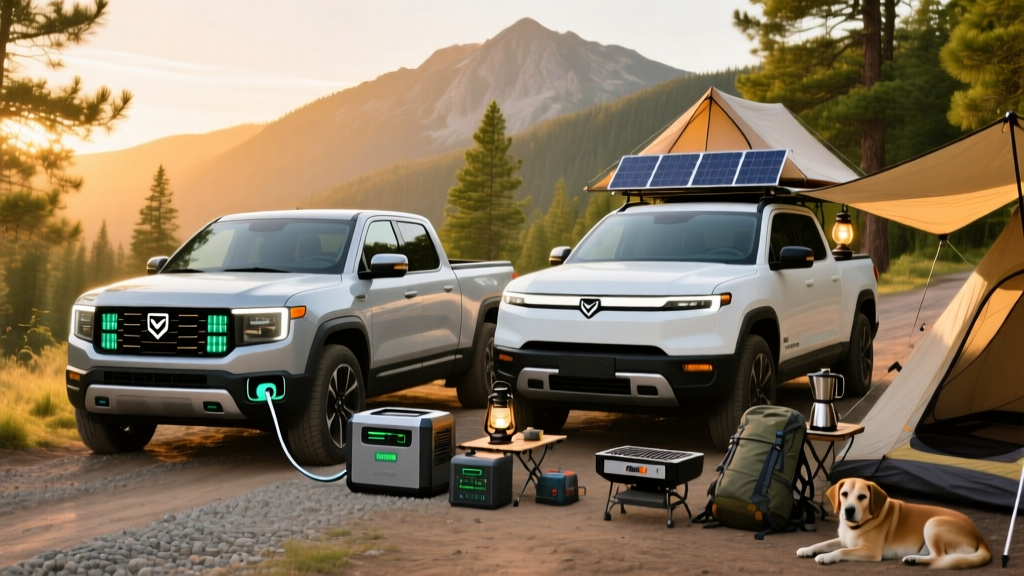
Rivian's R1T pickup and R1S SUV have always been positioned as adventure-first electric vehicles, but one feature consistently draws questions from outdoor buyers, contractors, and off-grid campers: Rivian V2L (Vehicle-to-Load). Unlike most EVs that only accept electrons, Rivian's dual-motor and quad-motor platforms can push power back out through built-in 120V and 240V outlets, effectively turning a 100+ kWh battery pack into a silent, fume-free generator.
This review profiles the 2026 Rivian R1T and R1S through the lens of their V2L capability, while covering every spec a serious buyer needs — EPA range, real-world efficiency, DC fast-charge speeds, pricing, and IRS §30D tax-credit eligibility. If you've been searching "rivian v2l" to find out whether these trucks can actually run a job site or keep a campsite powered for a weekend, the numbers below tell the full story.
Rivian V2L: What It Is and How It Works
Vehicle-to-Load (V2L) is a bidirectional power feature that lets you plug standard appliances, tools, and electronics directly into the vehicle. Rivian implements V2L through multiple outlets:
- Bed outlets (R1T): Two 120V household-style receptacles in the truck bed, plus a 240V NEMA 14-50 outlet capable of higher-draw equipment.
- Cabin outlets (R1T and R1S): 120V outlets in the center console and rear cargo area for laptops, drones, camera gear, and small appliances.
- Frunk power: A 120V outlet inside the front trunk for protected, weather-shielded charging of sensitive electronics.
The R1T's 240V bed outlet is the headline feature. Rated for up to 7.2 kW continuous output, it can run high-draw equipment like welders, air compressors, large power tools, and even a residential-grade induction cooktop. The 120V circuits are typically limited to 1.5 kW to 2.0 kW per outlet, which covers most campsite and tailgate scenarios — think portable fridges, blenders, laptops, and LED lighting rigs simultaneously.
Range, Battery, and Efficiency: The Numbers That Matter
V2L is only useful if there's energy left in the pack after driving. Here's how the 2026 Rivian lineup stacks up on the metrics that determine both daily usability and off-grid endurance.
| Spec | R1T Dual-Motor (Standard) | R1T Dual-Motor (Max Pack) | R1T Quad-Motor |
|---|---|---|---|
| Battery (usable) | ~92 kWh (NMC) | ~128 kWh (NMC) | ~128 kWh (NMC) |
| EPA Range | 272 mi | 352 mi | 328 mi |
| MPGe (combined) | 73 MPGe | 70 MPGe | 65 MPGe |
| kWh/100 mi | 46 | 48 | 52 |
| Horsepower | 533 hp | 533 hp | 850+ hp |
| 0–60 mph | 4.5 sec | 4.5 sec | ~3.0 sec |
| Drivetrain | AWD (dual-motor) | AWD (dual-motor) | AWD (quad-motor) |
| Max Tow Rating | 11,000 lbs | 11,000 lbs | 11,000 lbs |
Rivian uses NMC (nickel manganese cobalt) lithium-ion cells across the R1 lineup. NMC offers higher energy density than LFP (lithium iron phosphate), which is why the Max Pack fits 128+ kWh into the skateboard platform. The trade-off: NMC cells prefer not to sit at 100% SoC for extended periods, so daily charging to 80–90% is recommended for longevity — save 100% for road trips and extended V2L sessions.
Charging Speed: DC Fast Charge and Home Level 2
A truck that can power a campsite is only practical if you can refill it quickly between adventures. The second-generation Rivian platform (2025+ models) brought meaningful charging upgrades over the original R1T/R1S.
| Charging Level | Max Rate | Speed / Time | Connector |
|---|---|---|---|
| Level 1 (120V) | ~1.4 kW | ~3 mi/hr | J1772 / NACS |
| Level 2 (240V home) | 11.5 kW (48A) | ~25 mi/hr; full charge in 10–14 hrs | NACS (native) |
| DC Fast Charge | ~220 kW peak (Max Pack) | 10–80% in ~27 min (Max Pack) | NACS (Supercharger + adapters) |
The Gen 2 Rivians use a native NACS (North American Charging Standard) port, meaning direct access to the Tesla Supercharger network without an adapter. That's a major practical advantage for road-trippers heading into rural areas where Superchargers often outnumber Electrify America or EVgo stations.
On DC fast charging, expect the Max Pack to peak near 220 kW between roughly 15–35% SoC, then taper progressively. The curve flattens significantly above 80% — charging from 80–100% can take as long as 10–80%. This is standard behavior for large NMC packs with active thermal management, but it means highway stop strategy should target 10–80% sprints rather than full top-ups.
At home on a Rivian Wall Charger or equivalent 48A Level 2 unit, you'll add roughly 25 miles of range per hour. Overnight charging from 20% to 80% takes about 6–7 hours — ideal for topping back up after a weekend of V2L use.
Pricing, Trims, and Federal Tax Credit Eligibility
Rivian's pricing has shifted with the Gen 2 refresh, and the federal EV tax credit landscape for 2026 requires careful attention to sourcing and income rules.
| Trim / Config | Base MSRP | Est. §30D Credit | Net Price (if eligible) |
|---|---|---|---|
| R1T Dual-Motor Standard | ~$69,900 | Up to $7,500* | ~$62,400 |
| R1T Dual-Motor Max Pack | ~$83,900 | Up to $7,500* | ~$76,400 |
| R1T Quad-Motor Max Pack | ~$99,000 | Up to $7,500* | ~$91,500 |
*Eligibility for the IRS §30D clean vehicle credit depends on multiple factors that change regularly:
- MSRP cap: Pickup trucks must be at or below $80,000 MSRP to qualify. This means the Quad-Motor Max Pack at ~$99,000 likely exceeds the cap, while the Dual-Motor Standard at ~$69,900 clears it. The Dual-Motor Max Pack sits near the boundary — options can push it over.
- Buyer income limits: Modified AGI must not exceed $300,000 (joint), $225,000 (head of household), or $150,000 (single).
- Battery sourcing & critical minerals: A percentage of battery components must be manufactured/assembled in North America, and critical minerals must be sourced from the U.S. or FTA partners. These thresholds tighten annually. Rivian has worked to localize supply chains, but verify current-year compliance on the fueleconomy.gov tax credit lookup before purchasing.
- Point-of-sale transfer: As of 2024+, eligible buyers can transfer the credit to the dealer at purchase, reducing the out-of-pocket price immediately rather than waiting for a tax refund.
Always confirm eligibility with a tax professional and the official IRS tool in the month of purchase — battery-sourcing rules and manufacturer compliance lists update throughout the year.
V2L in Practice: Real-World Power Scenarios
Here's what Rivian V2L actually enables, with power-draw estimates:
Campsite Weekend (2 days, no hookups)
- Portable fridge/freezer (60W continuous): ~2.9 kWh over 48 hours
- LED camp lights (30W, 6 hrs/night): ~0.36 kWh
- Laptop + phone charging (100W, 4 hrs/day): ~0.8 kWh
- Electric grill / induction burner (1,800W, 30 min/day): ~1.8 kWh
- Total: ~6 kWh — roughly 5% of a Max Pack, or ~7% of a Standard pack
Job Site Power (8-hour day)
- Miter saw (1,800W intermittent, ~2 hrs active): ~3.6 kWh
- Air compressor (1,500W, ~1.5 hrs active): ~2.25 kWh
- Battery chargers for cordless tools (300W continuous): ~2.4 kWh
- Work lights (200W, 8 hrs): ~1.6 kWh
- Total: ~10 kWh — still under 10% of the Max Pack
Emergency Home Backup
Through the 240V bed outlet, the R1T can power essential circuits — refrigerator, furnace blower, well pump, a few lights — for 2–4 days depending on load, using 1.5–3 kW average draw. This isn't whole-home V2H (which requires a bidirectional charger and panel integration), but a heavy-duty extension cord to critical appliances works in a pinch.
Cargo, Interior, and Practicality
The R1T's V2L utility is amplified by its unique cargo layout:
- Bed length: 4.5 feet (54 inches) with the tailgate up; extends to ~8 feet with the Gear Tunnel and tailgate down
- Gear Tunnel: 11 cu ft lockable pass-through storage between cab and bed — ideal for securing generators, power strips, and extension cords
- Frunk: 11 cu ft front trunk with drain plug (doubles as a cooler), includes a 120V outlet
- Cabin: Seats 5; rear legroom is 38.2 inches — comfortable for adults on long trips
- R1S (SUV): Up to 104.7 cu ft cargo volume with rear seats folded; 3 rows seating up to 7
Both models feature Rivian's Driver+ ADAS suite — adaptive cruise, lane centering, and highway assist on mapped roads. This is an SAE Level 2 system: you must keep hands on the wheel and eyes on the road. It's not autonomous driving, but it reduces fatigue substantially on long highway stretches to remote destinations.
Warranty and Ownership Costs
| Coverage | Term |
|---|---|
| Battery Pack | 8 years / 175,000 miles (retains ≥70% capacity) |
| Drive System (motors, inverters) | 8 years / 175,000 miles |
| Bumper-to-Bumper | 5 years / 60,000 miles |
| Roadside Assistance | 5 years / 60,000 miles |
Rivian's battery warranty threshold of 70% capacity retention is standard for the industry. Real-world data from early 2022–2024 R1T owners suggests NMC degradation of roughly 5–8% over the first 60,000 miles, with the curve flattening afterward. Frequent V2L use at moderate SoC (40–80%) adds minimal cycle wear compared to driving — the draw rates are low relative to the pack capacity.
How Rivian V2L Compares to Competitors
- You need 240V outlet capability for tools, welders, or high-draw appliances
- Off-road capability (up to 14.9" ground clearance with air suspension) matters alongside V2L
- You want native NACS / Supercharger access for remote-area road trips
- The Gear Tunnel and frunk offer storage flexibility no competitor matches
- Budget is tighter (starting ~$55,000) and you need basic 120V/240V Pro Power Onboard
- You want a full-size 5.5- or 6.5-foot bed instead of the R1T's compact 4.5-foot bed
- Maximum towing range with a trailer is less critical (Lightning's real-world tow range is similarly limited)
- You need a full-size truck bed with a midgate for long lumber/ladders
- GM's Ultium platform V2L (via PowerBase) fits your use case at a lower starting price
The F-150 Lightning's Pro Power Onboard offers up to 9.6 kW — slightly more peak output than the R1T — but in a larger, less agile package. The R1T trades raw payload and bed length for off-road chops, a more premium interior, and better energy efficiency per mile. For pure V2L wattage, the Lightning wins on paper. For V2L paired with adventure capability and efficiency, the R1T holds its own.
Pros, Cons, and Final Verdict
Pros
- 7.2 kW V2L via 240V bed outlet — runs serious tools and appliances
- 352-mile Max Pack EPA range provides genuine off-grid endurance
- Native NACS port = direct Supercharger access
- Gear Tunnel + frunk + bed = unmatched cargo versatility
- 8-yr/175,000-mi battery and drivetrain warranty
- Outstanding off-road capability with air suspension
Cons
- Starting price near $70K; Max Pack and Quad-Motor push past $80–99K
- 4.5-foot bed is short for traditional truck buyers
- Towing cuts range drastically (~50% loss at highway speeds)
- Quad-Motor trims likely exceed the §30D $80K MSRP cap
- DC fast-charge speed (~220 kW peak) trails 800V competitors like the Ioniq 5 and EV6
- Service center network still expanding — rural owners may face long tow distances for repairs
Verdict: Rivian V2L is not a gimmick — it's a legitimately useful system backed by a massive battery and a thoughtful outlet layout. If your lifestyle involves camping, remote job sites, or emergency preparedness, the R1T's ability to deliver 7.2 kW silently and without fuel is a practical advantage no gas truck can match. The Max Pack's 352-mile EPA range means you can drive 200+ miles into the backcountry and still have 40+ kWh of usable energy for days of V2L use. The trade-off is price: this is a premium vehicle, and the tax credit won't apply to every configuration.
Frequently Asked Questions
What is the real-world range of the Rivian R1T?
The EPA rates the R1T Dual-Motor Max Pack at 352 miles, but real-world highway driving at 70–75 mph in moderate temperatures yields approximately 280–300 miles. In cold weather (below 30°F), expect 250–275 miles. Towing a trailer cuts range to roughly 140–170 miles depending on weight and aerodynamics.
How fast does the Rivian R1T charge at home and on the road?
On a 48A Level 2 home charger, the R1T adds about 25 miles of range per hour (11.5 kW). On a DC fast charger, the Max Pack peaks at approximately 220 kW, achieving a 10–80% charge in roughly 27 minutes. Charging slows substantially above 80% SoC — plan your road-trip stops around 10–80% sprints.
Does the Rivian R1T qualify for the $7,500 federal EV tax credit?
The Dual-Motor Standard (~$69,900 MSRP) falls under the $80,000 truck MSRP cap and may qualify, subject to buyer income limits and battery-sourcing compliance. The Quad-Motor Max Pack (~$99,000) likely exceeds the cap. Always verify current eligibility on fueleconomy.gov and consult a tax professional before purchase.
Can Rivian V2L power my entire house during an outage?
Not natively. V2L provides power through the vehicle's outlets — you can run extension cords to critical appliances (fridge, furnace, well pump) for multi-day backup. True whole-home backup requires Vehicle-to-Home (V2H) capability with a bidirectional charger and electrical panel integration, which involves additional hardware and utility coordination.
Is the Rivian R1T self-driving?
No. Rivian's Driver+ system is classified as SAE Level 2 driver assistance. It offers adaptive cruise control and lane centering on highways, but the driver must remain fully engaged — hands on the wheel, eyes on the road. It does not navigate autonomously or handle all driving scenarios.
How much usable energy does V2L have to work with?
The Max Pack holds approximately 128 kWh usable. If you arrive at a campsite with 80% SoC (~102 kWh) and reserve 20% for the drive home (~26 kWh), you have roughly 76 kWh available for V2L use — enough to run a 1,500W load continuously for over 50 hours, or a moderate campsite setup for an entire week.