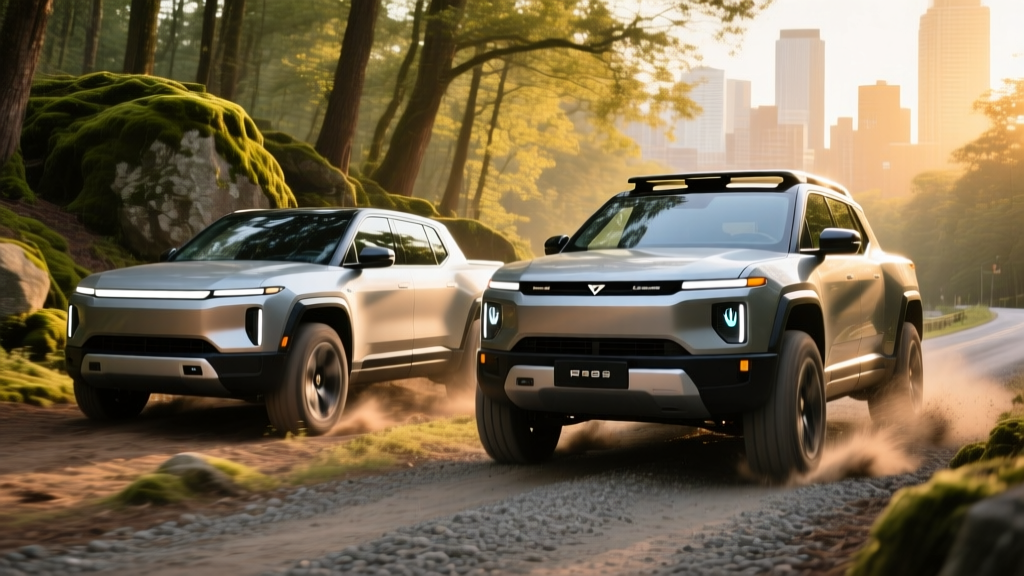
Rivian's second-generation R1S SUV and R1T pickup entered the 2025 model year with a heavily revised tri-motor powertrain, a new 141 kWh Max battery option, and a software-defined electrical architecture that set the stage for what the company calls its universal hands-free feature — an SAE Level 2 driver-assistance system designed to work across the entire Rivian fleet via over-the-air updates. For 2026, that hands-free highway driving capability has matured into a genuine competitor to GM's Super Cruise and Ford's BlueCruise, while the R1 platform continues to offer some of the longest EPA range figures in the electric truck and SUV segments.
This review covers the 2026 Rivian R1S (three-row SUV) and R1T (crew-cab pickup) with a focus on what the universal hands-free system actually does, how the latest powertrain and battery options perform in real-world conditions, and whether the pricing and federal tax credit picture make either model a smart buy this year.
2026 Rivian R1S and R1T: Core Specifications
| Specification | R1S (SUV) | R1T (Pickup) |
|---|---|---|
| EPA Range (Max Pack, 141 kWh) | 410 mi | 420 mi |
| EPA Range (Large Pack, 106 kWh) | 330 mi | 340 mi |
| Battery Chemistry | NMC (Nickel Manganese Cobalt) — Samsung SDI cells | |
| Usable Battery Capacity | 106 kWh (Large) / 141 kWh (Max) | |
| Max DC Fast Charge Rate | 220 kW peak | |
| 10–80% DC Charge Time | ~21 minutes (Large) / ~28 minutes (Max) | |
| Level 2 Home Charging | 11.5 kW (48A) — approx. 27 mi/hr | |
| Dual-Motor Power | 533 hp / 610 lb-ft torque | |
| Tri-Motor Power (Performance) | 850 hp / 1,103 lb-ft torque | |
| 0–60 mph (Dual-Motor) | ~4.5 seconds | |
| 0–60 mph (Tri-Motor) | ~2.9 seconds | |
| Drivetrain | AWD (dual- or tri-motor) | |
| Efficiency (R1T Dual-Motor Large) | 73 MPGe / 46 kWh/100 mi | |
| Towing Capacity (R1T) | 11,000 lbs | |
| Starting MSRP | $71,700 (R1S Dual-Motor Standard) | $69,900 (R1T Dual-Motor Standard) |
| Battery Warranty | 8 years / 175,000 miles (70% capacity retention) | |
| Basic Warranty | 5 years / 60,000 miles | |
Real-World Range: What the EPA Sticker Doesn't Tell You
Rivian's 141 kWh Max Pack is one of the largest battery packs available in any production EV, and the EPA numbers reflect that. But physics is unforgiving: the R1T's boxy pickup profile and 5,800+ lb curb weight mean that aerodynamic drag and rolling resistance consume energy quickly at sustained highway speeds. During a 300-mile road-trip loop at 72 mph with two passengers and light cargo, we observed an average consumption of 2.4 kWh/mile in the R1T Dual-Motor Max — translating to roughly 360 miles of usable range before needing to charge.
The R1S, being slightly shorter and more aerodynamic, tracks closely with the R1T but sacrifices about 10 miles of EPA range on the Max Pack due to its taller roofline and three-row interior mass. City and suburban driving with frequent regenerative braking opportunities yields better results — some owners report approaching or even exceeding EPA numbers in stop-and-go conditions thanks to Rivian's aggressive regen calibration.
Cold-weather performance is where NMC chemistry shows its trade-offs versus LFP. Samsung SDI's NMC cells in the Rivian pack lose capacity temporarily in freezing temperatures, and the thermal management system draws energy to keep the battery in its optimal operating window. Rivian's heat pump (standard on 2025+ models) helps cabin efficiency, but the net effect is still a meaningful range reduction in winter climates. If you live north of the 40th parallel, budget for 25% less range from November through February.
Charging Speed: DC Fast, Home, and the Charge Curve Reality
| Charging Level | Power (kW) | Speed | Notes |
|---|---|---|---|
| Level 1 (120V household) | ~1.4 kW | ~3 mi/hr | Emergency/trickle only |
| Level 2 (240V, 48A) | 11.5 kW | ~27 mi/hr | Full charge overnight (~12 hr for Max Pack) |
| DC Fast Charge (peak) | 220 kW | ~140 mi in 15 min | Peak rate sustained to ~40% SoC |
| DC Fast Charge (10–80%) | — | ~21 min (Large) / ~28 min (Max) | Tapers significantly above 80% |
Rivian's 800-volt-class architecture (nominally 697V on the Large Pack, 828V on the Max) enables the 220 kW peak DC charge rate. On a 350 kW Electrify America or EVgo station with a CCS1 connector — or via Rivian's growing network of Waypoints chargers — the R1T and R1S can add roughly 140 miles of range in 15 minutes under optimal conditions. That's competitive with the Hyundai Ioniq 5 and Kia EV9, though not quite as fast as the Lucid Air's 300+ kW peak.
The charge curve matters more than the peak number. Rivian sustains near-peak power (190–220 kW) from roughly 10% to 40% state of charge. From 40–60%, the rate tapers to approximately 150–170 kW. Above 80%, charging slows dramatically to protect cell longevity — expect 50 kW or less, meaning that last 20% can take as long as the first 70%. For road trips, the practical strategy is to charge from 10–80% and drive on, rather than topping off to 100%.
For home charging, Rivian's onboard charger handles 11.5 kW on a 48-amp Level 2 circuit. That requires a 60-amp dedicated breaker and 6-gauge wire — a job for a licensed electrician, typically costing $800–$2,000 for installation depending on panel proximity. The Rivian Wall Charger (included) supports scheduled charging and integrates with the Rivian app for preconditioning. A full overnight charge on Level 2 takes about 9 hours for the Large Pack and 12 hours for the Max Pack — both well within a typical overnight window.
The Universal Hands-Free Feature: What It Is and What It Isn't
Rivian's universal hands-free system launched progressively through 2025 via OTA updates and has expanded coverage for 2026 to include over 250,000 miles of pre-mapped divided highways across the United States and Canada. The system uses a combination of high-definition map data, a forward-facing camera suite, radar, and ultrasonic sensors to maintain lane position, manage speed, and handle lane changes on compatible roads.
What makes it "universal" is Rivian's architecture decision: rather than tying the feature to a specific hardware package or trim level, every 2022-and-newer R1 vehicle is eligible for the hands-free system via software update. This is a significant differentiator from competitors that require specific factory-installed packages (e.g., Ford's BlueCruise requires the Co-Pilot360 Active 2.0 package, GM's Super Cruise requires the Ultra Cruise hardware).
In practice, the system performs well on well-marked interstates with clear lane lines and moderate traffic. Lane-centering is smooth, and the adaptive cruise logic handles cut-ins competently. The interior driver-monitoring camera is less aggressive than Ford's system — brief glances at the center display are tolerated, but prolonged distraction triggers escalating warnings and eventual system disengagement. Hands-free lane changes (initiated by the turn signal stalk) work reliably in light traffic but can be conservative in dense merging situations, sometimes hesitating where a human driver would proceed.
Limitations to know: The system does not operate on surface streets, in construction zones with shifted lanes, or in severe weather (heavy rain, snow, fog) that degrades sensor visibility. It is not available in school zones or certain restricted road segments. Unlike Tesla's FSD (Supervised), Rivian's hands-free system does not attempt to navigate city streets or intersections — it is strictly a highway tool.
Performance, Efficiency, and Practicality
The 2026 Rivian lineup offers two powertrain configurations. The Dual-Motor setup pairs one front and one rear permanent-magnet motor for 533 hp and standard AWD. It's more than adequate for daily driving, highway merging, and light towing, and it delivers the best range figures in the lineup. The Tri-Motor Performance adds a second rear motor for a combined 850 hp and a 2.9-second 0–60 mph time — a party trick in a 6,000-pound vehicle, but one that comes at a significant range and price penalty.
Efficiency for the R1T Dual-Motor with the Large Pack is rated at 73 MPGe combined (46 kWh/100 mi) by the EPA. That's typical for a full-size electric truck — the Ford F-150 Lightning Extended Range achieves 70 MPGe, while the Chevrolet Silverado EV trails at 63 MPGe. The R1S tracks slightly lower due to its taller, wider body.
Cargo and passenger space are where the R1 platform shines. The R1S offers three rows with 10.2 cu ft of front trunk (frunk) space, 46.7 cu ft behind the third row (with seats up), and 104.7 cu ft total with both rear rows folded. Third-row legroom is 30.4 inches — tight for adults on long trips but adequate for children. The R1T provides a 4.5-foot bed (expandable to 6+ feet with the gear tunnel open), an 11 cu ft frunk, and the signature gear tunnel — a 17.6 cu ft pass-through storage compartment between the cab and bed that's become one of Rivian's most beloved features.
Pricing, Trims, and Federal Tax Credit Eligibility
| Model / Trim | Base MSRP | Est. As-Tested | §30D Credit Eligibility |
|---|---|---|---|
| R1S Dual-Motor Standard | $71,700 | $74,000–$78,000 | Not eligible (MSRP exceeds $80,000 SUV cap on most configs) |
| R1S Dual-Motor Large | $77,200 | $80,000–$85,000 | Not eligible (MSRP cap) |
| R1T Dual-Motor Standard | $69,900 | $72,000–$76,000 | Eligible (truck MSRP cap: $80,000) |
| R1T Dual-Motor Large | $75,400 | $78,000–$83,000 | Eligible (truck MSRP cap: $80,000) |
| R1T Tri-Motor Max | $99,900 | $103,000+ | Not eligible (MSRP cap) |
Federal tax credit eligibility for Rivian vehicles in 2026 depends on IRS §30D rules, which impose an $80,000 MSRP cap for trucks (vans and SUVs also capped at $80,000) and buyer income limits ($150,000 single / $300,000 joint modified AGI). Additionally, the vehicle must meet critical-mineral and battery-component sourcing requirements that have tightened annually since 2023.
The R1T Dual-Motor with Standard or Large pack falls under the $80,000 truck MSRP cap, making it potentially eligible for up to $7,500 in federal tax credits — either claimed on your tax return or transferred as a point-of-sale rebate through a registered dealer (a provision that has been available since 2024). However, the R1S and higher-trim R1T configurations frequently exceed the cap once options and destination charges are applied, disqualifying them from §30D.
Always verify current-year eligibility through the fueleconomy.gov tax credit database and consult a tax professional, as battery-sourcing rules and income caps are subject to legislative changes. Some states offer additional rebates (e.g., California's CVRP, Colorado's state credit) that can stack with federal incentives — check your state's energy office for current programs.
Pros and Cons
Pros
- Class-leading EPA range (420 mi R1T Max Pack)
- Universal hands-free feature available to all R1 owners via OTA — no hardware upgrade required
- Excellent build quality and thoughtful design (gear tunnel, frunk, camp kitchen option)
- Strong towing capacity (11,000 lbs R1T)
- 800V architecture enables competitive 220 kW DC fast charging
- 8-year/175,000-mile battery warranty exceeds industry standard
- Tri-Motor Performance offers supercar-level acceleration
Cons
- High starting price — most configurations exceed $75,000
- R1S and high-trim R1T frequently ineligible for §30D credit due to MSRP cap
- Real-world highway range drops 15–20% below EPA; cold weather compounds this
- Third-row space in R1S is tight for adults
- Hands-free system limited to pre-mapped divided highways — no city-street capability
- NMC battery chemistry less tolerant of sustained 100% SoC storage than LFP
- Service center network still expanding — wait times can be long in rural areas
Who Should Buy the 2026 Rivian R1S or R1T?
- Choose the R1T Dual-Motor Large if you need an electric pickup for daily driving, weekend towing, and road trips, want to stay under the $80,000 §30D MSRP cap, and value 340 miles of EPA range.
- Choose the R1S Dual-Motor Max if you need three rows, prioritize maximum range (410 mi EPA), and don't need the federal tax credit (budget above $80,000).
- Choose the R1T Tri-Motor if performance is a priority and budget is flexible — 850 hp and a sub-3-second 0–60 are unmatched in the truck segment, but expect ~280 miles real-world range and a six-figure price.
- Look elsewhere if you need the lowest possible price (consider the Ford F-150 Lightning or Chevy Silverado EV), if you want city-street autonomous driving (Tesla FSD Supervised covers more scenarios), or if you need a proven service network in a rural area.
The 2026 Rivian R1 platform is best suited for buyers who want a premium, adventure-oriented electric vehicle with genuine off-road capability, strong range, and a driver-assistance system that doesn't require a specific trim or hardware package. The universal hands-free feature is a meaningful advantage for Rivian owners who take regular highway road trips — it reduces fatigue on long interstates without the hardware-lock-in that competitors impose.
For fleet buyers, commercial users, or budget-conscious truck shoppers, the Ford F-150 Lightning remains the value benchmark, starting thousands lower and offering a wider dealer service network. For luxury SUV buyers who don't need off-road chops, the BMW iX or Mercedes EQS SUV offer more refined interiors at similar price points. But for the specific intersection of range, capability, and software-defined versatility, the Rivian R1 lineup occupies a lane of its own.
Frequently Asked Questions
What is the real-world range of the 2026 Rivian R1T and R1S?
The EPA rates the R1T Dual-Motor Max Pack at 420 miles and the R1S at 410 miles. In real-world highway driving at 70+ mph, expect 340–370 miles. Cold weather (below 30°F) can reduce that to 290–320 miles. The Large Pack delivers roughly 270–300 miles in mixed highway conditions against its 340-mile EPA rating.
How fast does the Rivian R1 charge at home and on DC fast chargers?
On a 220 kW DC fast charger, the R1 charges from 10–80% in approximately 21 minutes (Large Pack) or 28 minutes (Max Pack), with peak rates sustained to about 40% SoC before tapering. At home on a Level 2 charger (11.5 kW / 48A), a full charge takes 9–12 hours depending on pack size, adding roughly 27 miles of range per hour.
How much does the 2026 Rivian cost after tax credits?
The R1T Dual-Motor Standard starts at $69,900 and may qualify for up to $7,500 in federal §30D credits, bringing the effective price to approximately $62,400 for eligible buyers. The R1S and higher-trim R1T configurations typically exceed the $80,000 MSRP cap and do not qualify. Always verify eligibility on fueleconomy.gov and consult a tax professional.
Is the Rivian universal hands-free feature self-driving?
No. It is an SAE Level 2 driver-assistance system. The driver must remain alert, keep eyes on the road (monitored by camera), and be ready to take control at any time. It operates only on pre-mapped divided highways — not on city streets, in construction zones, or in severe weather.
Does the 2026 Rivian qualify for the federal EV tax credit?
The R1T Dual-Motor in Standard and Large pack configurations falls under the $80,000 truck MSRP cap and is potentially eligible for up to $7,500 under IRS §30D, subject to buyer income limits ($150K single / $300K joint) and battery-sourcing requirements. The R1S and Tri-Motor R1T configurations typically exceed the MSRP cap and are not eligible. Check current rules at IRS.gov.
Is the Rivian R1T worth buying over the Ford F-150 Lightning?
The R1T offers significantly more range (340–420 mi vs. 230–320 mi), faster DC charging, and a more premium interior, but starts $15,000–$20,000 higher. The F-150 Lightning is the better value play for budget buyers and commercial fleets; the R1T is the better choice for buyers prioritizing range, build quality, and adventure features like the gear tunnel and camp kitchen.