The Rivian Travel Kitchen: A Purpose-Built Camp Kitchen for the R1S and R1T
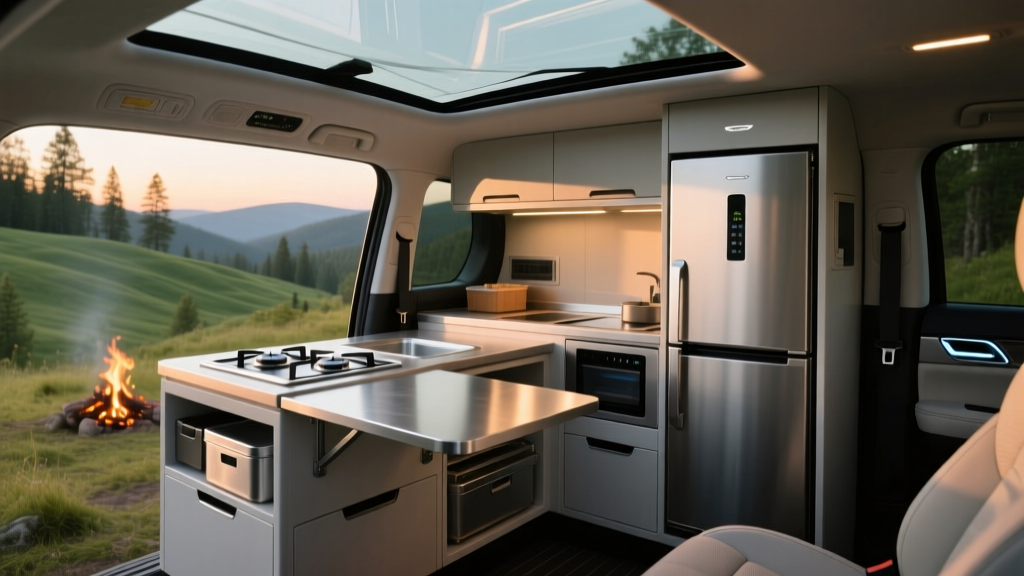
The Rivian Travel Kitchen is a modular, slide-out camp kitchen accessory designed specifically for the Rivian R1S SUV and R1T pickup. It nests into the R1T's Gear Tunnel or the R1S's rear cargo area and deploys a two-burner induction cooktop, integrated sink, collapsible faucet, and storage for cookware, utensils, and pantry staples. For overlanders and weekend campers who want a self-contained cooking solution powered by the vehicle's traction battery, it is one of the most tightly integrated camp kitchen systems available on any production EV.
But the Travel Kitchen is an accessory, not a standalone vehicle. Its usefulness depends entirely on the Rivian platform it rides in. This review covers the Travel Kitchen's design, functionality, and pricing alongside the 2026 Rivian R1S and R1T Dual-Motor and Quad-Motor configurations that power it — including the exact range, charging, and tax-credit details you need before committing.
What Is the Rivian Travel Kitchen and How Does It Work?
Rivian designed the Travel Kitchen as a modular system with interchangeable components. The base kit includes:
- Two-burner induction cooktop — draws power from the vehicle's high-voltage battery via the Gear Tunnel's 120V/240V outlet (R1T) or rear cargo 120V outlet (R1S)
- Integrated stainless steel sink with a collapsible faucet and a 2.5-gallon freshwater tank plus a 2-gallon grey water tank
- Slide-out rail system — extends from the Gear Tunnel (R1T) or cargo area (R1S) on heavy-duty bearings, supporting up to 150 lbs of loaded cookware
- Modular storage bins — stackable, removable containers for spices, utensils, cutting boards, and dry goods
- Windshield and prep surface — a fold-out bamboo cutting board with an integrated wind guard for the induction burners
The induction cooktop is the critical differentiator. Unlike propane camp stoves, it requires no fuel canisters, produces no carbon monoxide, and can be used inside a tent vestibule or tailgate shelter without ventilation concerns. The trade-off is power draw: running both burners simultaneously pulls roughly 1,800 watts, which translates to approximately 1.8 kWh per hour of high-heat cooking. A 30-minute dinner prep typically consumes 0.6–1.0 kWh — roughly 1–2 miles of range from the R1T's battery.
2026 Rivian R1S and R1T: The Platform Specs That Matter
The Travel Kitchen works with both current-generation Rivian vehicles. Below are the specs for the most popular configurations buyers pair with the camp kitchen.
| Spec | R1T Dual-Motor Standard | R1T Dual-Motor Max | R1S Dual-Motor Standard | R1S Dual-Motor Max |
|---|---|---|---|---|
| EPA Range | 272 mi | 420 mi | 270 mi | 410 mi |
| Battery (usable) | 92 kWh (NMC) | 141 kWh (NMC) | 92 kWh (NMC) | 141 kWh (NMC) |
| Horsepower | 533 hp | 533 hp | 533 hp | 533 hp |
| 0–60 mph | 4.5 sec | 4.7 sec | 4.6 sec | 4.8 sec |
| Max DC Fast Charge | 200 kW | 220 kW | 200 kW | 220 kW |
| 10–80% DC Time | ~28 min | ~36 min | ~28 min | ~36 min |
| Level 2 Home Charge | 11.5 kW (~25 mi/hr) | 11.5 kW (~25 mi/hr) | 11.5 kW (~25 mi/hr) | 11.5 kW (~25 mi/hr) |
| MPGe (combined) | 73 MPGe | 70 MPGe | 72 MPGe | 69 MPGe |
| Efficiency (kWh/100 mi) | 46 kWh | 48 kWh | 47 kWh | 49 kWh |
| Towing Capacity | 11,000 lbs | 11,000 lbs | 7,700 lbs | 7,700 lbs |
| Cargo (behind 2nd row / bed) | 54 cu ft (bed + tunnel) | 54 cu ft (bed + tunnel) | 47 cu ft | 47 cu ft |
| Base MSRP | $71,700 | $81,200 | $76,700 | $86,200 |
Source: fueleconomy.gov and Rivian R1T specs.
Charging Speed: DC Fast Charging and Home Level 2
Charging infrastructure access is critical when you're using the Travel Kitchen on remote camping trips. Here's what the 2026 Rivian platform delivers.
| Charging Level | Power (kW) | Rate (mi/hr added) | Notes |
|---|---|---|---|
| Level 1 (120V household) | 1.4 kW | ~3 mi/hr | Emergency/trickle only; full charge takes days |
| Level 2 (240V home, 48A) | 11.5 kW | ~25 mi/hr | Full overnight charge in 8–12 hours depending on pack size |
| DC Fast Charge (Standard pack) | 200 kW peak | ~140 mi in 20 min | Peak rate sustained to ~55% SoC, then tapers; 10–80% in ~28 min |
| DC Fast Charge (Max pack) | 220 kW peak | ~150 mi in 20 min | Larger pack absorbs peak longer; 10–80% in ~36 min |
Charging-curve reality check: Rivian's peak DC fast-charge rates are not sustained across the full session. The Standard Battery pack holds its peak rate to roughly 55% State of Charge before tapering, while the Max Battery sustains peak to approximately 60%. Above 80% SoC, charging slows dramatically to protect the NMC cells — expect the final 20% to take as long as the first 60%. On camping trips, plan your fast-charge stops around 10–80% sessions and avoid charging to 100% unless you'll be driving immediately.
Preconditioning matters: Rivian's navigation system will precondition the battery (warm it to optimal temperature) when you navigate to a DC fast charger. This is essential in cold weather — without preconditioning, peak charge rates can drop 30–50% when the battery is cold. Always navigate to your charger rather than just pulling in.
The Travel Kitchen's induction cooktop can draw from the vehicle's battery while charging at a Level 2 station, though cooking during a DC fast-charge session is not recommended due to the high current flowing through the pack.
Pricing: Travel Kitchen Accessory Cost and Vehicle Tax Credits
The Rivian Travel Kitchen is sold as a standalone accessory through Rivian's Gear Shop. As of the 2026 model year, pricing breaks down as follows:
- Travel Kitchen Base Kit (cooktop, sink, slide rail, storage bins): ~$5,500
- Optional Add-ons (premium cookware set, additional storage modules, awning integration): $500–$1,200
This cost is not included in the vehicle's MSRP and is purchased separately after delivery.
Federal Tax Credit Eligibility (IRS §30D)
The 2026 Rivian R1T and R1S may qualify for the federal EV tax credit under IRS §30D, but eligibility depends on several factors that change frequently:
- MSRP cap: The R1T (classified as a light truck) qualifies if MSRP is ≤$80,000. The R1S (classified as an SUV/van) qualifies if MSRP is ≤$80,000. Standard Battery trims fall under the cap; Max Battery trims may exceed it depending on options.
- Buyer income cap: Modified adjusted gross income must not exceed $150,000 (single), $225,000 (head of household), or $300,000 (married filing jointly).
- Battery sourcing: A percentage of critical minerals and battery components must be sourced from the U.S. or FTA-partner countries. These thresholds increase annually. Verify current-year compliance on fueleconomy.gov.
- Point-of-sale transfer: As of 2024, buyers can transfer the credit to the dealer at the point of sale, reducing the purchase price directly rather than waiting for a tax refund.
The Travel Kitchen accessory itself does not qualify for any tax credit — only the vehicle purchase does. Consult a tax professional for your specific situation.
Who the Rivian Travel Kitchen Suits Best
Best for: Overlanders, car-campers, and weekend adventurers who already own or plan to buy a Rivian R1T or R1S and want a fully integrated, propane-free camp kitchen. The induction cooktop is ideal for campgrounds with fire bans, and the vehicle-powered system eliminates fuel-canister logistics.
Not ideal for: Budget-conscious buyers (the combined vehicle + accessory cost exceeds $77,000 minimum), those who need a kitchen system compatible with non-Rivian vehicles, or campers who primarily boondock far from any charging infrastructure (induction cooking draws meaningful battery).
Competitor Comparison
No other OEM offers a factory-integrated camp kitchen accessory. The closest alternatives are:
- Aftermarket slide-in kitchens (e.g., Tailgate Kitchen, Nomadic Kitchen) — compatible with any truck bed but lack integrated EV power; typically $3,000–$7,000 plus propane infrastructure
- Ford F-150 Lightning + Pro Power Onboard — the Lightning's 9.6 kW Pro Power system can run a portable induction cooktop, but Ford does not sell a factory kitchen module; you'd pair it with a third-party solution
- Traditional propane camp stove — a Coleman two-burner costs ~$60 but requires fuel canisters, can't be used in enclosed spaces, and is subject to fire bans
The Rivian Travel Kitchen's advantage is integration: the slide-out mechanism, water system, and vehicle-powered induction are engineered as a single unit. The disadvantage is platform lock-in — it only fits Rivian vehicles.
Pros, Cons, and the Verdict
Pros
- Propane-free induction cooking — safe in enclosed spaces, no fire-ban issues
- Purpose-built slide-out design with heavy-duty rails
- Integrated freshwater and grey water tanks eliminate separate jugs
- Powered by vehicle battery — no separate fuel logistics
- Modular bins are removable for use at the campsite table
- Retains full Gear Tunnel access when installed (R1T)
Cons
- ~$5,500 accessory cost on top of a $71,700+ vehicle
- Only compatible with Rivian R1T and R1S
- Induction cooktop requires compatible cookware (magnetic stainless or cast iron)
- Running both burners draws ~1,800W, which reduces range on long off-grid trips
- Water tanks (2.5 gal fresh / 2 gal grey) are small for multi-day trips without refill access
- Installation requires Rivian service center or certified installer
Warranty and Long-Term Ownership
Rivian's vehicle warranty covers the platform the Travel Kitchen mounts to:
- Battery and drive unit: 8 years / 175,000 miles (whichever comes first), with a capacity retention threshold of 70% during the warranty period
- Vehicle limited warranty: 5 years / 60,000 miles bumper-to-bumper
- Travel Kitchen accessory: 3 years / unlimited miles through Rivian's Gear Shop warranty, covering manufacturing defects in the slide mechanism, induction cooktop, and plumbing components
The NMC battery chemistry used in all 2026 R1T and R1S packs offers high energy density (enabling the 420-mile Max Battery range) but is more sensitive to frequent 100% charging and extreme heat than LFP chemistry. For longevity, Rivian recommends daily charging to 80–90% and reserving 100% charges for road trips. The Travel Kitchen's battery draw during cooking is modest enough that it does not materially affect long-term battery degradation.
Frequently Asked Questions
What is the real-world range of a Rivian R1T with the Travel Kitchen loaded?
With the Travel Kitchen installed (~85 lbs loaded) and typical camping gear, the R1T Dual-Motor Max Battery delivers approximately 350–380 real-world highway miles in mild weather, and 280–320 miles in cold weather or when towing. The Standard Battery configuration yields roughly 230–250 highway miles loaded. The kitchen's weight impact on range is minimal (~1–2% reduction); driving speed, temperature, and terrain matter far more.
How fast does the Rivian R1T charge at home and on the road?
At home on a 240V Level 2 charger (11.5 kW), the R1T Max Battery gains roughly 25 miles of range per hour, with a full 10–100% charge taking about 12–14 hours. On a DC fast charger, it peaks at 220 kW and charges from 10–80% in approximately 36 minutes, adding roughly 150 miles of range in a 20-minute stop.
How much does a Rivian R1T cost after federal tax credits?
The 2026 R1T Dual-Motor Standard Battery starts at $71,700. If you qualify for the full $7,500 §30D federal tax credit (meeting income, MSRP, and battery-sourcing requirements), the effective price drops to approximately $64,200. Max Battery trims starting at $81,200 may exceed the $80,000 MSRP cap for the truck classification, potentially disqualifying them from the credit — verify on fueleconomy.gov before ordering.
Does the Rivian R1T qualify for the federal EV tax credit?
It depends on the trim, your income, and current battery-sourcing rules. The Standard Battery R1T ($71,700 MSRP) falls under the $80,000 truck cap and may qualify for up to $7,500 if you meet the income thresholds ($150K single / $300K married filing jointly) and the vehicle meets the critical-minerals and battery-component sourcing requirements for the current tax year. Rules change annually — always check the latest on IRS.gov and consult a tax professional.
Is the Rivian Travel Kitchen worth buying vs. an aftermarket camp kitchen?
If you already own or plan to buy a Rivian and value seamless integration, the Travel Kitchen is worth the premium. The vehicle-powered induction cooktop eliminates propane logistics, the slide-out mechanism is engineered for the Gear Tunnel's dimensions, and the water system is self-contained. However, if you want platform flexibility (use the kitchen on different vehicles), prefer a larger water capacity, or want to save $3,000–$5,000, an aftermarket slide-in kitchen paired with a portable induction cooktop and the Rivian's 120V outlet achieves a similar result with less integration.
Can I use the Travel Kitchen while the vehicle is charging?
You can use the induction cooktop while the vehicle is plugged into a Level 2 charger, though it will extend your total charge time slightly (the cooktop's ~1,800W draw is modest against the 11.5 kW charge rate). Using it during DC fast charging is technically possible but not recommended — it's better to cook while parked at a campsite or rest stop rather than at a busy fast-charging station.
Prices, tax credit rules, and specifications reflect 2026 model year data available at publication. Always verify current eligibility and pricing with Rivian and the IRS before purchasing.